A sphere falling into water generates a spectacular crown
splash at the surface. The object’s impact ejects a thin sheet of fluid
that rises vertically. The air pulled down into the cavity by the
sphere’s passage makes the air pressure inside the sheet lower than the
ambient air pressure on the exterior of the sheet. This pressure
difference is part of what draws the crown inward to seal the cavity. As
the splash collapses inward and seals, the liquid sheet starts to
buckle and wrinkle, leaving periodic stripes around the closing neck.
This so-called buckling instability occurs when the radius of the neck
collapses faster than the vertical speed of the splash. For more, see
the research paper or this award-winning video. (Image credit: J. Marston et al., source)
Search results for: “art”

Crown Splash Sealing

Auroras From Space
NASA has released a jaw-dropping new compilation of Earth’s auroras viewed from the International Space Station. It’s available in up to 4K resolution, and I heartily recommend watching it fullscreen at the highest resolution you can comfortably manage. (To paraphrase: this is ultra high definition – it’s better resolution than real life!) I don’t think I’ve ever seen aurora footage that so clearly showed the fluid behavior of auroras when viewed from space. This flow-like quality is to be expected since the auroras occur due to ionized particles from the solar wind exciting atoms in our upper atmosphere in a magnetohydrodynamic dance that never gets too old to watch. (Video credit: NASA; via Gizmodo)
Boston area FYFDers: I’m giving a talk at Harvard tomorrow afternoon on science communication – Wed. April 20th, 4pm, Maxwell Dworkin, G115.

Pinning a Drop
The shape of a droplet sitting on a surface depends, in part, on its surface tension properties but also on the nanoscale roughness of the surface. Small variations in the height and shape of the surface will change the area a drop contacts as well as the contact angle the edge of the drop makes with the surface. If the contact line between the drop and surface stays the same as a droplet evaporates into the surrounding gas or dissolves into the surrounding liquid, then we say the drop is pinned. A pinned drop’s contact angle will decrease as the drop’s volume decreases. This strains the ability of the nanoscale roughness to keep the drop’s edge pinned. As individual points of contact fail, the drop’s edge may jump inward to a new contact point. This set of discrete jumps between pinned states is called a stick-jump or stick-slip mode. (Image credit: E. Dietrich et al., source; see also: E. Dietrich et al. 2015)
Fluids Round-up
Time for another look at some of the best fluids content out there. It’s the fluids round-up – with a special focus this week on oceans!
– Ryan Pernofski spent two years filming the ocean in slow motion with his iPhone to make the short film “Slowmocean” seen above. It’s a gorgeous ode to the beauty of breaking waves.
– Oceans with higher salinity than Earth’s could drive global circulation that would make exoplanets more hospitable to life.
– Speaking of alien oceans that could harbor signs of life, there’s discussion afoot of how future missions to icy moons like Europa or Enceladus could collect samples from plumes ejected from beneath the ice.
– Wind and waves make harsh, erosive environments. This photo essay from SFGate shows how greatly the sands of Pacifica shift over time. (submitted by Richard)
Bonuses:
– New research explores how Martian mountains may have been carved out by the wind.
– Ever listened to an orchestra made from ice? You should! Learn about Tim Linhart, who builds and maintains ice instruments. (submitted by ashketchumm)
– MIT has demonstrated a new 3D-printing technique that allows for printing liquid and solid parts simultaneously, allowing would-be creators to rapid-prototype hydraulically-driven robotics.
Even more bonus bonus!
– ICYMI, the new FYFD video made Gizmodo!
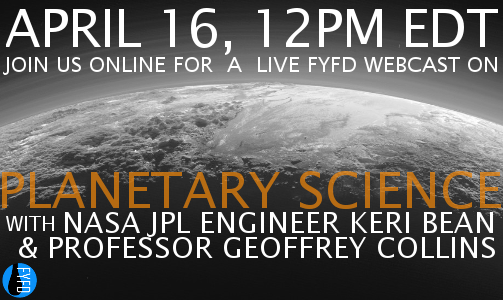
If you’re a fan of FYFD, please consider becoming a patron. As a bonus, you’ll get access to this weekend’s planetary science webcast!
(Video credit: R. Pernofski; via Flow Visualization; Pluto image credit: NASA/APL)

The Brazil Nut Effect
The Brazil nut effect is a common name for the phenomenon where large particles tend to rise to the top of a mixture when it’s shaken. It’s also the subject of the latest FYFD video, which you can see above.
I’ve seen other mentions of the topic previously, but when I started researching the literature, I discovered that the Brazil nut effect was much more complicated than I’d thought! Hopefully, you’ll find the results as interesting as I did. And if you want to dig further, there are links to the papers I used over on YouTube.
Filming was also interesting this time around. I tried out stop-motion animation for the first time. It takes so much patience! But I think the results are so cute. (Image and video credit: N. Sharp/FYFD)

Upcoming Webcast
This weekend I’ll be holding my second live webcast for FYFD patrons. This month we’ll be focusing on the subject of planetary science, one of the coolest applications out there for fluid dynamics. My guests will be Keri Bean, a NASA JPL mission operations engineer and atmospheric scientist, and Professor Geoffrey Collins, a geologist at Wheaton College in Massachusetts. Keri has worked on all the recent Martian missions, including Mars Curiosity and the Phoenix Lander. She currently works on operations for the Dawn mission to Ceres. Geoff studies the geophysics of icy planets and moons like Pluto and Titan. He was part of the Galileo and Cassini missions to Jupiter and Saturn and is currently part of the team working on a future mission to Europa.
A Rocket Launch From Above
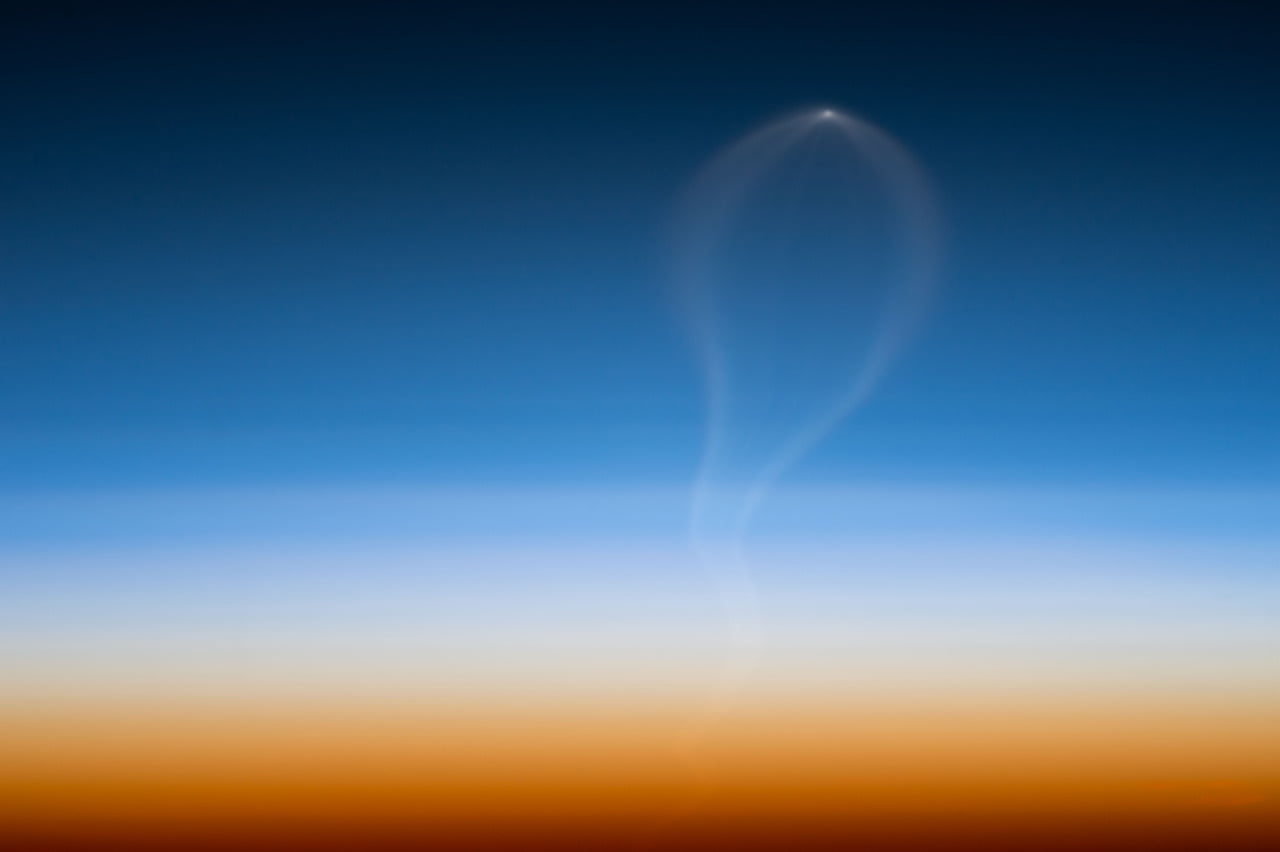
Rocket launches often produce spectacular imagery, but it’s rare to get a launch view quite like this one. The photograph above shows the recent launch of an Atlas V rocket as viewed from the International Space Station. The rocket itself is too small to be seen directly. Instead, that bright spot you see is the rocket’s exhaust. The smoky swooping curves mark the rocket’s exhaust plume. Because the gases leaving the rocket are at much higher pressure than the scant air pressure in the upper parts of the atmosphere, the exhaust expands rapidly, ballooning outward. Here the water vapor in the exhaust has frozen into crystals that catch the sunlight and make them stand out against the surrounding sky. (Image credit: NASA; via NASA Earth Observatory)

Underwater Explosions
Underwater explosions are incredibly dangerous and destructive, and this animation shows you why. What you see here are three balloons, each half-filled with water and half with air. A small explosive has been set off next to them in a pool. In air, the immense energy of an explosion actually doesn’t propagate all that far because much of it gets expended in compressing the air. Water, on the other hand, is incompressible, so that explosive energy just keeps propagating. For squishy, partially air-filled things like us humans or these balloons, that explosion’s force transmits into us with nearly its full effect, causing expansion and contraction of anything compressible inside us as our interior and exterior pressures try to equalize. The results can be devastating. To see the equivalent experiment in air, check out Mark Rober’s full video on how to survive a grenade blast. (Image credit: M. Rober, source)

Bumblebees in Turbulence

Bumblebees are small all-weather foragers, capable of flying despite tough conditions. Given the trouble that micro air vehicles have when flying in gusty winds, bumblebees can help engineers to understand how nature successfully deals with turbulence. Under smooth laminar conditions like those shown in the animation above, bumblebees stay aloft by beating their wings forward and backward in a figure-8-like motion. On both the forward downstroke and the backward upstroke, you’ll notice a blue bulge near the front of the bee’s wing. This is a leading-edge vortex, which provides much of the bee’s lift.
Researchers were curious how adding turbulence would affect their virtual bee’s flight. The still image above shows the bee in moderate freestream turbulence (shown in cyan). Surprisingly, this outside turbulence has very little effect on the flow generated by the bee, shown in pink. In fact, the researchers found that the bees could fly through turbulence without a significant increase in power. Too much turbulence does make it hard for the bee to control its flight, though. The bee’s shape makes it prone to rolling, and the researchers estimated, based on a bee’s 20 ms reaction time, that bumblebees can probably only correct that roll and maintain controlled flight at turbulence intensities less than 63% of the mean wind speed. (Image credits: T. Engels et al., source; via Physics Focus)

Drawing With Microfluidic Tweezers

One of the challenges of dealing with objects at the microscale is finding ways to manipulate them. This is what techniques like optical tweezers or magnetic traps are used for. The downside to these methods is that they often require complex experimental set-ups or place restrictions on the kinds of particles that can be manipulated. Recently, however, researchers have developed a new hydrodynamic alternative: the Stokes trap.
Using a six-channel microfluidic device like the the ones shown in A) and B) above, scientists can alter the flow in the device in such a way that they trap and manipulate two particles at the same time. The simultaneous inflow and outflow in the device creates streamlines like those shown in C) and D) above. The large white areas where the streamlines converge and diverge are stagnation points–areas of little to no velocity. The scientists trap their particles at the stagnation points and then carefully shift the flow rates into and out of the device to move the stagnation points–with particles in tow–wherever they want them. In the animation, you can see part of a movie where they use the particles to write out a capital I (for University of Illinois). The researchers hope the technique will be used in the future for studying the physics of soft materials and biologically-relevant molecules like DNA. For more, check out the full paper or the group’s website. (Image credit and submission: C. Schroeder et al.)
#/media/File:Aileron_roll.gif)