Search results for: “art”

  • Prehistoric Seiche

    Prehistoric Seiche

    Sixty-six million years ago, a meteorite impact in modern-day Mexico wiped out the dinosaurs and most other living species of the time. To call the event catastrophic feels like an understatement. At the site of impact, rocks and animals were vaporized. Further away, molten rock condensed into glass beads that form a geological layer found around the world.

    Still further away, in what is now North Dakota and was then the bank of a freshwater river, scientists have discovered a deposit full of saltwater fish, sharks, and rays that would have lived in the vast inland sea (A) that stretched northward from Texas. The meteorite’s impact pushed these creatures kilometers upstream against the river’s natural flow.

    One possible explanation for the inundation is a tsunami. But geological evidence indicates the deposit took place within 15 minutes to two hours of the impact, when glass beads were still raining down. To travel the 3,000 km from the point of impact would take a tsunami on the order of 18 hours – far too long.

    Instead, the deposit is likely the result of a seiche (pronounced “saysh”) – a type of standing wave that occurs in an enclosed or partially enclosed body of water. If you imagine water sloshing in a cup or a tub, that’s essentially what a seiche is, but this was on a much larger scale. (For an example, check out this insane footage of an earthquake-induced seiche in a swimming pool.)

    What set the seiche to sloshing are the seismic waves triggered by the meteorite impact. They would have reached this site 6-13 minutes after the impact and triggered waves on the order of 10m. As the waves drove up the riverways, they carried dead and dying sea creatures with them, leaving them stranded on the riverbank until scientists uncovered them tens of millions of years later. (Image and research credit: R. DePalma et al.; via The Conversation; submitted by Kam-Yung Soh)

  • Paddling

    Paddling

    When I lived in New England, I often spent summers paddling around a lake in either a kayak or canoe. Every stroke was an opportunity to stare down into the dark water and watch how the flow curled around my oar. Here you see a bit of what that looks like from underwater.

    The animation above shows a flat plate – twice as tall as it is wide – submerged about 20 mm below the surface and accelerated steadily from rest. As it starts moving, there’s a clear vortex ring formed and shed behind it. You can also see how the plate distorts the free surface into large depressions. Both of these cause extra drag on the plate. Eventually, though, the plate reaches a steady state.

    All together, what you see here is a good representation of what’s going on when a rower first begins to accelerate their boat from rest. Hydrodynamically speaking, the best way to do that isn’t to dig in with a deep stroke. It’s to use a series of short, relatively shallow strokes to get the boat up to speed. This takes advantage of the efficiency of drag generation during acceleration to get the boat to its cruising speed quickly. (Image and research credit: E. Grift et al.)

  • Foam Collapse

    Foam Collapse

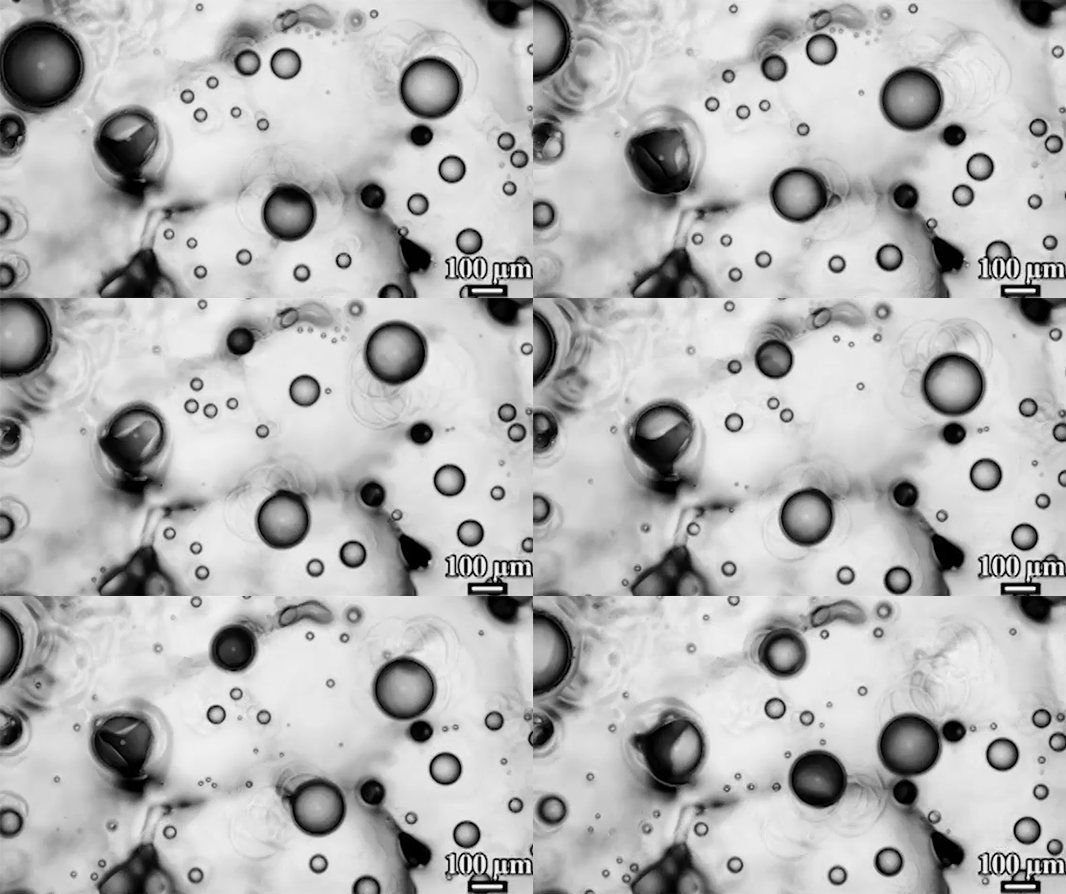
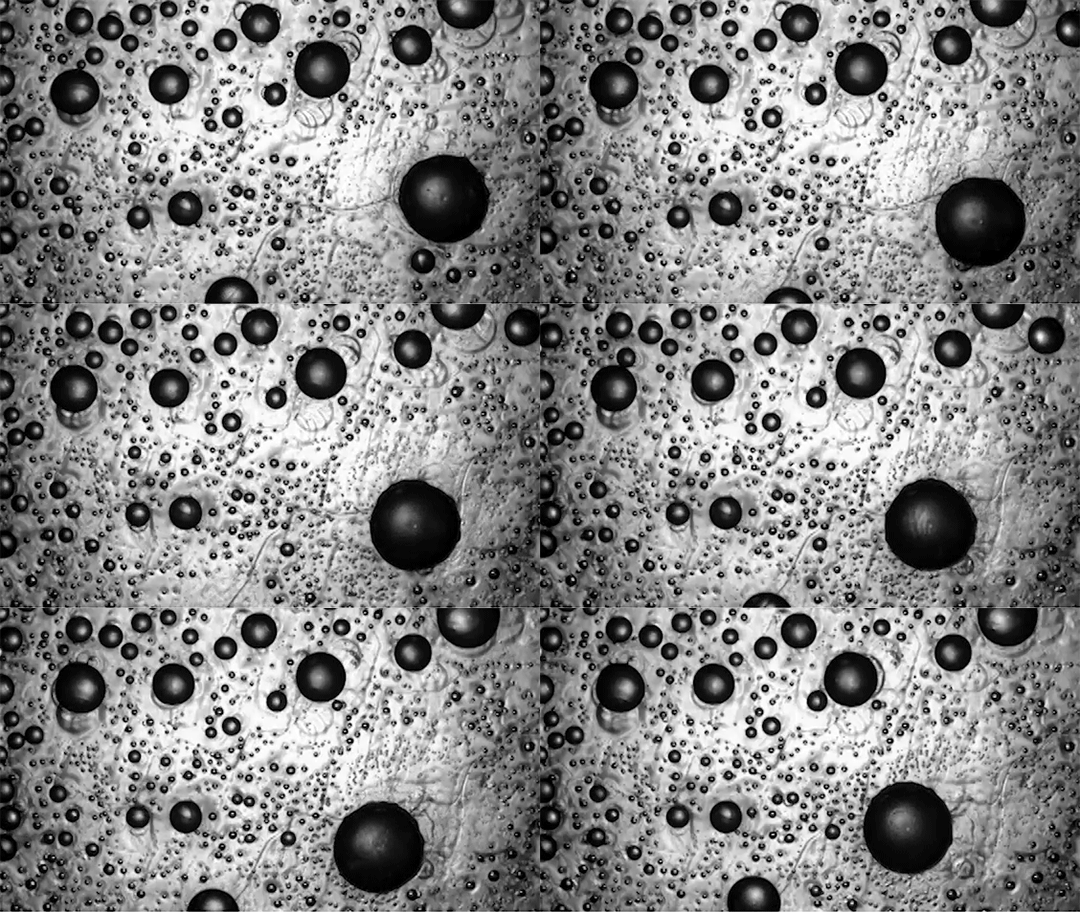
    Introduce the right additive and the bubble arrays in foam will collapse catastrophically. What you see above is high-speed video of a quasi-two-dimensional soap bubble foam collapsing. There are two main mechanisms in the collapse. The first is a propagating mode. When one section of the film breaks, a stream of liquid from the broken film can impact an adjacent section, causing it to break as well. This accounts for much of the breakage you see above.

    The second mode is through penetration by droplets. Watch carefully, and you’ll see that some of the breaking films generate tiny droplets which can fly through the wall of the next cell and impact against the far side. With the right conditions, that impact can trigger a new break along a non-adjacent film. Together, these two mechanisms can destroy foam in the blink of an eye. (Image and research credit: N. Yanagisawa and R. Kurita)

  • Featured Video Play Icon

    The Shaky Life of a Droplet

    An evaporating drop of ouzo goes through several stages due to the interactions of oil, alcohol and water. If you turn the situation around by placing a drop of (blue-dyed) water in a mixture of alcohol and anise oil (top image), you get some similarly odd behavior. The drop of water shimmies and grows as alcohol dissolves into it, carrying the occasional oil droplet with it. Eventually, the droplet grows large enough and buoyant enough that part of it detaches and floats to the surface (middle image). If you increase the alcohol ratio in the surrounding fluid, you speed up this process, causing droplets to stream up to the surface (bottom image). (Image and video credit: O. Enriquez et al., source)

  • Phase-Switching to Avoid Icing

    Phase-Switching to Avoid Icing

    Preventing ice and frost from forming on surfaces – especially airplane wings – is a major engineering concern. The chemical de-icing cocktails currently used in aviation are a short-lived solution, and while superhydrophobic surfaces can be helpful, they tend to be easily damaged and therefore impractical. Another possible solution, shown here, are so-called phase-switching liquids – substances like cyclohexane that have freezing points higher than that of water. This means that they form a solid coating near the freezing temperature of water.

    Water droplets on these coatings move in a random stick-slip walk (above) but they tend not to freeze. This is because freezing requires the droplets to release heat, which melts part of the phase-switching liquid. Now, instead of solidifying to the surface, the droplet moves on a film of the phase-switching liquid. Re-freezing that liquid is tough because it’s thermodynamically unfavorable, and the smoothness of the liquid layer makes it harder for ice to find a nucleation point. In lab tests, the phase-switching liquid surfaces resisted ice and frost more than an order of magnitude longer than conventional materials. (Image and research credit: R. Chatterjee et al.; video credit: Univ. of Illinois at Chicago; submitted by Night King)

  • The Color of Droplets

    The Color of Droplets

    In nature, color comes from many sources: like the pigmentation of skin and hair, the structural iridescence of a butterfly’s wings, or the refraction of a rainbow from water droplets. Recently, scientists discovered another source of brilliant color in simple, hemispherical water droplets.

    When small droplets form on a transparent surface, they form concave shapes capable of total internal reflection. This means that two light rays entering from the same angle can follow different paths inside the droplet. After reflecting several times, the light rays exit the droplet with a phase difference and how large that phase difference is determines the color. Check out the video below for some brightly colored examples of the effect. The researchers hope the technique will eventually be suitable for creating dye-free, color-changing technologies. (Image credit: F. Frankel; video credit: MIT News; research credit: A. Goodling et al.)

  • Forming a Waterfall

    Forming a Waterfall

    Many factors can affect a waterfall’s formation – changes in bedrock structure, tectonic shifts, and glacial motion, to name a few. But a new study suggests that some waterfalls may be self-forming. Using a lab-scale experiment, researchers created a homogeneous “bedrock” out of polyurethane foam, which they eroded with a combination of constant water flow and particulates. Even without external perturbations, the flow carved out a series of steps.

    As a pool deepened, particles built up inside, armoring the bed against further erosion. But further downstream, the chute continued to erode, steepening the area between them until a waterfall formed. On the timescale of the experiment, the waterfalls lasted only 20 minutes or so, but that’s equivalent to up to 10,000 years in geological time. (Image credit: M. Huey; research credit: J. Scheingross et al.; via EOS News; submitted by Kam-Yung Soh)

  • Rogue Waves

    Rogue Waves

    After centuries of tales from sailors, in 1995 the Draupner off-shore platform recorded the first ever evidence of a freak wave – a single, wall-like wave steeper and taller than any other waves around it. Theories have been tossed back and forth for the last quarter century as to how the Draupner wave formed, but now a group of researchers report they have recreated a lab-scale version of this is famous wave. 

    They did so in a wave pool by making two smaller groups of waves cross one another at about 120 degrees (top). The interaction of those wave packets generated a much larger, steeper wave (bottom image sequence) that matched the profile of the Draupner wave. Recreating this past freak wave confirms that wave-crossing can lead to freak waves, which will hopefully help us forecast when conditions may be right for more to occur. (Image credit and research credit: M. McAllister et al., source; via Motherboard; submitted by Kam-Yung Soh)
  • Moving Droplets

    Moving Droplets

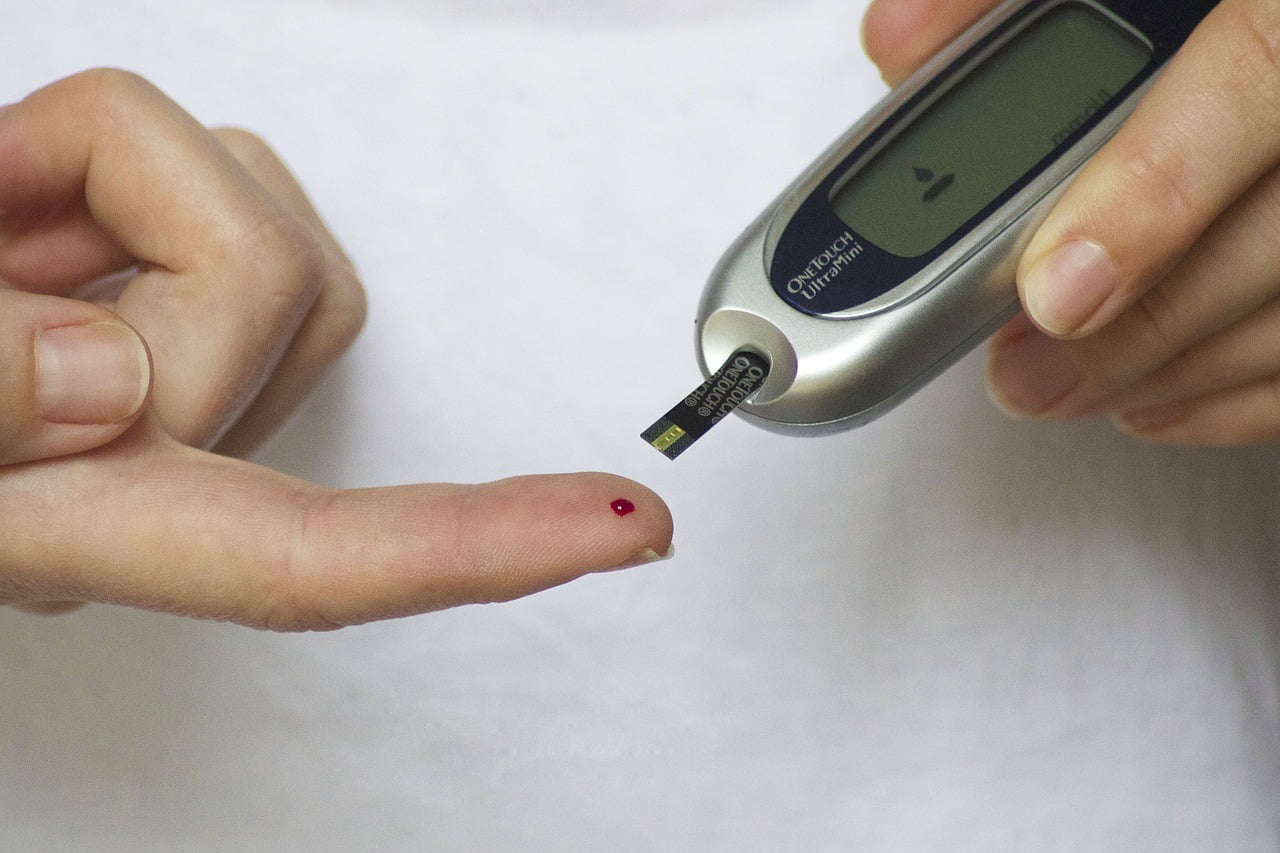
    Microfluidic devices – such as those used by individuals with diabetes to monitor their blood glucose levels – are all about transport. Typically, these devices use some kind of externally applied force, like a temperature gradient or electrical field, to force liquids through the device’s narrow channels. But a new study describes a way to move droplets without an external force.

    The researchers built their devices using two slips of glass, coated with an oil-attracting, water-repellent mixture. They attached the glass slips with a narrow spacer at one end, leaving the other end free. This made a narrow, but slightly flexible gap. When the scientists placed an oil drop inside the closed end, it spread on the glass, pulling the two sides closer to one another. Water drops, on the other hand, tried to force the walls apart, in an effort to minimize contact. Both sets of drops, interestingly, moved toward the open end of the device.

    The researchers found that the shapes assumed by the droplets create an internal pressure gradient, which, in both cases, slowly moves the drops. They call this method bendotaxis, a type of self-propulsion driven by the drops’ ability to bend the material they’re touching. It’s not a fast way to transport fluids – the drops moved only a few micrometers per second – but it may be useful for applications like drug deliveries where the liquid needs to be administered slowly over a longer period. (Image credit: TesaPhotography; research credit: A. Bradley et al.; via APS Physics; submitted by Kam-Yung Soh)

  • Featured Video Play Icon

    Freezing Drop Impact

    At the altitudes where aircraft fly, it’s often cold enough for water drops to freeze in seconds or less. Once attached to a wing, such frozen drops disrupt the flow, reducing lift and increasing drag. To help understand how such droplets freeze, scientists study droplet impact on cold surfaces. Starting at room temperature (counter-clockwise from upper left), a drop will spread on the surface, then retract. When the temperature is colder, parts of the droplet freeze before retraction completes, leaving a thin sheet with a thicker center. At even colder temperatures, the droplet’s rim destabilizes and freezing occurs before the droplet has time to retract fully. And at the coldest temperatures, the droplet breaks apart into a frozen splash. (Image and video credits: V. Thievenaz et al.)