Category: Research

  • Breaking With a Wave

    Breaking With a Wave

    For rocket combustion and other applications, like watering your lawn with a hose, a stream of fluid may need to be broken up into droplets. While simply spraying a liquid jet will make it break up, waving that jet back and forth will break it up faster. A recent study simulated this problem numerically to determine the exact mechanisms driving that break-up. The researchers found two major culprits.

    The first is a Kelvin-Helmholtz, or shear-based, instability. When a jet leaves the nozzle, there’s friction between it and the comparatively still air surrounding it. This creates tiny ripples in the surface that eventually grow into the distortions we can see, and it’s found in all jets, regardless of their side-to-side motion.

    The second culprit, which is only found in the oscillating jet, is a Rayleigh-Taylor instability. By moving the jet side-to-side, you’re driving the dense liquid into less dense air, which creates a different set of disturbances that also help break up the jet. The final result: swinging the jet side-to-side breaks it into smaller droplets faster. (Image and research credit: S. Schmidt et al.)

  • Forming Europa’s Bands

    Forming Europa’s Bands

    Jupiter’s icy moons, Europa and Ganymede, are home to subsurface oceans. These moons also experience strong tidal forces from their parent planet and sibling moons that squeeze and deform them over time. A new study focuses on the bands, seen in red in the top image of Europa, that form as a result of these deformations. By simulating (bottom image) both the convective currents within the Europan ocean and the deformation of the ice over time, scientists are able to study how these geological surface features may have formed. Over the course of about a million years, material from the interior ocean works its way up into the center of a band. Because this process takes so long, the researchers point out that any attempt to collect material from the bands will yield “fossil” ocean material – essentially a glimpse of Europa’s ocean as it existed a million years ago rather than how it exists today! (Image credit: NASA; image and research credit: S. Howell and R. Pappalardo, source; submitted by Kam-Yung Soh)

  • Manipulating Droplets Remotely

    Manipulating Droplets Remotely

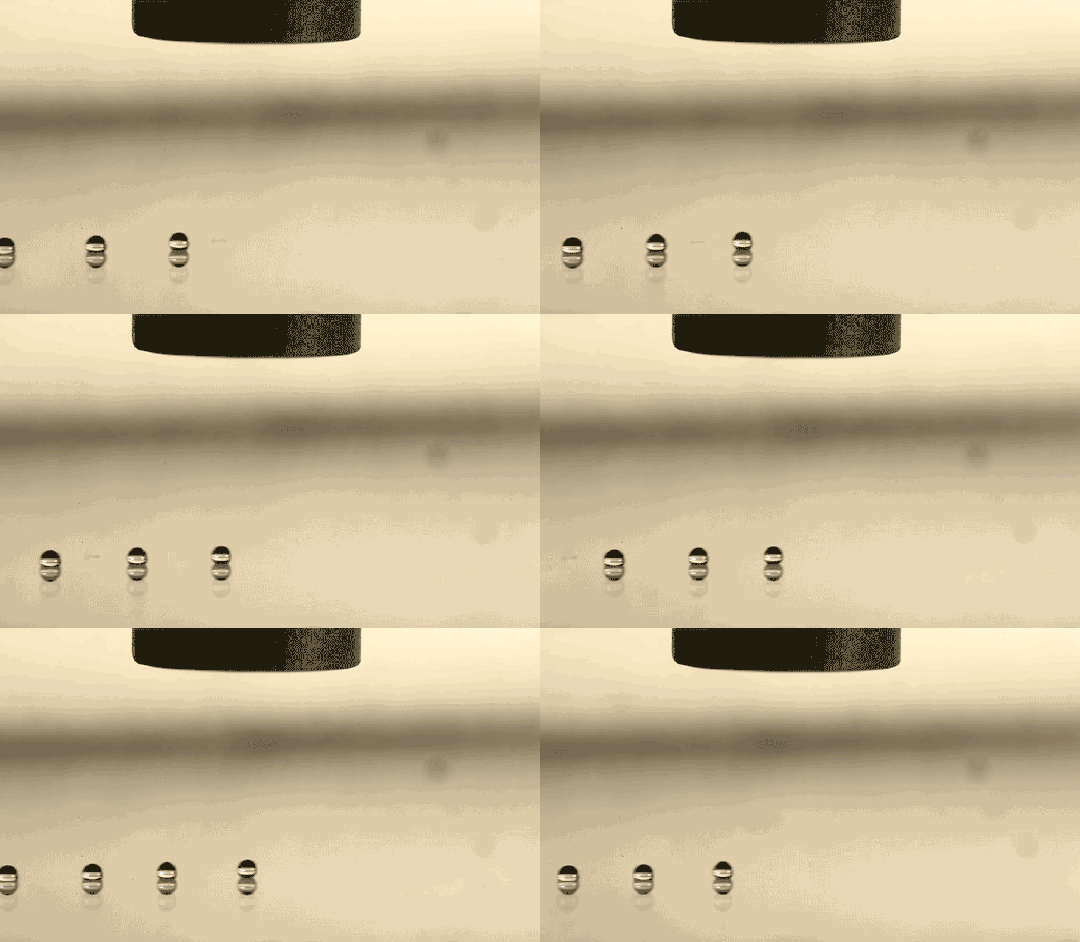
    Using acoustic levitation and an array of carefully-placed speakers, researchers can manipulate droplets without touching them. This lets scientists study the physics of droplet coalescence (top) without interference from solid surfaces, but it also provides opportunities for mixing two different substances in the final droplet. 

    On the bottom left, we see a droplet formed from the coalescence of a dyed droplet (visible as gray) and an undyed droplet. The swirling and mixing in the levitating droplet is fairly slow. By contrast, the droplet on the right is vibrated by manipulating the sound waves holding it aloft. This mixes the droplet quite efficiently, allowing it to reach a uniform state more than six times faster than the other droplet. (Image and research credit: A. Watanabe et al., source)

  • The Swimming of a Dead Fish

    The Swimming of a Dead Fish

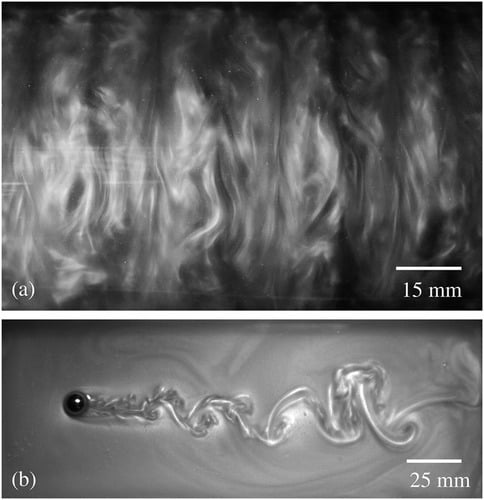
    When I was a child, my father would take me trout fishing, and I spent hours marveling from the riverbank at the trouts’ ability to, seemingly effortlessly, hold their position in the fast-moving water. As it turns out, those trout really were swimming effortlessly, in a manner demonstrated above. The fish you see here swimming behind the obstacle is dead. There’s nothing powering it, except the energy its flexible body can extract from the flow around it.

    The obstacle sheds a wake of alternating vortices into the flow, and when the fish is properly positioned in that wake, the vortices themselves flex the fish’s body such that its head and its tail point in different directions. Under just the right conditions, there’s actually a resonance between the vortices and the fish’s body that generates enough thrust to overcome the fish’s drag. This means the fish can actually swim upstream without expending any energy of its own! The researchers came across this entirely by accident, and one of the questions that remains is how the trout is able to sense its surroundings well enough to intentionally take advantage of the effect. (Image and research credit: D. Beal et al.; via PhysicsBuzz; submitted by Kam-Yung Soh)

  • Featured Video Play Icon

    The Fluid Dynamical Sewing Machine

    If you’ve drizzled viscous liquids like honey or syrup, you’ve no doubt witnessed their ability to coil. Combine that coiling with a moving platform and you form a system known as the fluid dynamical sewing machine, which creates different consistent patterns of loops and curves depending on the speed at which the liquid falls and the velocity of the moving platform. The predictability of these patterns makes them especially useful for 3D printing. Previously a group at MIT developed a glass printer that could use the instability, and here a group from Montreal demonstrates how they can build solid coils at various scales. Their video also explores what the structural properties of such coils are after they solidify. (Image, video, and research credit: R. Passieux et al.)

  • Flying Backwards

    Flying Backwards

    Spend a summer afternoon floating in a kayak and chances are you’ll see some impressive aerial acrobatics from dragonflies. One of the dragonfly’s superpowers is its ability to fly backwards, which helps it evade predators and take-off from almost any orientation. To do this, the dragonfly rotates its body so that it is nearly vertical, thereby changing the direction it generates lift. In engineering terms, this is “force-vectoring,” similar to the techniques used by helicopters and vertical-take-off jets. 

    Scientists found that backwards-flying dragonflies could generate forces two to three times their body weight, in part due to the strong leading-edge vortices (bottom image) formed on the forewings. They also found that the hind wings are timed so that their lift is enhanced by catching the trailing vortex of the first pair of wings. Engineers hope to use what they’re learning from insect flight to build more capable flying robots. (Image and research credit: A. Bode-Oke et al., source; via Science)

  • Craters and Rays

    Craters and Rays

    The history of our solar system is written in impact craters, but these craters have been remarkably mysterious for years. Scientists knew that you could recreate many of their features by dropping solid objects into granular materials like sand, but this did not produce the distinctive rays that we see around many real craters (bottom image, Mars). It was only by watching videos of schoolchildren recreating these experiments that scientists discovered what they’d been doing wrong: they’d smoothed the sand’s surface first. 

    It turns out that when you smooth the sand before impact (top left), you get an even ejecta curtain with no rays. But when the surface is uneven, as it is in kids’ experiments or on actual planetary bodies, suddenly rays form (top right). The object’s impact creates a shock wave in the granular medium, which becomes a rarefaction (i.e., expansion) wave when it reaches the surface. This is what actually ejects material. The uneven surface focuses those rarefaction waves, creating the distinctive ejecta rays. (Image credit: T. Sabawala et al., source; NASA; research credit: T. Sabawala et al.; via Jennifer O.)

  • Tea Physics

    Tea Physics

    Tea is a popular beverage around the world, and nearly everyone has their own method for making the perfect cup. Perhaps unsurprisingly, scientists have studied tea physics as well. One such study used both experiments and numerical simulations to study tea infusion from teabags. The authors looked at round, two-dimensional teabags in two configurations – one in which the bag was left still during infusion and one in which the bag was dunked up and down in the water.

    In the static case, as the hot water leeches solutes out of the tea leaves, it forms a buoyant convection current. In this case, the convection is driven by solute concentration, not temperature. The convection creates a re-circulation in the cup that helps slowly distribute the tea solutes.

    The dunking method, unsurprisingly, distributes tea solutes much faster. In addition to stirring the cup’s contents, dunking helps drive flow through the tea leaves, releasing solutes faster. Although the authors study the two methods in detail, they decline to pass judgement on what method is “the best”. (Photo credit: T. Foster, source; research credit: G. Lian and C. Astill; submitted by Marc A.)

  • Collecting Fog

    Collecting Fog

    In some parts of the world, fog is a major source of freshwater, but collecting it is a challenge. Most systems use a wire mesh to capture and collect droplets, but the process is highly inefficient, pulling only 1-3% of droplets from the fog. Researchers found that this is due largely to aerodynamic effects. The presence of the wire deflects droplets around it (bottom left). To solve this, engineers introduced an electric charge into the fog. The subsequent electric field actually pulls droplets to the wires (bottom right). When applied to a mesh (top), the efficiency of fog capture improves dramatically. 

    The technique can also be used to capture water vapor that would otherwise escape from the cooling towers of power plants. The MIT researchers who developed the technique will conduct a full-scale test at the university’s power plant this fall. They hope the technique will recapture millions of gallons of water that would otherwise drift away from the plant. (Image credits: MIT News, source; image and research credits: M. Damak and K. Varanasi, source)

  • Sandy Splashes

    Sandy Splashes

    Sand and other granular materials can be strikingly fluid-like. Here the impact of a solid sphere on sand generates a splash remarkably similar to what’s seen with water. When the ball hits, it creates a crater in the surface and sends up a bowl-like spray of sand. As the ball continues falling through the sand, the grains try to fill the empty space left behind. The walls of sand collapsing around the void meet somewhere between the surface and the depth of the ball. This generates the tall jet we observe, as well as a second one under the surface that we can’t see. We know that collapse traps an air bubble under the surface because of the eruption that occurs as the jet falls. That’s the air bubble reaching the surface. (Image credit: T. Nguyen et al., source; see also R. Mikkelsen et al.)