Category: Research

  • Forests Slow Avalanches

    Forests Slow Avalanches

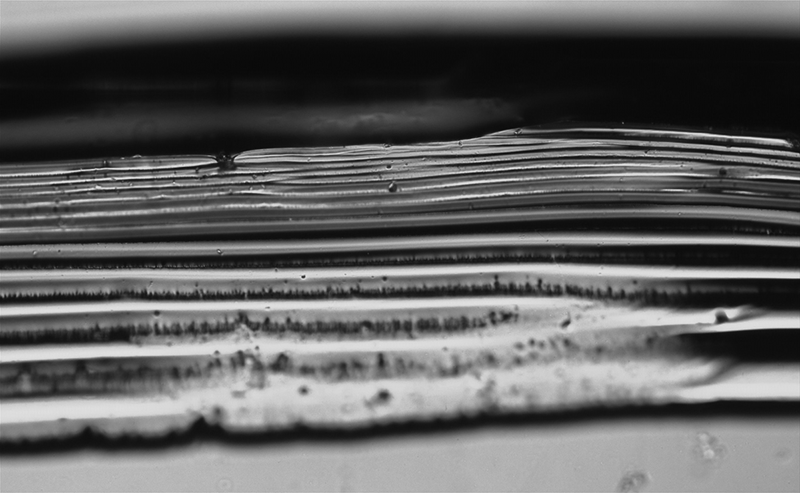
    In snowy mountainous regions, avalanches are a dangerous and destructive problem. Researchers studying the mechanisms of these flows have a suggestion: plant more trees. A group of researchers found that a “forest” of regularly spaced pillars slowed avalanches by as much as two-thirds. On an empty slope, the avalanche picked up speed as its thickness grew. But with regularly-spaced pillars the slower flow rate became almost completely independent of avalanche thickness.

    The researchers with their avalanche set-up, which releases glass beads through a forest of pillars.
    The researchers with their avalanche set-up, which releases glass beads through a forest of pillars.

    For now, the researchers suggest placing trees every 3 meters on steep, avalanche-prone slopes — a technique that, admittedly, only works for slopes below the treeline. In their next round of experiments, the researchers plan to see how a randomly arranged forest affects an avalanche. (Image credit: top – N. Cool, apparatus – Université Paris-Saclay/FAST; research credit: B. Texier et al.; via Physics World)

  • Scooting Droplets

    Scooting Droplets

    As a child, I always loved watching rain on the windows as I rode in the car. Hemispherical droplets got stretched by the wind flowing over them. But they never stretched smoothly; instead they seemed to shiver and shake unevenly. A recent study looks at a similar situation: drops of glycerin forced to slide along a horizontal surface under the force of the wind. Like the drops on my parents’ car, the glycerin gets stretched out into an elongated oval. Surface waves develop atop the drop and move downstream. The drops, the authors observe, move a bit like a crawling caterpillar, pilling up and smoothing out as they move. (Image credit: rain – A. Alves, experiment – A. Chahine et al.; research credit: A. Chahine et al.; via APS Physics)

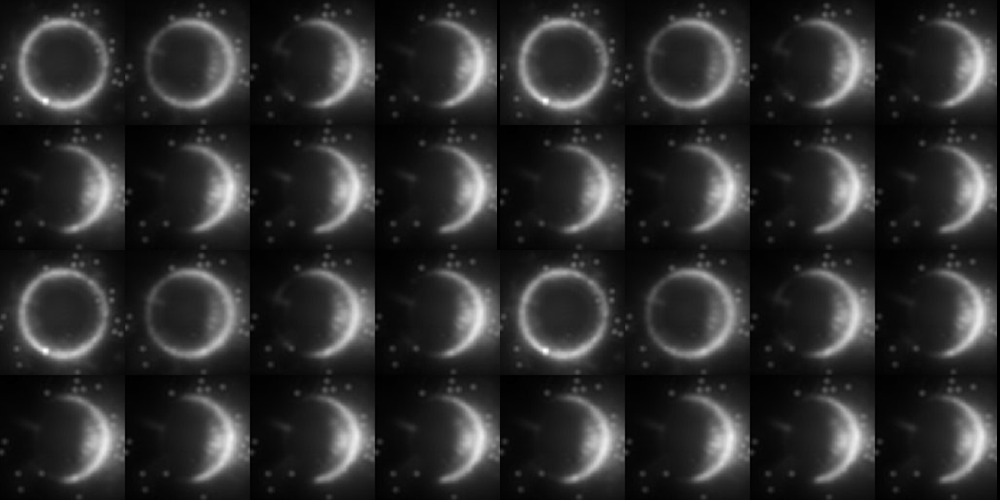
    This series of images shows an elongated droplet subjected to airflow moving from left to right. Waves form on the drop and move downstream in a fashion similar to a caterpillar crawling.
    This series of images shows an elongated droplet subjected to airflow moving from left to right. Waves form on the drop and move downstream in a fashion similar to a caterpillar crawling.
  • Stopping a Bottle’s Bounce

    Stopping a Bottle’s Bounce

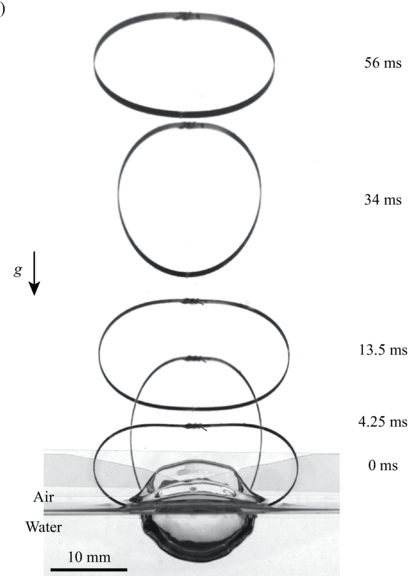
    A few years ago, the Internet was abuzz with water bottle flips. Experimentalists are still looking at how they can arrest a partially fluid-filled container’s bounce, but now they’re rotating the bottles vertically rather than flipping them end-over-end. Their work shows that faster rotating bottles have little to no bounce after impacting a surface.

    This image sequence shows how water in a rotating bottle moves during its fall (top row) and after impact (bottom row). Water climbs the walls during the fall, creating a shell of fluid that, after impact, forms a central jet that arrests the bottle's momentum.
    This image sequence shows how water in a rotating bottle moves during its fall (top row) and after impact (bottom row). Water climbs the walls during the fall, creating a shell of fluid that, after impact, forms a central jet that arrests the bottle’s momentum.

    The reason for this is visible in the image sequence above, which shows a falling bottle (top row) and the aftermath of its impact (bottom row). When the bottle rotates and falls, water climbs up the sides of the bottle, forming a shell. On impact, the water collapses, forming a central jet that shoots up the middle of the bottle, expending momentum that would otherwise go into a bounce. It’s a bit like the water is stomping the landing.

    The authors hope their observations will be useful in fluid transport, but they also note that this bit of physics is easily recreated at home with a partially-filled water bottle. (Image and research credit: K. Andrade et al.; via APS Physics)
  • Weathering Spilled Oil

    Weathering Spilled Oil

    As long as we continue to extract and transport oil, marine oil spills will continue to be a problem. Recent work shows that spilled oil weathers differently depending on both sunlight and water temperature. When exposed to sunlight, crude oil undergoes chemical reactions that can change its makeup. Researchers studied the mechanical properties of crude oil samples kept at different temperatures in both sunlight and the dark.

    They discovered that sunlight-exposed crude oil kept at a high temperature had twice the viscosity of a sample kept in the dark at the same temperature. In contrast, the high-temperature sunlit sample’s viscosity was 8 times lower than a sunlit sample kept at a lower temperature. That’s quite a large difference, and it implies that tropical oil spills may behave quite differently than Arctic ones. Cold-water spills will entrain and dissolve less than warm-water ones, so there may be more surface oil to collect at high-latitude spills. The differences in viscosity may also necessitate different spill mitigation techniques. (Image credit: NOAA; research credit: D. Freeman et al.; via APS Physics)

  • Butterfly Scales

    Butterfly Scales

    Catch a butterfly, and you’ll notice a dust-like residue left behind on your fingers. These are tiny scales from the butterfly’s wing. Under a microscope, those scales overlap like shingles all over the wing. Their downstream edges tilt upward, leaving narrow gaps between one scale and the next. Experiments show that, although butterflies can fly without their scales, these tiny features make a big difference in their efficiency.

    At the microscale, a butterfly's scales overlap like roof shingles but are tilted upward, leaving cavities in the downstream direction.
    At the microscale, a butterfly’s scales overlap like roof shingles but are tilted upward, leaving cavities in the downstream direction.

    When air flows over the scales, tiny vortices form in the gaps between. These laminar vortices act like roller bearings, helping the flow overhead move along with less friction and, thus, less drag. Compared to a smooth surface, the scales reduce skin friction on the wing by 26-45%. (Image credit: butterfly – E. Minuskin, scales – N. Slegers et al., experiment – S. Gautam; research credit: N. Slegers et al. and S. Gautam; via Physics Today)

    This lab-scale experiment shows how air moves over butterfly scales. As flow moves from left to right, small persistent vortices form in the gaps between scales. These act like roller bearings that reduce the skin friction from air moving past.
    This lab-scale experiment shows how air moves over butterfly scales. As flow moves from left to right, small persistent vortices form in the gaps between scales. These act like roller bearings that reduce the skin friction from air moving past.
  • Drag Is Greatest Before Submersion

    Drag Is Greatest Before Submersion

    A new study shows that partially submerged objects can experience more drag than fully submerged ones. This unexpected result comes from the excess fluid that piles up ahead of the object, as seen in the image above, where flow is moving from left to right. The experiments used centimeter-sized spheres and showed that the maximum drag on a nearly-submerged sphere could be 300-400% greater than the drag on a fully submerged sphere.

    Even more surprisingly, they found that water-repellent hydrophobic coatings — which are often suggested for drag reduction — actually increased the drag even further on partially submerged spheres. That’s because the water-repelling coating caused an even larger build-up of fluid ahead of the sphere, increasing the pressure on the front side of the sphere and creating even more drag. Spheres with a hydrophilic coating had less water build-up and thus lower drag.

    The study suggests that — at the centimeter-scale — drag physics at the air-water interface may be more complicated than we assume. (Image and research credit: R. Hunt et al.; via Physics World; submitted by Kam-Yung Soh)

  • Changing Climes on Mars

    Changing Climes on Mars

    China’s Zhurong rover explored Utopia Planitia on Mars from May 2021 to December 2022. During that expedition, the rover uncovered evidence of a major shift in climate that took place some 400,000 years ago. Originally, the area was covered in crescent-shaped barchan dunes formed by winds from the northeast. But after Mars exited its last ice age — courtesy of a shift in its rotational axis — the winds shifted around 70 degrees, coming from the northwest. Those shifted winds eroded the barchan dunes and caused new transverse ridges to form atop them. (Image credit: NASA/JPL-Caltech/UArizona; research credit: J. Liu et al.; via Gizmodo)

  • Featured Video Play Icon

    Aquatic Escape Artists

    Springtails are tiny hexapods found living on the air-water interface. Like other creatures living at the interface, they sometimes need to make a quick escape. For the springtail, that means a high-flying leap, driven by their fork-shaped furcula. The springtail soars into the air, where it contorts its body and uses aerodynamic forces — along with a droplet it carries on its belly — to orient itself. For landing, it uses that droplet as a sticky anchor that helps it adhere to water (or ground) instead of bouncing. Nailing that landing sets it up to make another daring escape as quickly as needed. (Video and image credit: Deep Look; research credit: V. Ortega-Jimenez et al.)

  • Modeling Wildfires With Water

    Modeling Wildfires With Water

    Turbulence over a burning forest can carry embers that spread the wildfire. To understand how wildfire plumes interact with the natural turbulence found above the forest canopy, researchers modeled the situation in a water flume. Dowel rods acted as a forest, with turbulence developing naturally from the water flowing past. For a wildfire, the researchers used a plume of warmer water, which buoyancy lofted into the turbulence over their model forest.

    The experiment used to model wildfire flows. Dowel rods represent the forest and a plume of warm water (right side; distorting the background) represents the wildfire. The dark device in the foreground is a probe used to measure turbulence.
    The experiment used to model wildfire flows. Dowel rods represent the forest and a plume of warm water (right side; distorting the background) represents the wildfire. The dark device in the foreground is a probe used to measure turbulence.

    The flow over the forest canopy naturally forms side-by-side rolls of air rotating around a horizontal axis. As the buoyant plume rises, it can be torn apart by these rollers, as well as carried downstream. Varying the turbulence, they found, did not affect the average trajectory of the plume. But the more intense the turbulence, the greater the vertical fluctuations in the plume. Those large variations, they concluded, could lift more embers into stronger winds that distribute them further and spread a fire faster. (Image credit: wildfire – M. Brooks, experiment – H. Chung and J. Koseff; research credit: H. Chung and J. Koseff; via APS Physics)

  • Predicting Landslides

    Predicting Landslides

    Landslides can cause catastrophic damage, but historically it’s been difficult to monitor susceptible slopes and predict when they’ll fail. But a recent study looking at the 2017 Mud Creek landslide in California shows that new methods could provide a heads up.

    The researchers used satellite data from the months preceding the landslide to study how areas on the slope moved relative to one another. Within their survey region, they found sub-regions where ground locations largely moved together. These sub-regions, called communities in the researchers’ parlance, were remarkably persistent, showing little variation over long periods. But 56 days before the landslide, the researchers saw a sudden change between the communities on the slope. They believe their methodology could help identify slopes in danger of imminent slides.

    So far, though, they’ve only applied this method to the Mud Creek landslide. It’s a promising start, but they’ll need to show that the technique works for other slides as well. If so, it will be a major step forward in landslide prediction. (Image credit: USGS; research credit: V. Desai et al.; via APS Physics)