Just as prairie dogs bark to warn the colony of danger, many plants can signal their neighbors when they’re under attack. This thale cress releases calcium when caterpillars eat it; neighboring plants pick up the chemical signal and pass it along. To better understand how the signal gets passed, researchers genetically modified this plant to fluoresce when extra calcium is on the move. It’s incredible to watch the flow from one side of a leaf to another. (Image and research credit: Y. Aratani et al.; via Colossal)
Category: Research

Superfluid Heat Transfer
Near absolute zero, as atoms slow down, some materials become a superfluid, a type of matter with zero viscosity. Superfluids do all kinds of strange things like generate fountains, leak from sealed containers, and form quantized vortices. Theorists also predicted that in a superfluid heat would slosh back and forth like a wave, even without any flow. They call this “second sound” and researchers have now detected it for the first time.
In a typical experiment, we’d use an infrared camera to see how heat moves in a substance, but at the frigid temperatures of superfluids, that’s not possible. Instead, the team developed a method that measured the temperature of their atomic gas using radio frequency. When their lithium-6 fermions were at a higher temperature, they resonated with a higher radio frequency. Using radio frequency to probe the substance, they were able to observe exactly when heat stopped diffusing like in normal matter and switched to the superfluid second sound state. Since superfluids may live at the heart of neutron stars, further experiments will help us understand these exotic forms of matter. (Image credit: J. Olivares/MIT; research credit: Z. Yan et al.; via MIT News and Gizmodo)

Liquid Metal Printing


Engineers have developed a new 3D-printing technique that uses molten aluminum to quickly manufacture large-scale parts. This Liquid Metal Printing method deposits the metal into a bed of tiny glass beads, which hold the metal in place while it cools. In minutes, they can produce furniture-sized parts, but that speed comes at a cost in resolution; the printed parts are rough, but they have the strength to withstand further machining by bending, milling, etc. The process is also well-suited for reusing scrap metal. The team hopes their method will be a useful prototyping tool as well as a possible manufacturing technique in architecture and construction. (Image and video credit: MIT News; research credit: Z. Karsan et al.)
Serpents and Ouroboros


Beads of condensation on a cooling, oil-slicked surface have a dance all their own in this video. Large droplets gobble up their fellows as they follow serpentine paths; each new droplet donates its interfacial energy to feed the larger drop’s kinetic energy. Eventually, the big drops switch to a circular path, like an ouroboros, the tail-eating serpent of mythology. This transition happens due to the oil shifted by the dancing droplets. You can recreate the effect at home by rubbing a thin layer of oil over glass and setting it atop a hot mug of your favorite beverage. (Video and image credit: M. Lin et al.; research credit: M. Lin et al.)

Skittering Drops
Drip some ethanol on a hot surface, and you’d expect it to spread into a thin layer and evaporate. But that doesn’t always happen, and a recent study looks at why.
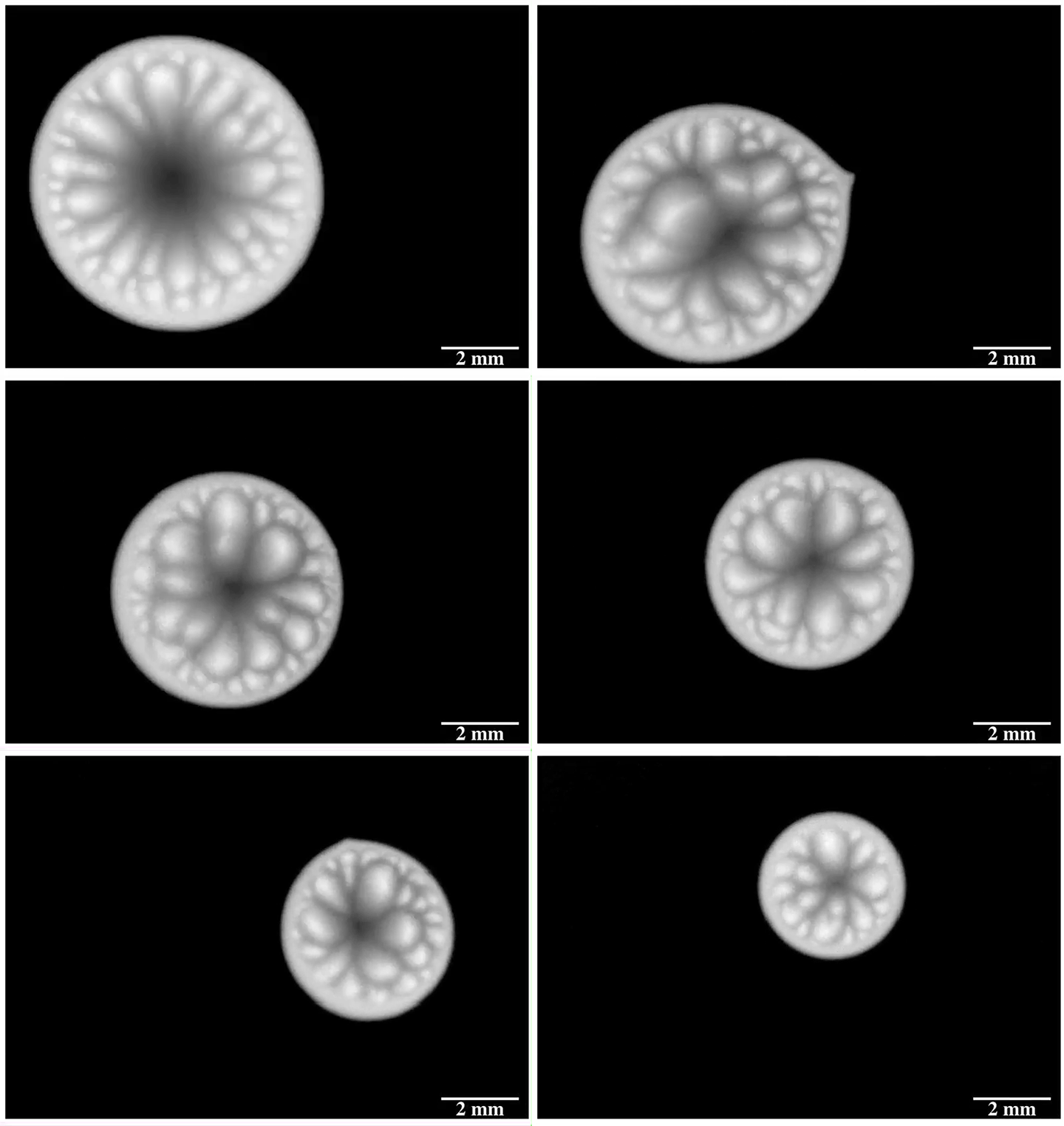
Ethanol is what’s known as a volatile liquid, meaning that it evaporates easily at room temperatures, well below its boiling point. When dropped on a uniformly heated surface above 45 degrees Celsius, the drop contracted into a hemisphere and then began to wander randomly across the surface. Researchers trained an infrared camera on the drop from below (above image), and found an unsteady, roiling motion inside the drop. These asymmetric flows, they concluded, drive the drop’s erratic self-propulsion. They suspect the mechanism may explain why some ink droplets wind up in the wrong place on a page during ink-jet printing. (Image and research credit: P. Kant et al.; via APS Physics)

The Unusual Auroras of Mars
Earth, Saturn, and Jupiter have auroras at their poles, generated by the interaction of their global magnetic fields with the solar wind. Mars has no global magnetic field, only remnants of one frozen into areas of its crust; yet it, too, has auroras. Mars’s auroras are rarer and discrete. They occur most often over the southern hemisphere, and researchers now think they know why.
Four billion years ago, we think Mars had a global magnetic field, much like Earth does. But somehow the planet lost that field. The traces that remain are caught in the minerals of its crust, much like the ancient magnetic fields recorded in areas of the Earth’s sea floor. These magnetized regions of Mars’s crust, shown above as contours in pink and blue, are where the discrete auroras occur.
Using data from NASA’s MAVEN spacecraft, which orbits Mars, the team discovered a pattern. They found that auroras occur most often when the magnetic lines of the incoming solar wind run antiparallel to the magnetic field lines of the crust. This suggests that the auroras happen as a result of magnetic reconnection, a process where antiparallel magnetic field lines rearrange themselves, releasing energy as a result. Reconnection events provide an opportunity for electrons from the solar wind to accelerate into Mars’s atmosphere, exciting molecules there and generating the auroras. So far we’ve only caught the auroras in UV light, but hopefully one day we’ll see them in visible light as well. (Image credit: R. Lillis et al.; research credit: C. Bowers et al. and B. Johnston et al.; via APS Physics)
Eel-Like Swimming


Working with living creatures can’t always reveal their mechanics. That’s one reason engineers like building biorobots. Here, researchers built 1-guilla, an eel-like swimmer, and studied how its body motions affected its swimming. Eels are anguilliform swimmers that use a traveling wave moving along their body from head to tail for propulsion. In the video (and paper), they break down the robot’s motion step by step — looking at amplitude, wavelength, and tail angle — to find the optimal values for maximizing speed and, separately, efficiency in swimming. (Video and image credit: A. Anastasiadis et al.; research credit: A. Anastasiadis et al.)

Feynman’s Sprinkler Solved
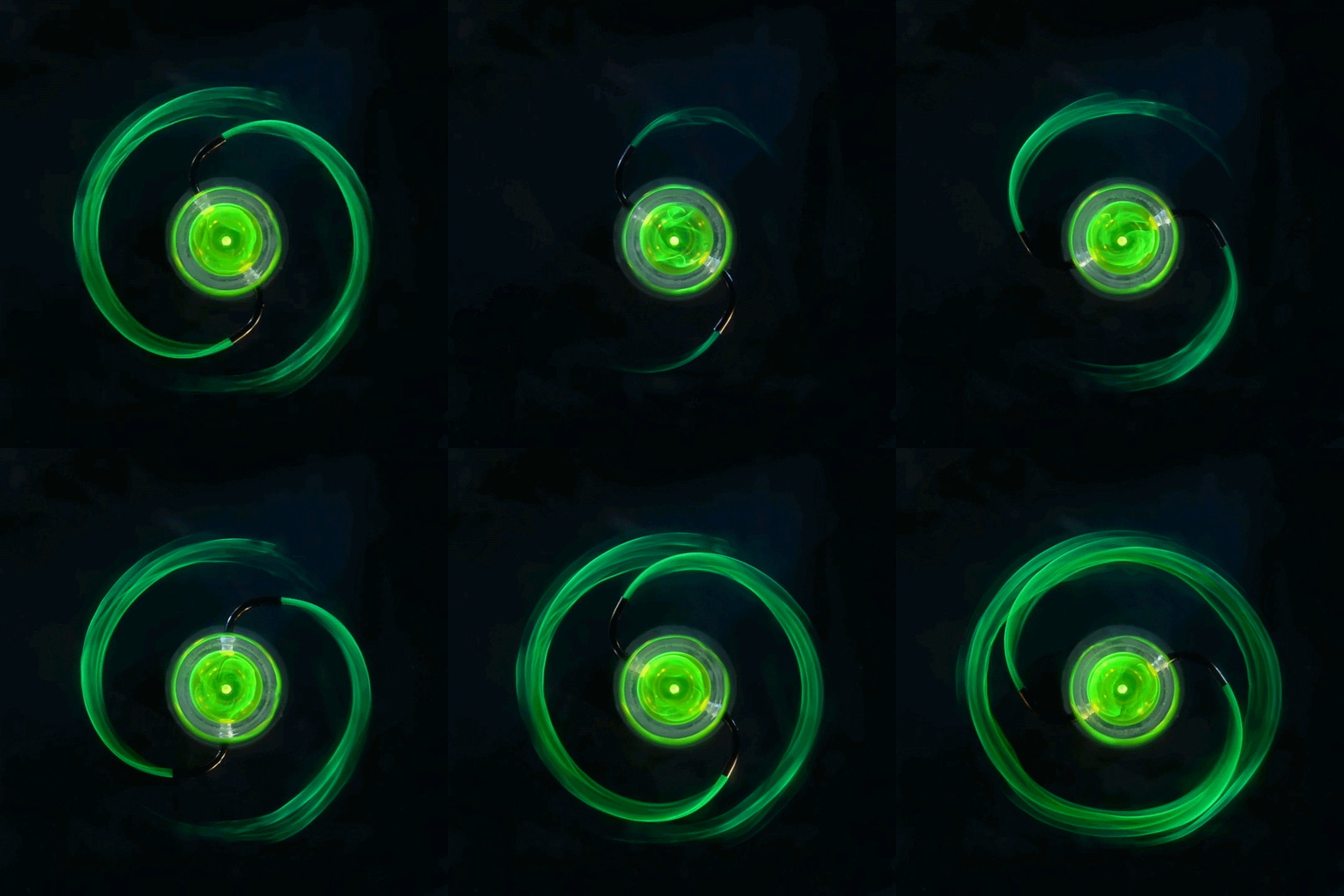
In graduate school, my advisor introduced us to a particularly vexing fluid dynamical thought experiment known as the Feynman sprinkler. After observing an S-shaped sprinkler that rotated when water shot out its arms, physicist Richard Feynman wondered what would happen if the device were placed in a tank of water with the flow reversed. If the sprinkler was sucking in water, would it rotate and, if so, in what direction?
This seemingly simple question has confounded physicists ever since, in part because you can make believable arguments for multiple different results. Attempts to build the apparatus experimentally produced differing results, too — often due to variables that don’t appear in the thought experiment, like friction in the sprinkler’s bearing. But, at long last, a group posits they have the final answer to the problem.

They cleverly built their sprinkler so that it floats in its tank, with the addition or removal of water from the sprinkler controlled by a second siphon-connected tank. With no solid-solid contacts, the sprinkler can rotate with very little friction.

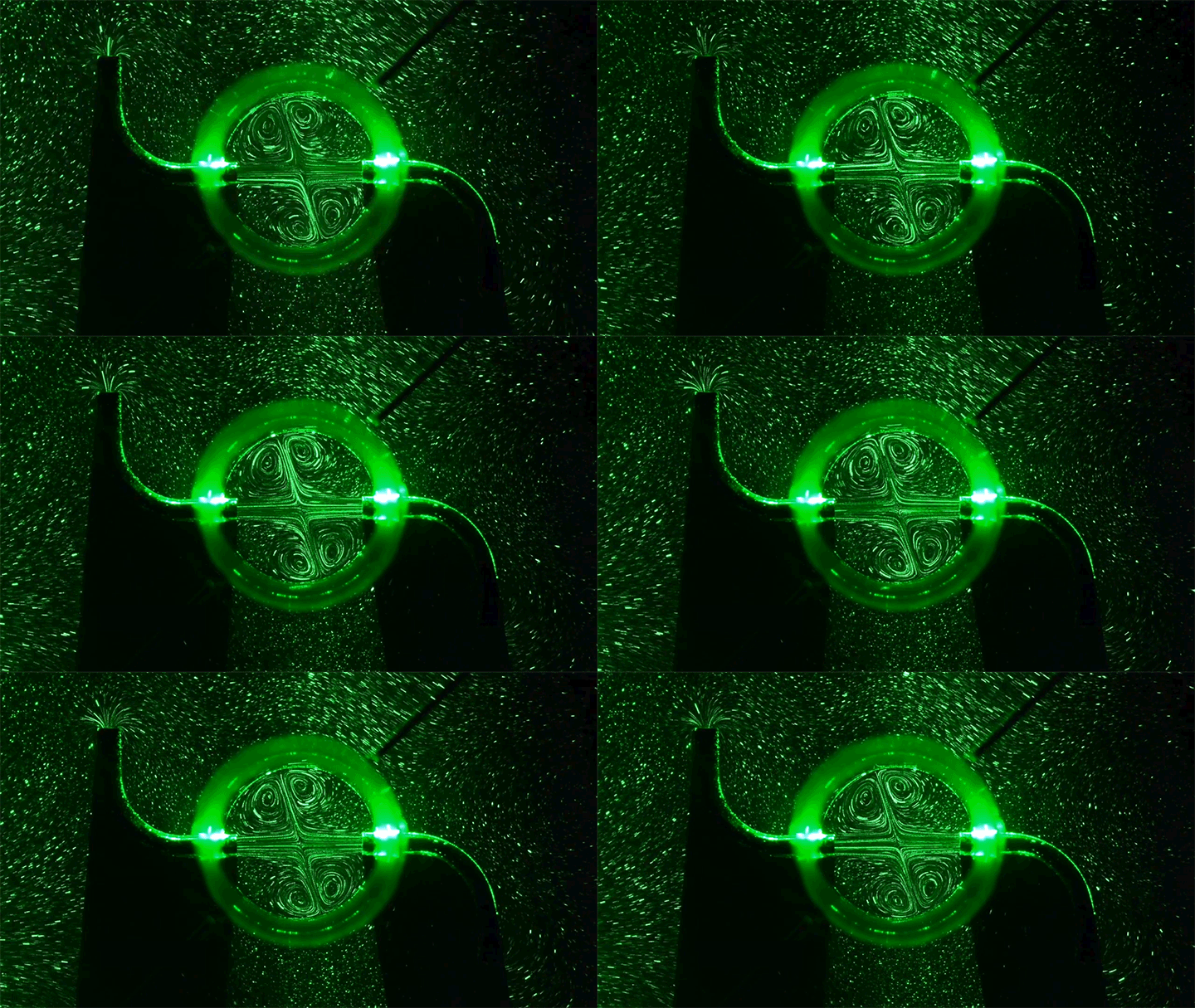
Flow visualization of the sprinkler in reverse (suction) mode. For image clarity, the device is held in place to prevent spinning. Notice how the jets coming into the hub glance off one another and form counter-rotating vortex pairs at an angle. This asymmetry is the source of the sprinkler’s rotation when allowed to move. The team found that sucking water into the sprinkler does, indeed, reverse the sprinkler’s rotation, but it’s not a simple reversal of the forward sprinkler’s flow. To see why, check out the video above, which visualizes flow inside the sprinkler during suction. For clarity, the device is held fixed in place during flow visualization. Notice that the two arms of the sprinkler sit directly opposite one another in the hub. Thus, you’d expect their two jets to collide and form counter-rotating vortices along a vertical axis. But the vortex pairs are offset from the centerline.
This asymmetry takes place because the velocity profiles of flow across the hub inlets are skewed. Instead of the largest velocity occurring on the centerline of the inlet, each occurs slightly to one side. So when the jets collide, they do so off-center and impart a torque to the sprinkler. The reason for the skewed profiles at the inlets lies further upstream in the curved arms of the sprinkler. Centrifugal force from turning the corner leaves a mark on the flow, leading, ultimately, to the skewed velocity profiles, offset jets, and spinning sprinkler. (Image and research credit: K. Wang et al.; via APS Physics)

Stretching Ant Rafts
In their natural habitat, fire ants experience frequent floods and so developed the ability to form rafts. Entire colonies will float out a flood in a two-ant-thick raft anchored to whatever vegetation they can find. Because ants in the upper layer of the raft are constantly milling about, the rafts have some ability to “self-heal” as they’re stretched.
Pulling slowly gives the ants time to “heal” their stretching raft. In these experiments, researchers slowly (above) and quickly (below) stretched ant rafts to see how they responded. Given a slow enough stretch, the ants were able to adjust and keep the raft together until it doubled in length. In contrast, a faster stretching rate overwhelmed the raft by the time it was 30% longer. (Image credit: top – Wikimedia Commons, others – C. Chen et al.; research credit: C. Chen et al.; via APS Physics)
Pulling quickly breaks an ant raft because the ants cannot react fast enough to heal the raft. 
Lasing Bubbles
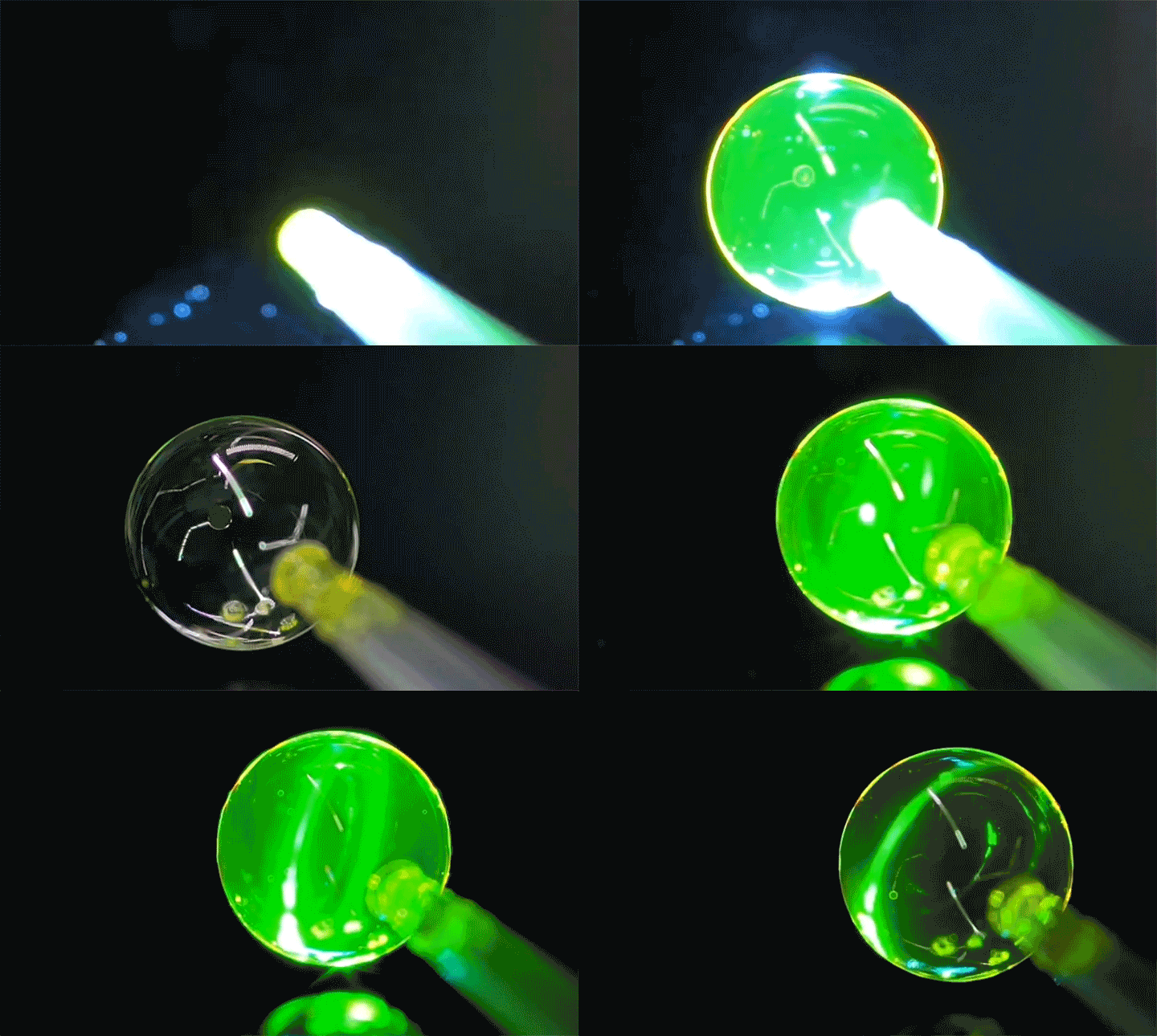
The thin shells of bubbles interact with light in fascinating ways; that is, of course, the source of their brilliant colors. In this recent study, researchers discovered that bubbles can serve as tunable lasers. A laser has three major components: an energy source, an optical resonator, and a gain medium that amplifies light in the resonator. For bubble lasers, an external pump laser provides energy and the bubble’s thin shell acts as a resonator. Fluorescent dye in the bubble serves as the gain medium.
Once formed, the bubble lasers are incredibly sensitive to electric fields and pressure changes, making them excellent sensors. For added stability, the team is using smectic liquid crystal bubbles, which, unlike soap bubbles, don’t evaporate easily. (Video, image, and research credit: Z. Korenjak and M. Humar; via APS Physics)