Category: Phenomena

  • Featured Video Play Icon

    Dam Failure

    In a recent video, Practical Engineering tackles an important and often-overlooked challenge in civil engineering: dam failure. At its simplest, a levee or dam is a wall built to hold back water, and the higher that water is, the greater the pressure at its base. That pressure can drive water to seep between the grains of soil beneath the dam. As you can see in the demo below, seeping water can take a curving path through the soil beneath a dam in order to get to the other side. When too much water makes it into the soil, it pushes grains apart and makes them slip easily; this is known as liquefaction. As the name suggests, the sediment begins behaving like a fluid, quickly leading to a complete failure of the dam as its foundation flows away. With older infrastructure and increased flooding from extreme weather events, this is a serious problem facing many communities. (Video and image credit: Practical Engineering)

  • Self-Healing Bubbles

    Self-Healing Bubbles

    Soap films have the remarkable property of self-healing. A water drop, like the one shown above, can pass through a bubble (repeatedly!) without popping it. This happens thanks to surfactants and the Marangoni effect. Surfactants are molecules that lower the surface tension of a liquid and congregate along the outermost layer of a soap film. When water breaks through the soap film, its lack of surfactants causes a higher surface tension locally. This triggers the Marangoni effect, in which flow moves from areas of low surface tension toward ones of high surface tension. That carries surfactants to the region where the drop broke through and helps stabilize and heal the soap film. Incidentally, the same process lets you stick your finger into a bubble without popping it as long as your hand is wet! (Image credit: G. Mitchell and P. Taylor, source)

  • Featured Video Play Icon

    Flames in Freefall

    Gravity is such an omnipresent force in our lives that we frequently forget how strongly it affects our daily experiences and how differently nature behaves without it. A wonderful example of this is the simple flame of a candle. On Earth, a candle flame is tear-drop-shaped and elongated, burning hotter near the bottom and glowing yellow from soot at the top. But, as Dianna demonstrates with her free-fall experiment, this shape is due entirely to the effects of gravity. Buoyant forces make the hot air near the candle rise, pulling in cooler air and fresh oxygen at the base while stretching out the flame. In microgravity – or free-fall – flames are instead spherical, their shape driven by molecular and chemical diffusion. Check out the full video to see more effects of acceleration on flames. (Video credit: Physics Girl)

  • Island Wakes

    Island Wakes

    One of my favorite aspects of fluid dynamics is watching how patterns repeat at all kinds of scales. The cotton-candy-colored image above is a false-color satellite image of the island Tristan da Cunha (left), a volcanic island group in the South Atlantic. The prevailing winds, oriented roughly left to right in the image, flow over the rocky island and part in a series of swirls that alternate in their direction of rotation: clockwise for the upper set and counter-clockwise for the lower ones. This pattern is called a von Karman vortex street, named for an  aerodynamicist who studied the mechanism. Von Karman vortices are frequently observed in satellite images of remote islands, but they are also common behind spherical and cylindrical objects of all sizes. Sometimes they even show up in sci-fi! (Image credit: NASA Earth Observatory; submitted by Steve G.)

  • Turning Sand Into a Fluid

    Turning Sand Into a Fluid

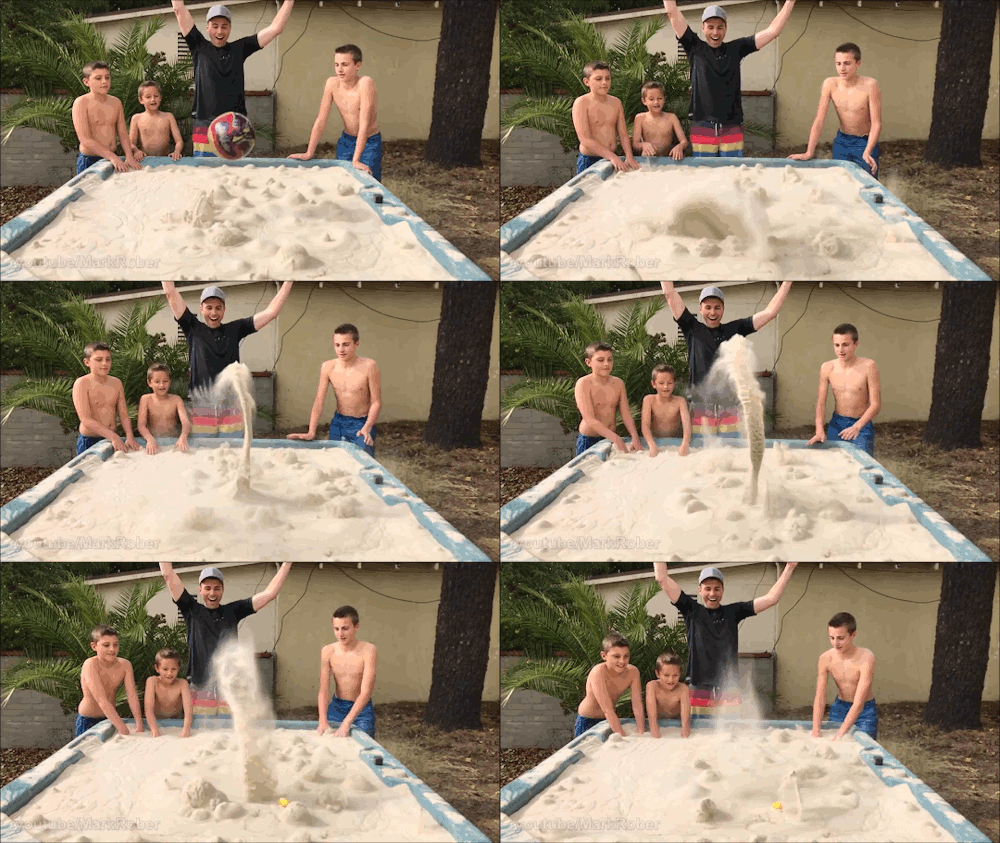
    Pumping air through a bed of sand can make the grains behave just like a liquid. This process is called fluidization. Air introduced at the bottom of the bed forces its way upward through the sand grains. With a high flow rate, the space between sand grains gets larger, eventually reaching a point where the aerodynamic forces on a grain of sand equal gravitational forces. At this point the sand grains are essentially suspended in the air flow and behave like a fluid themselves. Light, buoyant objects – like the red ball above – can float in the fluidized sand; heavier, denser objects will sink. Fluidization has many useful properties – like good mixing and large surface contact between solid and fluid phases – that make it popular in industrial applications. For a similar (but potentially less playful) process, check out soil liquefaction. (Image credits: R. Cheng, source; via Gizmodo; submitted by Justin)

  • Jupiter’s Atmosphere

    Jupiter’s Atmosphere

    Jupiter’s atmosphere is fascinatingly complex and stunningly beautiful. This close-up from the Juno spacecraft shows a region called STB Spectre, located in Jupiter’s South Temperate Belt. The bluish area to the right is a long-lived storm that’s bordering on very different atmospheric conditions to the left. Shear from these storms moving past one another creates many of the curling waves we see in the image. These are examples of the Kelvin-Helmholtz instability, which generates ocean waves here on Earth, creates spectacular clouds in our atmosphere, and is even responsible for waves in galaxy clusters. Check out some of the other amazing images Juno has sent back of our solar system’s largest planet. (Image credit: NASA/JPL-Caltech/SwRI/MSSS/R. Tkachenko; via Gizmodo)

  • Galapagos Week: Lava Flows

    Galapagos Week: Lava Flows

    The Galapagos islands are geologically similar to the Hawaiian islands; both are archipelagos that were born and continue to be formed by lava flows originating from a volcanic hot spot. Lava from this type of volcano is high in basalt content, which affects both its flow properties and the formations it creates. Geologists have actually borrowed words from the Hawaiian language to describe the two main kinds of lava formations seen in basaltic flows: pahoehoe and a’a.

    Pahoehoe formations tend to be relatively smooth and often leave behind a pattern of rope-like coils (below). In contrast, a’a lava features are sharp, rough, and challenging to traverse. Both flows are gravity-driven, and which features a given eruption forms depends on many factors. Many flows will even begin with a pahoehoe section that stretches for several kilometers before transitioning to an a’a structure. Researchers believe the transition occurs when the lava crystallizes enough to develop a yield-strength, meaning that it will behave like a solid until enough force is applied to make it flow again. Toothpaste, ointment, and mud are similar so-called yield stress fluids which will only flow after a critical force is applied.  (Image credits: lava flow – Epic Lava Tours, source; pahoehoe lava – J. Shoer)

    Galapagos Week continues tomorrow here on FYFD. Check out previous posts.

  • Galapagos Week: Pistol Shrimp

    Galapagos Week: Pistol Shrimp

    One of the most striking things about snorkeling in the Galapagos was how loud it was underwater. There were hardly any boats nearby, but every time my ears dipped below the surface, I could hear a constant cacophony of sound. Some it came from waves against the sand, some of it was the sound of parrotfish nibbling on coral, but a lot of it was likely the work of a culprit I couldn’t see hidden in the sand: the pistol shrimp.

    These small crustaceans hunt with an oversized claw capable of snapping shut at around 100 kph. When the two halves of the claw come together, they push out a high-speed jet of water. High velocity means low pressure – a low enough pressure, in fact, to drop nearby water below its vapor pressure, causing bubbles to form and expand. These cavitation bubbles collapse quickly under the hydrostatic pressure of the surrounding water, creating a distinctive pop that makes the pistol shrimp one of the loudest sea creatures around. (Image credit: BBC Earth Unplugged, source; research credit: M. Versluis et al.)

    All week we’re celebrating the Galapagos Islands here on FYFD. Check out previous posts in the series here.

  • Galapagos Week: Introduction

    Galapagos Week: Introduction

    One hundred and eighty-two years ago today, the H.M.S. Beagle reached the Galapagos archipelago carrying, among others, naturalist Charles Darwin. The ship would spend the next month exploring the islands, and Darwin’s experiences during that time, and the specimens he collected, would ultimately lead him to propose the concept of evolution.

    I had the incredible opportunity to visit the Galapagos Islands last October, and, like so many before me, I was fascinated by the islands and their remarkable ecosystems. The Galapagos Islands are located at the equator, but they owe much of their rich biodiversity to sitting at the confluence of several ocean currents, both warm and cold. In particular, the cold Cromwell Current’s upwelling on the western side of the archipelago carries valuable nutrients up from the deep and helps support vibrant marine life from bioluminescent plankton to leaping mobula rays. (And, yes, I geeked out over both.)

    Over the next week, FYFD will be exploring some of the fluid dynamics of the Galapagos Islands and their denizens on land, sea, and air. Be sure to check back every day for a new post! (Image credit: N. Sharp and J. Shoer)

  • Farewell, Cassini!

    Farewell, Cassini!