Category: Phenomena

  • Featured Video Play Icon

    Pop-Pop Boats

    I confess I’ve never heard of the pop-pop boat toys Steve Mould uses in this video. They feature a tank filled with water and a small source of heat in the form of a tea light candle. Together, these features generate propulsion and a distinctive popping sound from the toy. As he is wont to, Mould explains the physics behind the toy using a transparent version to show the water/steam oscillations that drive the boat. Having watched, I have to say that this set-up seems ready made for an undergrad fluids class and a control volume analysis! (Image and video credit: S. Mould)

  • Particle-Filled Coatings

    Particle-Filled Coatings

    Pulling a solid object from a liquid bath can coat it in a thin layer of liquid. The thickness of the coating layer depends on the speed at which the object is removed. Introducing particles into the liquid bath adds a new dimension to the coating problem, namely the size of the particles. In this poster, researchers demonstrate some of the coatings possible in a mixture with particles of more than one size. It’s even possible, they note, to filter out particles of a certain size by carefully selecting the removal speed. (Image credit: D. Jeong et al.)

  • Featured Video Play Icon

    How Wells and Aquifers Work

    When rain falls, some of that water turns into run-off in storm systems but much of it seeps into the ground. What happens to that water? In most places, it joins the local aquifer, infusing the spaces between soil particles underground. In this video, Grady takes us through some of the interactions between surface water, aquifers, and the wells we use to access water underground. He’s even built some great demonstrations to show how aquifers and surface water like rivers pass water back and forth. (Image and video credit: Practical Engineering)

  • Surf’s Up

    Surf’s Up

    Surfers flock to northern Peru to enjoy what’s been called the world’s longest wave. These waves are generated by storms thousands of miles away in the Pacific and Southern Oceans. In the open water between, the waves sort themselves into groups of similar wavelength and speed. With the deep water off Peru, the large swells continue to travel together until close to the shore. Surfers also benefit from the tendency for incoming waves to arrive nearly parallel to the coastline, creating long shoreline stretches for breaking. Where many famous wave breaks can be ridden for seconds, surfers can ride these for minutes! (Image credit: L. Dauphin; via NASA Earth Observatory)

  • Featured Video Play Icon

    Recreating Flocks

    Birds, fish, and other creatures form amazing, undulating swarms of individuals. How these collectives comes together and move continues to fascinate scientists. Here, researchers look at simple particles with two “instructions,” if you will. One causes the particle to self-navigate toward a target; the other causes short-range repulsion if the particle gets too close to another one. With only these two simple guidelines, a flock of these particles forms complex, ever-changing flows! (Image and video credit: M. Casiulis and D. Levine)

  • Featured Video Play Icon

    Flying With Geese

    Some people fly with geese to train them for wind tunnel tests, and some people fly with them to teach them safer migratory paths. Today’s video focuses on the latter, specifically conservationist Christian Moullec, who has spent decades living and flying with lesser white-fronted geese as part of an effort to save the threatened species. He flies with them using an ultralight aircraft, exercising daily to prepare for the cross-continental migration. To help fund the effort, he offers passengers a spot on his short flights, letting people fly with the birds! (Image and video credit: T. Scott; via Colossal)

  • Featured Video Play Icon

    Pumping Waste

    Sewage systems rely on gravity to remove waste from our homes and carry it toward treatment plants. But that constant downward slope can’t always be maintained. Sometimes we have to bring the sewage back up to the surface to process it. For that, modern systems rely on pumps and other equipment to move the challenging slurry of liquid and solid materials. In this video, Grady from Practical Engineering breaks down the physics and engineering of sewage pumping. (Image and video credit: Practical Engineering)

  • Tidal Vortices

    Tidal Vortices

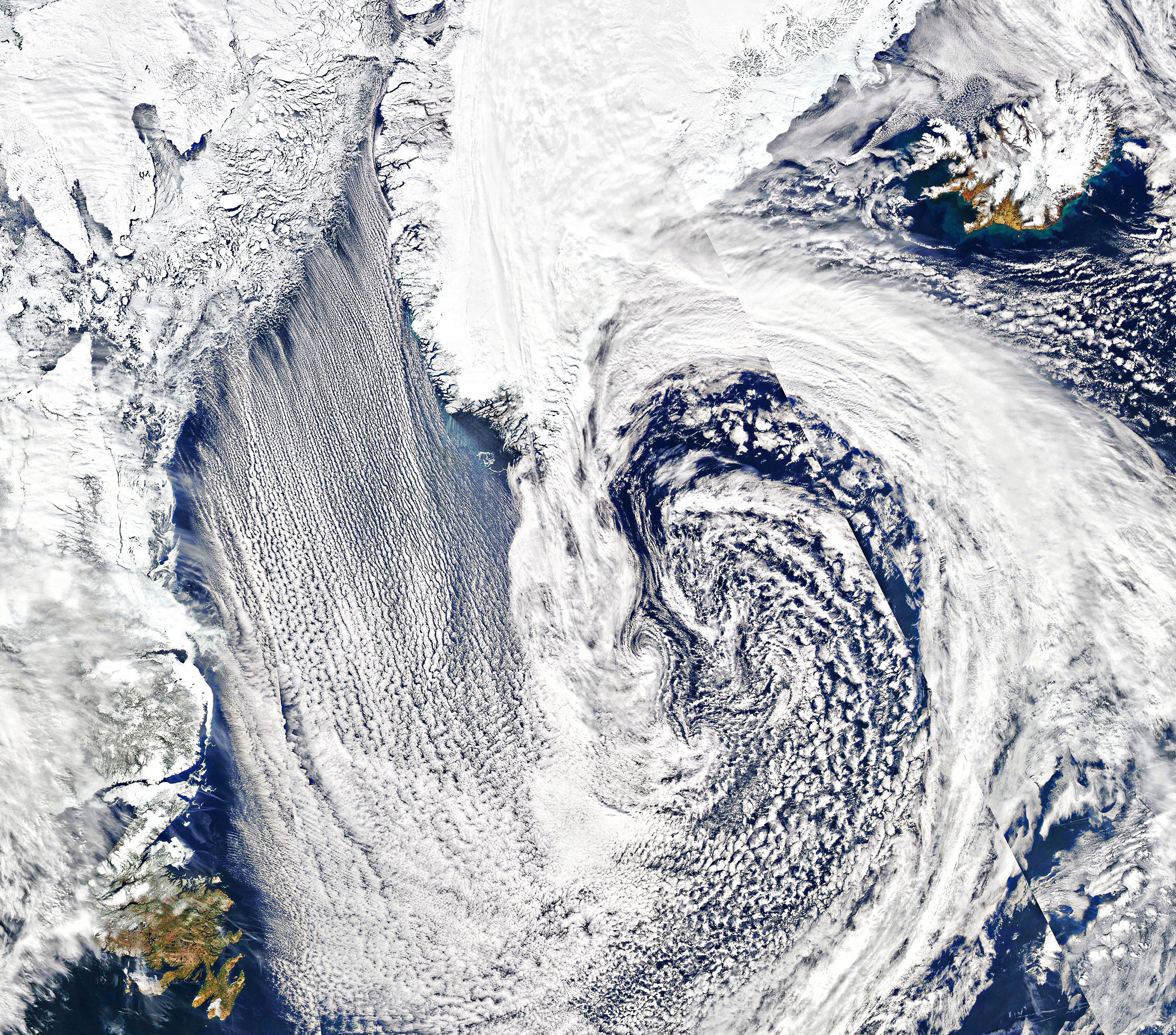
    Local topography in the Sea of Okhotsk funnels water to create some of the largest diurnal tides in the world — nearly 14 meters! The currents rushing past islands and outcrops create swirling vortices like the ones seen in this natural-color satellite image. In some places, you can even see multiple vortices, strung together into a von Karman vortex street. At high tide, the vortex streets stretch westward, but at low tide they point east. (Image credit: N. Kuring/NASA/USGS; via NASA Earth Observatory)

  • Merging Along Wires

    Merging Along Wires

    As oil slides down two slowly converging wires, the droplets will merge into a sheet that stretches between both wires. When this happens can vary somewhat but occurs somewhere around the liquid’s capillary length.

    In the poster above, the leftmost image (not the illustration) shows three possible merger points. To the right of the image, is a teal curve; this is a probability density function. Essentially, this curve shows where the merger is most likely to occur. The peak of the curve corresponds to the most probable point of merger.

    The following two composite images show the same system — same oil flow rate, same wire spacing — with gas blowing upward along the wires. As the gas’s flow rate increase, the oil drops get larger, making the oil films thinner. The result? The wires have to get closer to one another before the oil merges. That’s reflected in the yellow and orange probability density functions, which have peaks further along the wires than the no-gas-flow case. (Image credit: C. Wagstaff et al.)

  • Featured Video Play Icon

    Whistle Physics

    Ever wondered how whistles work? Depending on the type of whistle, there are a few different phenomena in play, but the most fundamental one is the oscillation of a fast-moving air stream. Any small deviation in the air stream can set up a situation where the flow shifts side-to-side, and most whistles use this oscillation to drive the sound they produce.

    Many whistles direct the air flow onto a wedge-shape to strengthen the oscillation; then they have a cavity that amplifies the sound using resonance. Water whistles — which warble in a bird-like way — do the same thing, but the water inside them creates a shape-changing cavity, thereby changing the pitch to create an unsteady, warbling sound. You can see all these whistles and more deconstructed in Steve’s video. (Video and image credit: S. Mould)