Category: Phenomena

  • Actinoform Clouds

    Actinoform Clouds

    Flower-shaped actinoform clouds, like those seen on the left side of this satellite image, were only discovered in the 1960s once satellite imagery allowed meteorologists to identify cloud structures that were too large to recognize from the ground. Often appearing over the ocean, these clouds can stretch over hundreds of kilometers, bringing drizzling rain.

    This particular set of actinoform clouds have some distinctive neighbors in the right side of the image, where V-shaped slashes through the cloud cover mark the origins of two von Karman vortex streets. The vortex streets appear downwind of two rocky islands, Alejandro Selkirk Island and Robinson Crusoe Island. (Image credit: L. Dauphin; via NASA Earth Observatory)

  • Featured Video Play Icon

    Inside a Metal Vortex

    What do you get when you combine liquid gallium, a blender, and a special probe lens? Some pretty wild slow-mo video of a liquid metal vortex, courtesy of the Slow Mo Guys. This video is almost as notable for its set-up as it is for the high-speed footage, given the lengths Gav and Dan go to in order to get the shot! (Image and video credit: The Slow Mo Guys)

  • Featured Video Play Icon

    Escaping the Flood

    Fire ants clump together into giant rafts to stay alive during floods. But these rafts won’t form with just any number of ants. Researchers found that individual ants will actually kick one another away. It’s not until there are about ten ants that the raft formation becomes stable. In this video, the team lays out their experiments and models for fire ant rafting, showing that capillary action helps draw the raft together and individual ants’ activity can destabilize rafts if they’re too small. (Image and video credit: H. Ko and D. Hu)

  • Featured Video Play Icon

    How Dunes Form

    On its face, the idea that sand and wind can come together to form massive mountainous dunes seems bizarre. But dunes — and their smaller cousins, ripples — are everywhere, not just on Earth but on other planetary bodies where fine particles and atmospheres interact. In this video, Joe Hanson gives a great overview of sand dynamics, beginning with what sand is, how it moves, and what it can ultimately form. It’s well worth a watch, even if you know a little about dunes already; I know I learned a thing or two! (Image and video credit: Be Smart)

  • Featured Video Play Icon

    Rifts in Rafts

    A raft of particles floating on water has some natural cohesion from particle attraction and capillary action. But when the raft is pulled apart, what happens? Does it break cleanly in one spot? Does it stretch and deform? That’s what this video explores. It turns out that the speed you pull the raft at determines how it holds together. Every particle cluster has a preferred relaxation rate, and by choosing the pulling speed, you determine which relaxation rate — and therefore cluster size — can survive most effectively. (Image and video credit: K. Tô and S. Nagel)

  • Featured Video Play Icon

    Treating Water

    In an ongoing series, Practical Engineering is looking at how civil engineers deal with sewage and wastewater. In this video, Grady looks at how wastewater gets treated to remove contaminants. Where possible, engineers use gravity to do this job, building infrastructure that slows the flow down and lets gravity make heavier particles settle out. Of course, sometimes gravity alone doesn’t act quickly enough, in which case engineers use a little extra help in the form of chemicals that can neutralize particles’ electric charge and help them clump together and settle faster. Check out the full video for a tour of how wastewater gets processed. (Image and video credit: Practical Engineering)

  • Submarine Eruptions

    Submarine Eruptions

    The green-blue plume on the left of this satellite image is an eruption from Kavachi, an underwater volcano in the Solomon Islands. Kavachi’s crest is currently estimated to lie 20 meters below the surface, with its base at a depth of 1.2 kilometers. Eruptions are quite common at the volcano, but that doesn’t stop wildlife — like hammerhead sharks! — from making the crater their home. Over the last century, Kavachi’s eruptions have repeatedly formed small islands at the surface, but they were quickly eroded away by wave action. (Image credit: J. Stevens/NASA/USGS; via NASA Earth Observatory)

  • Featured Video Play Icon

    Making Hurricanes

    With oceans warming, there’s more energy available to intensify hurricanes. And while our weather models have gotten better at predicting where hurricanes will go, they’re less good at predicting hurricane intensity, largely because capturing real data from storms is so difficult and dangerous. To address that shortfall, engineers build facilities like the one seen here, which simulates hurricane wind and water conditions so that scientists can study their interaction and better understand storm physics. Check out the full Be Smart video for a tour of the facility and a look at their work. (Image and video credit: Be Smart)

  • Featured Video Play Icon

    Meet BILLY

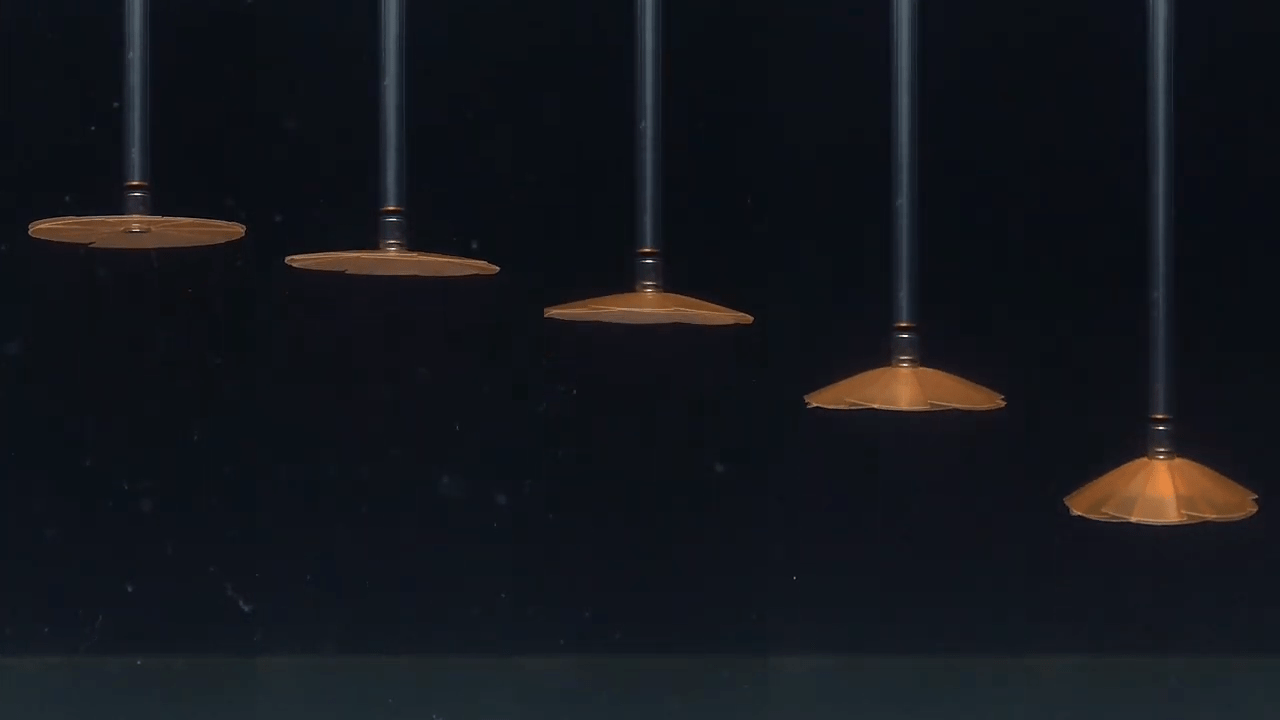
    Many wings in nature are not rigid. Instead they flex and curve with the flow. Here researchers imitate that phenomenon with BILLY (Bio-Inspired Lightweight and Limber wing prototYpe). Using an evolutionary-style algorithm, BILLY determines its own optimal flapping characteristics to maximize performance. Its flexible membrane-style wing actually performs better than a rigid wing! Check out the end of the video for some flow visualization of the leading edge vortex. (Image and video credit: A. Gehrke et al.)

  • Rip Currents

    Rip Currents

    Rip currents — also known as rips — are a threat to beachgoers around the world, and, unfortunately, they’re often underestimated or misunderstood. As waves crash on the shore, water must find a path back out to sea, often through deeper channels that provide a break between the waves. These flow paths are rip currents, and they can form, shift, and intensify with little warning.

    Over the years, researchers have found that efforts to educate beachgoers through signs, flags, and other methods once at the beach have done little to help visitors understand, avoid, or escape rips. Instead, it’s better to educate people long before the water is in sight. Since no one method is guaranteed success for escaping a rip, it’s better to learn to recognize and avoid these dangerous areas. Check out the video below for advice on spotting rips, and here’s a video showing rips from a surfer’s perspective, as well as one using dye flow visualization to mark a rip. Be safe and smart out there! (Image credit: P. Auitpol; video credit: Surf Life Saving Australia; via Hakai Magazine; submitted by Kam-Yung Soh)