Category: Phenomena

  • Teaching Diffusion With Eggs

    Teaching Diffusion With Eggs

    Many cultures around the world marinate hard-boiled eggs — like pickled eggs in Europe or tea- and soy-infused eggs from Asia. These delicacies offer a fun (and tasty) way to demonstrate the concept of diffusion, the tendency of a substance to move from areas of high concentration to low concentration via random molecular motion.

    Simply steep peeled, hard-boiled eggs in your sauce (or food dye) of choice. Remove an egg every so often and slice it in half to see how far the sauce traveled. You can also play with the temperature to accelerate the diffusion. The longer an egg steeps and the hotter its surroundings, the further into the egg white the sauce will diffuse! (Image credit: Wordridden; research credit: C. Emeigh et al.)

  • Featured Video Play Icon

    Fast Fractal Fingers

    With the right balance of viscosity and surface tension, many fluid combinations can form fractal or dendritic patterns. Here, researchers use a drop of food coloring atop a mixture of water and xanthan gum. Depending on the concentration of gum (and the age of the viscous fluid) different fractal patterns spread quickly across the surface. (Image and video credit: R. Camassa et al.)

  • Featured Video Play Icon

    Within the Bubble’s Pop

    To our eyes, a soap bubble appears to pop instantly, but when observed in high-speed video, the process is far more complex. In this video, the Slow Mo Guys pop human-sized bubbles, giving us an opportunity to appreciate the rupture process at speeds up to 50,000 frames per second.

    Once the rupture starts, the hole spreads very symmetrically. But as the hole grows, the remaining soap film starts distorting. As Gav and Dan observe, the far side of the bubble actually wrinkles up before the rupture front arrives and tears the remaining fluid into droplets! (Image and video credit: The Slow Mo Guys)

  • Sunrise Cloudscape

    Sunrise Cloudscape

    With the low sun angle of dawn, the details of this cloudscape stand out. Captured by an external camera on the International Space Station, this image shows cloud formations over the northwest Atlantic. In the foreground, towering cumuli mark rising plumes of warm, moist air evaporating from the ocean. Beyond those clouds, a flat anvil cloud spreads horizontally after a temperature inversion prevented it from rising any further. (Image credit: NASA; via NASA Earth Observatory)

  • Featured Video Play Icon

    Listening to Tempura

    Most cooks know that their frying oil isn’t hot enough if dropping the food in doesn’t create a furious burst of bubbles. But the canniest cooks know they can check the temperature just by listening to the sound made when inserting a utensil, like a wooden chopstick. When oil nears the right temperature, a cloud of bubbles forms around the utensil, leading to a flurry of sound as those bubbles break.

    In this video, researchers explore the sound and bubble dynamics together as a function of temperature. They show how the final sound carries the signature of the its bursting bubble, too. So next time you’re getting ready to fry and you can’t find your thermometer, don’t panic. Just listen! (Image and video credit: A. Kiyama et al.)

  • Featured Video Play Icon

    Parametric Resonance

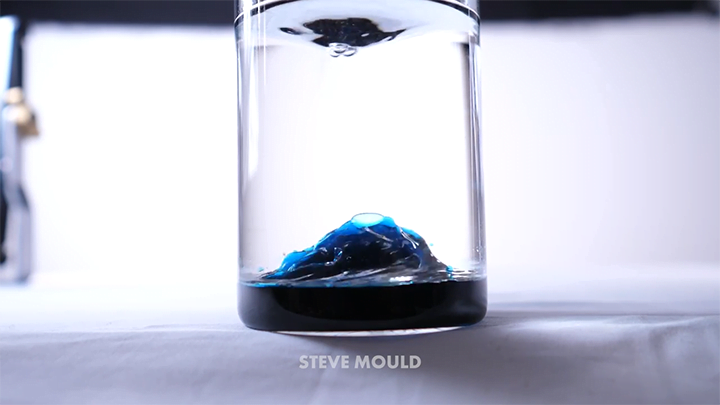
    At first glance, Steve Mould’s video on parametric resonance has nothing whatsoever to do with fluid dynamics. He uses a pendulum suspended on a spring to demonstrate how driving a system at a frequency that’s a multiple of the system’s natural frequency can add energy through resonance. Although his examples don’t use fluids, this phenomenon happens there, too, especially in vibrated fluid systems. Take, for example, this droplet bouncing on a vibrating pool. Depending on the amplitude of the vibrations driving the system, the droplet may bounce in time with the vibration, in time with the waves, or at a frequency twice that of the vibration. (Image and video credit: S. Mould)

    Animation depicted parametric resonance of a mass on a spring pendulum.
    By pulling on the string each time the mass swings through its lowest point (i.e., twice per swing cycle), Steve adds energy to the system, which is reflected in the increasing amplitude of the pendulum’s swing. This is an example of parametric resonance.
  • Spinning Tops

    Spinning Tops

    What does the flow look like around a spinning top? Here, researchers used dye to visualize what happens in a Newtonian fluid (like air or water) as well as a viscoelastic fluid. The Newtonian fluid (upper images) divides into two circulating zones, one below the top and one above. They both take the shape of a toroidal, or donut-shaped, vortex, visible here in cross-section.

    The long molecules of the viscoelastic fluid lend it elasticity to resist stretching. The result is a very different flow field. Beneath the top, there’s still a toroidal vortex, though it appears tighter. But around the upper part of the top, there’s a butterfly-like region of recirculation! (Image credit: B. Keshavarz and M. Geri)

  • Featured Video Play Icon

    Eruption in a Box

    In layers of viscous fluids, lighter and less viscous fluids can displace heavier, more viscous liquids. Here, researchers demonstrate this using four fluids sandwiched between layers of glass and mounted in a rotating frame. (Think of those liquid-air-sand art frames found in museums but bigger!)

    In their first example, each layer of fluid is denser than the one beneath it, so buoyancy forces the lowest layer — air — to rise. The air pushes its way through the more viscous layer of olive oil, then slowly makes its way through the even more viscous glycerin before bursting through the last layer in an eruption. As the team varies the viscosity and miscibility of the layers, the movement of the buoyant fluids through the viscous layers changes dramatically. (Image and video credit: A. Albrahim et. al.)

  • Featured Video Play Icon

    Columbia Glacier’s Retreat

    In southeastern Alaska, the Columbia Glacier once stretched as far as Heather Island in Prince William Sound. After a long period of stability, the glacier began retreating in 1980 and currently sits more than 15 miles from its previous extent. This video explores the glacier’s evolution through false-color satellite imagery, which allows researchers to distinguish the glacier from sea ice, open water, exposed rocks, and nearby vegetation. Though rapid overall, the glacier’s retreat takes place in fits and starts, due to a combination of influences including climate change, sea and ice interactions, and the effects of local topography. (Video and image credit: NASA Earth Observatory)

    False-color animation showing the retreat of Alaska's Columbia Glacier since 1980.
    False-color animation showing the retreat of Alaska’s Columbia Glacier since 1980.
  • Erie Ice

    Erie Ice

    Lake Erie, the shallowest of the Great Lakes, sees large swings in ice cover over the winter. In late January 2022, the lake was nearly completely frozen over, with 94 percent of its area covered in ice. By February 3rd, ice cover had dropped to 62 percent before rising again to 90 percent by the 5th. Air temperature and wind are the primary drivers of Erie’s fast ice growth and decay. As storms roll through, the ice can spread rapidly, but once temperatures rise, it takes very little forcing from the wind for the ice to begin breaking up. (Image credit: J. Stevens/USGS; via NASA Earth Observatory)