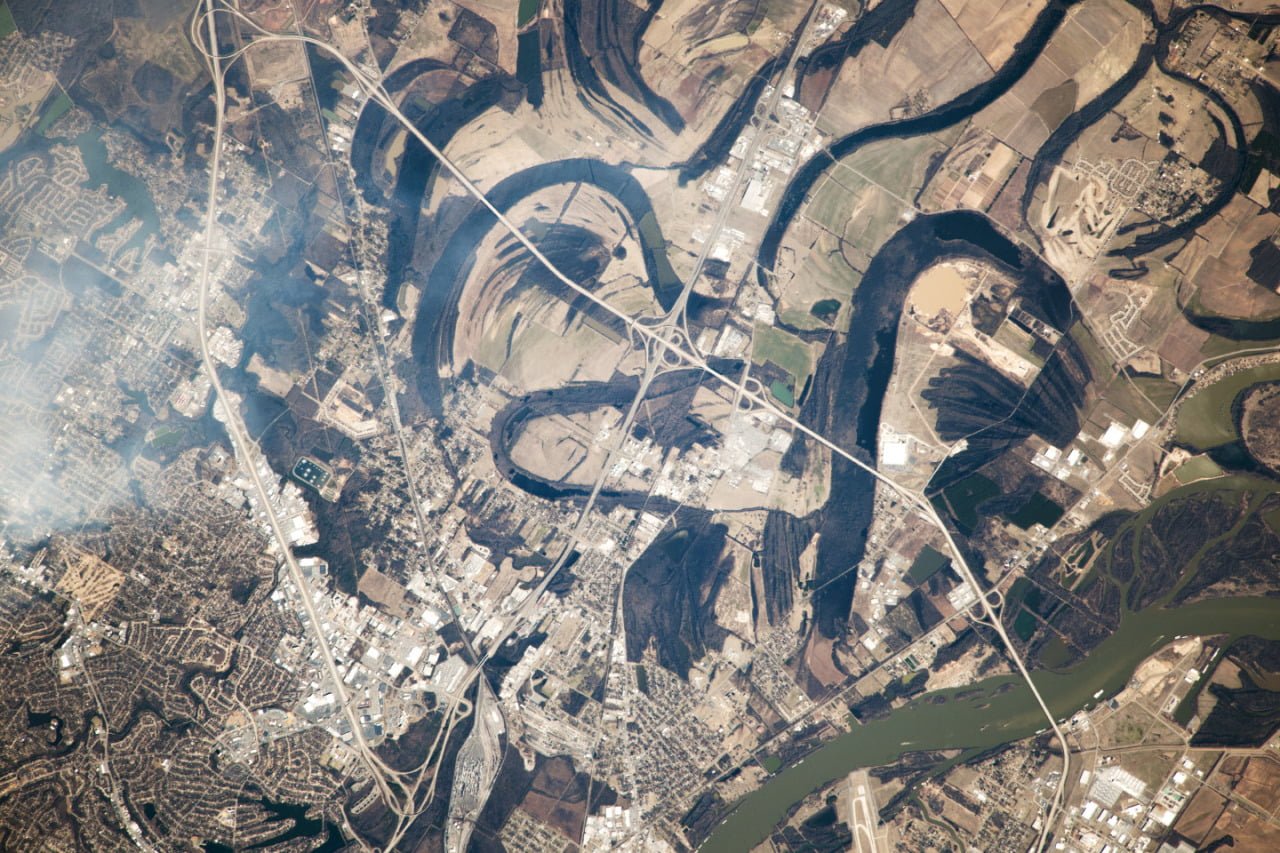
When unconstrained by the local topography, rivers tend to meander, as shown in this astronaut photograph of the Arkansas River near Little Rock, AR. The current course of the river is visible in green in the lower right hand corner of the image, but numerous lakes and curved banks show some of the former paths the river took. When rivers develop a bend, flow is faster on the inner bank than around the outer bank. This speed difference causes a vortical secondary flow inside the river that removes sediment from the outer bank and deposits it on the inner side. The end result is that the bend in the river gets sharper and the river meanders further. Sometimes the bends get so sharp they pinch off, leaving behind lakes. (Photo credit: Exp. 38/NASA Earth Observatory)
Category: Phenomena

May the Fourth Be With You
It only seems appropriate to share this little bit of schlieren photography today. May the Fourth be with you all. (Video credit: M. Hargather and J. Miller)
Vibrating on a Subwoofer
[original media no longer available]
Vibrating a liquid droplet produces some awesome behavior. The video above shows a water droplet vibrating on a subwoofer at real-time speeds. The behavior and shape of the droplet shifts with the frequency of vibration, which we hear as a change in pitch. To see more clearly the shapes a particular frequency induces, check out this high-speed video of vibrating water droplets. For a given driving frequency, the droplet’s shape, or mode, is distinct and consistent. For a droplet vibrating to a song, though, there is more than one frequency driving its motion. In this case, the droplet’s shape is a superposition of the individual modes, which is just a way of saying adding the shapes together. So frequency determines the droplet’s shape. The vibration amplitude, or audible volume, affects how energetic the drop’s motion is. And the fluid’s surface tension and viscosity act as dampers to the system, controlling how quickly the drop can change shape as well as how well it holds together. (Video credit: A. Read)
Cavitation in a Bottle
This high-speed video shows the cavitation that occurs when a bottle of water is struck. The impact accelerates the bottle downward, generating localized vacuums between the glass and the liquid. These are cavitation bubbles, which expand until the pressure of the water surrounding them is too great. This outside pressure triggers an implosion of the bubble, which collapses until the pressure within the bubble makes it expand again. These rapid oscillations in pressure can often shatter the glass bottle. Cavitation can also generate extremely high temperatures and even trigger luminescence. It’s used by both pistol shrimp and mantis shrimp to hunt their prey. (Video credit: P. Taylor)

Island Vortex Street
Von Karman vortex streets are a pattern of alternating vortices shed in the wake of a bluff body. They’re commonly associated with cylinders and can be demonstrated in simulation and in the lab. (They even show up in supersonic flows.) But they also show up in nature quite frequently, like in this cloud pattern off Central America. Such wakes often occur downstream of rocky, volcanic islands that rise above the smooth ocean surface and disrupt the atmosphere’s boundary layer. The same phenomenon is responsible for the “singing” of electrical lines on a windy day, and I’ve even heard it make the spokes on my bicycle wheel sing in a crosswind. (Photo credit: R. Mastracchio; via @BadAstronomer; submitted by jshoer)
Bursting a Bubble
Though seemingly instantaneous to the naked eye, the bursting of a soap bubble is fascinating when slowed down. Here it is at about 2200 frames per second. Initially, the bubble is approximately spherical – its shape determined by a balance between surface tension, gravity, and pressure. The prick of a pinpoint disrupts the balance, and surface tension pulls the thin film away from the defect. The liquid sheet of the bubble retracts swiftly into a filament of fluid and a cloud of tiny droplets. (Video credit: soapbubble.dk)
Instability
[original media no longer available]
Many systems can exhibit unstable behaviors when perturbed. The classic example is a ball sitting on top of a hill; if you move the ball at all, it will fall down the hill due to gravity. There is no way to perturb the ball in such a way that it will return to the top of the hill; this makes the top of the hill an unstable point. In many dynamical systems, a very small perturbation may not be as obviously unstable as the ball atop the hill, especially at first. Often a perturbation will have a very small effect initially, but it can grow exponentially with time. That is the case in this video. Here a tank of fluid is being vibrated vertically with a constant amplitude. At first, the sloshing effect on the fluid interface is very small. But the vibration frequency sits in the unstable region of the parameter space, and the perturbation, which began as a small sloshing, grows very quickly. In a real system (as opposed to a mathematical one), this kind of unstable or unbounded growth very quickly leads to destruction. (Video credit: S. Srinivas)
Balloons in the Car
Destin from Smarter Every Day has just made a video on one of my favorite fluids brain teasers: what happens to a helium balloon when you accelerate in a car? Take a moment to think about the answer before watching or reading further…
Okay, so what happens? Contrary to what you may expect, hitting the accelerator with a balloon in the car will make it shift forward. This is a matter of buoyancy. As Destin demonstrates with the water bottle, when two fluids are accelerated forward, the denser one will shift backwards, which pushes the lighter one forward. Because the helium is lighter than the air filling the car, accelerating pushes the air backward (just as it does the pendulum and the car’s inhabitants) and that shifting of the air pushes the helium in the balloon forward. (Video credit: Smarter Every Day)
Rubens’ Table
Veritasium’s new video has an awesome demonstration featuring acoustics, standing waves, and combustion. It’s a two-dimensional take on the classic Rubens’ tube concept in which flammable gas is introduced into a chamber with a series of holes drilled across the top. Igniting the gas produces an array of flames, which is not especially interesting in itself, until a sound is added. When a note is played in the tube, the gas inside vibrates and, with the right geometry and frequency, can resonate, forming standing waves. The motion of the gas and the shape of the acoustic waves is visible in the flames. Extended into two-dimensions, this creates some very cool effects. (Video credit: Veritasium; via Ryan A.; submitted by jshoer)

Rebounding
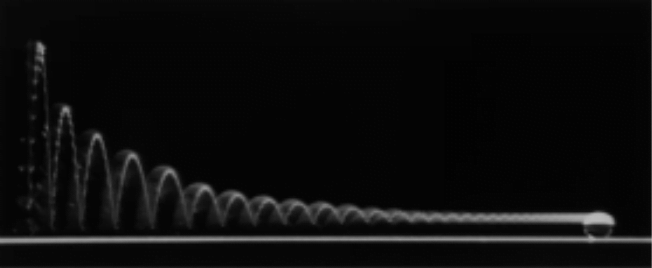
A water droplet can rebound completely without spreading from a superhydrophobic surface. The photo above is a long exposure image showing the trajectory of such a droplet as it bounces. In the initial bounces, the droplet leaves the surface fully, following a parabolic path with each rebound. The droplet’s kinetic energy is sapped with each rebound by surface deformation and vibration, making each bounce smaller than the last. Viscosity damps the drop’s vibrations, and the droplet eventually comes to rest after twenty or so rebounds. (Image credit: D. Richard and D. Quere)