The steam hammer phenomenon–and the closely related water hammer one–is a violent behavior that occurs in two-phase flows. Nick Moore has a fantastic step-by-step explanation of the physics, accompanied by high-speed footage, in the video above. Pressure and temperature are driving forces in the effect, beginning with the high-temperature steam that first draws the water up into the bottle. As the steam condenses into the cooler water, the steam’s pressure drops, drawing in more water. Eventually it drops low enough that the incoming water drops below the vapor pressure. This triggers some very sudden thermodynamic changes. The drop in pressure vaporizes incoming water, but the subsequent cloud cools rapidly, which causes it to condense but also drops the pressure further. Water pours in violently, cavitating near the mouth of the bottle because the acceleration there drops the local pressure below the vapor pressure again. The end result is a flow that’s part-water, part-vapor and full of rapid changes in pressure and phase. As you might imagine, the forces generated can destroy whatever container the fluids are in. Be sure to check out Nick’s bonus high-speed footage to appreciate every stage of the phenomenon. (Video credit and submission: N. Moore)
Category: Phenomena

The Magnus Effect in Football
Like many sports, the gameplay in football can be strongly affected by the ball’s spin. Corner kicks and free kicks can curve in non-intuitive ways, making the job of the goalie much harder. These seemingly impossible changes in trajectory are due to airflow around the spinning ball and what’s known as the Magnus effect. In the animation above, flow is moving from right to left around a football. As the ball starts spinning, the symmetry of the flow around the ball is broken. On top, the ball is spinning toward the incoming flow, and the green dye pulls away from the surface. This is flow separation and creates a high-pressure, low-velocity area along the top of the ball. In contrast, the bottom edge of the ball pulls dye along with it, keeping flow attached to the ball for longer and creating low pressure. Just as a wing has lift due to the pressure difference on either side of the wing, the pressure imbalance on the football creates a force acting from high-to-low pressure. In this case, that is a downward force relative to the ball’s rightward motion. In a freely moving football, this force would curve its trajectory to the side. (GIF credit: SkunkBear/NPR; original video: NASA Ames; via skunkbear)
Turbojet Engines
[original media no longer available]
GE has a great new video with a straightforward explanation of the turbojet and the turbofan engines. The simplest description of the engines–suck, squeeze, bang, blow–sounds like a euphemism but it’s fairly accurate. The engines draw in air, compress it by making it flow through a series of small rotating blades, add fuel and combust the mixture, pull out energy through a turbine, and then blow the high-speed exhaust out the back to generate thrust. The thrust is key because it’s the force that overcomes drag on the plane and also generates the speed needed to create lift. There are two ways to significantly increase thrust: a) increase the mass flow rate of air through the engine, and/or b) increase the exhaust velocity. The turbojet engine draws in smaller amounts of air but generates very high exhaust velocities. The turbofan is today’s preferred commercial aircraft engine because it can generate thrust more efficiently at the desired aircraft velocity. The turbofan essentially has a turbojet engine in its center and is surrounded by a large air-bypass. Most of the air passing through the engine flows through the bypass and the fan. This increases its velocity only slightly, but it means that the engine accelerates much larger amounts of air without requiring much larger amounts of fuel. As an added bonus, the lower exhaust velocities of the turbofan engine make it much quieter in operation. (Video credit: General Electric)

Jupiter Timelapse
This timelapse video shows Jupiter as seen by Voyager 1. In it, each second corresponds to approximately 1 Jupiter day, or 10 Earth hours. Be sure to fullscreen it so that you can appreciate the details. The timelapse highlights the differences in velocity (and even flow direction!) between Jupiter’s cloud bands. It is these velocity differences that create the shear forces which cause Kelvin-Helmholtz instabilities–the series of overturning eddies–seen between the bands. Earth also has bands of winds moving in opposite directions, but there are fewer of them and the composition of our atmosphere is such that they do not make for such a dramatic naked eye view of large-scale fluid dynamics. (Video credit: NASA/JPL/B. Jónsson/I. Regan)

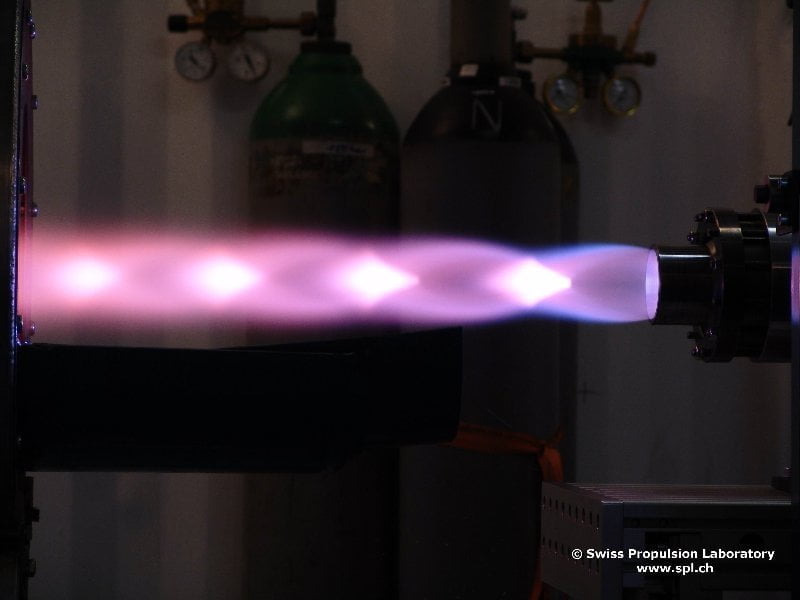
Mach Diamonds
Rocket engines often feature a distinctive pattern of diamonds in their exhaust. These shock diamonds, also known as Mach diamonds, are formed as result of a pressure imbalance between the exhaust and the surrounding air. Because the exhaust gases are moving at supersonic speeds, changing their pressure requires a shock wave (to increase pressure) or an expansion fan (to decrease the pressure). The diamonds are a series of both shock waves and expansion fans that gradually change the exhaust’s pressure until it matches that of the surrounding air. This effect is not always visible to the naked eye, though. We see the glowing diamonds as a result of ignition of excess fuel in the exhaust. As neat as they are to see, visible shock diamonds are actually an indication of inefficiencies in the rocket: first because the exhaust is over- or under-pressurized, and, second, because combustion inside the engine is incomplete. (Photo credit: Swiss Propulsion Laboratory)

The Atmospheric River
Atmospheric rivers are long, narrow corridors of concentrated water vapor transport in the atmosphere. They often occur when winds from storms over the ocean draw moisture together and project it ahead of a cold front. The phenomenon was only recognized in the 1990s, but subsequent research has shown that atmospheric river conditions account for many instances of heavy rainfall and flooding in areas along the West Coast of the United States. Forecasters can now recognize the phenomenon in forecast models, allowing them to predict potential flood-inducing rainfall days in advance. To learn more, check out NOAA’s atmospheric river Q&A. (Image credit: NOAA)
Granular Jets
Object impacts in water and other fluids often create cavities that generate jets when they collapse. But impacts on granular materials can produce similar results, forming a cavity, a splash corona, and, under the right circumstances, a jet. This Sixty Symbols video explores the effect of grain size (and thus weight) on the formation of such a rebound jet. Ultimately, the jet behavior is driven by air. When the granular material is poured, air gets trapped between the grains. The impact compresses the grains, forcing the previously trapped air up and out through the cavity created by the impact. Interestingly, once the air pressure is low enough, jet creation is suppressed, not unlike splash suppression in liquids. (Video credit: Sixty Symbols/Univ. of Nottingham)
Kelvin-Helmholtz in the Lab
The Kelvin-Helmholtz instability looks like a series of overturning ocean waves and occurs between layers of fluids undergoing shear. This video has a great lab demo of the phenomenon, including the set-up prior to execution. When the tank is tilted, the denser dyed salt water flows left while the fresh water flows to the right. These opposing flow directions shear the interface between the two fluids, which, once a certain velocity is surpassed, generates an instability in the interface. Initially, this disturbance is much too small to be seen, but it grows at an exponential rate. This is why nothing appears to happen for many seconds after the tilt before the interface suddenly deforms, overturns, and mixes. In actuality, the unstable perturbation is present almost immediately after the tilt, but it takes time for the tiny disturbance to grow. The Kelvin-Helmholtz instability is often seen in clouds, both on Earth and on other planets, and it is also responsible for the shape of ocean waves. (Video credit: M. Hallworth and G. Worster)
Colliding in Microgravity
On Earth, it’s easy for the effects of surface tension and capillary action to get masked by gravity’s effects. This makes microgravity experiments, like those performed with drop towers or onboard the ISS, excellent proving grounds for exploring fluid dynamics unhindered by gravity. The video above looks at how colliding jets of liquid water behave in microgravity. At low flow rates, opposed jets form droplets that bounce off one another. Increasing the flow rate first causes the droplets to coalesce and then makes the jets themselves coalesce. Similar effects are seen in obliquely positioned jets. Perhaps the most interesting clip, though, is at the end. It shows two jets separated by a very small angle. Under Earth gravity, the jets bounce off one another before breaking up. (The jets are likely separated by a thin film of air that gets entrained along the water surface.) In microgravity, though, the jets display much greater waviness and break down much quicker. This seems to indicate a significant gravitational effect to the Plateau-Rayleigh instability that governs the jet’s breakup into droplets. (Video credit: F. Sunol and R. Gonzalez-Cinca)
The March of Drops
I love science with a sense of humor. This video features a series of clips showing the behavior of droplets on what appears to be a superhydrophobic surface. In particular, there are some excellent examples of drops bouncing on an incline and droplets rebounding after impact. For droplets with enough momentum, impact flattens them like a pancake, with the rim sometimes forming a halo of droplets. If the momentum is high enough, these droplets can escape as satellite drops, but other times the rebound of the drop off the superhydrophobic surface is forceful enough to overcome the instability and draw the entire drop back off the surface. (Video credit: C. Antonini et al.)