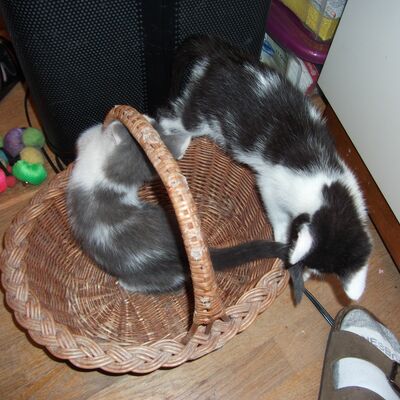
As bizarre as the branching fractal fingers of the Saffman-Taylor instability look, they’re quite a common phenomenon. In his video, Steve Mould demonstrates how to make them by sandwiching a viscous liquid like school glue between two acrylic sheets and then pulling them apart. The more formal lab-version of this is the Hele-Shaw cell, which he also demonstrates. But you may have come across the effect when pealing up a screen protector or in dealing with a cracked phone screen. In all of these cases, a less viscous fluid — specifically air — is forcing its way into a more viscous fluid, something that it cannot manage without the fluid interface fracturing. (Video and image credit: S. Mould)
Category: Phenomena

Interstellar Jets
This JWST image shows a couple of Herbig-Hero objects, seen in infrared. These bright objects form when jets of fast-moving energetic particles are expelled from the poles of a newborn star. Those particles hit pockets of gas and dust, forming glowing, hot shock waves like those seen here in red. The star that birthed the object is out of view to the lower-right. The bright blue light surrounded by red spirals that sits near the tip of the shock waves is actually a distant spiral galaxy that happens to be aligned with our viewpoint. (Image credit: NASA/ESA/CSA/STScI/JWST; via APOD)

Kirigami in the Flow
Kirigami is a paper art that combines folding and cutting to create elaborate shapes. Here, researchers use cuts in thin sheets of plastic and explore how the sheets transform in a flow. Depending on the configuration of cuts, the sheets can stretch dramatically in the flow, creating complex, dynamic, and beautiful wakes. I feel like there must be some applications out there that would benefit from kirigami-induced mixing. (Video and image credit: A. Carleton and Y. Modarres-Sadeghi)

Dams Fill Reservoirs With Sediment
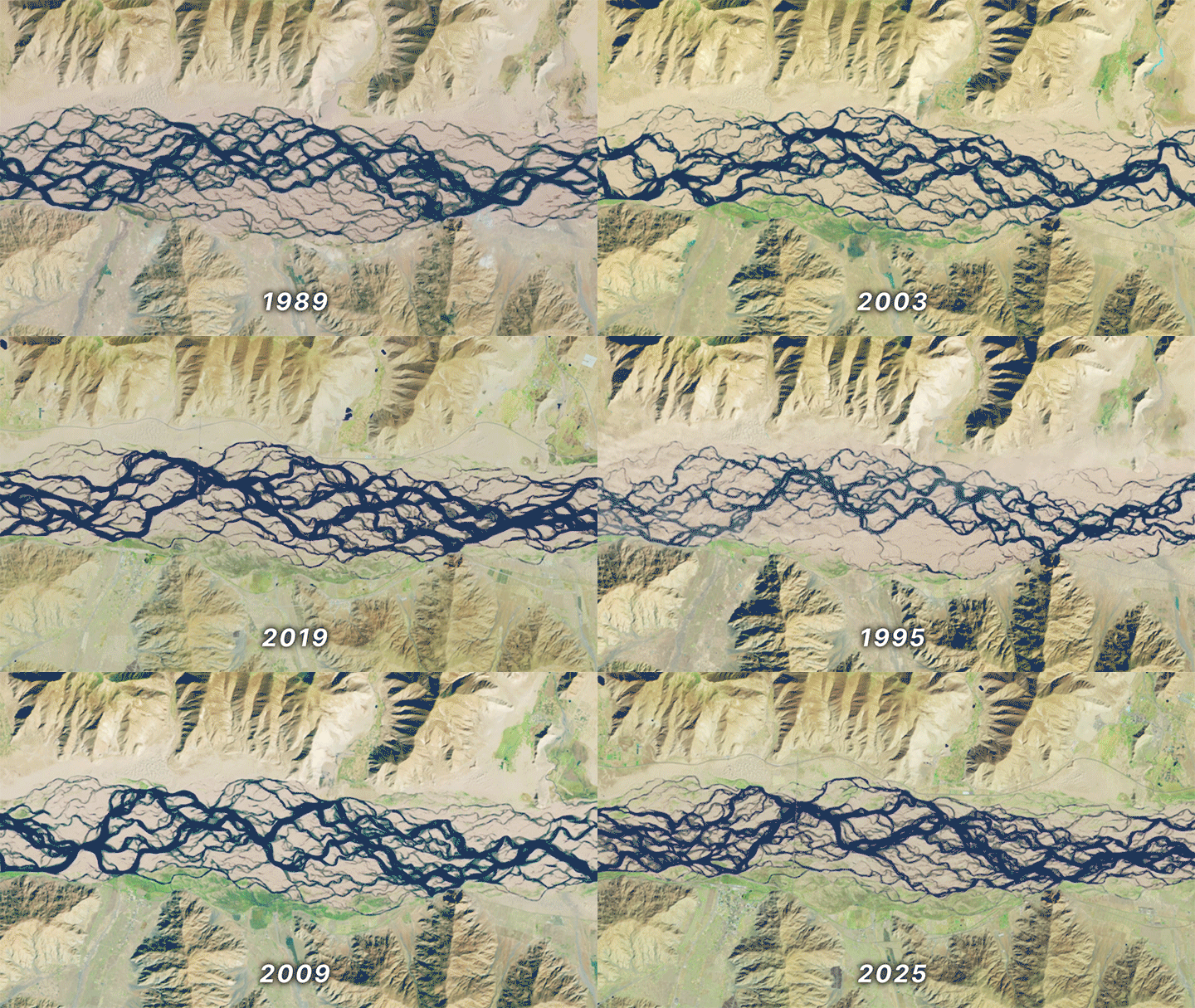
Dams are critical pieces of infrastructure, but, as Grady shows in this Practical Engineering video, they are destined to be temporary. The reason is that they naturally fill with sediment over time. Rivers carry a combination of water and sediment; the latter is critical to healthy shorelines and stable ecology. But while sediment gets carried along by a fast-flowing river, slower flow rates allow sediment to fall out of suspension, as demonstrated in Grady’s tabletop flume. As his river transitions to a deeper, slower-flowing reservoir, sand falls out of the flow, building up colorful strata. The sand and water even create dynamic feedback loops, as seen with the dunes that form in his timelapse and march toward the dam.
Any long-term plan for a dam has to deal with this inevitable build-up of sediment, and, unfortunately, it’s not a simple or cheap problem to address, as discussed in the video. (Video and image credit: Practical Engineering)

On the Mechanics of Wet Sand
Sand is a critical component of many built environments. As most of us learn (via sand castle), adding just the right amount of water allows sand to be quite strong. But with too little water — or too much — sand is prone to collapse. For those of us outside the construction industry, we’re most likely to run into this problem on the beach while digging holes in the sand. In this Practical Engineering video, Grady explains the forces that stabilize and destabilize piled sand and where the dangers of excavation lie. (Video and image credit: Practical Engineering)

Escape From Yavin 4
In an ongoing tradition, let’s take another look at some Star Wars-inspired aerodynamics. This year it’s the TIE fighter’s turn. Here, researchers simulate the spacecraft trying to escape Yavin 4’s atmosphere at Mach 1.15. The research poster’s blue contours show pressure contours, with darker colors connoting higher pressures. The bright low pressure region immediately behind the craft suggests a difficult, high-drag ascent and a turbulent, subsonic wake despite the craft’s supersonic velocity. (Image credit: A. Martinez-Sanchez et al.)

Quietening Drones
A drone’s noisiness is one of its major downfalls. Standard drones are obnoxiously loud and disruptive for both humans and animals, one reason that they’re not allowed in many places. This flow visualization, courtesy of the Slow Mo Guys, helps show why. The image above shows a standard off-the-shelf drone rotor. As each blade passes through the smoke, it sheds a wingtip vortex. (Note that these vortices are constantly coming off the blade, but we only see them where they intersect with the smoke.) As the blades go by, a constant stream of regularly-spaced vortices marches downstream of the rotor. This regular spacing creates the dominant acoustic frequency that we hear from the drone.

Animation of wingtip vortices coming off a drone rotor with blades of different lengths. This causes interactions between the vortices, which helps disrupt the drone’s noise. To counter that, the company Wing uses a rotor with blades of different lengths (bottom image). This staggers the location of the shed vortices and causes some later vortices to spin up with their downstream neighbor. These interactions break up that regular spacing that generates the drone’s dominant acoustic frequency. Overall, that makes the drone sound quieter, likely without a large impact to the amount of lift it creates. (Image credit: The Slow Mo Guys)

Climate Change and the Equatorial Cold Tongue
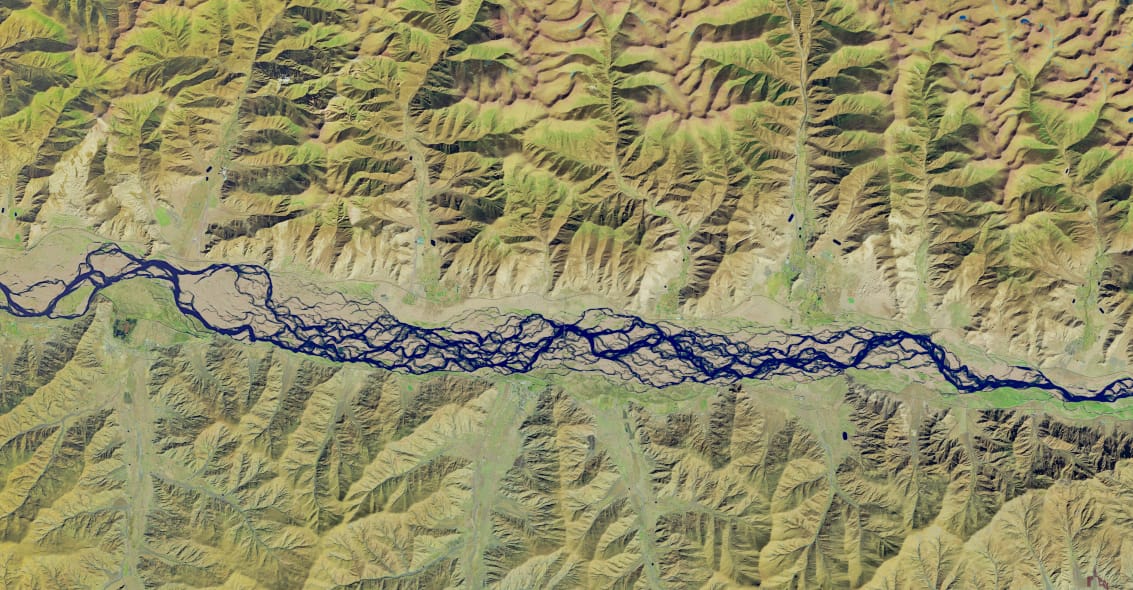
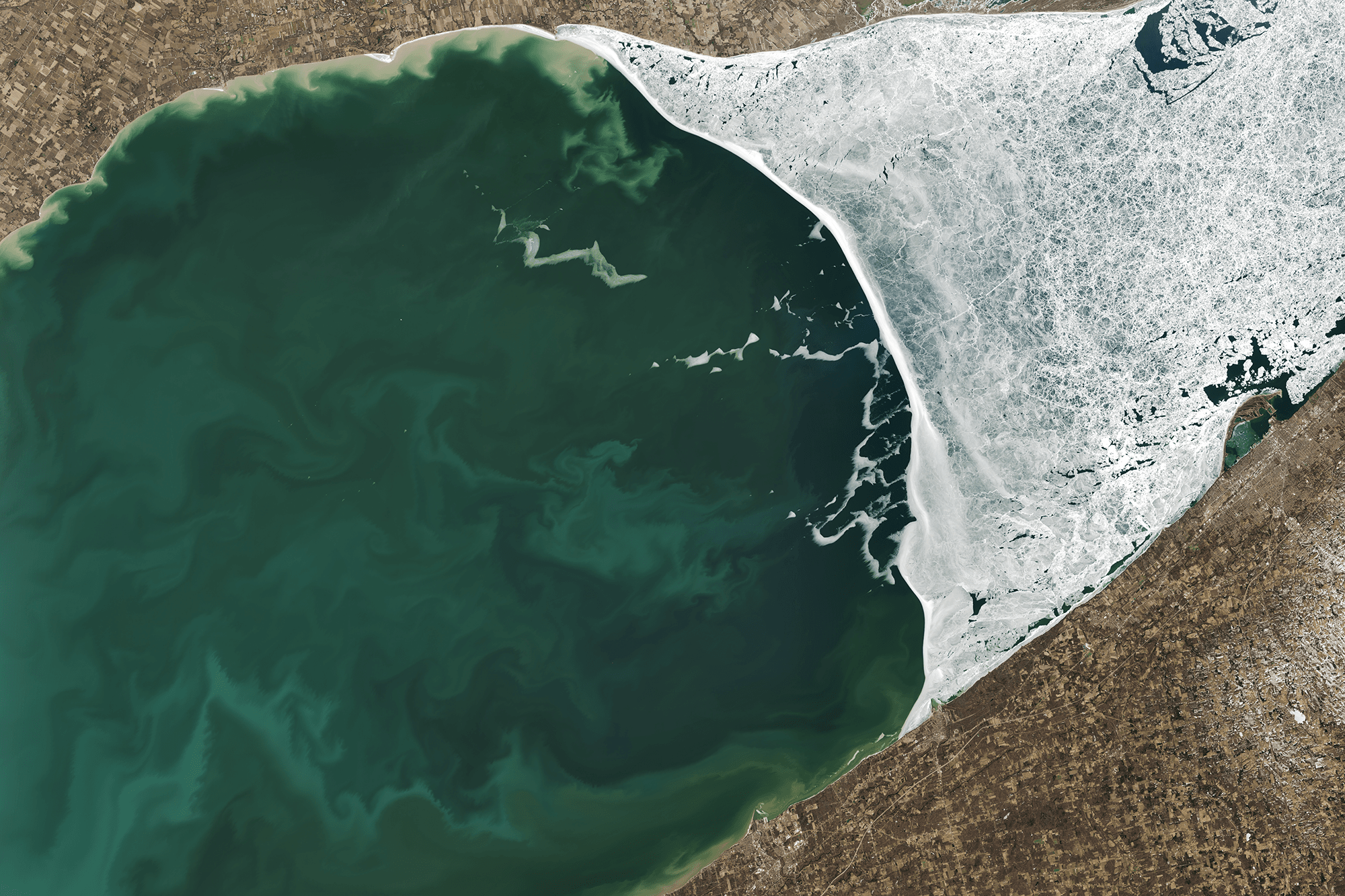
A cold region of Pacific waters stretches westward along the equator from the coast of Ecuador. Known as the equatorial cold tongue, this region exists because trade winds push surface waters away from the equator and allow colder, deeper waters to surface. Previous climate models have predicted warming for this region, but instead we’ve observed cooling — or at least a resistance to warming. Now researchers using decades of data and new simulations report that the observed cooling trend is, in fact, a result of human-caused climate changes. Like the cold tongue itself, this new cooling comes from wind patterns that change ocean mixing.
As pleasant as a cooling streak sounds, this trend has unfortunate consequences elsewhere. Scientists have found that this cooling has a direct effect on drought in East Africa and southwestern North America. (Image credit: J. Shoer; via APS News)

Drops on the Edge
Drops impacting a dry hydrophilic surface flatten into a film. Drops that impact a wet film throw up a crown-shaped splash. But what happens when a drop hits the edge of a wet surface? That’s the situation explored in this video, where blue-dyed drops interact with a red-dyed film. From every angle, the impact is complex — sending up partial crown splashes, generating capillary waves that shift the contact line, and chaotically mixing the drop and film’s liquids. (Video and image credit: A. Sauret et al.)

Playful Martian Dust Devils
The Martian atmosphere lacks the density to support tornado storm systems, but vortices are nevertheless a frequent occurrence. As sun-warmed gases rise, neighboring air rushes in, bringing with it any twisted shred of vorticity it carries. Just as an ice skater pulling her arms in spins faster, the gases spin up, forming a dust devil.

In this recent footage from the Perseverance Rover, four dust devils move across the landscape. In the foreground, a tiny one meets up with a big 64-meter dust devil, getting swallowed up in the process. It’s hard to see the details of their crossing, but you can see other vortices meeting and reconnecting here. (Video and image credit: NASA/JPL-Caltech/LANL/CNES/CNRS/INTA-CSIC/Space Science Institute/ISAE-Supaero/University of Arizona; via Gizmodo)