Photographer Mike Olbinski has captured a spectacular timelapse of a supercell thunderstorm over the plains of Texas. Supercells are characterized by a strong, rotating updraft known as a mesocyclone, seen clearly in the video. These storms are commonly isolated occurrences, forming when horizontal vorticity in the form of wind shear is redirected upwards by an updraft. Such a strong updraft is typically created by a capping inversion, a situation where a layer of warmer air traps the colder air beneath it. (This is why one sees a distinctive cut-off at the top of some clouds.) As warm air rises from the surface, either the air above the cap will cool or the air below the cap will warm. Either situation results in an instability with cooler air on top of warmer air, providing a catalyst for the kind of dramatic weather seen here. (Video credit: M. Olbinski; via io9)
Category: Art

Dye Droplet
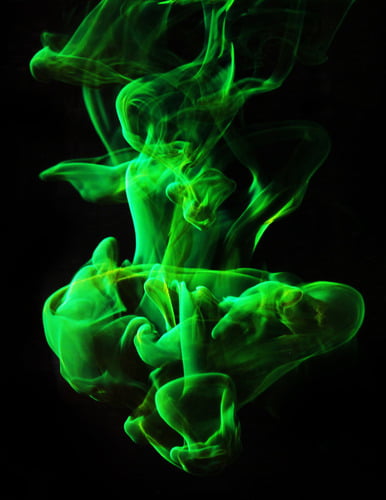
A drop of fluorescent dye falling into quiescent water forms fantastical structures that are a mixture of vorticity, turbulence, and molecular diffusion. The horseshoe-like shape near the front of the drop is a typical shape for two fluids strained by moving past one another. The main section of the drop billows outward like a parachute, but the turbulence of its wake stretches the dye into fine threads that quickly disperse in the water. (Photo credit: D. Quinn et al.)

“Levitating Water”
Al Seckel, a cognitive neuroscientist and expert on illusions, created this “Levitating Water” installation, in which multiple streams of water appear as a series of levitating droplets thanks to a strobing light. The well-timed strobe lighting tricks the brain into seeing many different falling droplets as the same, nearly stationary droplet. The effect is similar to the one created by vibrating a stream of falling water. (Video credit: wunhanglo)
Bubble Lenses
In this video, artist Jesse Zanzinger experiments with the lens-like refractive properties of bubbles. Though focused on the bending of light, there’s plenty here in terms of coalescence, surface tension, and miscibility. He has a similar video that includes a shot of his set-up here. (Video credit: J. Zanzinger)
Magnetic Putty
For a little Friday fun, enjoy this timelapse of magnetic putty consuming magnets. Really this is a bit of slow-motion magnetohydrodynamics. The magnet’s field exerts a force on the iron-containing putty, which, because it is a fluid, cannot resist deformation under a force. As a result, the putty will flow around the magnet, eventually coming to a stop once it reaches equilibrium, with its iron equally distributed around the magnet. Assuming the putty is homogeneously ferrous (i.e. the iron is mixed equally in the putty), that means the putty will stop moving when the magnet is at its center of mass. (Video credit: J. Shanks; submitted by Neil K.)

Liquid Sculptures


Water droplet art celebrates the infinite forms created from the impact of drops with a pool and rebounding jets. It’s a still life captured from split second interactions between inertia, momentum, and surface tension. These examples from photographer Markus Reugels are among some of the most complex shapes I’ve seen captured. Be sure to check out his website for more beautiful examples of liquids frozen in time. (Photo credits: Markus Reugels; via Photigy)
Skittering Droplets
Water splattered onto a a hot skillet will skitter and skip across the surface on a thin layer of vapor due to the Leidenfrost effect. The partial vaporization of the droplet provides a low-friction cushion for the droplet to glide on and acts as an insulating layer that delays the vaporization of the rest of the droplet. Modernist Cuisine shows us how serene this common and sometimes explosive effect looks at 3,000 frames per second. (On the topic of cooking, you can use the Leidenfrost effect to see if your skillet is hot enough when making pancakes. If a few droplets of water skitter across the pan before sizzling away, then your pan is ready for batter!) (Video credit: Modernist Cuisine; submitted by Eban B.)

Colorful Spirals
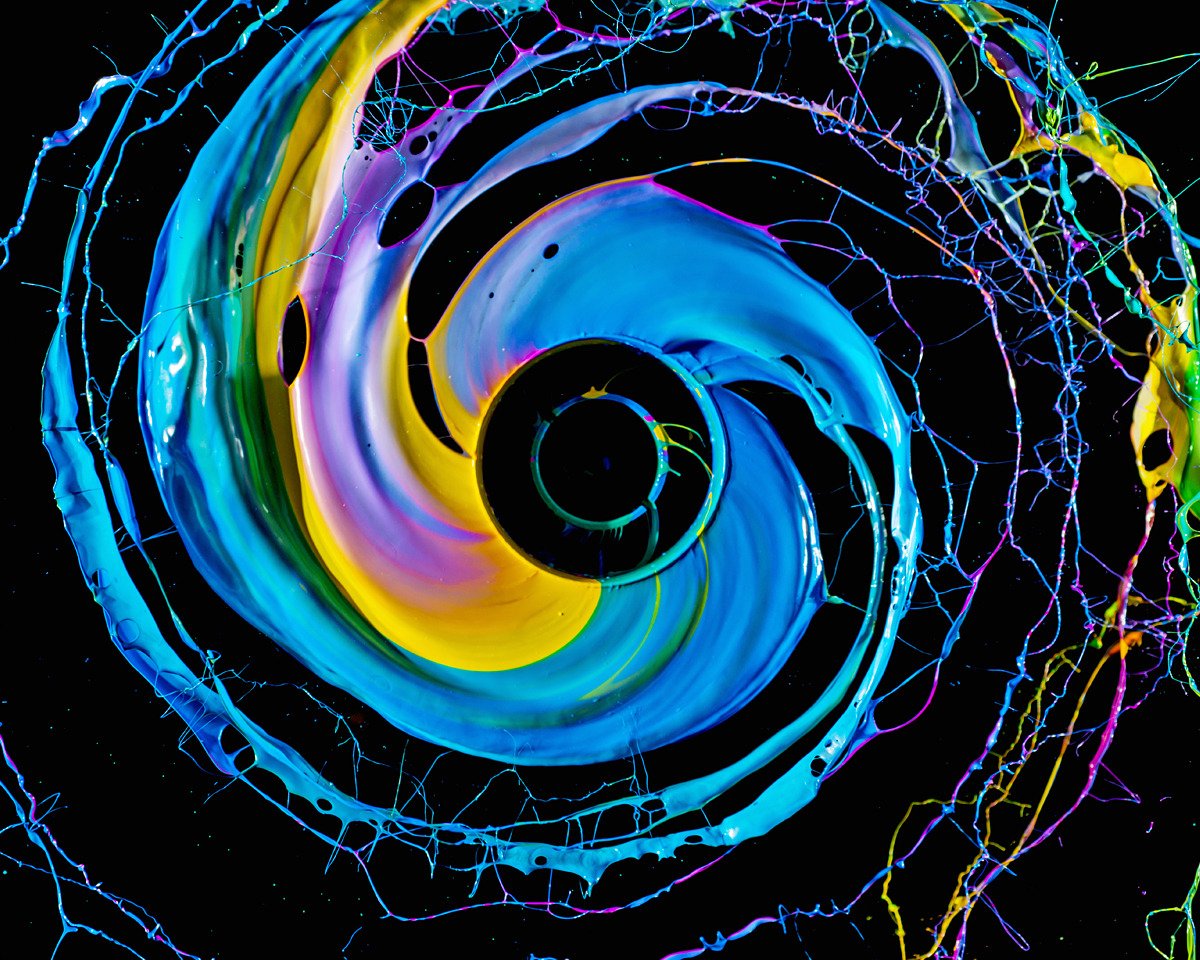
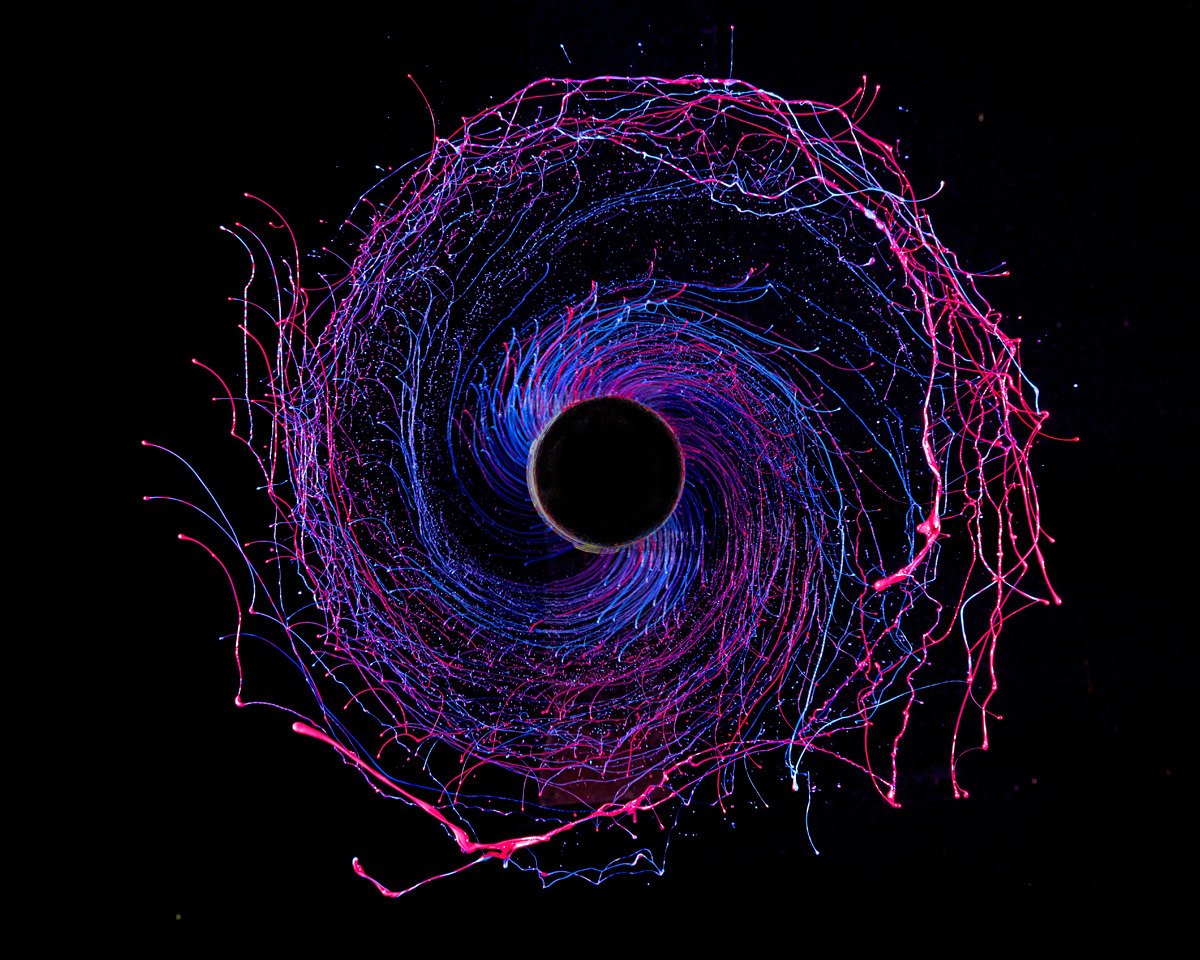
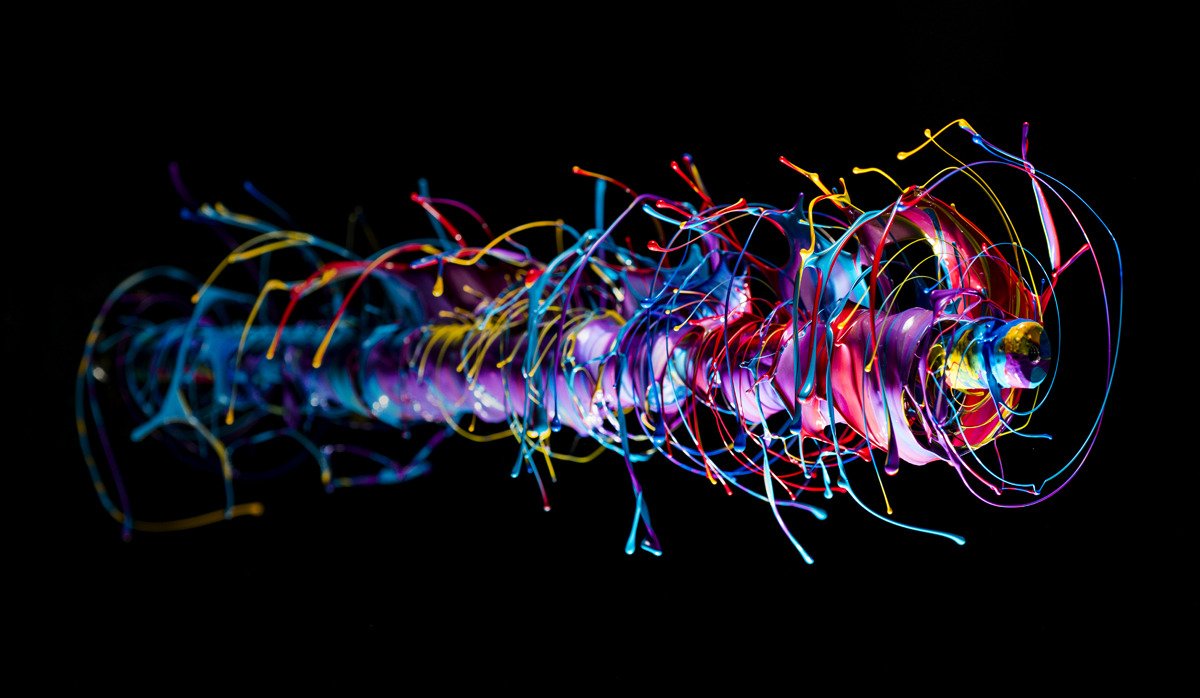
Artist Fabian Oefner captures these colorful portraits of fluid instability by dripping acrylic paints onto a metal rod, which is connected to a drill. When the drill is switched on, paint is flung away from the rod, creating these snapshots of centripetal force and surface tension. Note how droplets gather at the ends of the spiral arms like in a Plateau-Rayleigh or a rimming instability. For more, check out Oefner’s webpage, which includes a video showing how the images are made, or his previously featured work, “Millefiori”. (Photo credit: F. Oefner; submitted by Stephen D.)

Under the Waves
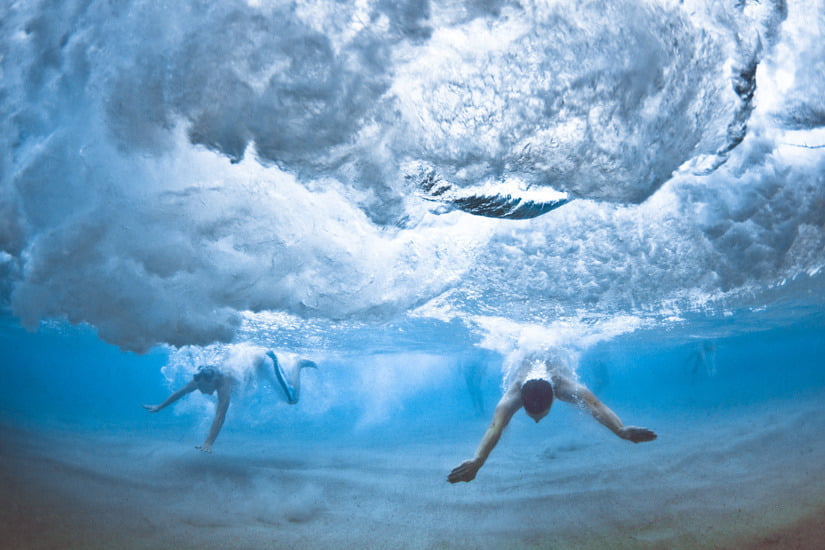


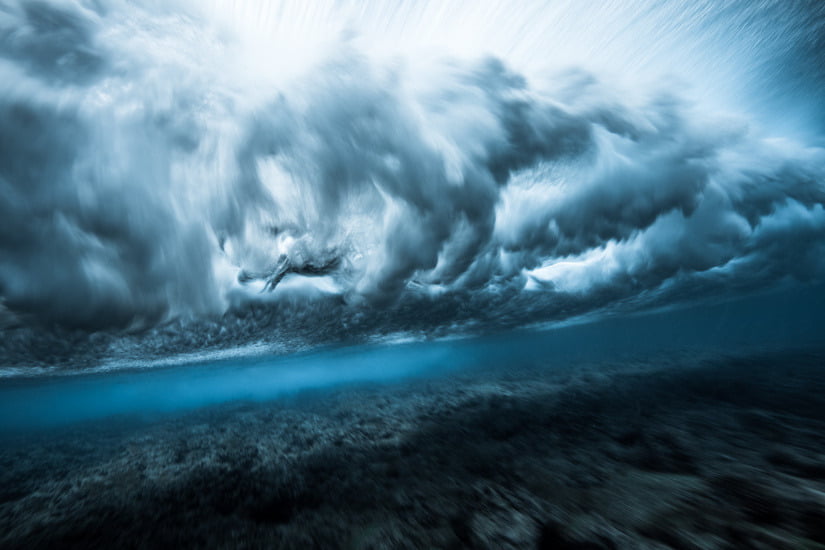
When I was a kid, I liked to dive underwater in the pool and sit at the bottom, looking up at the peculiar dancing sky the water made overhead. Photographer Mark Tipple takes it further, capturing images of the ocean from below the surface as waves roll in. His photos show swimmers and surfers diving to escape a roiling wave that, from below, bears a surreal similarity to the underside of a thundercloud in a summer storm. This is part of the beauty of fluid dynamics. Despite their differences, water and air obey the same physics. (Photo credits: Mark Tipple; via io9)
“Frozen” Water Stream
We saw previously how vibrating a falling stream of water and filming it with a matching camera frame rate appears to “freeze” the falling liquid. This video shows the same illusion, now with a 24 Hz sine wave, which the falling water mimics. Vibrating the speaker that drives the water stream slightly slower or slightly faster than the camera frame rate makes the water appear to slowly fall or rise relative to its “frozen” wave state. This is a beat effect caused by the slight difference in frequency between the water and the camera. (Video credit: brusspup; via BoingBoing; submitted by many readers)