Tag: space

  • Shock Waves in the Solar Wind

    Shock Waves in the Solar Wind

    The empty space of our solar system is not truly empty, as we’ve discussed previously. For one, there’s a fast-moving flux of charged particles – the solar wind – that flows constantly from the Sun. Sometimes these solar wind particles encounter their interstellar equivalents – charged ions from outside our solar system – and exchange energy.

    One predicted mechanism for this energy swap is a solar wind shock wave, which occurs when a faster-moving clump of charged particles plows into a slower-moving one. Scientists hypothesized in the mid 1990s that far from the Sun, solar wind shock waves would lose their energy by passing it to these interstellar ions, in a process known as pickup. Data from the New Horizons spacecraft has finally provided evidence for this theory.

    In October 2015, instruments on the spacecraft recorded a shock wave when the speed of solar wind ions nearby jumped from 380 km/s to 440 km/s. Comparing the energies of solar and interstellar ions before and after the event, researchers found that interstellar pickup ions became 30% more energetic while solar ions lost 85% of their energy. It’s an important confirmation of theoretical predictions and should help us better understand high-energy particle physics at the edges of our solar system. (Image credit: NASA; research credit: E. Zirnstein et al., via J. Ouellette)

  • Featured Video Play Icon

    Ionic Sound

    So, as we learned previously, sound can actually travel through space. But the recordings our spacecraft send us from other planets or from the edge of the Solar System aren’t really that kind of sound. Acoustic waves require a medium; they travel when particles bump into one another, which, given the sparseness of space, means that only very low frequency sounds can travel. But space has a lot of ions and plasmas – charged particles like electrons and protons – and those particles can interact without physically contacting one another. Instead their motion causes a changing magnetic field that affects nearby particles, which in turn affect more particles (and so on). This transmits what’s called ionic sound. Check out the video above to hear some awesome examples of the ionic sounds of our solar system! (Video credit: The Point Studios)

  • Featured Video Play Icon

    Hearing in Space

    Everyone knows that, in space, no one can hear you scream. Sound is a wave that requires a medium to travel through, and if space is empty, there’s no medium to carry that sound. Except, as Mike from The Point Studios explains, empty is a relative term. Space is full of dust and gas and plasma, just not as full of that matter as we’re used to. Thus, the question of whether sound can travel through space turns into a matter of scale. If the scale–the wavelength–of a sound is much larger than the distance between molecules, then the sound can propagate. So there CAN be sound in space – it just has to have a very long wavelength and, thus, a very low frequency. Check out the video for the full story! (Video credit: The Point Studios)

  • Fire in Microgravity

    Fire in Microgravity

    In the movie “Gravity” Sandra Bullock’s character battles a fire aboard the International Space Station. Combustion is a huge concern in space habitats. Microgravity fires are challenging to detect and fight because they behave very differently in the absence of buoyancy. On Earth, buoyancy makes hot air rise from a flame while cooler air is pulled in near the base. This feeds fresh oxygen to the teardrop-shaped flame. In space, there is no buoyancy and flames are spherical. They also burn at lower temperatures and lower oxygen concentrations–so low, in fact, that the oxygen depletion necessary to extinguish a fire is lower than what humans require to survive.

    No buoyancy makes it harder for fires to spread, but it also makes them harder to detect since smoke doesn’t rise toward a detector on the ceiling. Instead, fire detectors aboard the Space Station are housed in the ventilation system that moves air through the modules constantly. In the event of a fire, astronauts use a three-step fire suppression system. First, they shut off the ventilation system to delay the fire’s spread. Then they shut off power to the affected unit, and, finally, they use fire extinguishers on the flames. The Russian module is equipped with a foam extinguisher and the others use CO2 units. (Image credit: Warner Brothers)

  • Ferrofluid Thrusters

    Ferrofluid Thrusters

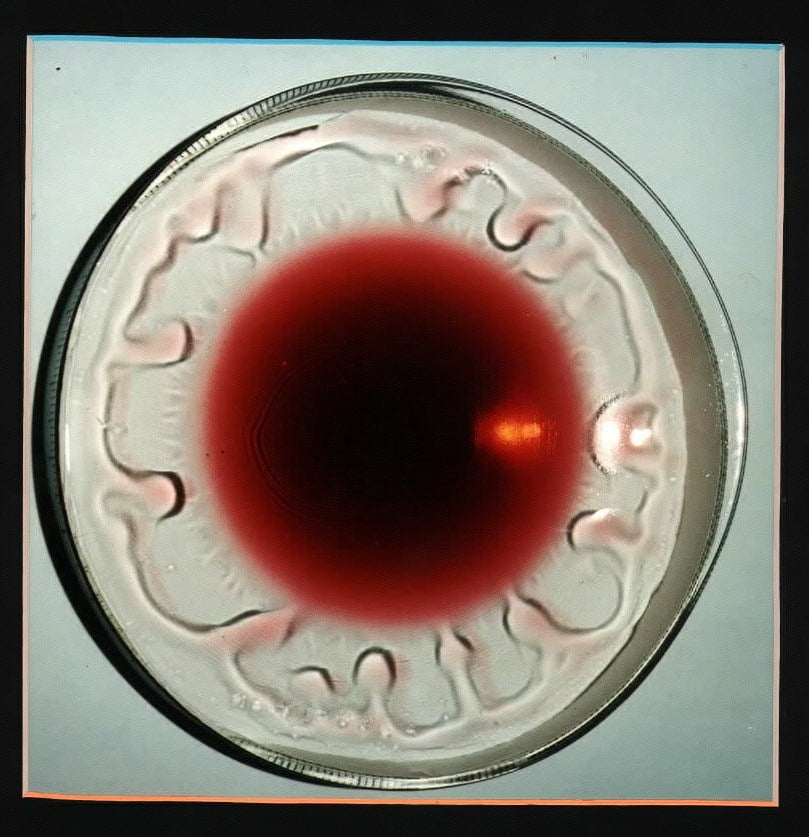
    Ferrofluids–magnetically-sensitive fluids made up of a carrier liquid and ferrous nanoparticles–may soon have a new application as a miniature thruster on nanosatellites. Microspray thrusters use tiny hollow needles to electrically spray jets of liquid that propel a satellite. But manufacturing the fragile microscopic needles used to disperse the propellant is expensive. Instead researchers are now using ferrofluids to create both the needle-like structures and to serve as the propellant. A ring of ferrofluid is placed on the thruster surface and a magnetic field applied to create the ferrofluid’s distinctive spikes. Then, when an electric force is applied, tiny jets of ferrofluid spray out from each tip, creating thrust. Unlike the conventional needles, the ferrofluid spikes are robust and can reform after being disturbed. (Photo credit: L. B. King et al.; submitted by jshoer)

  • Featured Video Play Icon

    Viscoelastic Fluids in Space

    In honor of astronaut Don Pettit’s launch to the International Space Station (and in the hope that he’ll do more neat microgravity fluids demonstrations while in space!), here’s a look a the behavior of viscoelastic fluids in microgravity. The elasticity of these fluids means that, when strained, the fluid deforms instantaneously and then returns to its initial shape when the strain is removed. Pettit demonstrates both Plateau-Rayleigh instability behavior, where a column of fluid breaks apart due to surface tension variations, and die swell, where a fluid jet expands beyond the diameter of nozzle from which it was extruded. Such swelling is commonly caused by the stretching and relaxation of polymers in the fluid as they react to forces caused by the nozzle opening.

  • Featured Video Play Icon

    Mixing in Space

    Living here on earth, we are so accustomed to gravity’s effects on fluid behaviors that it’s not always obvious how microgravity will affect them. Here astronaut Richard Garriott demonstrates mixing and separating immiscible liquids in space.

  • Featured Video Play Icon

    Microgravity Water Spheres

    Here astronaut Don Pettit demonstrates the effects of rotation on a sphere of water in microgravity. Bubbles, being less dense than water, congregate in the middle of the sphere along its axis of rotation. Tea leaves, which are denser than the water, are thrown to the outside; this is the same concept used in a centrifuge for separating samples.

  • Featured Video Play Icon

    Astronomical Jets

    Researchers have pieced together Hubble images of jets from newborn stars into timelapse movies that reveal the interstellar fluid mechanics responsible for the formation of stars like our sun. These jets stream out clumps of matter that has fallen on the new star. When faster moving eddies impact slower ones, bow shocks can form, much like shockwaves running before an airplane. See more HD video of these jets and bow shocks here#

  • Microgravity Marangoni

    Microgravity Marangoni

    Astronauts are preparing an experiment on the Marangoni effect, in which a variation in surface tension can cause mass flow, for flight aboard the International Space Station. The effect, also responsible for causing tears of wine, will benefit from study in microgravity because competing effects like gravity-induced sedimentation and buoyant convection will be negligible. Astronaut Ron Garan reports more on the upcoming experiment on the Fragile Oasis blog.