Year: 2026

  • Fluids Can Fracture

    Fluids Can Fracture

    Fracture is a sudden, brittle breaking-apart that we generally associate with solid materials that get stressed too far. Some viscoelastic, non-Newtonian fluids have been known to fracture, but that was generally thought to be unusual. But a recent study turns that idea on its head, revealing that even simple, albeit highly viscous, liquids can fracture.

    A viscous hydrocarbon fluid gets stretched at 100 mm/s.
    A viscous hydrocarbon fluid gets stretched at 100 mm/s, drawing it into a thinning shape.

    When you stretch a liquid, the general expectation is what you see above: the liquid gets drawn into an ever thinner shape. But researchers found that–when stretched quickly–that same simple hydrocarbon liquid cracked open:

    A viscous hydrocarbon fluid gets stretched at 300 mm/s, causing it to fracture like a solid.
    A viscous hydrocarbon fluid gets stretched at 300 mm/s, causing it to fracture like a solid.

    There’s even an audible snap, which you can hear in the video below. The results were so surprising that they repeated the experiment several times and with different viscous (but Newtonian) liquids. The results held. When the liquids were pulled to a critical stress, they audibly snapped and fractured like a solid.
    The next question, of course, is why this happens. The authors suspect (but have yet to show) that cavitation may be at play in the initiation of the crack that separates the liquid in two. (Image, video, and research credit: T. Lima et al.; via Gizmodo)

    Fediverse Reactions
  • Meandering Along the Alabama River

    Meandering Along the Alabama River

    Over time, rivers naturally curve and meander. As water accelerates around a river bend’s curve, it creates a secondary flow that carves sediment away from the outer bank and deposits it on the inner one. That, in turn, makes the river bend sharper until it eventually cuts part of the river off into an oxbow lake. In this astronaut photo, we see the Alabama River flowing right-to-left. The river’s natural meander is constrained by the dam on the center left, which widens the river upstream. The higher water level upstream creates the feather-like floodplains lining the river. (Image credit: NASA; via NASA Earth Observatory)

  • Aflutter in the Breeze

    Aflutter in the Breeze

    Fabrics flutter in seemingly impossible ways in artist Thomas Jackson‘s images. But despite first appearances, each photograph is true to life; the fabrics are suspended on taut lines. Their dance is driven by wind energy, drag, tension, and flow–not manipulated pixels. I love the (turbulent) energy of them! (Image credit: T. Jackson; via Colossal)

    Fediverse Reactions
  • Recreating Atmospheres

    Recreating Atmospheres

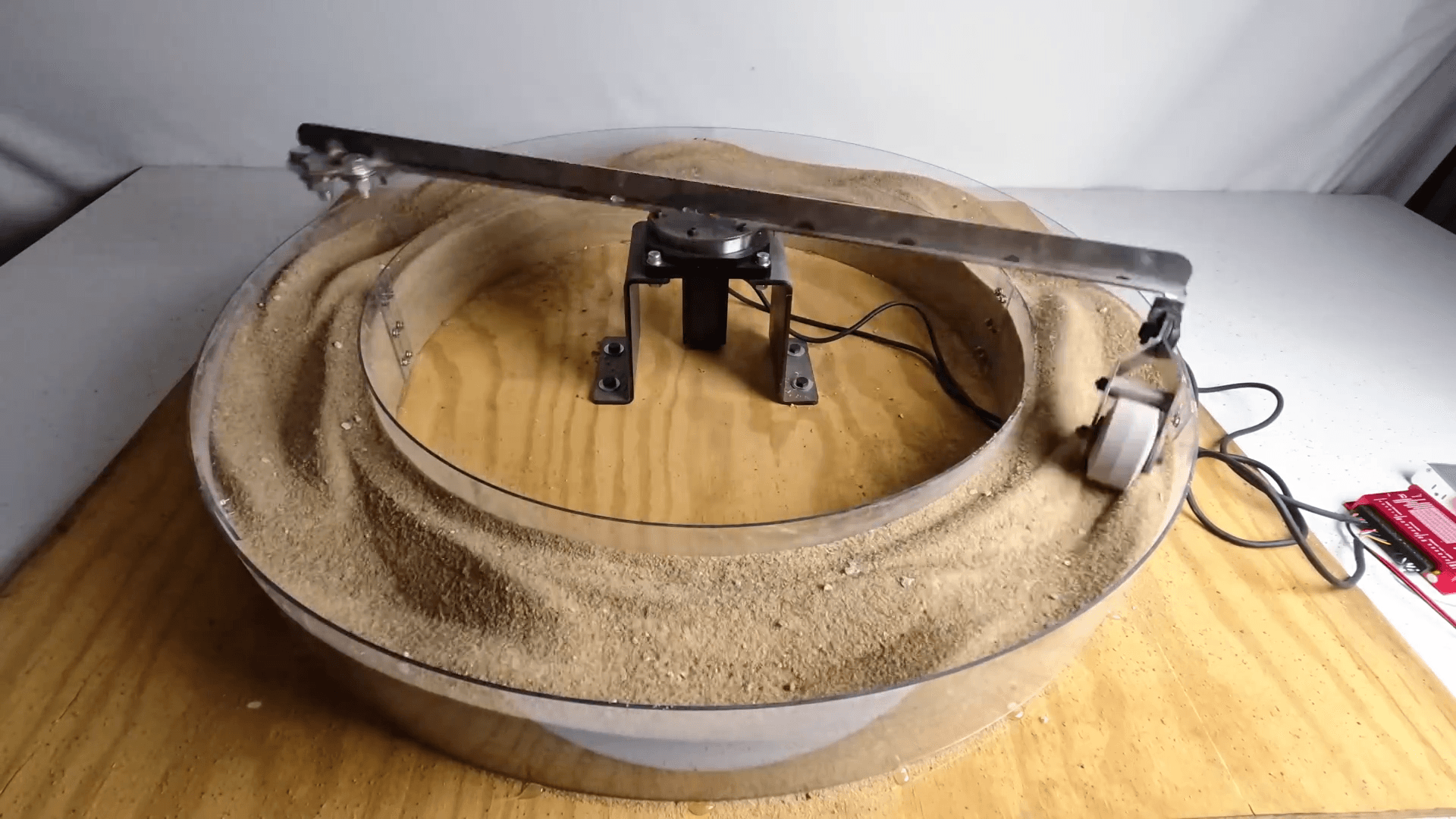
    In planetary atmospheres, energy and vorticity can cascade from large scales to smaller ones, but the mechanics of this transfer remain somewhat elusive. In a recent experiment, researchers built a lab-scale representation of an atmosphere using a meter-scale rotating annular tank. The outer bottom edge of the tank gets heated–representing the sun’s warming at the equator–while a pipe in the center of the tank gets cooled near the tank surface, which mimics the chilling effect of the poles. Researchers filled the tank with a water-glycerol mixture and recorded how their artificial atmosphere responded at different rotation rates.

    Two different rotating atmospheres, colored by vorticity (red clockwise, blue counterclockwise). The left version has a slower rate of rotation, and thus larger length scales.
    Two different rotating atmospheres, colored by vorticity (red clockwise, blue counterclockwise). The left version has a slower rate of rotation, and thus larger length scales.

    The results show an energy spectrum that’s consistent with atmospheric observations–with a steep drop at large length scales and a flatter one at smaller scales. But interestingly, they also found that the cascade was temperature-dependent in ways that current models don’t predict. Untangling that effect could help us understand not only our atmosphere but those of other planets. (Image credit: tank – H. Scolan, animation – S. Ding et al.; research credit: S. Ding et al.; via APS)

    Fediverse Reactions
  • Featured Video Play Icon

    Bouncing on a Wave

    On a vibrating fluid, droplets can bounce and interact in complex ways. Here, researchers demonstrate some of the peculiar dynamics of these wave-guided droplets, showing how they can do things like pair up in waltzes. To keep the droplets from coalescing with one another, they perform their experiments in a pressurized chamber; the higher air pressure makes it harder for the air film between droplets to drain during a collision, making the droplets unable to coalesce. Under these conditions, the authors show that the droplet-wave system has quantum-like statistics. (Video and image credit: J. Clampett et al.)

    Fediverse Reactions
  • “Sidewall Symphony”

    “Sidewall Symphony”

    Flow visualization is both an art and science in fluid dynamics. Here, researchers were interested in studying the separation bubble that forms over a backward-facing ramp–a shape that shows up, for example, on an aircraft. In these areas, the flow over the surface separates, leaving an unsteady, recirculating bubble.

    That’s the flow that researchers are visualizing here. They’ve done so by adding tiny helium-filled soap bubbles to the flow. With bright lights illuminating the bubbles, each one leaves a streak in a photograph, showing where the bubble moved during the time the camera’s shutter was open. Although images like these are beautiful, they can also be analyzed by computers to extract the underlying flow that created the image. (Image and research credit: B. Steinfurth et al.; see also here)

    A research poster showing streaks left by hydrogen bubbles in the flow over a backward-facing ramp.
    Fediverse Reactions
  • A Colorful Glimpse

    A Colorful Glimpse

    Peeking between the clouds, satellites caught a glimpse of a massive phytoplankton bloom off the coast of Greenland in May 2024. The tiny organisms may be visible only under a microscope, but gatherings like these stretch hundreds of kilometers and are visible from space. Like tracer particles in a flow, the phytoplankton outline the swirls and eddies of the underlying ocean. (Image credit: L. Dauphin; via NASA Earth Observatory)

    A satellite image reveals the blue and green swirls of a phytoplankton bloom.
    A satellite image reveals the blue and green swirls of a phytoplankton bloom.
  • Featured Video Play Icon

    “Frozen Waves”

    Photographer Jan Erik Waider is a master of capturing incredible landscape imagery. In these videos, he uses a drone to film waves in the Baltic Sea gently undulating polygonal slabs of ice on the ocean surface. The interplay of light, color, and motion looks almost surreal, but nature is better than we credit at making imagery too good to look away from. (Video and image credit: J. Waider/NorthLandscapes; via Colossal)

    Fediverse Reactions
  • Viscoelastic Vortex Street

    Viscoelastic Vortex Street

    When flow moves past a cylinder, vortices get shed in its wake. Known as a von Karman vortex street, this distinctive pattern is seen behind flags, islands, and even behind starships. Here, researchers are simulating flow of a viscoelastic fluid, where–unlike water or other Newtonian fluids–elastic stresses can build up.

    As the flow hits the leading edge of the cylinder, the polymers in the fluid compress and then get stretched as the flow moves around the cylinder. The left image shows vorticity in the flow; the right shows elastic stresses. The large swirls are primary vortices–those shed off the cylinder. But look closely and you’ll see smaller secondary vortices curled up beside the primaries. These form when the elastic stresses in the fluid pull some of the shear layer into the wake. (Image and research credit: U. Patel et al.)

    Simulation of a flow around a cylinder in a viscoelastic flow. Left, vorticity; right, elastic stresses.
  • Featured Video Play Icon

    Understanding Fish and Turbines

    Fish detect turbulence in the water around them; among other things, this helps them avoid colliding with objects. Here, researchers are looking to understand how fish interact with underwater turbines. Experiments give them a set of trajectories that actual fish follow when dealing with the experimental turbine. But to understand what the fish is detecting, the researchers build a digital facsimile of the turbine and use Large Eddy Simulation (LES) to calculate the turbine’s wake.

    By overlaying the fish trajectories onto the simulated flow structures, they can better understand what flows the fish is and is not comfortable with. That knowledge helps engineers design turbines with smaller ecological impact. (Video and image credit: H. Seyedzadeh et al.)