Year: 2026

  • Building Triboelectric Charge

    Building Triboelectric Charge

    In volcanic eruptions, collisions between ash particles can sometimes build up enough electric charge for lightning to arc through the plume. Scientists have long debated how this happens–it’s not obvious that insulating materials like oxides would build up electric charges through contact, especially when dealing with substances of the same material. It’s not like rubbing a balloon against your hair, where each material–and its tendency to hold a charge–differs.

    A 500-micron silica sphere acoustically levitated above a silica plate in the experiment.
    A 500-micron silica sphere acoustically levitated above a silica plate in the experiment.

    To test how charges build on identical materials, a team of scientists used acoustic levitation to repeatedly bounce a silica bead against an identically treated silica plate, observing their charge build-up. Then they would take one of the pieces–either the sphere or the plate–and treat it to strip away the film of molecules that naturally adsorb onto the surface over time. Then they bounced the treated and untreated surfaces off one another again.

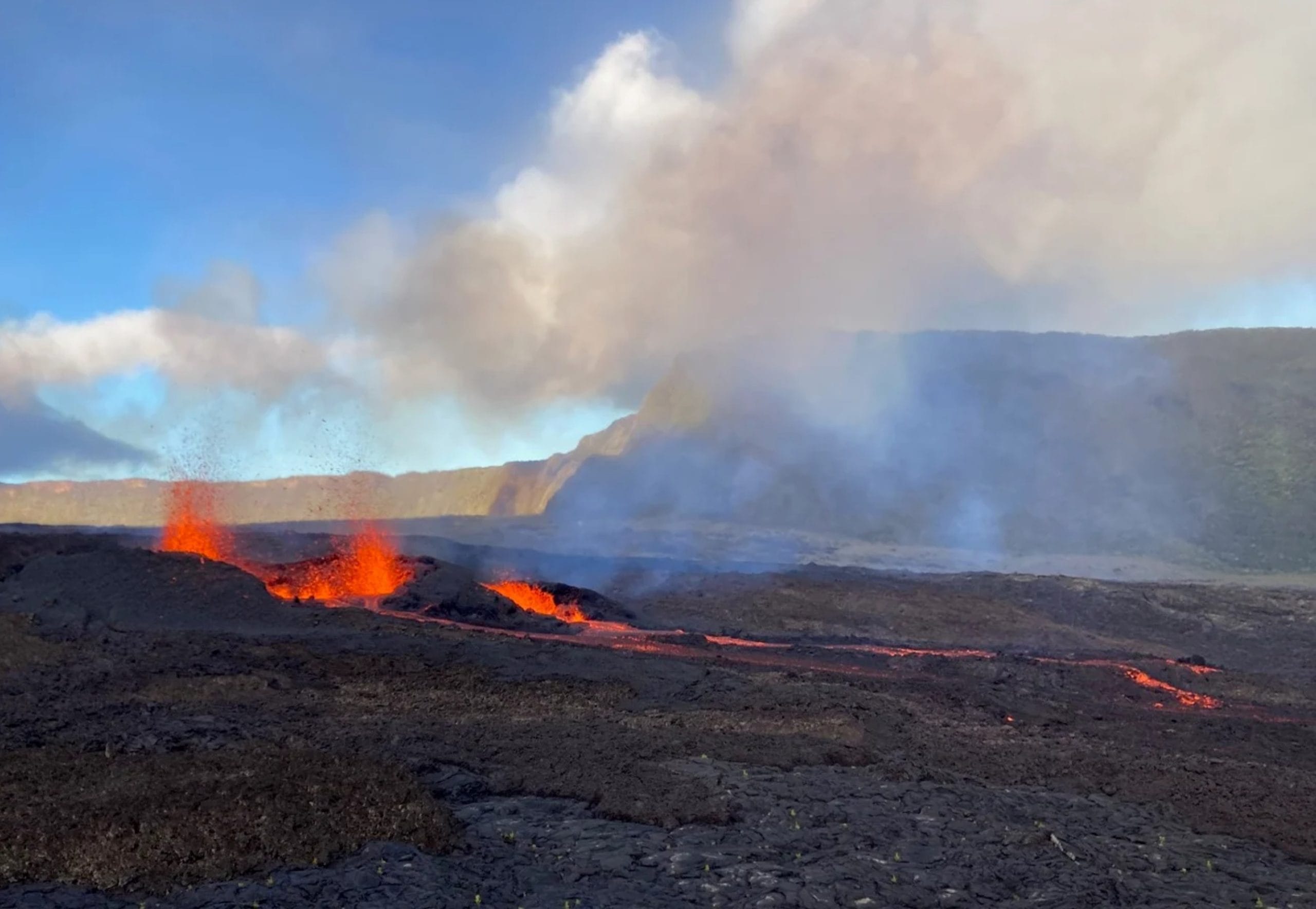
    The result was–pardon the pun–striking. Whichever surface had been treated to remove adsorbates charged more negatively the second time around. Looking more closely at what they were removing, the team found their surfaces were mostly adsorbing carbon molecules. And if they iteratively removed the carbon from both the sphere and plate, they could no longer charge the two through collision. It seems that the key to charging two oxides off one another is actually the difference between the incidental amounts of carbon on their surfaces! (Image credit: volcano – M. Szeglat, experiment – G. Grosjean et al.; research credit: G. Grosjean et al.; via Gizmodo)
    Fediverse Reactions
  • Featured Video Play Icon

    Fire From Below

    A slight change in perspective can do wonders. In this video, the Slow Mo Guys look at a burning flame from below. They accomplish this by mounting a gas grill upside-down. This small change means that buoyancy can’t simply lift heat and exhaust gases away from the flame source. Instead, the flow pushes out and around the edges of the grill.

    The views are, as always, amazing. The billowing flames are mesmerizing–often closer to laminar than turbulent. And the added spectacle of cinnamon combusting in the later segments really does make for the kind of visuals you’d expect in a sci-fi movie. (Video and image credit: The Slow Mo Guys)

    Fediverse Reactions
  • Glacial Blues

    Glacial Blues

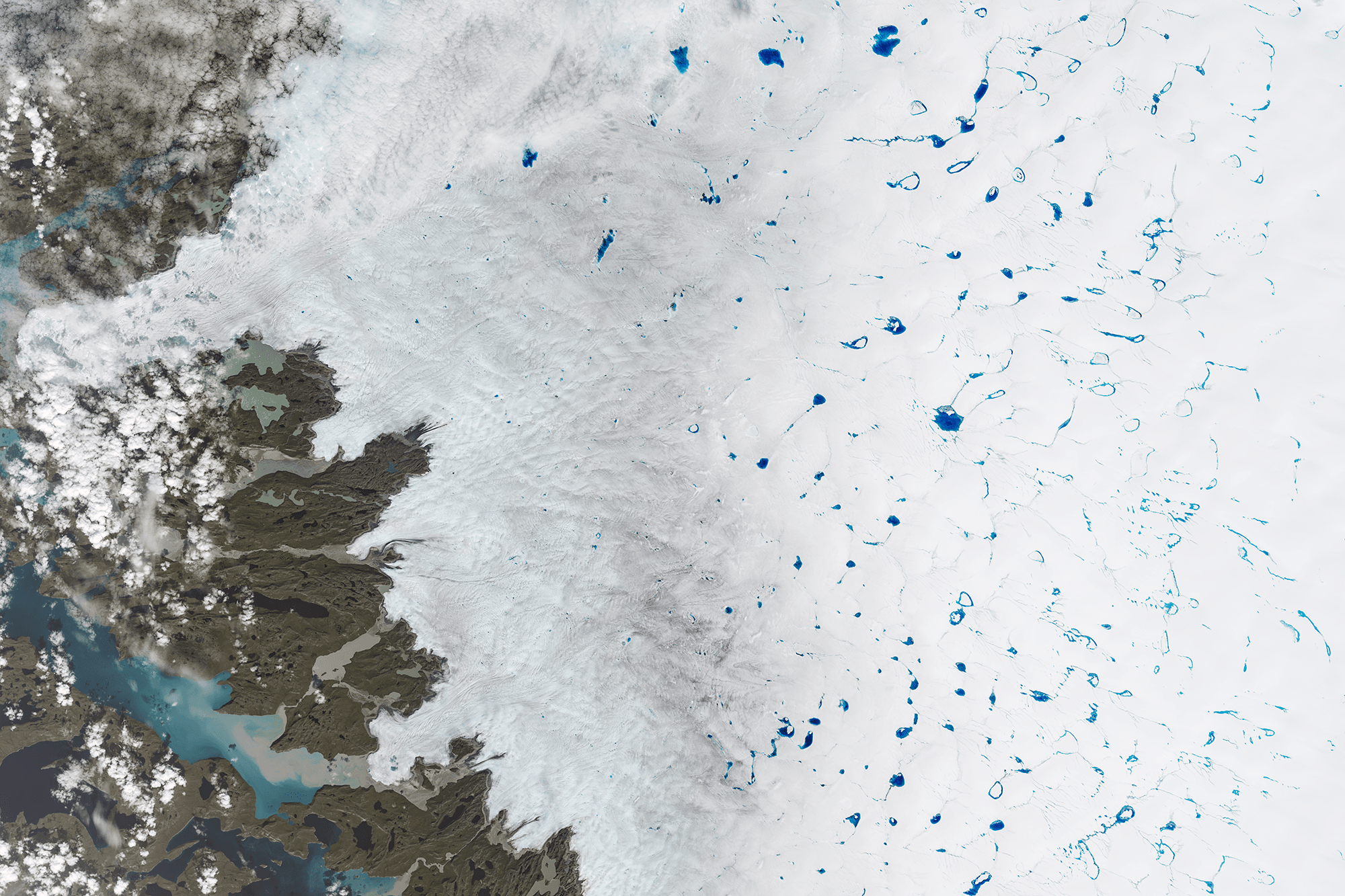
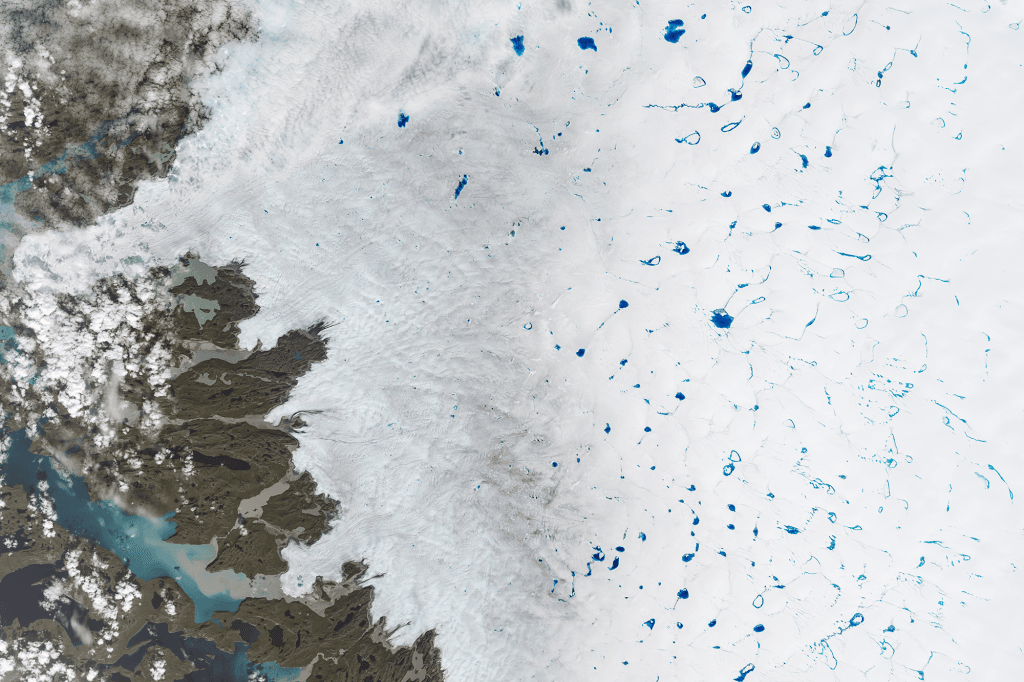
    Meltwater braids like a river delta in this gorgeous image from photographer Stuart Chape. It earned the Silver distinction from the World Nature Photography Awards in their “Planet Earth’s landscapes and environments” category. Water takes tortuous paths like these as it tries to balance the local incline, erosion, deposition, and flow rate. (Image credit: S. Chape/WNPA; via Colossal)

    "Glacial blue" by Stuart Chape, Silver winner in the Landscapes category of the World Nature Photography Awards.
  • Making a Star-Shaped Droplet

    Making a Star-Shaped Droplet

    We usually think of surface tension turning droplets into spheres in order to minimize their area. But spheres aren’t the only shape surface tension can enforce. Here, researchers suspend tiny droplets of oil in a soapy fluid. At the right temperature, these droplets form a crystalline surface while the fluid within remains liquid. As in the fully liquid droplet, surface tension tries to minimize the shell’s surface energy, enabling it to take on many different shapes.

    Video showing the droplet's transition from hexagon to star and back. The shape changes occur as the liquid's temperature changes, thereby affecting its surface tension.
    The droplet’s transition from hexagon to star and back. The shape changes occur as the liquid’s temperature changes, thereby affecting its surface tension.

    In this study, researchers demonstrate that the shell-enclosed droplets can even change, reversibly, from a hexagon to a six-pointed star and back. The transformation is shown above, in an experiment that gradually changes the droplet’s temperature–and, thus, its surface tension.

    Although shape changes similar to these have been described before, this experiment was the first where the shell’s defects–the vertices of the hexagon–don’t shift during the transformation. (Video, image, and research credit: C. Quilliet et al.; via APS)

    Fediverse Reactions
  • Featured Video Play Icon

    Particles Separate When Flowing Downhill

    When particle-laden fluids like a mudslide flow downhill, even well-mixed particles can wind up separating. To explore how this works, researchers put glass spheres–of two different sizes but equal density–into silicone oil and let it flow down an incline. Their initially well-mixed oil soon turned red as the larger red particles overtook the smaller blue particles near the front. Looking at the flow from the side, the team observed a Brazil-nut-effect-like behavior where the larger particles move toward the top of the flow. That’s where the flow speed is fastest, and the particles are congregating there despite being denser than the oil carrying them! (Video and image credit: Y. Ba et al.)

  • Explaining the Swirl of Wildfire Smoke

    Explaining the Swirl of Wildfire Smoke

    In recent years, smoke from powerful wildfires has raised questions among atmospheric scientists by always swirling in the same direction. The confounding structures were observed in the stratosphere, where smoke injected at around 15 kilometers in altitude absorbed sunlight and rose further, up to about 35 kilometers of altitude. The rising column of fluid would stretch, causing any residual rotation to get stronger and form vortices.

    None of this was a surprise. What was surprising is that all of the observed vortices were anticyclones, when theory–at least for a heat-driven vortex from a stationary heating source–called for a cyclone-anticyclone pair.

    Researchers looked at how a self-heating (and, therefore, moving) source would rotate. They concluded that this, too, would create a pair of vortices–one cyclonic and one anticyclonic–but the anticyclone would be stronger than the cyclone that trailed behind it. By further considering the vertical shear the vortex pair would encounter, the researchers found that the trailing cyclone could get stripped away, leaving behind only the anticyclone–matching our wildfire observations. (Image credit: J. Stevens/NASA Earth Observatory; research credit: K. Shah and P. Haynes 1, 2; via APS)

    Fediverse Reactions
  • Crowned Jets

    Crowned Jets

    If you fill a test tube with water and drop it, the impact causes a pressure wave that travels up from the bottom and creates a focused jet (left). If the impact is strong enough, cavitation bubbles form at the bottom and generate a sheet-like jet around the central one, like a crown (center and right). (Image credit: H. Watanabe et al.)

    Research poster with black and white images of jets with a crown-like liquid sheet around them.
  • “Quiet Pulse” and “Another World”

    “Quiet Pulse” and “Another World”

    Light shines dimly through the wall of an ice cave in this photograph by Marie-Line Dentler. Shaped by melting, pressure, freezing, and fracture, these structures are dynamic and ethereal. (Image credit: M. Dentler; via Colossal)

    Detail of an ice cave in Iceland, by Marie-Line Dentler.
    View in an ice cave by Marie-Line Dentler.
    Fediverse Reactions
  • Observing Ice Giant Atmospheres

    Observing Ice Giant Atmospheres

    Uranus is one of our solar system’s oddest inhabitants, stuck spinning on its side with a tilted and offset magnetosphere. To better understand it, a team observed the planet for 17 hours with JWST. The near-infrared measurements gave new insight into the planet’s ionosphere, where auroras form. They found that temperatures peaked between 3,000 and 4,000 kilometers, while ion densities peaked at 1,000 kilometers. They also confirmed previous observations that Uranus’s upper atmosphere is cooling down. (Image and video credit: ESA/Webb/NASA/CSA/STScI/P. Tiranti/H. Melin/M. Zamani; research credit: P. Tiranti et al.; via Gizmodo)
    Fediverse Reactions
  • Featured Video Play Icon

    Bioconvection

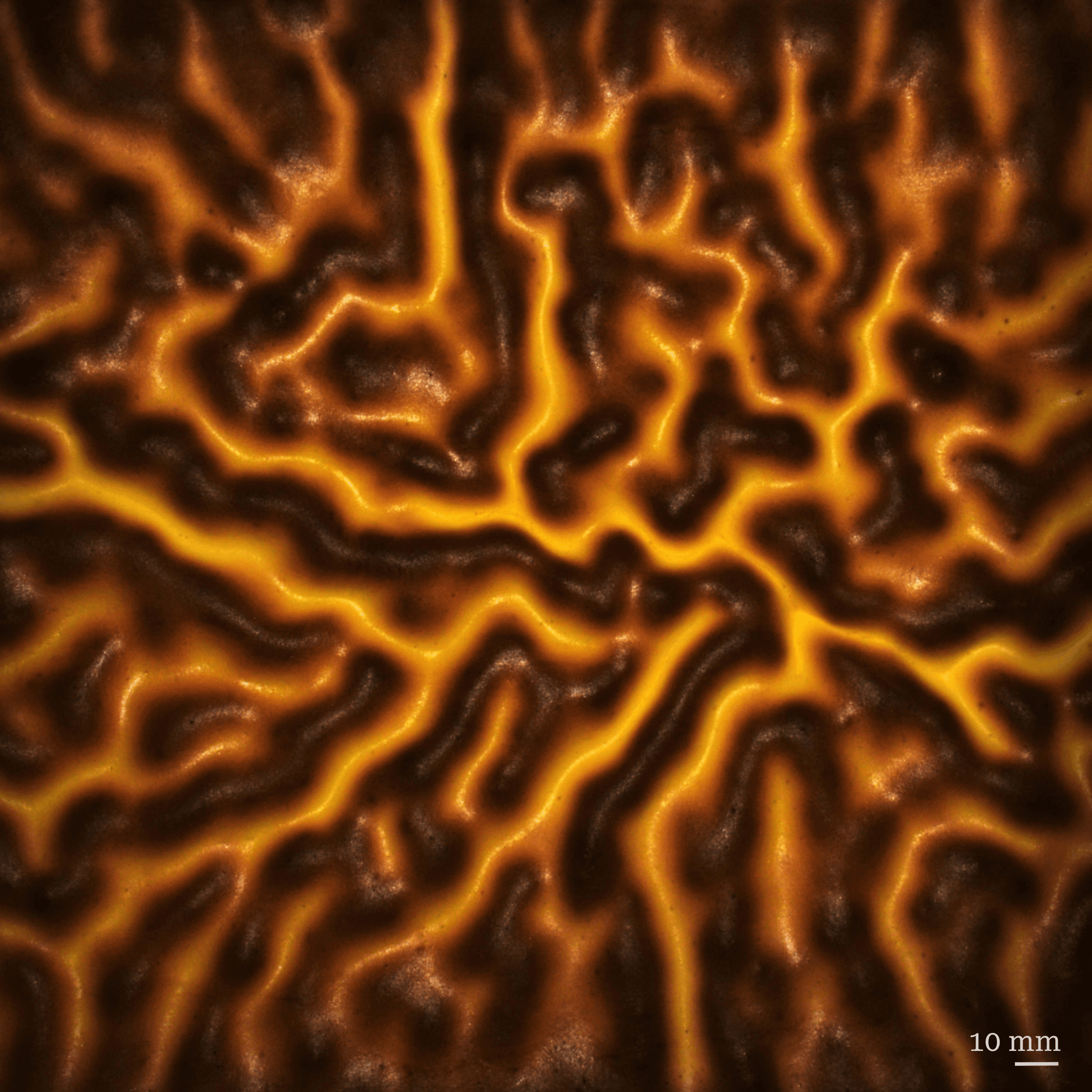
    Convection isn’t always driven by temperature. Here, researchers explore the convective patterns formed by Thiovulum bacteria. These bacteria are negatively buoyant, meaning they will sink if they aren’t swimming. They also have an asymmetric moment of inertia, so any flow moving past them tends to affect their swimming direction.

    When let loose in a Hele-Shaw cell with a oxygen levels that decrease with depth, the bacteria create complex convection-like patterns. They swim slowly upward in wide, slow plumes and sink in denser, narrow plumes. In other areas, they form large-scale rotating vortices. (Video and image credit: O. Kodio et al.)
    Fediverse Reactions