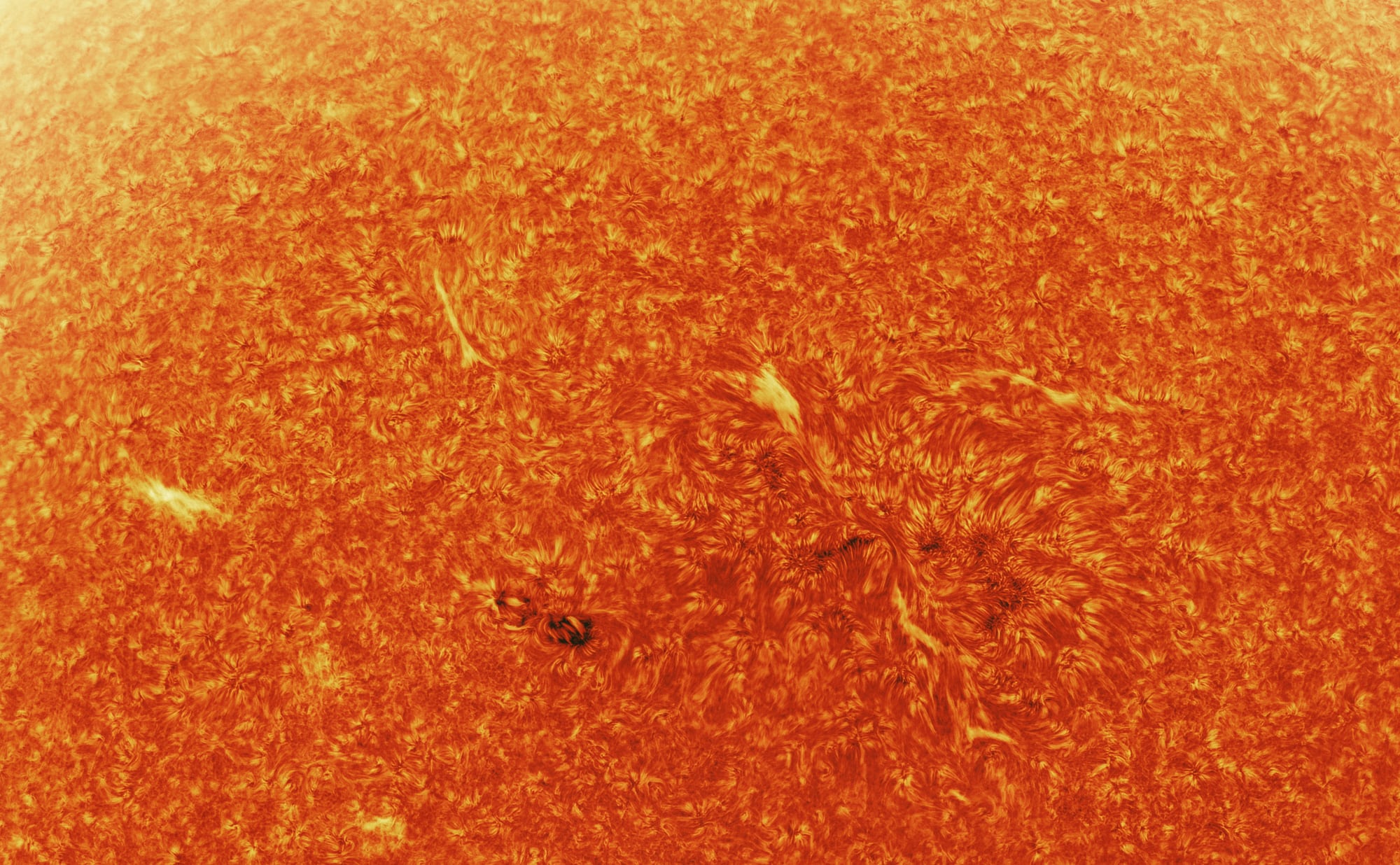
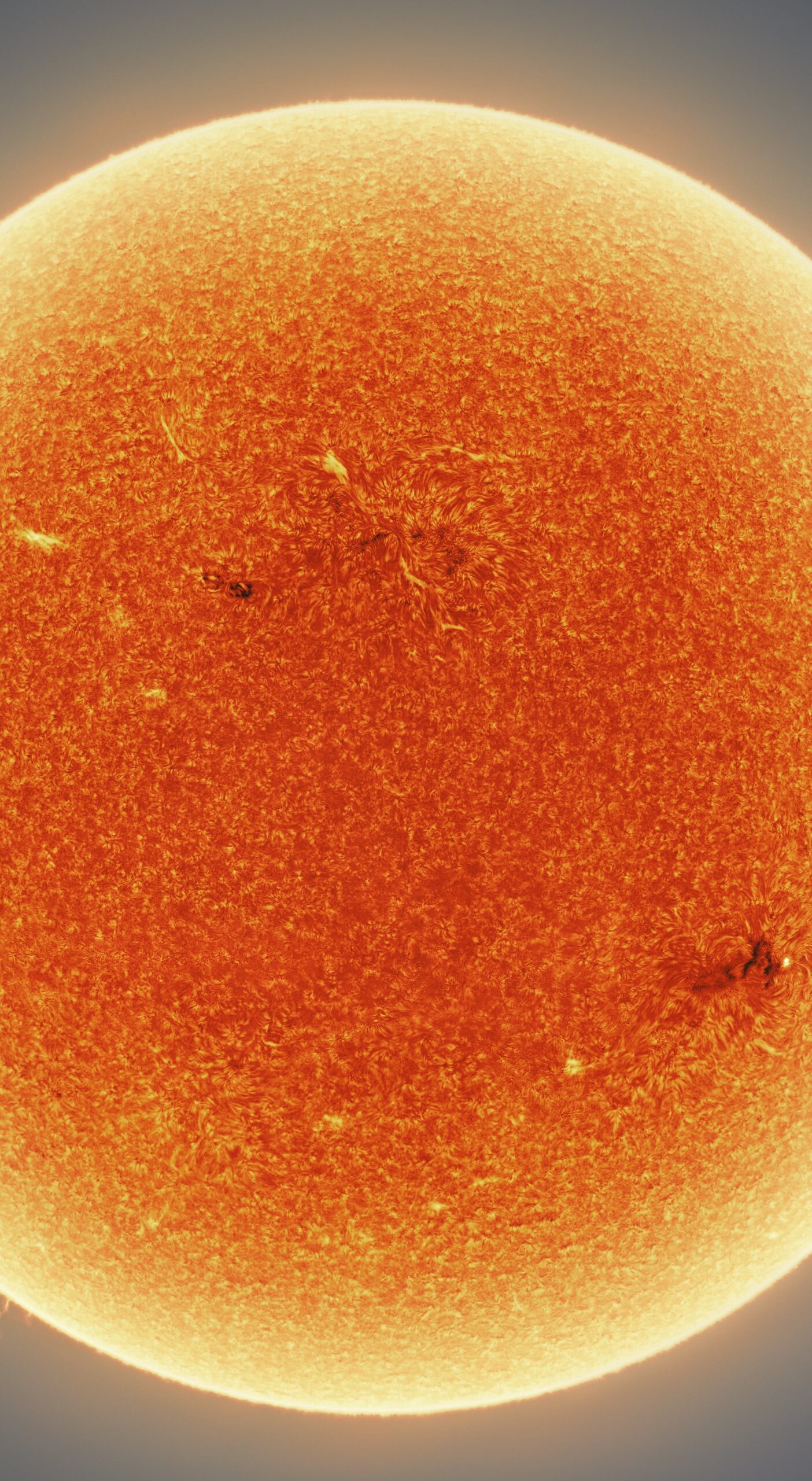
Photographer Andrew McCarthy constructed this spectacular 300-megapixel image of our sun by compositing thousands of individual images. Sunspots, coronal mass ejections, and feathery convective swirls abound. Check out his site for prints of this and other celestial images! (Image credit: A. McCarthy; via Colossal)
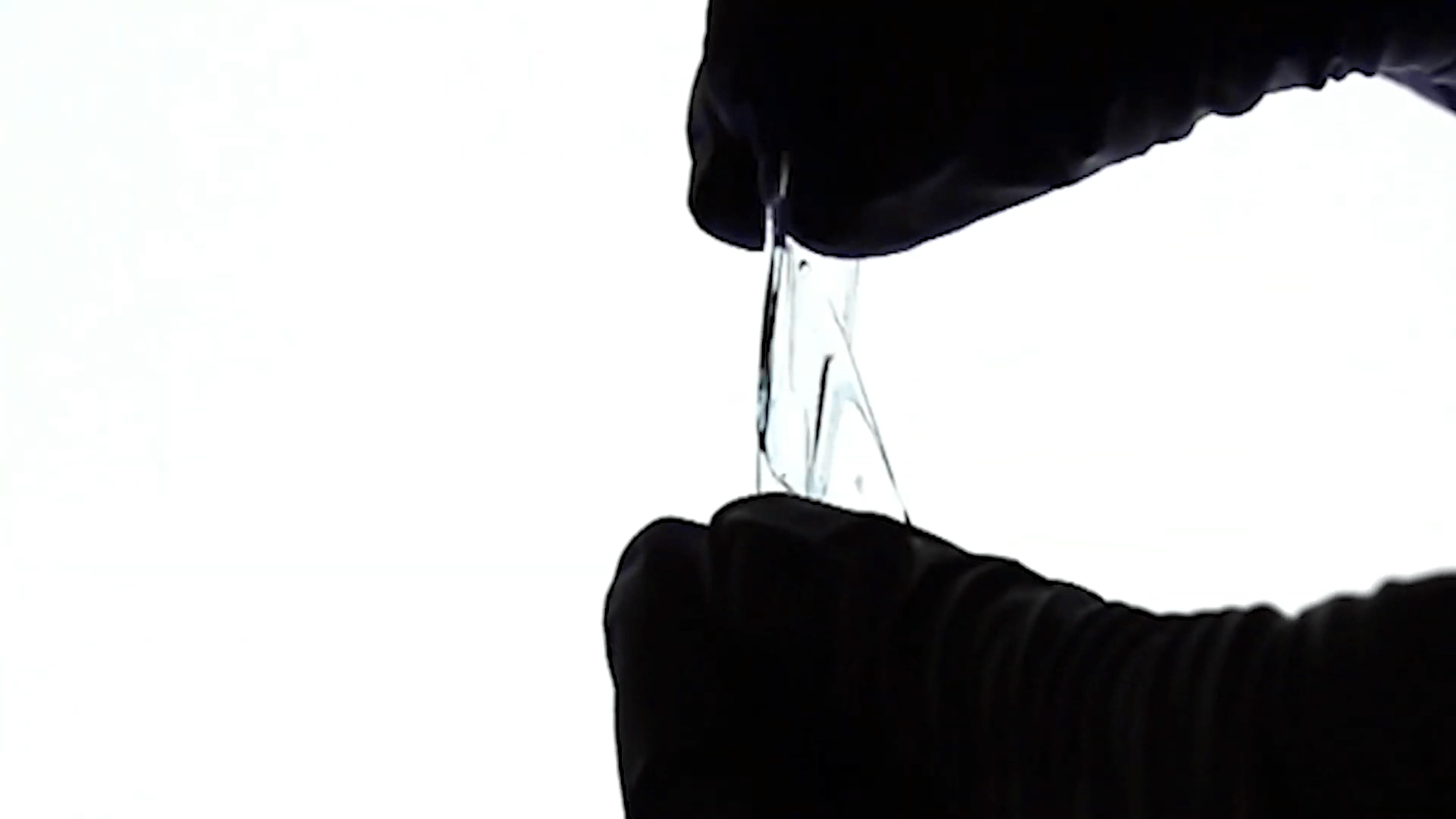
Hydrogels are soft, stretchy solids made from polymer chains immersed in water. Engineers hope these materials will be good candidates for medical implants, but to reach that goal, hydrogels need to be durable enough to withstand repeated stretching and contortion without tearing. One team has built a better hydrogel by encouraging entanglement within the gel’s polymer network.
The polymers inside a hydrogel form their network with two main components: physical entanglements between polymer chains and chemical cross-links. If you imagine the polymers as a tangle of yarn, the cross-links would be spots where pieces of yarn are knotted together and the entanglements are spots where strands wrap and cross without knotting. If you pull on the network, cross-links (knots) will allow very little stretching, whereas the looser entanglements can stretch and deform without tearing. In a hydrogel with lots of entangled polymers but very few cross-links, the material is strong and stretchy without becoming brittle or easily torn. (Video credit: Science; research credit: J. Kim et al.)
In cavitation, tiny bubbles of vapor form and collapse in a liquid, often sending shock waves ricocheting. In most occurrences beyond the lab, cavitation bubbles aren’t a solo act; many bubbles can form and interact. This video takes a look at some of the effects of those interactions. When close together, two cavitation bubbles can act to focus the flow during collapse, generating a microjet strong enough to penetrate into nearby surfaces. Researchers hope this technique may one day be used for needle-free injections. (Image, video, and submission credit: A. Mishra et al.)
That the wind causes ocean waves is obvious to anyone who has spent time near the water, but the details of that process remain fuzzy. Many of the explanations — like the Kelvin-Helmholtz instability — only explain part of the process, usually the beginning when the waves are very small. As the waves get larger, they affect the wind in turn, complicating matters.
As messy as the theory gets, our ability to measure the wind and water in situ is limited, too. Just look at this wild research platform oceanographers designed to study wind and waves. It’s part of a 355-ft vessel that’s towed out to sea horizontally and then flipped so that 300 feet of it remain underwater to stabilize the remainder for measurements. Even with equipment like this, measuring the turbulent air and water near the ocean-sky interface is incredibly difficult.
This review article gives a nice overview of different historical efforts to explain how wind makes waves and provides a snapshot of the latest research in the area. (Image credit: R. Bilcliff; see also N. Pizzo et al.)
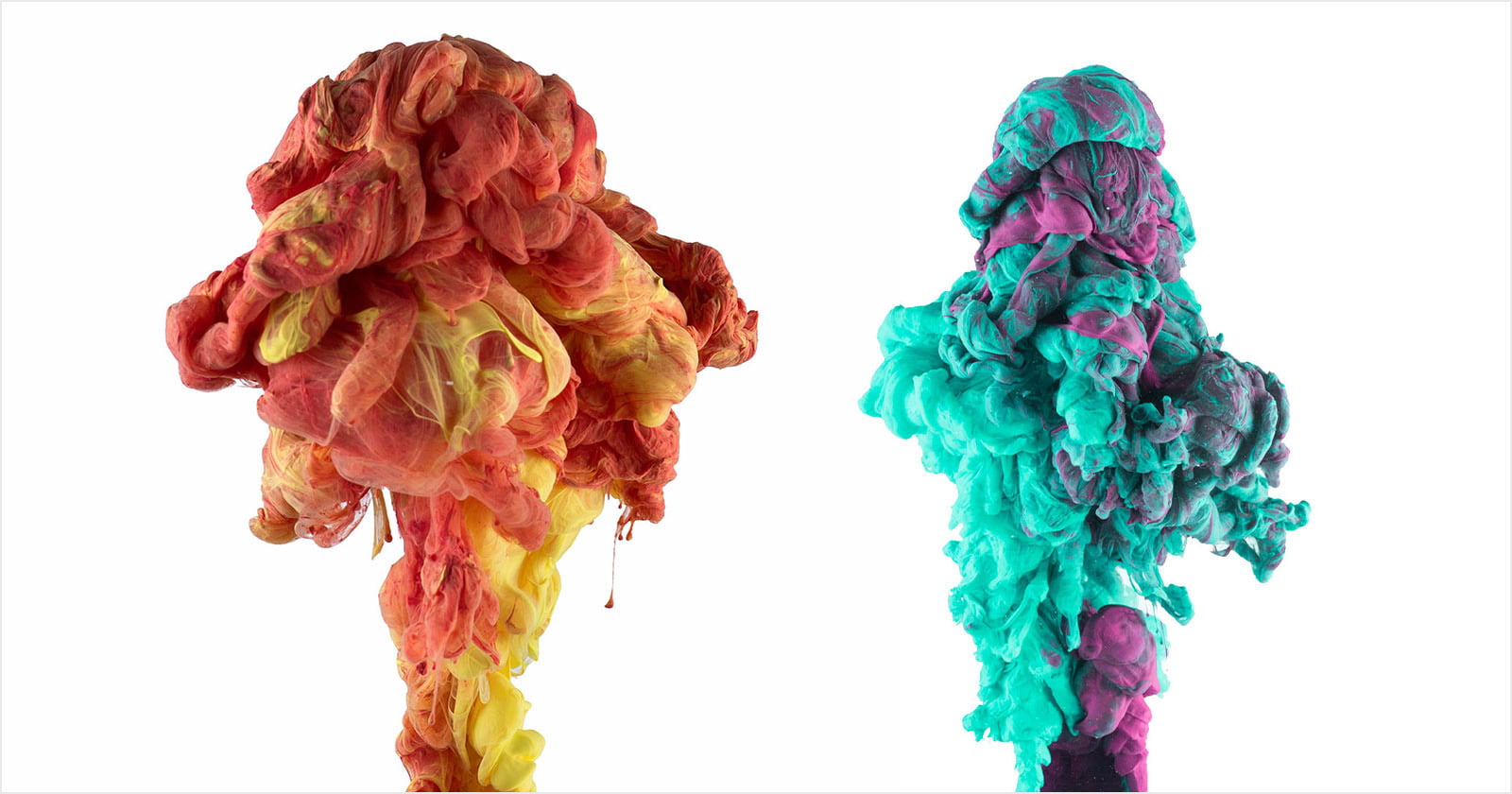
Ever wanted to try your hand at making these cool billowing ink photos? Photographer Jason Parnell-Brookes has a detailed tutorial over at PetaPixel laying out the necessary tools and set-up. I haven’t tried this out myself, but I hope to! How about you? (Image credit: J. Parnell-Brookes; submitted by clogwog)
To take these high-resolution images of individual snowflakes, Nathan Myhrvold and his collaborators built a special camera. Their apparatus keeps the snowflakes chilled despite the strong illumination cast on them. It uses a 500 microsecond shutter and focus-stacking to produce incredibly detailed portraits of these ephemeral subjects. Each snowflake’s shape is the result of the temperature and humidity that crystal experienced as it grew. Since these are natural snowflakes, no two are alike, but, with enough environmental control, it is possible to make twin snowflakes. (Image credit: N. Myhrvold; via Colossal)
The teapot effect — that tendency for liquid to dribble down the outside of the spout when pouring — is a frustration to many tea drinkers. Unraveling the fluid dynamics of this phenomenon has taken various researchers decades, but a team now believe they’ve captured the problem fully. Their full mathematical description is quite dense, but it boils down to a subtle interplay of capillary, viscous, and inertial forces.
Essentially, they found that droplets will always form just under the lip of the spout, thereby keeping that area wetted. The flow rate of the pour (along with the geometry and surface characteristics of the spout) determines how large those droplets can grow. At low flow rates, the droplets can grow large enough to redirect the entire stream around the spout’s edge, creating a hugely frustrating mess. You can see this flow rate effect in the high-speed video below. (Image credit: S. Ferrari; video and research credit: B. Scheichl et al.; via Ars Technica; submitted by Kam-Yung Soh)
This one definitely belongs in the do-not-try-this-yourself category, but this Slow Mo Guys video of a colorful fire tornado is pretty spectacular. Using an array of different fuels and a ring of box fans, Gav sets up a vortex of flame that transitions smoothly from red all the way to blue. As he points out in the video, the translucency of the vortex is so good that you can see how the two sides of the vortex rotate! (Video credit: The Slow Mo Guys)
As wearing face masks for long periods has become more typical, you may have wondered whether a soggy mask offers less protection. All masks — cloth, surgical, and N-95s — get moist from their wearer’s breath. A recent study indicates this isn’t a cause for alarm, though.
Researchers looked at how relatively high-speed droplets (like those from a cough or sneeze) impact dry and wet masks. These high-speed droplets can break into smaller droplets upon impact with a mask layer. The more layers a mask has, the fewer droplets make it through. But even for single-layer masks*, a moistened mask layer lets fewer droplets through. So you don’t have to worry if it’s a little humid in there. Your mask is still working! (Image credit: top – V. Davidova, other – S. Bagchi et al.; research credit: S. Bagchi et al.; via APS Physics)
* To be clear, you should be wearing masks that are more than a single layer thick. Personally, I’m still only going into indoor public spaces in an N-95 at this point.
Droplet penetration through a mask. Top row: dry, single layer mask. Middle row: wet, single layer mask. Bottom row: wet, triple layer mask. When wet, masks permit fewer droplets through.
When pulled, viscous liquids stretch into ligaments that thin and then break into droplets. In this video, researchers investigate how these ligaments break up, depending on their composition. The initial views show the break-up of a water-glycerol ligament (Image 1) and an oil ligament (Image 2). By placing a water droplet inside oil, the researchers got quite different results, including oil-encapsulated droplets (Image 3). The technique could be useful for making compound droplets, even with more than two components. (Image and video credit: V. Thiévenaz and A. Sauret)