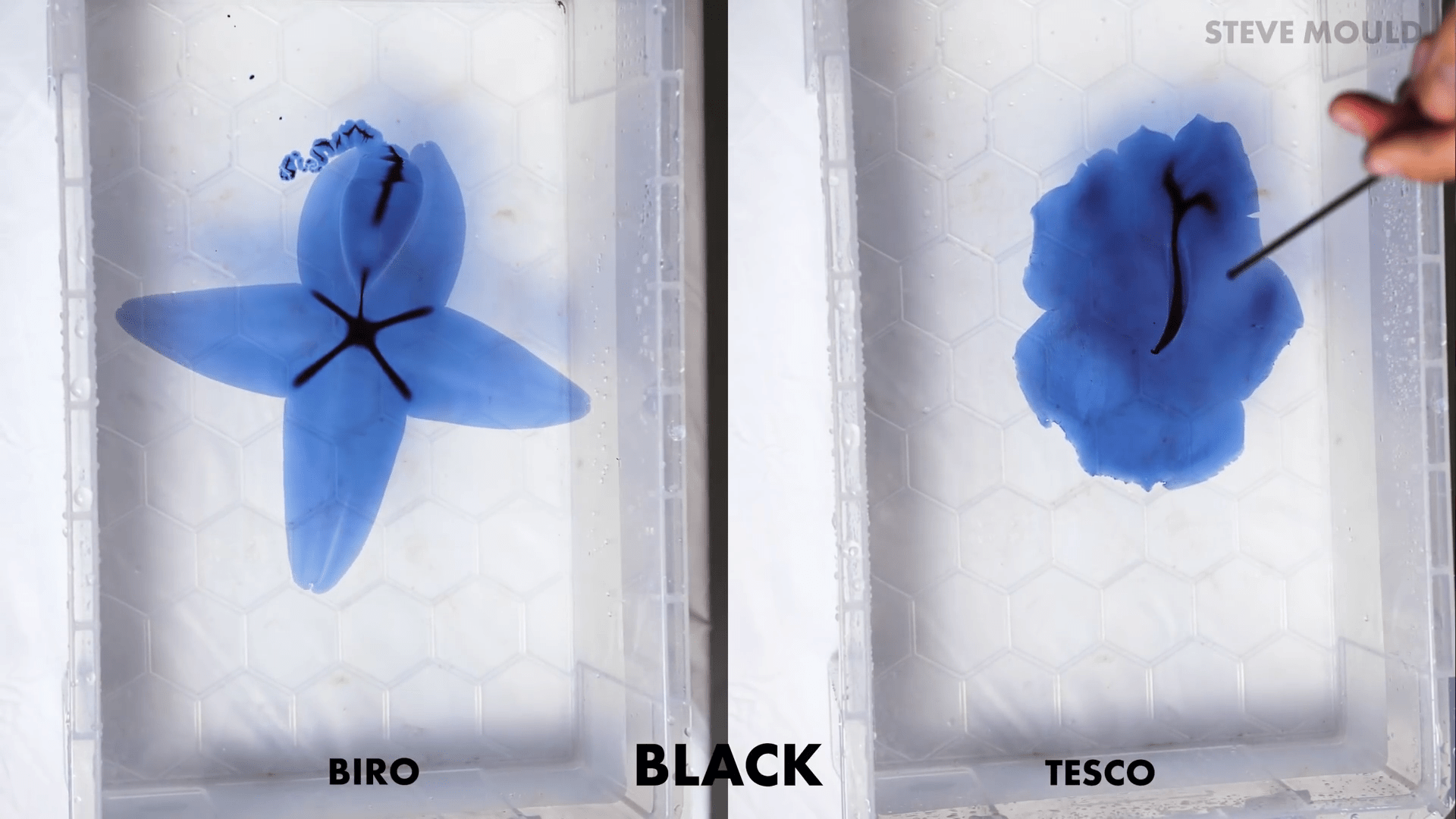
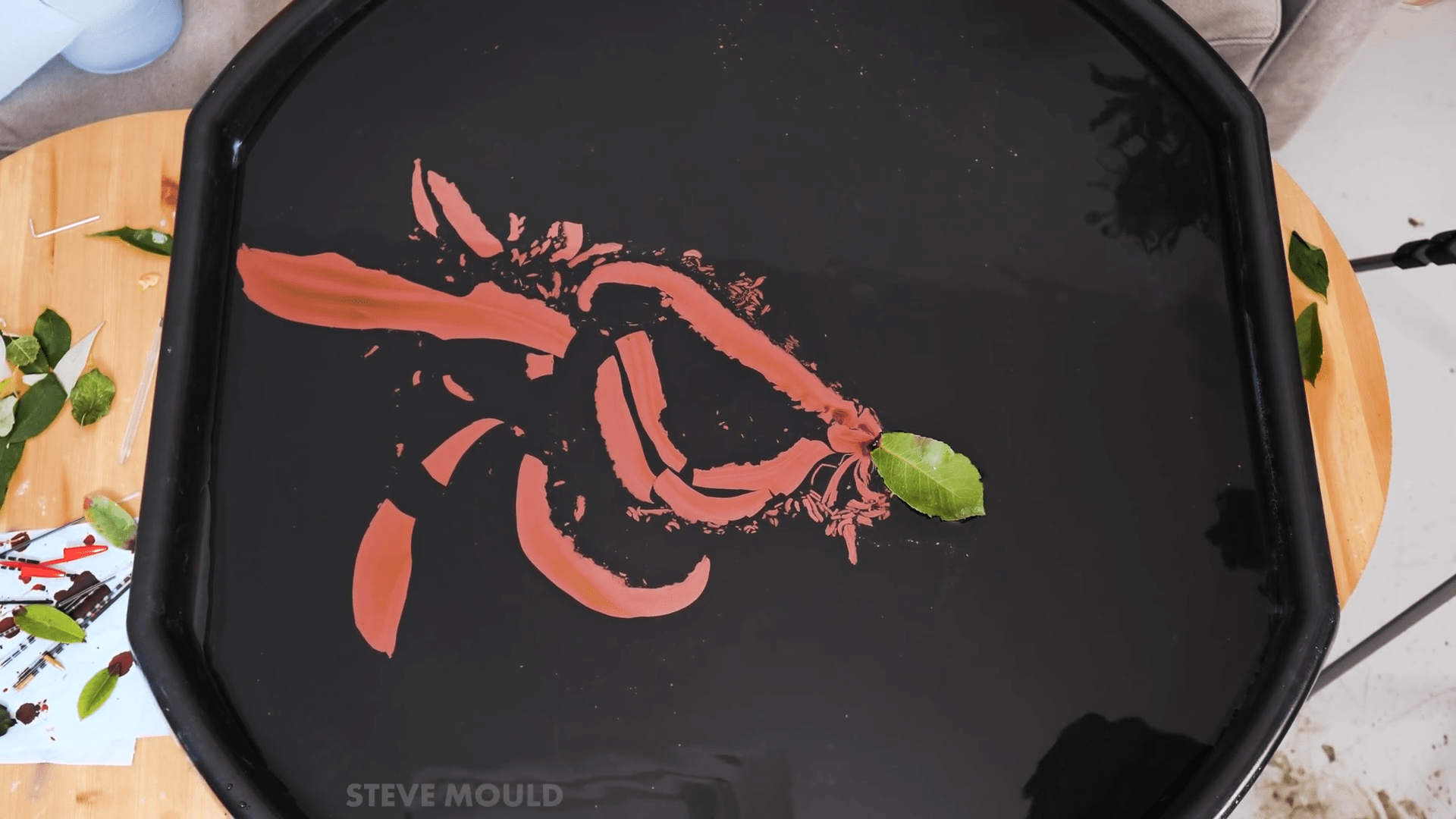
In this video, Steve Mould explores an interesting phenomenon: propulsion via ballpoint pen ink. Placing ink on one side of a leaf or piece of paper turns it into a boat with a dramatic dye-filled wake. It’s not 100% clear what’s happening here, though I agree with Steve that there are likely several effects contributing.
Firstly, there’s the Marangoni effect, the flow that happens from an area of low surface tension to high surface tension. This is what propels a soap boat as well as many water-walking insects. I think this is a big one here, and not just because the ink has surfactants. As any component of the ballpoint ink spreads, its varying concentration is going to trigger this effect.
Secondly, there’s a rocket effect. Rockets operate on a fairly simple principle: throw mass out the back in order to go forward. These dye boats are also doing this to some extent.
And finally there’s some chemistry going on. Some kind of reaction seems to be taking place between one or more of the ink components and the water in order to create the semi-solid layer of dye. Presumably this is why the dye doesn’t simply dissolve as it does in some of Steve’s other experiments.
I figure some of my readers who are better versed in interfacial dynamics, rheology, and surface chemistry than I am will have some more insights. What do you think is going on here? (Video and image credit: S. Mould)