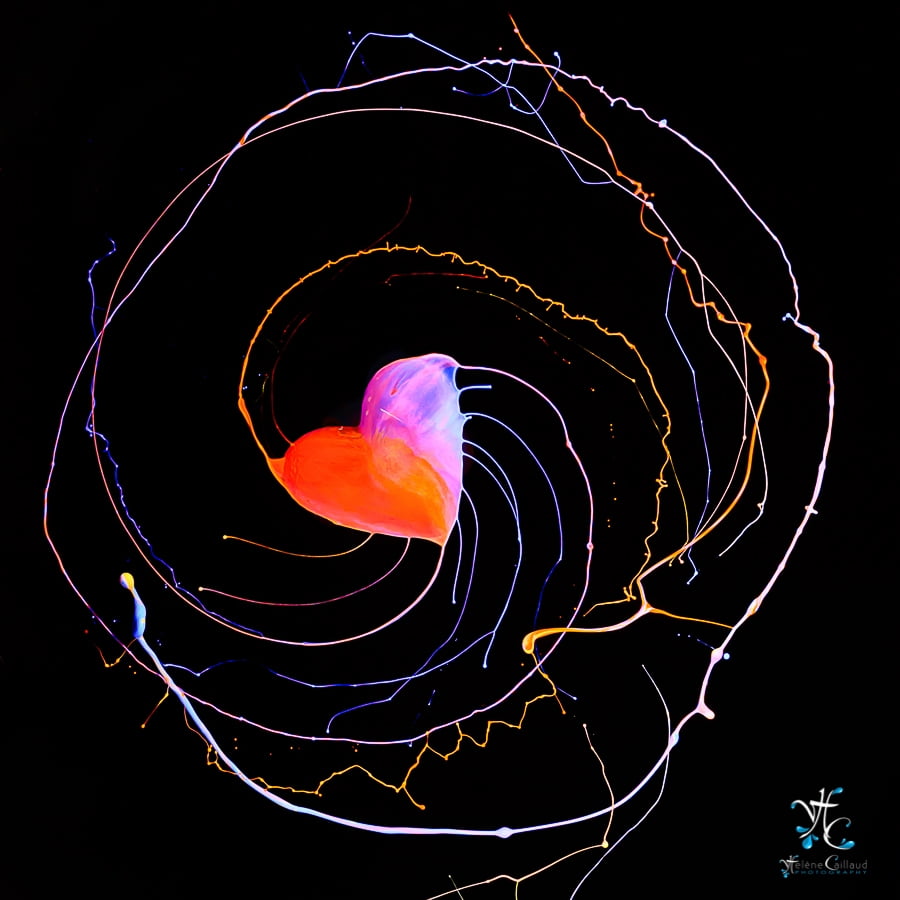
To make this heart, photographer Helene Caillaud flung paint off a tool attached to a drill bit, much like Fabian Oefner did in his “Black Hole” series. Caillaud, however, tweaked the set-up to create distinctive shapes at the center of her images, with centrifugal force creating the beautiful filaments spiraling outward. It’s a neat effect and a fitting way to celebrate Valentine’s Day here on FYFD! (Image credit: H. Caillaud)
Year: 2020

Watery Suction Enables Spiderman-Like Climbing

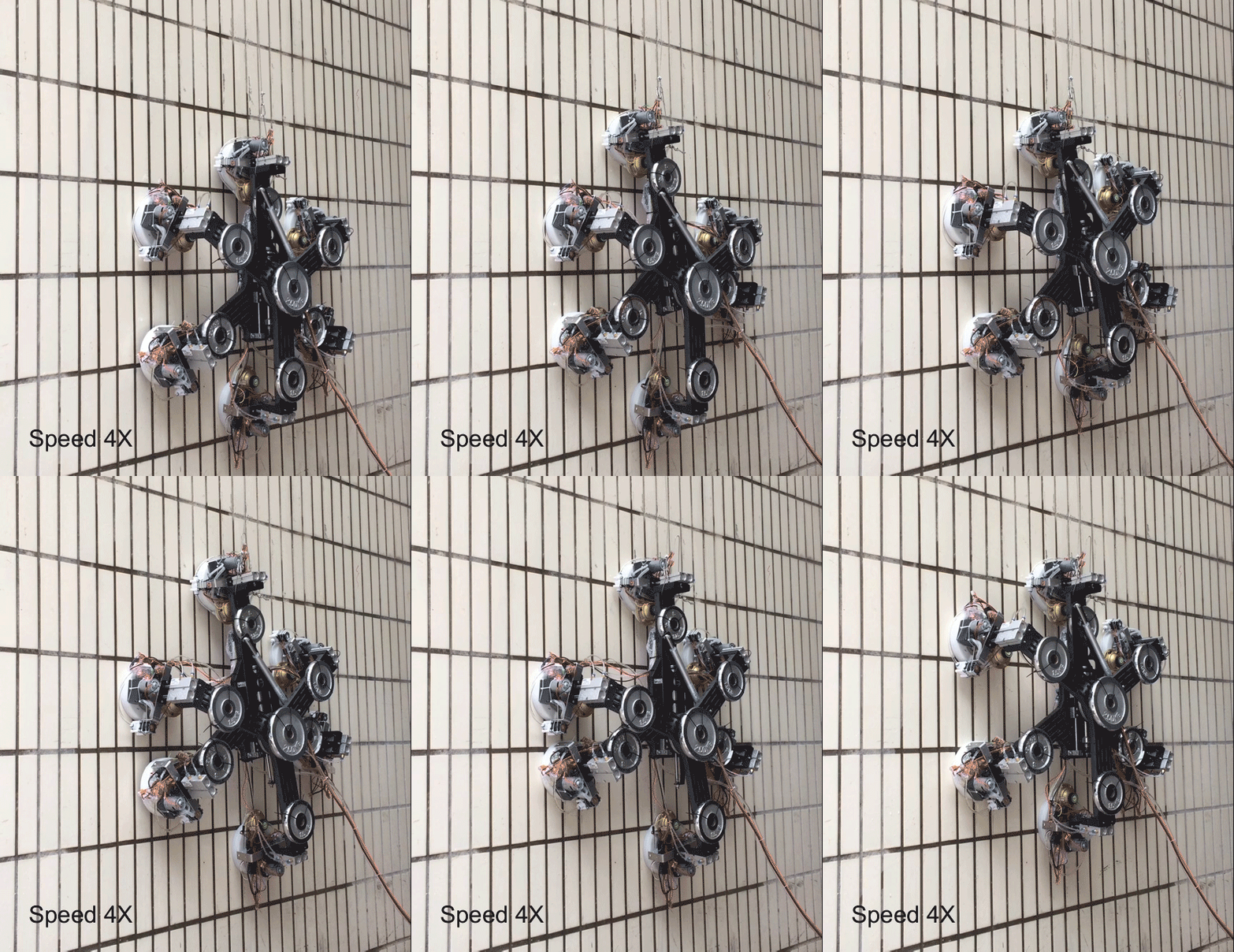
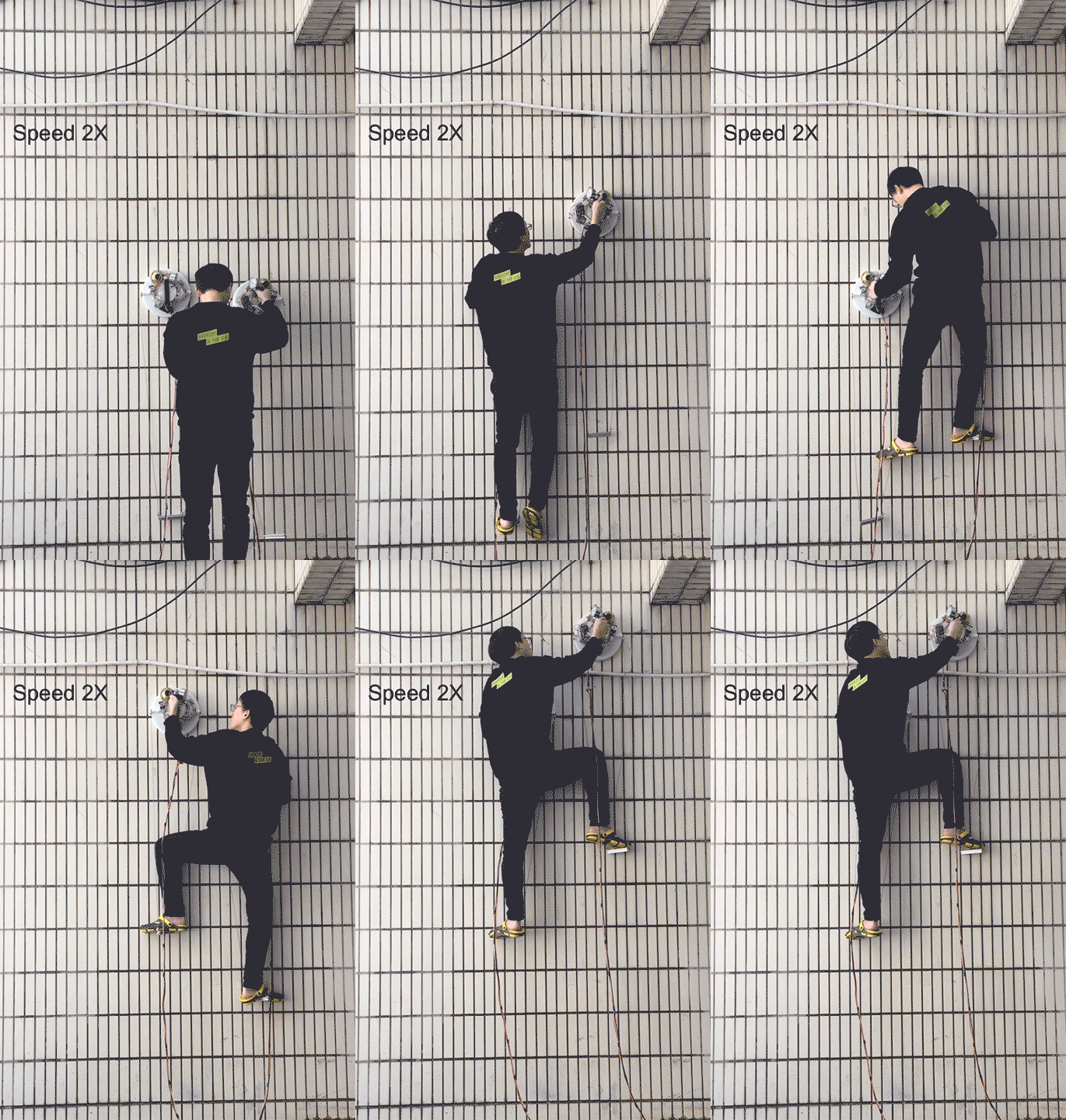
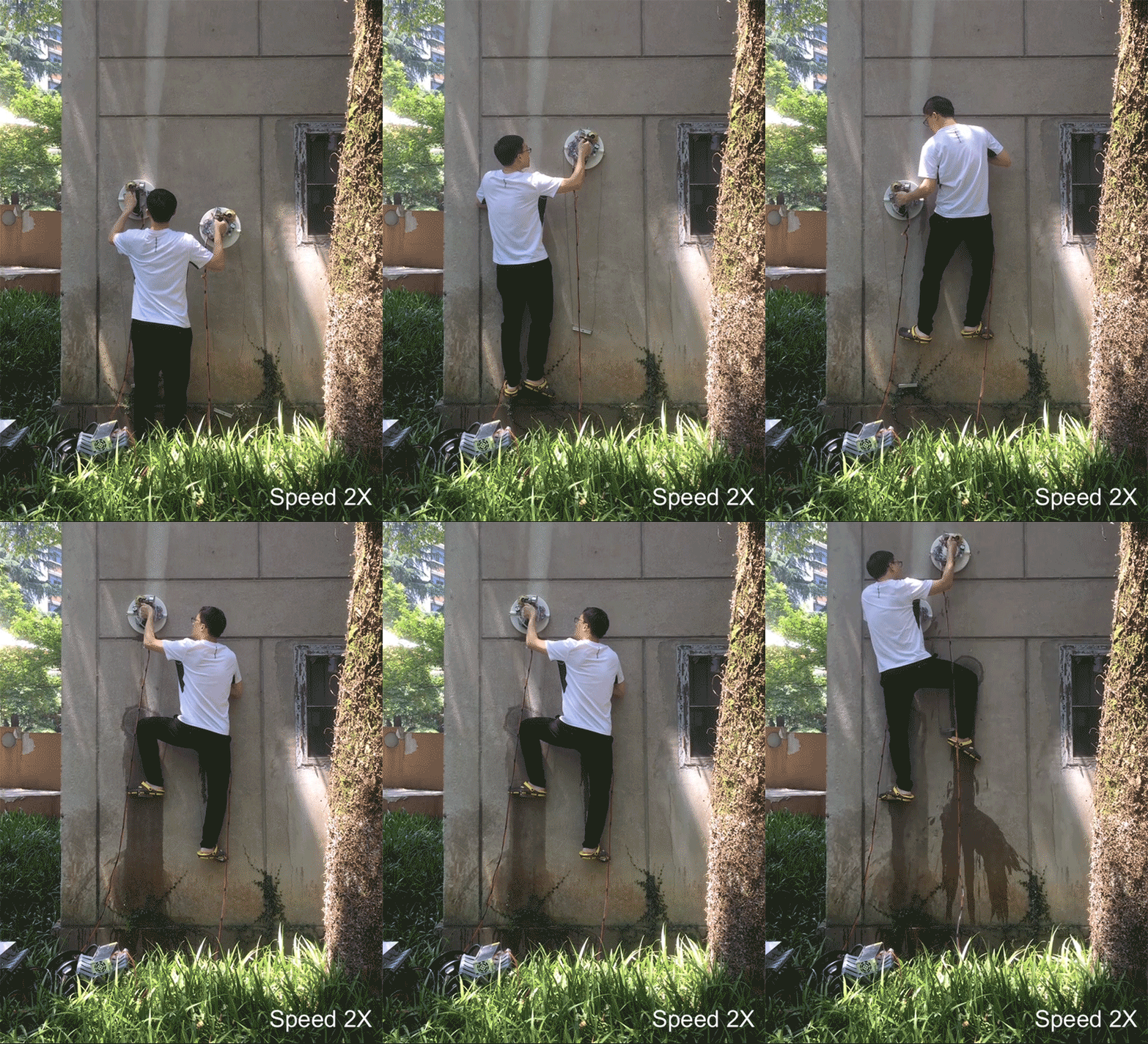
Spiderman makes it look easy, but sticking to surfaces with enough force to climb them is a challenge at the human scale. These researchers tackled the problem with a new method of suction. Traditional suction devices are limited by their ability to seal at the edges. Any surface roughness that prevents a perfect seal creates a leak and fighting those leaks to maintain vacuum pressure requires larger and more powerful pumps.
In this work, the researchers essentially eschew a solid sealing mechanism for a liquid one. A fan inside each suction cup creates a spinning ring of water along the seal’s boundary that allows it to conform even to very rough surfaces without losing vacuum pressure. The researchers demonstrate the principle in action with a hexapod wall-climbing robot as well as with human-scale climbing systems.
But don’t plan your web-slinging adventures just yet! As you can see on the concrete wall example, the system leaks a lot of water, especially when disengaging the suction. Right now, you can only climb as far as your water supply allows. (Image and research credit: K. Shi and X. Li; via Spectrum; submitted by Kam-Yung Soh)

Using Flow Separation to Fly
Fixed-wing flight typically favors the efficiency of long skinny wings, which is why so many aircraft have them. But for smaller flyers, like micro air vehicles (MAVs), short and stubby wings are necessary to stand up the disruption of sudden wind gusts. But a new MAV design eschews that conventional wisdom in favor of a biological tactic: intentionally disrupting the flow.
Usually designers aim to have a smooth, rounded leading edge to wings in order to guide air around the airfoil. But here researchers instead chose a sharp, thick leading edge that immediately disrupts the flow, causing a turbulent separation region over the front section of the wing. A rounded flap added over the trailing edge of the wing guides flow back into contact, giving the wing its lift generation.
Odd as that design choice seems at first blush, it actually makes the aircraft extremely resilient, especially to the turbulence that so often thwarts small flyers. When your flow is already disrupted, a little extra turbulence doesn’t make a difference.
The thicker wing also allows them to use a longer wingspan — thereby gaining that skinny wing efficiency — and move most of the components that would normally be in a fuselage into the wings themselves. By essentially turning most of the MAV into a wing, the designers avoid the loss of lift associated with the fuselage section of the wings.

(Image, video, and research credit: M. Di Luca et al.; via IEEE Spectrum; submitted by Kam-Yung Soh)

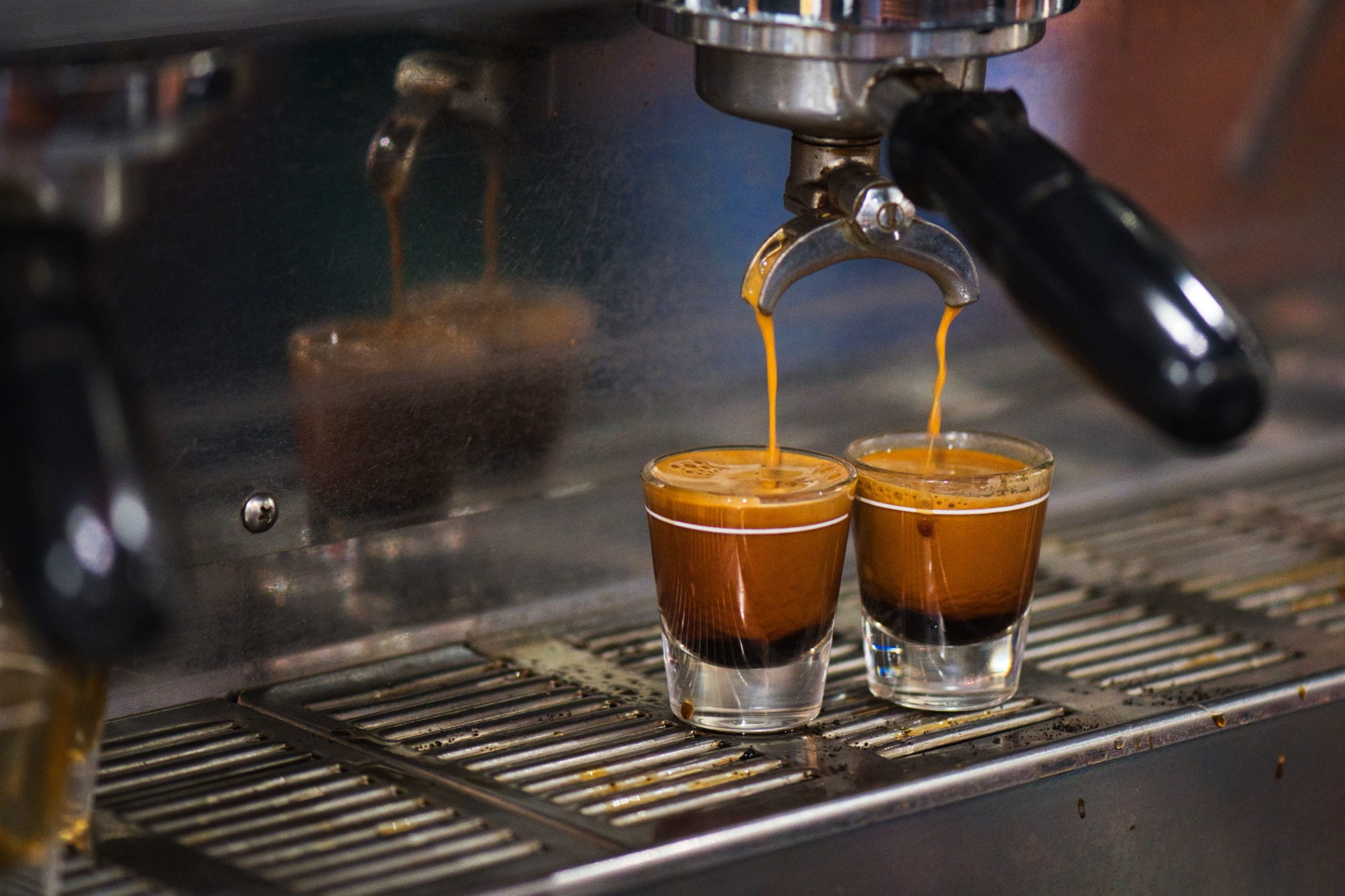
In Search of a Better Espresso
Of specialty coffee drinks, espresso has the most cup-to-cup variation in quality. For those who are not coffee aficionados — such as yours truly — espresso is made by forcing hot water through a packed bed of coffee grains. Many factors can affect the final output, including the amount of dry coffee used, the fineness of the grind, water temperature and pressure, and how tightly packed the granular bed is.
Conventional wisdom suggests that a fine grind is best since it increases the exposed surface area of coffee, but researchers found this is not, in fact, ideal. At very fine grinds, the bed of coffee becomes so tightly packed that water cannot pass through some sections, meaning that the coffee there is completely wasted since nothing is extracted.
Instead, a slightly coarser grind provided better and more consistent extraction because water passed through the entire bed of grains. The researchers point out that this not only produces a good, consistent cup of espresso, but it does so with less waste, something that is becoming more and more important as the climate crisis affects coffee growers. (Image credit: K. Butz; research credit: M. Cameron et al.; via Cosmos; submitted by Kam-Yung Soh)
The World in a Droplet


Capturing refracted images in a droplet is a popular pastime among high-speed photographers, and in this solo Slow Mo Guy outing, we get to see that process in video. Physically, the subject is a simple drop of water, which on impact with a pool, rebounds into a Worthington jet and ejects one or more droplets from its tip. Despite hundreds of years of study, it’s still a joy to watch, especially at 12,000 frames per second.
It’s also not the easiest image to capture, and one thing I rather enjoy about this video is how it gives you a sense of the trial and error involved in capturing just the right view. Even without having to worry about the timing issues, there is a lot of fiddling with lenses, focus, lights, and positioning — something familiar not just to photographers and videographers but to many researchers as well! (Image and video credit: The Slow Mo Guys)

Perfecting Giant Bubbles
Whether young or old, everyone enjoys blowing soap bubbles, and the bigger the bubble, the more impressive it is. Researchers have been on a quest to discover how bubbles can survive with volumes measured in the tens of meters and thicknesses of mere microns.
The key to these behemoth bubbles are the polymer chains inside them. The long molecules of polymers get entangled with one another and resist further stretching, which strengthens the soap film. The researchers found that a mixture of polymer lengths are even better for long-lasting bubbles because they entangle more fully than polymers that are all the same size.
But if what you really want are practical results, I have good news for you: the researchers have released their recommended recipe for making the best giant soap bubbles. It’s included in the video below, but I’ve also reproduced it in text for easier recreation (with thanks to Ars Technica):
Giant Soap Bubble Solution
From the Burton Lab, via Ars Technica
Ingredients
1 liter of water (about 2 pints)
50 milliliters of Dawn Professional Detergent (a little over 3 TBSP)
2-3 grams of guar powder, a food thickener (about 1/2 heaping TSP)
50 milliliters of rubbing alcohol (a little more than 3 TBSP)
2 grams of baking powder (about 1/2 TSP)Directions
Mix the guar powder with the alcohol and stir until there are no clumps.Combine the alcohol/guar slurry with the water and mix gently for 10 minutes. Let it sit for a bit so the guar hydrates. Then mix again. The water should thicken slightly, like thin soup or unset gelatin.
Add the baking powder and stir.
Add the Dawn Professional Detergent and stir gently to avoid causing the mixture to foam.
Dip a giant bubble wand with a fibrous string into the mixture until it isf fully immersed and slowly pull the string out. Wave the wand slowly or blow on it to create giant soap bubbles.
Happy bubble making! (Image credit: Burton Lab; video credit: Emory University; research credit: S. Frazier et al.; via Ars Technica; submitted by Kam-Yung Soh)

Where are Titan’s Deltas?


Saturn’s moon Titan is the only other planetary body in our solar system known to have bodies of liquid on its surface. But where Earth has lakes and seas of water, Titan’s are hydrocarbon-based, primarily ethane and methane. As on Earth, these liquids rain from skies and run down rivers and streams into larger bodies. What they do not do, as far as scientists can tell, is form deltas.
On Earth (and ancient Mars), rivers tend to slow and branch out as they run into larger, still bodies. Many of these river deltas — like the Nile, Ganges, and Mississippi — are visible from space. But so far we’ve seen no equivalent formations on Titan, even though the radar resolution of Cassini should have allowed for it.
There are currently two hypotheses to explain this absence. One posits that density differences between hydrocarbon rivers and lakes mean that deltas do not form. On Titan, the larger bodies are warmer and do not absorb as much atmospheric nitrogen, making them lighter overall. That means a cold, dense river might just sink immediately beneath the lake without slowing to deposit sediment.
Another hypothesis is that deltas do form but that the shifting shorelines of Titan’s seas wash them out and make them unrecognizable. There’s evidence that Titan’s northern and southern hemispheres can swap their liquid hydrocarbons back and forth on a 100,000 year timescale. If that’s true, those shifts could obscure any evidence of deltas.
Experiments are underway to test the first hypothesis, but the final answers may have to wait until NASA’s Dragonfly mission reaches Titan in 2034. (Image credit: Titan – NASA/JPL-Caltech/ASI/Cornell, Alaska – NOAA; via AGU Eos; submitted by Kam-Yung Soh)

Wild Gray Seals Clap Back
Here’s a paper that cries out for fluid dynamical/acoustical follow-up: wild gray seals have been observed signaling underwater by clapping their forefins. As you can hear in the video, the sound is quite loud and carries well underwater. The biologists who observed the behavior postulate that it’s used by males during breeding season to ward one another off and to signal strength to nearby females.
Although many species (including humans) slap against the water surface to generate noise, we don’t know of other species producing such a loud clap entirely underwater. The clap resembles the motions used by seals for propulsion, though the results are obviously quite different. I know plenty of researchers already looking into seal propulsion — here’s your future work! (Image and video credit: B. Burville; research credit: D. Hocking et al.; via Gizmodo)
Collective Catfish Convection


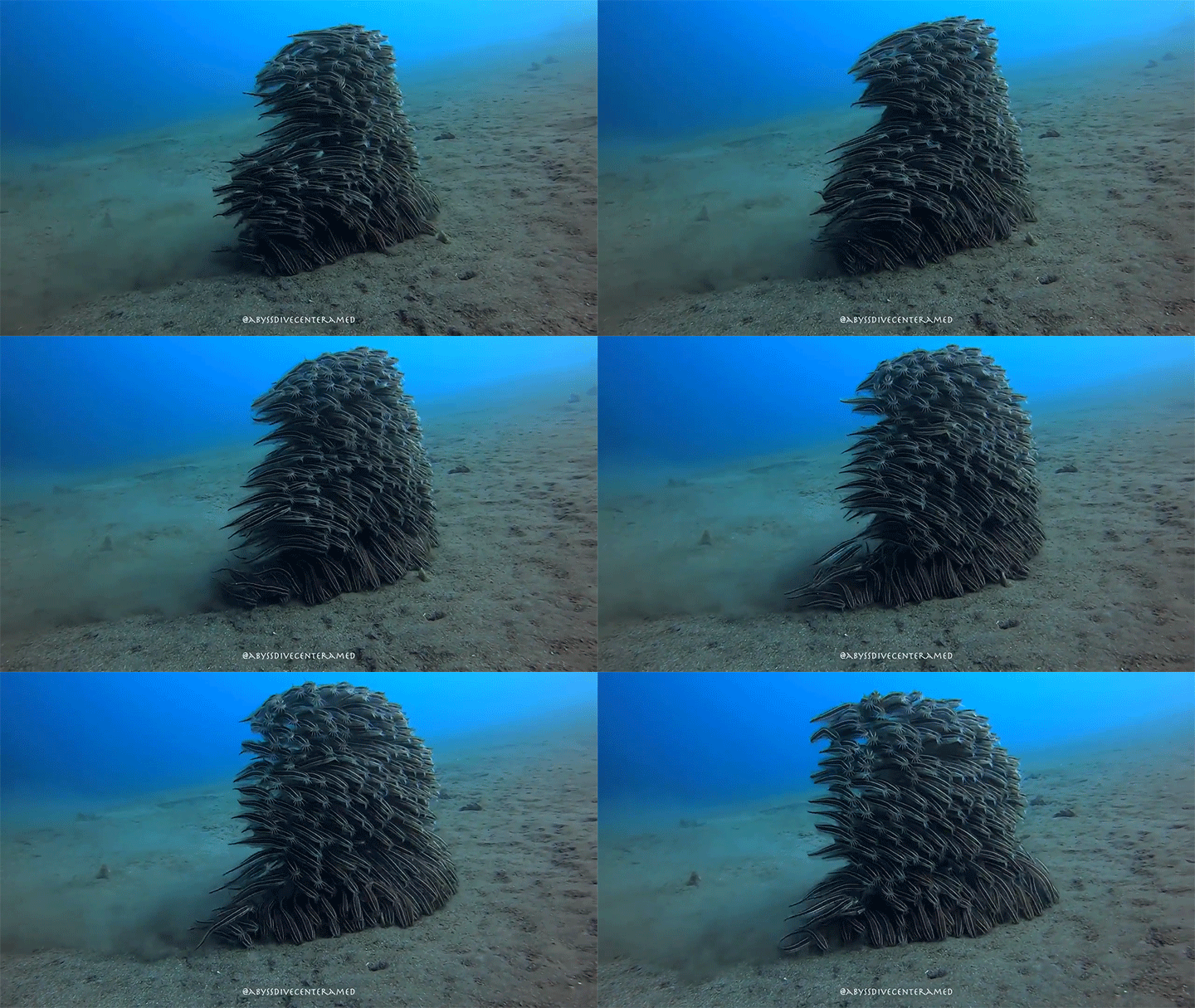
Gather many birds, fish, or humans together and you often get collective motion that’s remarkably fluid-like in appearance. This video shows a group of juvenile striped eel catfish, an (eventually) venomous species that uses strength in numbers for protection while young. Their movement is rather mesmerizing, and if you watch individual catfish, you’ll see a sort of convective motion inside the blob. There’s a general downward trend near the front of the school and a rising one on the backside. Perhaps they’re taking turns feeding near the bottom of the pack? (Image and video credit: Abyss Dive Center; via Colossal)
Coalescence in Heavy Metal Droplets
When a drop of water falls into a pool, it doesn’t always coalesce immediately. Instead, it can go through a coalescence cascade in which the drop partially coalesces, a daughter drop bounces off the surface, settles, and itself partially coalesces. We’ve seen this many times before, but today’s video shows something a little different: here the drop and pool in question are made of a gallium alloy immersed in a background of sodium hydroxide. This means that the drop has very high surface tension (and density) but does not form an oxidation layer on its surface that could inhibit coalescence. And just like the water droplet, the gallium alloy undergoes a series of partial coalescences.

There’s one key difference, though. Did you notice that the water droplets bounce higher as the drops get smaller, but the gallium droplets do the opposite? Previous research suggested that the droplet rebound height is driven by capillary forces, but the high surface tension of both of these liquids means that capillary forces should be large for both of them. Perhaps there’s much more viscous drag in the gallium and sodium hydroxide case? (Image, video, and research credit: R. McGuan et al.)