Year: 2020

  • Featured Video Play Icon

    Tranquilizer Darts in Slow Mo

    Like most syringes, tranquilizer darts use pressure to drive flow. But where a typical syringe has that pressurization provided by a human driving the piston, tranquilizer darts must deploy without any hands-on action. As shown in the video above, this is achieved by pressurization prior to firing.

    The tranquilizer dart has a few key features. Its needle, though sharp, does not have a hole in the end. Instead, it has a hole partway down the barrel of the needle, which is covered before launch by a rubber sleeve. The dart also contains two chambers. One is filled with the medicine being deployed. The other gets pressurized with air through a one-way valve. As long as the rubber sleeve stays over the needle’s hole, the dart is then pressurized, but the fluid has nowhere to go.

    Until it’s fired, of course. On impact, the rubber sleeve is pushed away, and the higher pressure inside the air chamber drives the medicine out of the needle and into the animal. (Video and image credit: The Slow Mo Guys)
  • Submarine Canyons Focus Waves

    Submarine Canyons Focus Waves

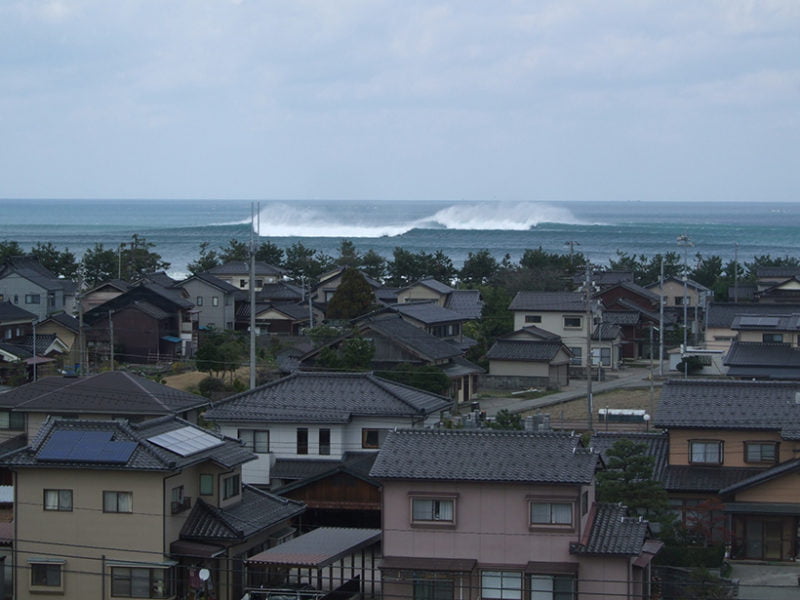
    In winter months Toyama Bay in Japan can get hammered by waves nearly 10 meters in height. These waves, known as YoriMawari-nami, pose dangers to both infrastructure and citizens, and, thus far, are not captured by typical forecasting models.

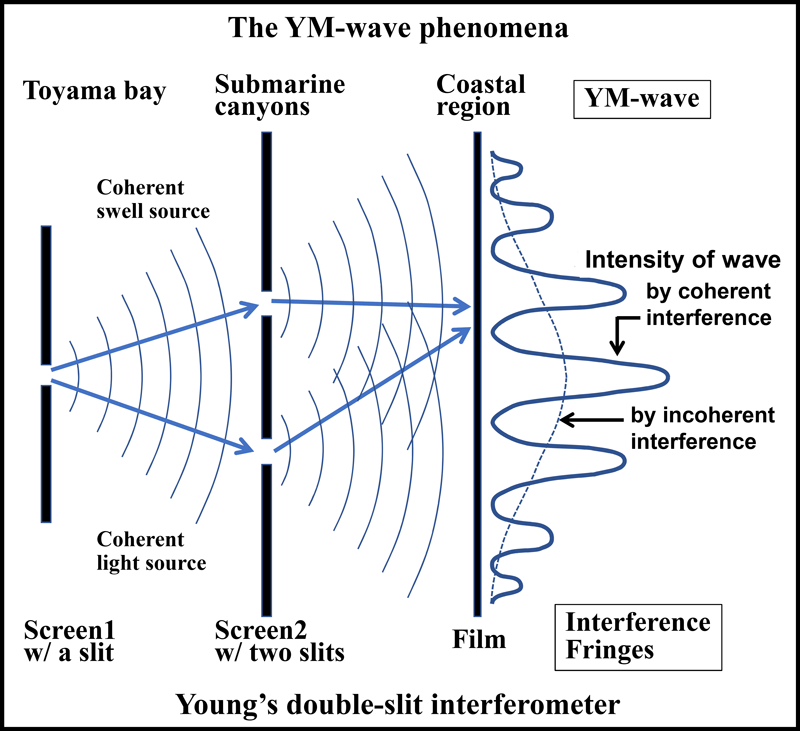
    A new study indicates that these waves have their origin in the particular topography of Toyama Bay and the physics behind the double-slit experiment. The shape of Toyama Bay is such that only waves from the north-northeast can propagate all the way to shore. That restriction essentially creates a single, coherent source for waves in the bay.

    The bay is also home to submarine canyons that stretch like underwater valleys from the continental shelf down toward the deeper ocean. To the incoming waves, these canyons act much like the slits in the double-slit experiment, creating two sets of waves whose fronts can interfere. In some positions, a wave crest will combine with a wave trough, cancelling one another out. But in other spots, two wave crests will meet and combine, creating the much larger YoriMawari-nami wave.

    Diagram illustrating the similarity of the YM-wave phenomenon to Young's double-slit experiment. By H. Tamura et al.

    Toyama Bay is not the only spot in the world where this phenomenon happens. The same physics is behind some of the most popular surf spots in the world, including Half-Moon Bay in California and Nazaré, Portugal. In all of these cases, properly predicting wave heights requires tracking an extra variable — wave phase — that most models leave out. That’s why forecasters have struggled with Toyama Bay’s waves. (Image credit: wave – M. Kawai, diagram – H. Tamura et al.; research credit: H. Tamura et al.; via AGU Eos; submitted by Kam-Yung Soh)

  • Pearls On a Puddle

    Pearls On a Puddle

    Leave a drop of coffee sitting on a surface and it will leave behind a ring of particulates once the water evaporates. But what happens to a droplet made up of multiple liquids that evaporate differently? That’s the subject of this new study. Researchers mixed a volatile drop (isopropyl alcohol) with a smaller amount of a non-volatile liquid and observed how this changed the droplet’s splash rim and evaporation pattern.

    When the surface tension difference between the two liquids was large, the researchers found that the splash formed fingers along its rim (Image 1). The fingers consist almost entirely of the non-volatile component, driven to the outskirts of the drop by Marangoni forces. The dark and light bands you see in the image are interference fringes, which the researchers used to track the film’s thickness.

    When the researchers used liquids with similar surface tensions, the droplet rim instead formed pearl-like satellite droplets. Once the volatile liquid evaporated away, the remaining liquid merged into a thick film. (Image and research credit: A. Mouat et al.; via APS Physics; submitted by Kam-Yung Soh)

  • The Sand Sea’s End

    The Sand Sea’s End

    The northern extent of Africa’s Namib Sand Sea ends where the reddish dunes meet the Kuiseb River and the hard, rocky land on its other side. Within the sand sea, dunes stretch as high as 300 meters while the prevailing winds create and march them across the desert. Although dunes rarely occur in isolation, the mechanisms that regulate dune-dune interactions are still poorly understood, though new experiments are beginning to shed light on the processes. (Image credit: USGS/NASA Earth Observatory)

  • Hydrodynamics of Sheep

    Hydrodynamics of Sheep

    As we’ve discussed previously, not all fluid-like behavior occurs within a literal fluid. Many groups of organisms — humans included — behave like a fluid en masse. Herds of sheep are a fantastic example of this, and now researchers have actually analyzed footage of sheep as a fluid!

    The authors find strong evidence for emergent collective behavior among the sheep, as well as a tendency for the flock to minimize its perimeter. In other words, even though the sheep do not physically exert an attractive force on one another, they behave as though the flock has surface tension! For a herd animal, this behavior makes sense since it minimizes the exposure of individuals to predators. (Image credit: top image – S. Carter, drone footage – M. Bircham; research credit: M. de Marcken and R. Sarfati; submitted by Kam-Yung Soh)

    ETA: Thanks to commenter gib for finding the original author of the drone footage!

  • Featured Video Play Icon

    “The Other Side”

    “The Other Side” is a short film imagining fluids on the other side of people’s eyes. The fast-paced editing makes this one feel rather different from Thomas Blanchard’s other films, which often take the time to linger on the mixing of soaps, inks, and paints that form the bulk of the imagery. There are hints of ferrofluids here, too, but like much of the action, if you blink you’ll miss it.

    Strange as it may sound, there’s actually a strong connection between eyes and fluid dynamics, whether you’re considering the optimal length for eyelashes, the way a tear film coats the eye, or how vision changes in microgravity. (Image and video credit: T. Blanchard)

  • Ice Rings Caused By Underlying Eddies

    Ice Rings Caused By Underlying Eddies

    Observations of strange ice rings on Lake Baikal, the world’s deepest lake, have puzzled scientists for decades. Surveys of satellite imagery have revealed rings on Baikal and two other lakes dating back to the 1960s and some of our earliest satellite images. The rings are roughly 5-7 km in diameter, with a dark layer of thin ice about 1 km wide around a brighter layer of thick ice.

    A new study, buoyed in part by on-the-ground observations during Siberian winter, argues that the ice rings observed on the surface are related to eddies of warmer water circulating below. The researchers were able to capture several eddies in their measurements, including one migratory one. The size, shape, and location of these sub-surface eddies are consistent with ice ring appearance. The kilometers’ wide eddies are several degrees warmer at shallow depths and rotate approximately once every 3 days.

    The researchers suspect the eddies form long before the ice does. Infrared observations in late autumn suggest the eddies form from a combination of wind and influx of river water into the lakes. Then, as ice does form, it’s affected by the underlying circulation. (Image credits: NASA, 1, 2; research credit: A. Kouraev et al.; via Gizmodo)

  • Vortex Collisions Leave Clues to Turbulence

    Vortex Collisions Leave Clues to Turbulence

    Vortex ring collisions have long been admired for their beauty, but they’re now shedding light on the fundamental interactions that lead to turbulence. By dying just the cores of colliding vortex rings (Image 2), researchers observed anti-symmetric perturbations that develop along each core as they interact. These are indicative of what’s known as the elliptical instability.

    But the breakdown doesn’t stop there. Instead, as the elliptical instability develops, it generates a set of secondary vortex filaments that wrap around the original cores (Image 3). Just like the original vortex cores, those counter-rotating secondary filaments interact with one another, develop their own elliptical instability, and generate a set of smaller, tertiary filaments (Image 4).

    What’s exciting is that this process gives us a physical mechanism for the turbulent energy cascade. Researchers have talked for decades about energy passing from large-scale eddies to smaller and smaller ones, but this work lets us actually observe that cascade in the form of smaller and smaller pairs of vortex filaments interacting. To see more, check out some of our previous posts on this work. (Image and research credit: R. McKeown et al.; via Cosmos; submitted by Ryan M. and Kam-Yung Soh)

  • Levitation Without Boiling

    Levitation Without Boiling

    One way to levitate droplets is to place them on a surface heated much higher than the droplet’s boiling point. This creates the Leidenfrost effect, where a droplet levitates on a thin layer of its own evaporating vapor. In this study, the situation is quite different.

    Although the underlying pool of liquid — here, silicone oil — is heated, its temperature is well below the boiling point of the water droplet. But the droplet still levitates over the pool, thanks to an air layer fed by convection. Aluminum powder in the oil reveals large-scale convection in the pool; note how the oil moves radially toward the droplet. That movement drags the air in contact with the oil with it, which forms the vapor layer keeping the droplet aloft.

    One side effect of this convection-driven levitation is that the droplet hovers over the coldest point in the oil. That fact suggests that users can manipulate the droplet’s motion by tuning the underlying heating. (Image and research credit: E. Mogilevskiy)

  • Featured Video Play Icon

    “It’s All About Flow”

    Fluid dynamicists, like other scientists, have lives and interests well beyond our research. Ivo Nedyalkov, for example, is a professional rapper in addition to a PhD-level fluid dynamicist. In “It’s All About Flow,” Dr. Ivo brings those areas of expertise together with a rap all about fluid dynamics. The version embedded here is a bit shorter than the full version, which digs not only into experimental fluid dynamics but into computational work as well.

    Check it out, and if you’d like to see the full lyrics and explanation behind them, he’s posted those as well. You can also ping me here or on Twitter if you’d like to know more about the phenomena he discusses. (Video and image credit: I. Nedyalkov/ASME; full video here; lyrics and explanation)