Month: April 2019

  • Rays in Craters

    Rays in Craters

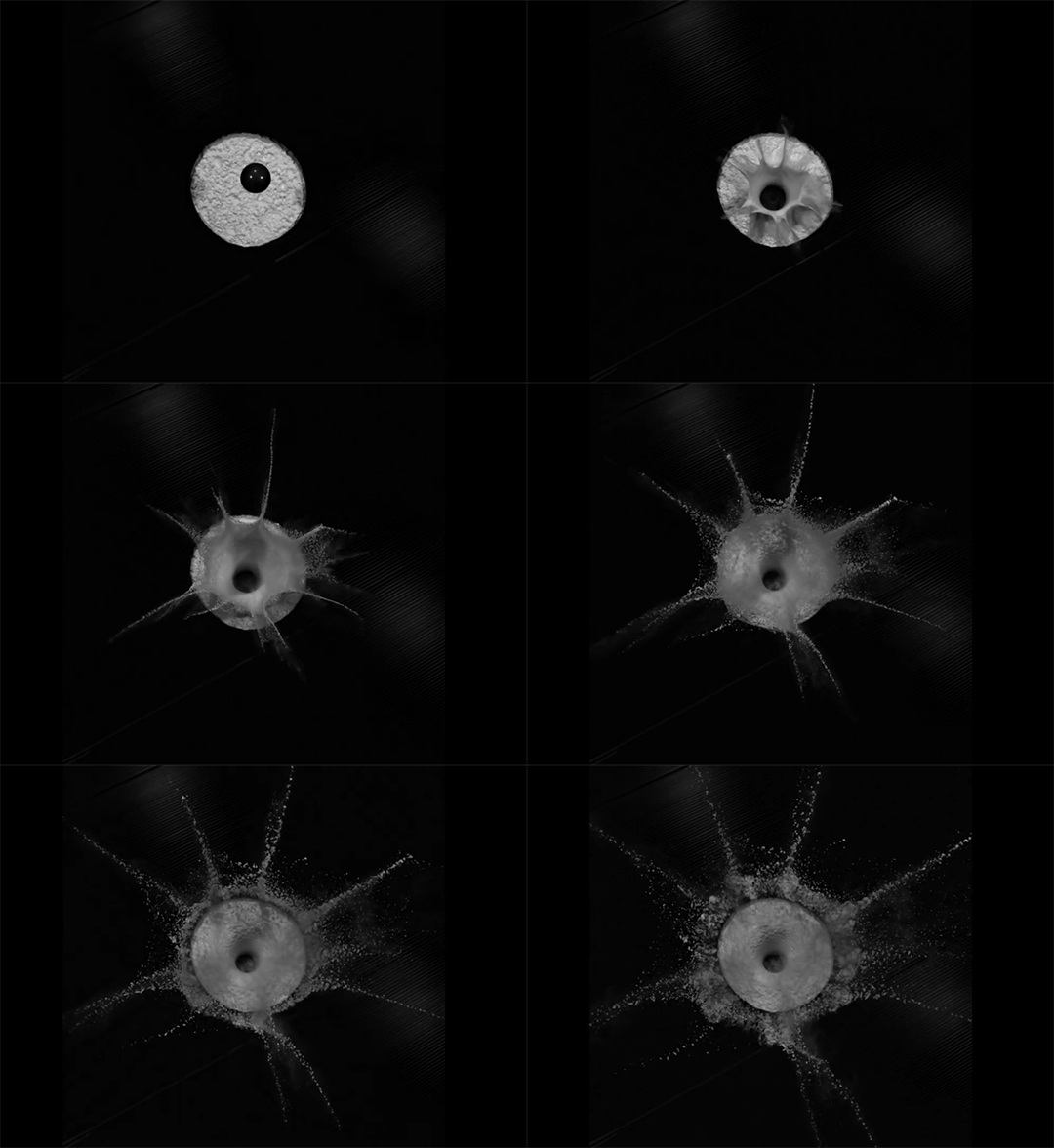
    On bodies around the solar system, there are craters marking billions of years’ worth of impacts. Many of these craters have rays–distinctive lines radiating out from the point of impact. But if you drop an object onto a smooth granular surface (upper left), the ejecta form a uniform splash with no rays. The impactor must hit a roughened surface (upper right) in order to leave rays. 

    Through experiment and simulation, researchers found that the rays emanate from valleys in the surface that come in contact with the impactor. Moreover, the number of rays that form depends only on the size of the impactor and the undulations of the surface. That means that, by knowing the topography of a planetary body and counting the number of rays left behind, scientists can now estimate what the size of the object that struck was! (Image, video, and research credit: T. Sabuwala et al.)

  • Featured Video Play Icon

    The Art of Paper Marbling

    Known as ebru in Turkey and suminagashi in Japan, the art of paper marbling has flourished in cultures around the world since medieval times. The details of methods vary, but in general, the technique uses a base of oily water to float various dyes and pigments. Artists then use brushes, wires, and other tools to manipulate the dyes into the desired pattern. Paper is spread over the top to soak up the color pattern before being hung to dry. Every print made in this manner is a unique result of buoyancy, surface tension variation, and viscous manipulation. Check out the video above to watch a timelapse video showing the technique in action. (Video and image credit: Royal Hali)

  • Freezing Stains

    Freezing Stains

    When they evaporate, drops of liquids like coffee and red wine leave behind stains with a darker ring along the edges, thanks to capillary action and surface tension pulling particles to that outer edge. In contrast, sublimating a frozen droplet leaves a stain pattern that concentrates at the center (top). When droplets freeze from the surface upward, particles within the droplet are driven toward the center as the freeze front pushes toward the drop apex. The final shape of the stain depends on the initial geometry of the droplet, and the concentration of particles toward the center occurs because of the way that the particle freezes, not how it sublimates (bottom). 

    Since many industrial processes rely on droplet evaporation to spread coatings, this work offers a new way to control the final outcome. (Image and research credit: E. Jambon-Puillet, source)

  • Astrophysical Turbulence

    Astrophysical Turbulence

    Subsonic turbulence – like the random and chaotic motions of air and water in our everyday lives – is something we have only a limited understanding of. Our knowledge of supersonic turbulence, where shock waves and compressibility rule, is even more tenuous. In part this is because, although we can observe snapshots of supersonic turbulence in astronomical settings like the Orion Nebula shown above, we cannot watch it evolve. On these scales, features simply don’t change appreciably on human timescales.

    This has limited scientists to mostly numerical and theoretical studies of supersonic turbulence, but that is starting to change. Researchers are now building experimental set-ups that collide laser-driven plasma jets to generate boundary-free turbulence at Mach 6. Thus far, the observations are consistent with what’s been seen in nature: at low speeds, the turbulence is consistent with Kolmogorov’s theories, with energy cascading from large scales to smaller ones predictably. But as the Mach number increases, the nature of the turbulence shifts, moving toward the large density fluctuations seen in nebulae and other astrophysical realms. (Image credit: F. Battistella; research credit: T. White et al.; see also Nature Astronomy; submitted by Kam-Yung Soh)

  • Featured Video Play Icon

    Fluid at Work

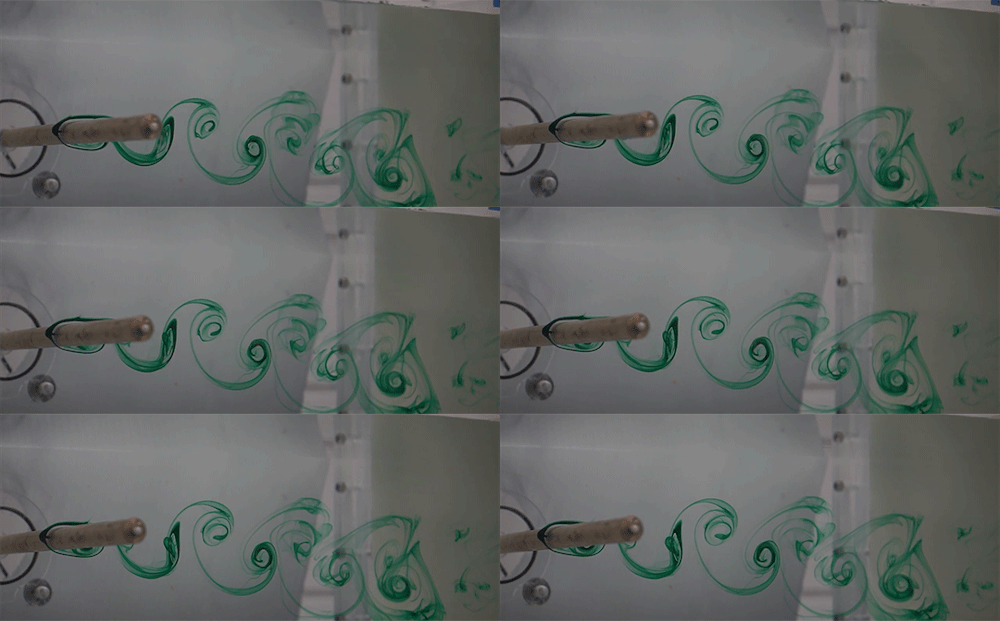
    For many engineering students, their first experience with flow visualization comes in undergraduate labs, where dye introduced into a flume demonstrates basic flow features around airfoils, cylinders, and spheres. This short video by undergraduate Nick Di Guigno and partners quietly illustrates that experience, from the introduction to the equipment to loading the dye and watching the flow develop under the commentary of one’s professor. For those of you who have done this, I suspect it may ignite a bit of nostalgia. For those who haven’t, I think it captures some of the magical feeling of stepping into the lab the first time, even when you’re just recreating a phenomenon others have seen a thousand times before. (Image and video credit: N. Di Guigno et al.)

  • As Ice Flows

    As Ice Flows

    The movement of glaciers is driven by gravity. The immense weight of the ice causes it to both slide downhill and deform – or creep. As glacier melting speeds up, scientists have debated how glacier flow will respond: will the loss of ice cause the glaciers to move more slowly since they have less mass, or will the increase in meltwater help lubricate the underside of glaciers and make them flow even faster?

    By analyzing satellite image data of Asian glaciers collected between 1985 and 2017, researchers are finally answering that question. Their research shows that these glaciers are slowing down as they lose mass and speeding up as they gain mass. Nearly all – 94% – of the flow changes they observed can be accounted for solely from ice thickness and slope. This is valuable information as scientists continue to monitor and predict the changes we must expect as the world continues to warm. (Image credit: J. Stevens; research credit: A. Dehecq et al.; via NASA Earth Observatory)

  • Anak Krakatoa Tsunami

    Anak Krakatoa Tsunami

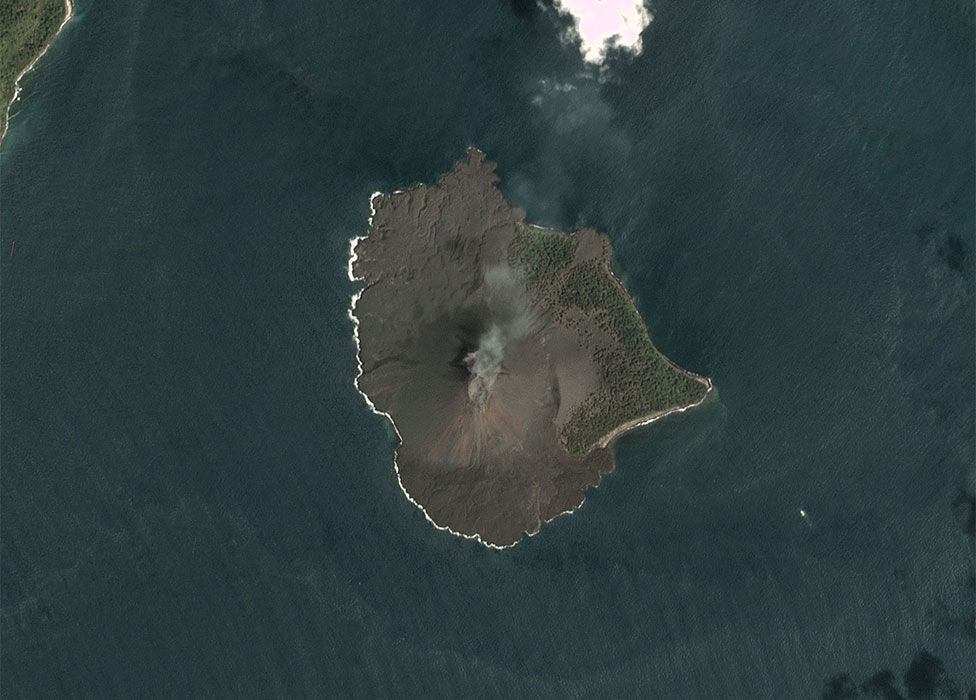
    In late December 2018, a landslide on the island Anak Krakatoa triggered a deadly tsunami in Indonesia. The island (upper left, pre-landslide) lost an estimated 300 meters of height in the landslide, dramatically altering its appearance (upper right; post-landslide). Much of the slide occurred underwater, dumping material into a crater left by the famous 1883 eruption of Krakatoa

    The slide displaced a massive amount of water, creating a tsunami that spread, refracting around nearby islands and reflecting off shorelines in complicated patterns. A new numerical simulation, shown above, models the post-slide tsunami based on terrain data and fluid physics. Its wave predictions match well with the high-water readings from nearby islands. The scientists hope that such models, combined with monitoring, will help save lives should a future eruption trigger more tsunamis.

    For a full picture of both the recent Anak Krakatoa eruption and its famous predecessor, check out this video. (Image credits: satellite views before and after landslide – Planet Labs; simulation – S. Ward, source; via BBC News; submitted by Kam-Yung Soh)

  • Featured Video Play Icon

    Fiery Backdraft

    Combustion is ultimately a chemical reaction, and like any chemical reaction, it requires the right balance of ingredients. The only way to completely exhaust the reaction is to have the perfect amount of fuel (i.e. stuff to burn) and oxidizer (i.e. oxygen). When those ratios don’t match, the reaction can slow down or even appear to end, but that doesn’t mean a fire’s gone out.

    Firefighters face one of the dangerous consequences of this situation in the form of backdrafts. When a fire has been burning in a sealed container and exhausted its oxygen supply, it can get extremely hot even if the flames seem to have died down. When oxygen is added back by opening a door or window, the fire can react explosively, as the Slow Mo Guys demonstrate above. The good news is that backdrafts are relatively rare and there are steps you can take to avoid them. (Image and video credit: The Slow Mo Guys)

  • Featured Video Play Icon

    Breaking

    As waves fold over and break, they trap air, creating bubbles of many sizes. The smallest of these bubbles can be only a few microns across and persist for long times compared to larger bubbles. When they burst, they create tiny droplets that can carry sea salt up into the atmosphere to seed rain. Understanding how these bubbles form and how many there are of a given size is key to predicting both oceanic and atmospheric behaviors. Numerical simulations like the one featured in the video above reveal the dynamic collisions that create these tiny bubbles and help researchers learn how to model the tiniest bubbles so that future simulations can be faster. (Image and video credit: W. Chan et al.)

  • Resonating on a Bounce

    Resonating on a Bounce

    When we think of resonance, we often think of it in simple terms: hit the one right note, and the wine glass will shatter. But resonance isn’t always about a one-to-one ratio between a driving frequency and the resonating system. Especially in fluid dynamics, we often see responses that occur at other, related frequencies.

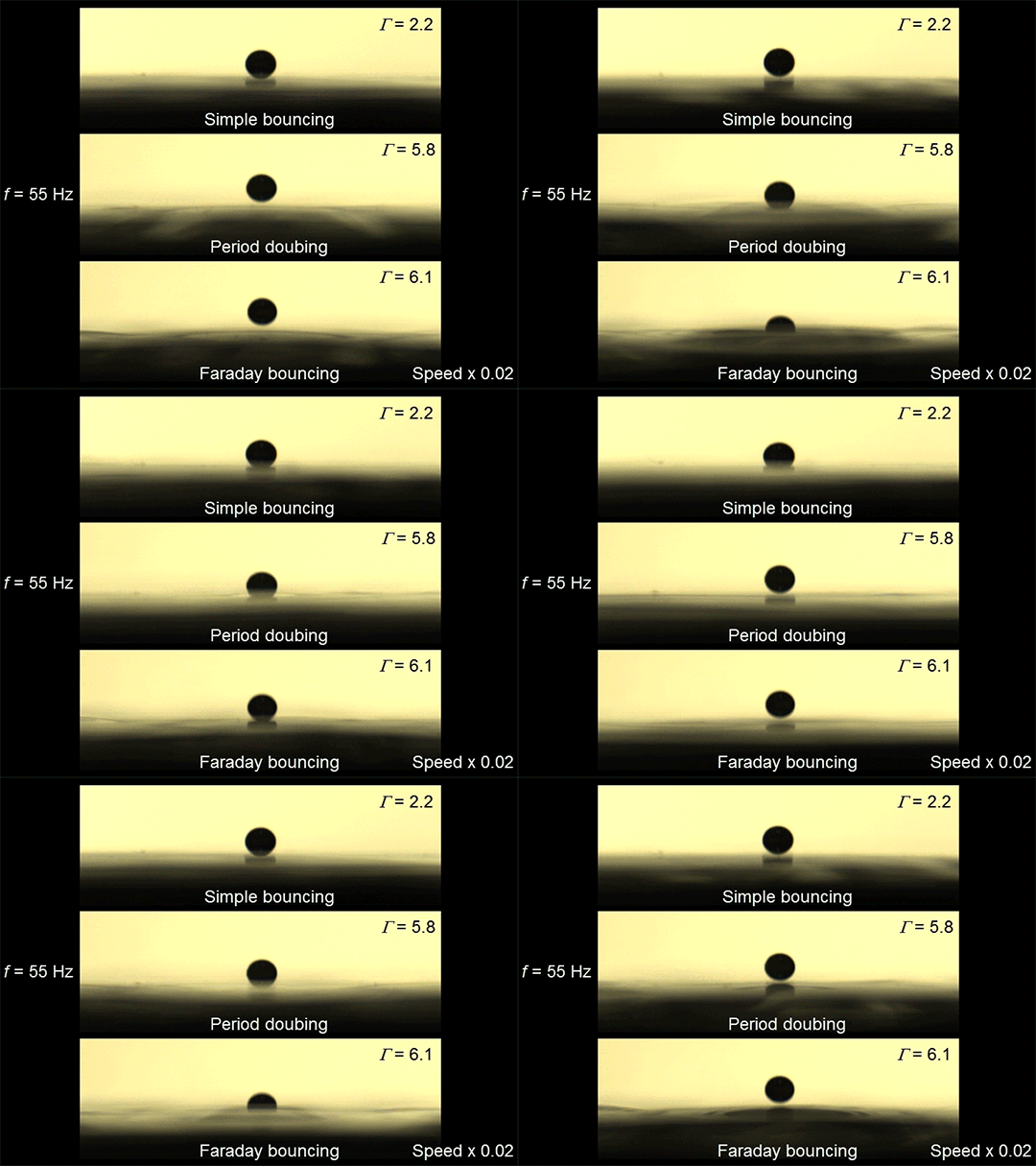
    One of the simplest places to see this is with a droplet bouncing on a bath of fluid. Above you see a liquid metal droplet bouncing on a bath of the same metal. At low amplitude, the pool surface moves at the driving frequency and a droplet bounces simply upon that surface, with one bounce per oscillation. Increase the amplitude, though, and the droplet’s bounce changes. It bounces twice – one large bounce and one small bounce – in the time it takes for the pool surface to go through one cycle. This is called period doubling because the bouncing occurs at twice the driving frequency.

    Turn the amplitude up further, and the system undergoes another change. Faraday waves form on the surface. They resonate at half the driving frequency, and a droplet’s bouncing will sync up with the waves. That means the droplet returns to a one-to-one bounce with the waves, but the waves themselves are no longer reacting at the driving frequency. It’s this kind of complexity that makes fluid systems fertile grounds for studying paths toward chaos. (Image and research credit: X. Zhao et al.)