Month: April 2019

  • Featured Video Play Icon

    Recreating Pyroclastic Flow

    One of the deadliest features of some volcanic eruptions is the pyroclastic flow, a current of hot gas and volcanic ash capable of moving hundreds of kilometers an hour and covering tens of kilometers. Since volcanic particles have a high static friction, it’s been something of a mystery how the flows can move so quickly. Using large-scale experiments (top), researchers are now digging into the details of these fast-moving flows.

    What they found is that the two-phase flow results in a pressure gradient that tends to force gases downward. This creates a gas layer with very little friction near the bottom of the pyroclastic flow (bottom), essentially lubricating the entire flow with air. This helps explain why pyroclastic flows are so fast and long-lived despite their inherent friction and the roughness of the terrain over which they flow. (Image and research credit: G. Lube et al.; video credit: Nature; submitted by Kam-Yung Soh)

  • Coalescence at the Smallest Scales

    Coalescence at the Smallest Scales

    The coalescence of two water droplets happens so quickly, it’s essentially impossible to see, even with high-speed cameras. For this reason, researchers have turned to simulating molecular dynamics – essentially building computer programs that model the actions of all the molecules contained in the water droplets. Viewed this way, the very first contact between drops comes from thermal fluctuations – the random jumping of molecules across the separating gap. Once the bridge starts to form, it continues to grow, driven by thermal forces and opposed by surface tension. Eventually, this thermal regime gives way to the more familiar hydrodynamic one, where the bridge is large enough for flow to drive its growth. (Image credits: experiment – S. Nagel et al.; simulation – S. Perumanath et al.; research credit: S. Perumanath et al.; submitted by Rohit P.)

  • Digging Sandpits

    Digging Sandpits

    Antlion larvae dig sandpits to catch their prey, and, according to a new study, they rely on the physics of granular materials to do so. The antlion digs in a spiral pattern (bottom), beginning from the outside and working its way inward. As it digs, it ejects larger grains and triggers avalanches that cause large grains to fall inward. This leaves the walls of the final pit lined with small grains, which have a shallower angle of repose and will slip out from under any prey that wander in. The subsequent avalanche will carry the victim to the antlion lying in wait at the center of the pit. (Image credits: antlion larva – J. Numer; antlion digging – N. Franks et al.; research credit: N. Franks et al.; submitted by Kam-Yung Soh)

  • Featured Video Play Icon

    Fizzy Droplets

    Leidenfrost drops surf on a layer of their own vapor, created by the high temperature of a nearby surface relative to their boiling point. These Leidenfrost drops can self-propel and skitter and skate across a surface, but they’re not the only droplets that do this. In this video, researchers show how a drop of carbonated water on a superhydrophobic (water-repelling) surface also avoids contact. As long as the drop has carbon dioxide to expel, it will maintain a gap relative to the surface and can even surf over a ratcheted surface the way that their Leidenfrost cousins do. (Image and video credit: D. Panchanathan et al., source)

  • Jumping Droplets

    Jumping Droplets

    From butterfly wings to lotus leaves, many surfaces in nature are shaped to repel water. This typically means roughness on the scale of tens of nanometers, which helps trap air between water and the surface. Droplets can still form on these surfaces, but when they merge, the sudden excess of surface energy sends the coalesced droplet flying. With enough height, the tiny droplet can catch the wind and get carried away. It’s like a natural anti-fogging mechanism, and it’s one that engineers are keen to understand and replicate. (Image and research credit: P. Lecointre et al.)

  • Prehistoric Seiche

    Prehistoric Seiche

    Sixty-six million years ago, a meteorite impact in modern-day Mexico wiped out the dinosaurs and most other living species of the time. To call the event catastrophic feels like an understatement. At the site of impact, rocks and animals were vaporized. Further away, molten rock condensed into glass beads that form a geological layer found around the world.

    Still further away, in what is now North Dakota and was then the bank of a freshwater river, scientists have discovered a deposit full of saltwater fish, sharks, and rays that would have lived in the vast inland sea (A) that stretched northward from Texas. The meteorite’s impact pushed these creatures kilometers upstream against the river’s natural flow.

    One possible explanation for the inundation is a tsunami. But geological evidence indicates the deposit took place within 15 minutes to two hours of the impact, when glass beads were still raining down. To travel the 3,000 km from the point of impact would take a tsunami on the order of 18 hours – far too long.

    Instead, the deposit is likely the result of a seiche (pronounced “saysh”) – a type of standing wave that occurs in an enclosed or partially enclosed body of water. If you imagine water sloshing in a cup or a tub, that’s essentially what a seiche is, but this was on a much larger scale. (For an example, check out this insane footage of an earthquake-induced seiche in a swimming pool.)

    What set the seiche to sloshing are the seismic waves triggered by the meteorite impact. They would have reached this site 6-13 minutes after the impact and triggered waves on the order of 10m. As the waves drove up the riverways, they carried dead and dying sea creatures with them, leaving them stranded on the riverbank until scientists uncovered them tens of millions of years later. (Image and research credit: R. DePalma et al.; via The Conversation; submitted by Kam-Yung Soh)

  • Featured Video Play Icon

    The Beauty of Flames

    The flickering yellow and orange flames most of us are used to thinking of are rather different from the flames researchers study. In this video, the Beauty of Science team offers a short primer on different flame shapes studied in combustion, including laminar, swirling, and jet flames. Each has its own distinctive character and may be advantageous or not, depending on the application for the flame. A laminar flame, for example, is steady, which might make it a good choice for something like a Bunsen burner, where consistency is needed. Whereas a turbulent flame is better capable of mixing fuel and oxidizer, which is key in applications like rocket engines, where that mixing can be a limiting factor in the engine’s efficiency. (Image and video credit: Beauty of Science)

  • Vibrating in the Flow

    Vibrating in the Flow

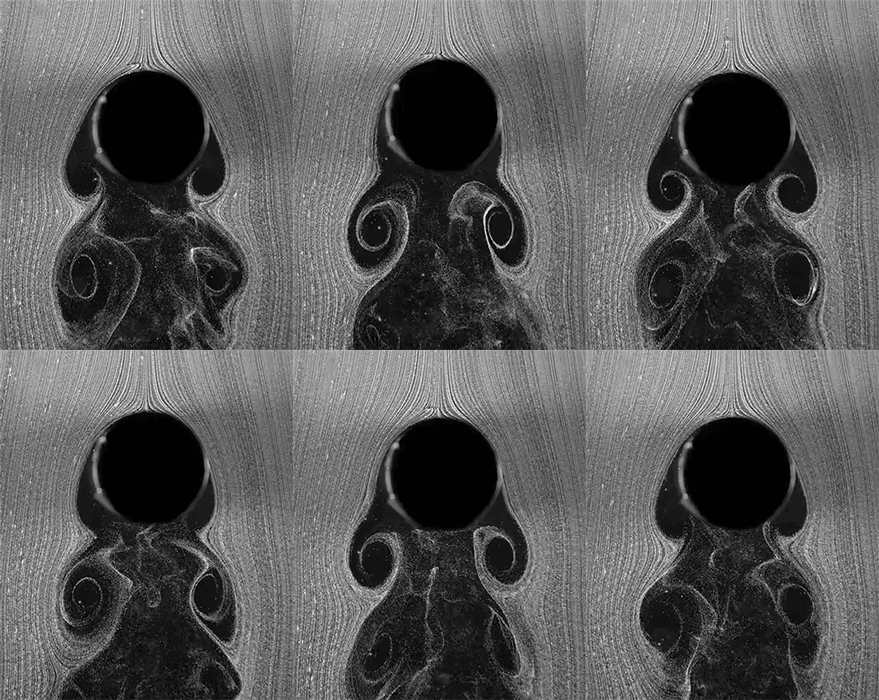
    Objects can obviously affect flows, but that’s not a one-way street. Flows can also affect objects, even ones as simple a circular cylinder. If you live somewhere with traffic lights mounted to a horizontal bar, you’ve probably seen this. On a windy day, the beam holding the traffic lights will oscillate up and down. This is an example of vortex-induced vibration, a coupling between the flow structures formed by an object and the motion of the object itself. With cylinders, engineers have mostly studied a situation like the traffic light – one where the motion of the cylinder is perpendicular to the direction of the flow. 

    But it’s also possible to get vortex-induced vibration in the same direction as the flow. That’s what you see visualized in the images above. Notice how the oscillation of the cylinders is inline with the flow direction. As with the crossflow version of vortex-induced vibration, this inline example has several wake forms that vary based on flow conditions. (Image and research credit: T. Gurian et al.)

  • Communication Between Microswimmers

    Communication Between Microswimmers

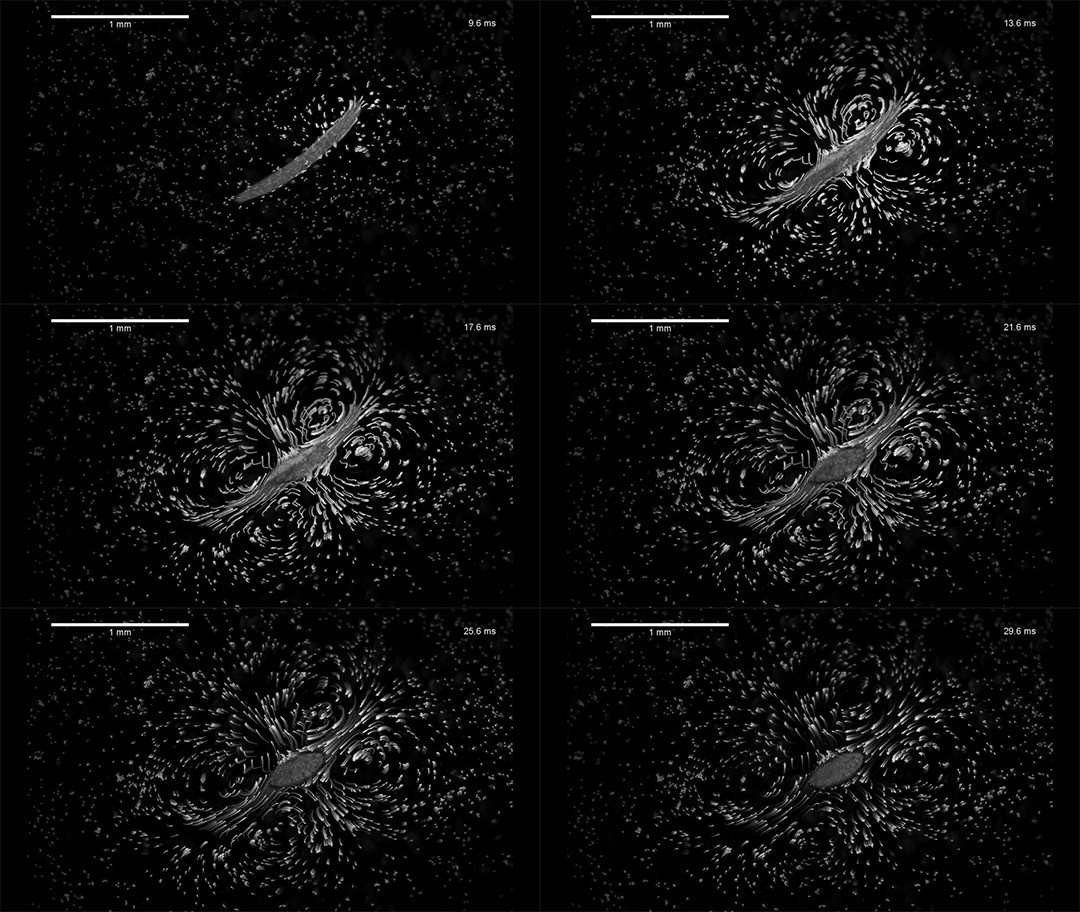
    The elongated cells of Spirostomum ambiguum swim using hair-like cilia, but when threatened, the cells contract violently, sending out long-range hydrodynamic waves, like those visualized above. Along with these waves, the cells release toxins aimed at whatever predator threatens them. In a colony, these waves act like a communication beacon. The swirl of a previous cell’s reaction tugs on its neighbors. As they contract, the message–and the toxins–spread. If the colony density is high enough, the hydrodynamic trigger waves will propagate through the entire colony, releasing enough toxins to disable even large predators. (Image and video credit: A. Mathijssen et al.)

  • Soap Film Evolution

    Soap Film Evolution

    The beautiful colors of a soap film reflect its variations in thickness. As a film drains and evaporates, it turns to shades of gray and black as it gets thinner. More than fifty years ago, one scientist proposed a free-energy-based explanation for how such ultrathin films might evolve. But it’s taken another half a century for experimental techniques to reach a point where the thickness of these ultrathin films could be measured well enough to test that theory. The new mechanism, known as spinodal stratification, has been observed in both vertical films (top) and foam (bottom) but has so far not been observed in any horizontal configuration, suggesting that buoyant effects are likely important, too. (Image and research credit: S. Yilixiati et al.; submitted by James S.)