Month: November 2018

  • Stone Skipping Physics

    Stone Skipping Physics

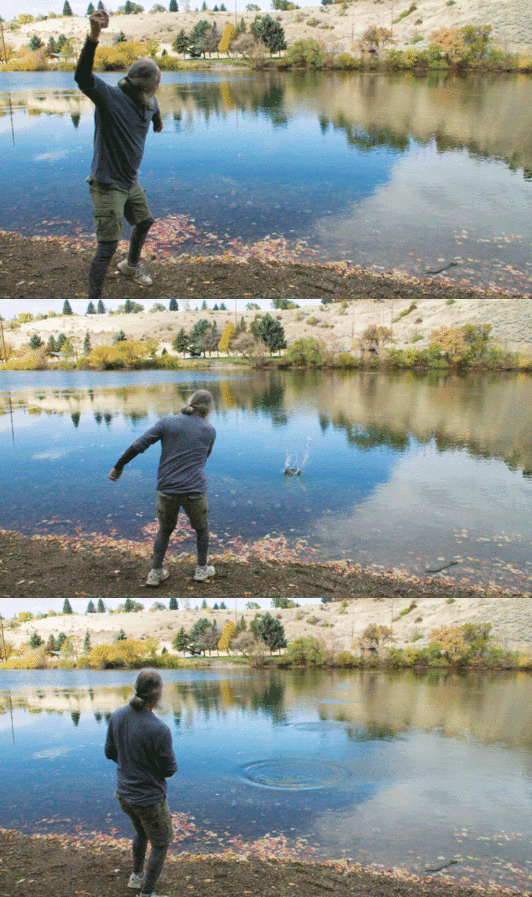
    The current record for stone-skipping is about 88 skips. For most of us, that’s an unimaginably high number, but according to physicists, human throwers may top out around 300 or 350 skips. In the video above and the accompanying article, Wired reporter Robbie Gonzalez explores both the technique of a world-record-holding skip and the physics that enable it.

    The perfect skip requires many ingredients: a large, flat rock with good edges; a strong throw to spin the rock and hold it steady at the right angle of attack; and a good first contact with the right entry angle and force to set up the skips’ trajectory. The video is long, but it’s well worth a full watch. It gives you an inside look both at a master skipper and at the experts of skipping science. (Video and image credit: Wired; see also: Splash Lab, C. Clanet et al.; submitted by Kam-Yung Soh)

    ETA: Wired’s embed code is acting up, so if you can’t see the stone skipping video here, just go to the article directly.

    Heads up for those going to the APS DFD meeting! You can catch my talk Monday, Nov. 19th at 5:10PM in Room B206. I’ll be talking about how to use narrative devices to tell scientific stories. I’ll be around for the whole meeting, so feel free to come say hi!

  • Sheep as a Compressible Flow

    Not everything that flows is a fluid. And when viewed from above traffic, crowds, and even herds of sheep flow in patterns like those of a fluid. In particular, these conglomerations move like compressible fluids – ones that allow substantial changes in density as they flow. From above, each sheep is just a few pixels of white, but you can see which areas of the herd have the highest density by how white an area looks. The highest density regions also tend to be the slowest moving – not surprising in a crowd.

    Now watch the gates. They act like choke points in the flow and, to some extent, like a nozzle in supersonic flow. As the sheep approach the gate, they’re in a dense, slow moving clump, but as they pass through it, the sheep speed up and spread out. This is exactly what happens in a supersonic nozzle. On the upstream end, flow in the nozzle is subsonic and dense. But once the flow hits the speed of sound at the narrowest point in the nozzle, the opening on the downstream side allows the flow to spread out and speed up past Mach 1.  (Video credit: MuzMuzTV*; submitted by Trent D.)

    *Editor’s Note: I do my best to credit the original producers of any media featured on FYFD, but this is especially difficult with viral videos as there can be many copies, all of which are uncredited. I’ve made my best guess on this one, but if this is your video, please let me know so that I can credit you properly. Thanks!

  • Featured Video Play Icon

    Dinosaurs, Propellers, and Hiding Objects

    The latest FYFD/JFM video is out, and it’s all about the interactions between structures and flows! We learn about plesiosaur-inspired underwater robots, how turbulence affects air-water interfaces, and how adding a tail can help hide an object in a flow. If you missed one of the previous episodes in this series, you can find them all here. (Image and video credit: T. Crawford and N. Sharp)

  • Hovering

    Hovering

    Nectar-drinking species of hummingbirds and bats are both excellent at hovering – one of the toughest aerodynamic feats – but they each have their own ways of doing it. Hummingbirds (bottom) use a nearly horizontal stroke pattern that’s quite symmetric on both the up- and downstroke. To keep generating lift in the upstroke, they twist their wings strongly midway through the stroke. So although hummingbirds get most of their lift from the downstroke, they get quite a bit from the upstroke as well.

    Bats, on the other hand, use an asymmetric wingbeat pattern when hovering. Bats flap in a diagonal stroke pattern, using a high angle of attack in the downstroke and an even higher one during the upstroke. They also retract their wings partially during the upstroke. This flapping pattern gives them weak lift during the upstroke, which they compensate for with a stronger downstroke. Compared to non-hovering bat species, nectar-drinking bats do get more lift during the upstroke, but they’re nowhere near as good as the hummingbirds. The bats compensate by having much larger wings compared to their body size. Bigger wings mean more lift.

    In the end, the two types of hovering cost roughly the same amount of power per gram of body weight. That’s great news for engineers designing the next generation of flapping robots because it suggests two very different, but equally power-efficient methods for hovering. (Image credit: Lentink Lab/Science News, source; research credit: R. Ingersoll et al.; via Science News; submitted by Kam Yung-Soh

  • Featured Video Play Icon

    An Introduction to Turbulence

    With some help from Physics Girl and her friends, Grant Sanderson at 3Blue1Brown has a nice video introduction to turbulence, complete with neat homemade laser-sheet illuminations of turbulent flows. Grant explains some of the basics of what turbulence is (and isn’t) and gives viewers a look at the equations that govern flow – as befits a mathematics channel! 

    There’s also an introduction to Kolmogorov’s theorem, which, to date, has been one of the most successful theoretical approaches to understanding turbulence. It describes how energy is passed from large eddies in the flow to smaller ones, and it’s been tested extensively in the nearly 80 years since its first appearance. Just how well the theory holds, and what situations it breaks down in, are still topics of active research and debate. (Video and image credit: G. Sanderson/3Blue1Brown; submitted by Maria-Isabel C.)

  • Featured Video Play Icon

    Making a Square Vortex

    As someone who has played with her share of vortex cannons, I can assure you that messing around with smoke generators and vortex rings is a lot of fun. And in this video, Dianna gives things a little twist: she makes the vortex cannon’s mouth a square instead of a circle.

    Now, that doesn’t create a square vortex ring. (Vortex rings don’t really do 90-degree corners.) But it does make the vortex ring all neat and wobbly. Whenever you have two vortices near one another (or, in this case, two parts of a vortex line near one another), they interact. As Dianna shows with hurricanes, depending on the direction of rotation and their relative strength, nearby vortices can orbit one another or travel together in straight lines – or they can cause more complicated interactions, like in the case of the square-launched rings.

    I think there may also be some interesting effects here from vortex stretching, but that’s a topic for another day! (Video and image credit: D. Cowern/Physics Girl; see also: LIBLAB; submitted by Maria-Isabel C.)

  • Carbonation in Microgravity

    Carbonation in Microgravity

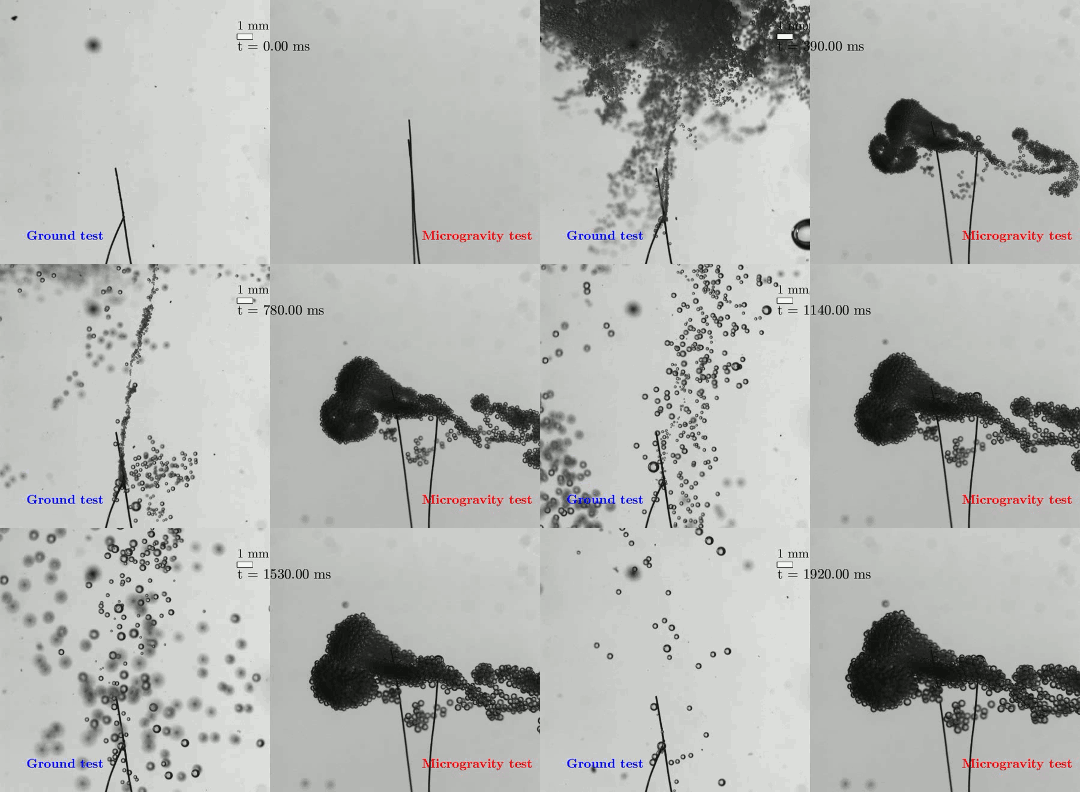
    Bubbly beverages are popular among humans, but there’s surprising complexity underlying their seemingly simply carbonation, as explored in a new Physics Today article. Most drinks get their bubbles from carbon dioxide, which at higher than atmospheric pressures, can stay dissolved inside water and other liquids. When that pressure gets released, any carbon-dioxide-filled gas cavity in the liquid adopts the allowable saturation concentration for the ambient pressure, which sets up a concentration gradient of carbon dioxide  between the liquid and the bubble. That causes carbon dioxide gas to diffuse into the bubbles, making them grow. 

    Here on Earth, those growing bubbles are buoyant, and they form rising plumes of bubbles. They continue gathering carbon dioxide as they rise, making them grow ever larger (lower left). In microgravity, on the other hand, the bubbles congregate where they form and continue growing through diffusion (lower right). This is one reason carbonated beverages are unpopular in space – instead of rising to the surface and escaping, all the carbon dioxide in a drink gets consumed, leaving astronauts with no way to expel it aside from burping!

    For lots more fascinating facts about bubbly drinks – including how they relate to geology! – check out the full Physics Today article. (Image credits: beer – rawpixel; bubbles – P. Vega-Martínez et al.; see also: R. Zenit and J. Rodríguez-Rodríguez)

  • Featured Video Play Icon

    The Tacoma Narrows Bridge

    One of the most dramatic and famous engineering failures of the twentieth century is also one of the most complicated: the collapse of the Tacoma Narrows Bridge. This early suspension bridge earned the name “Galloping Gurtie” from construction workers while it was still being built because its flexibility made it prone to moving up and down under even relatively light winds. That vertical motion was due to vortex-induced vibration. As the wind blew, it shed vortices off the downstream side of the bridge. These vortices alternated, coming off the top and then bottom of the bridge deck. The resulting forces made the bridge shift up and down.

    That wasn’t the bridge’s ultimate downfall, though. Shortly before it collapsed, the bridge stopped flexing up and down and instead twisted back and forth. This was a clear sign that the bridge had moved into aeroelastic flutter. In this situation, you get a feedback loop between the bridge’s aerodynamics and its structural dynamics. When the wind twists the bridge deck to a positive angle of attack, it will try to continue forcing the bridge to twist that direction. The internal forces of the bridge will try to twist it back, but when that happens, it can overshoot and end up at a negative angle of attack. At that point, the wind tries to push it further that direction and internal forces twist it back, overshooting the other way. This back-and-forth can create a dangerous feedback loop where the twisting of the bridge keeps getting worse and worse. In fact, that’s exactly what happened – right up until the bridge collapsed rather than twisting any more. (Video and image credit: Practical Engineering)

  • Nacreous Clouds

    Nacreous Clouds

    During winter, the polar skies can ignite with mother-of-pearl-like iridescence. Polar stratospheric clouds – also known as nacreous clouds – are a rare, beautiful, and destructive type of cloud found only in high latitudes at altitudes of 15 – 25 km. They are formed from tiny crystals of ice and nitric acid, and they shine brightest a few hours before sunrise or after sunset, when sunlight shines on them but not the surface. Their destructive side is connected with ozone depletion; they serve as reaction sites for chlorofluorocarbons in the atmosphere to react and produce ozone-destroying molecules. The clouds may have cultural significance as well; at least one study suggests they were part of Munch’s inspiration for “The Scream”. (Image credit: A. Light; via Gizmodo)

  • Featured Video Play Icon

    “Float”

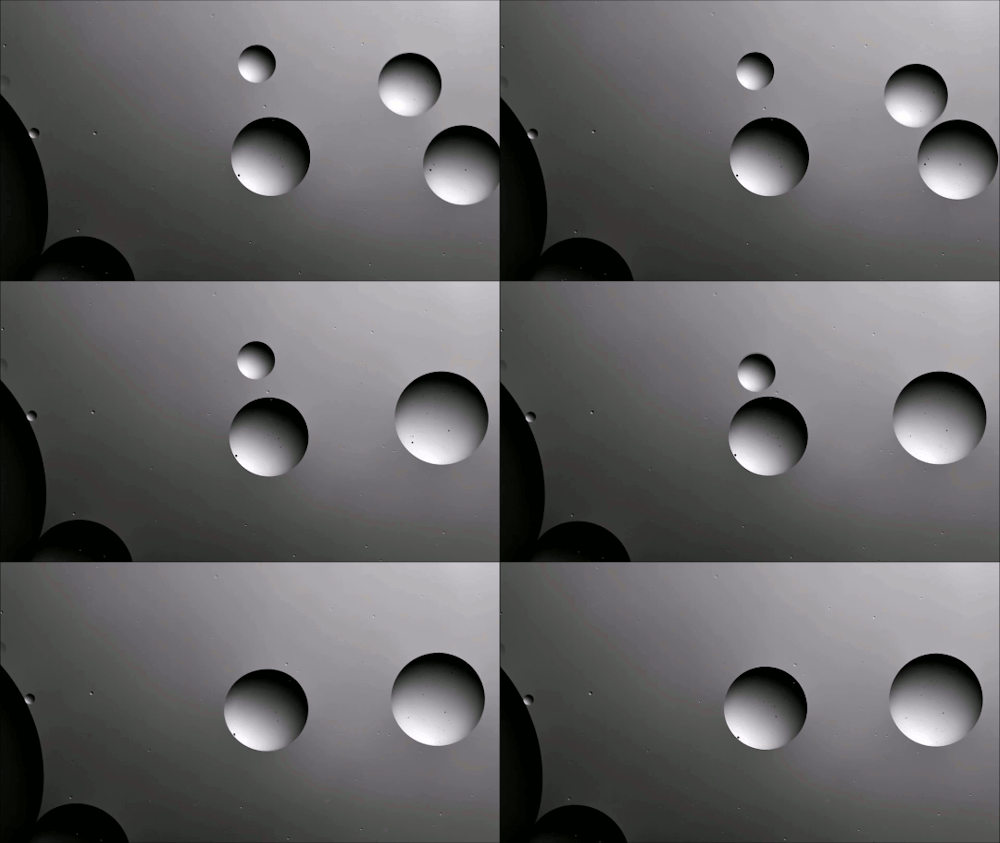
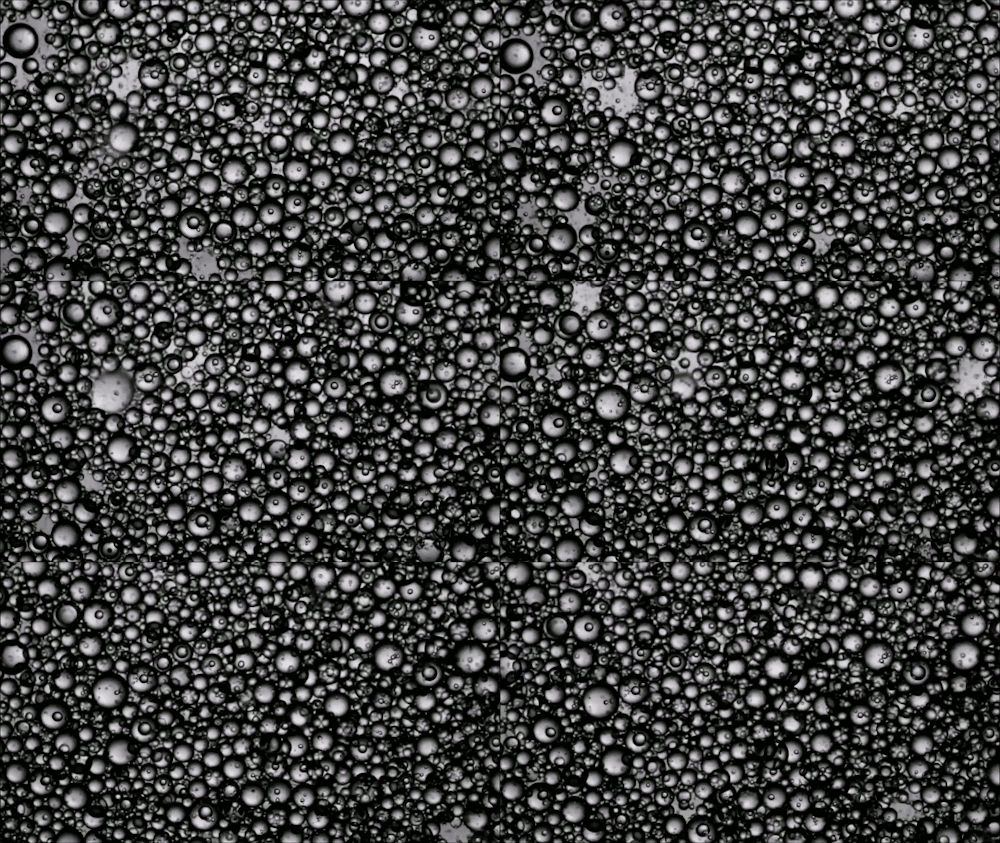
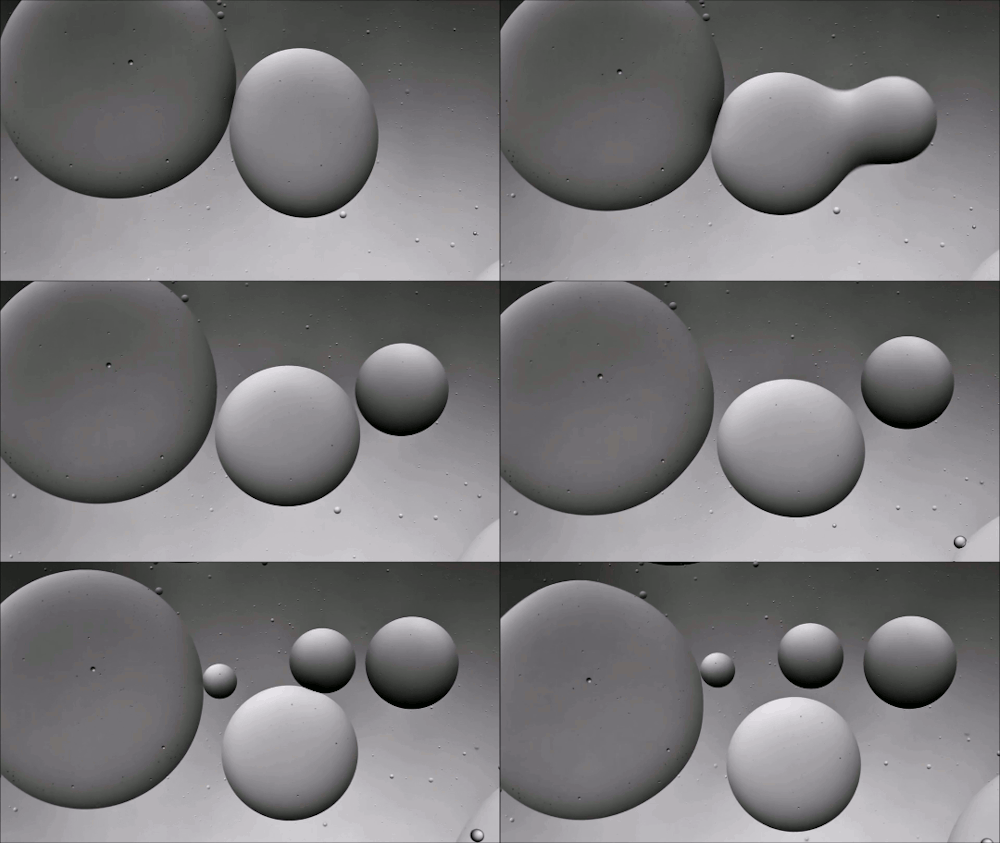
    In “Float” artist Susi Sie uses water and oil to create a whimsical landscape of bubbles and droplets. Coalescence is a major player in the action, though Sie uses some clever time manipulations to make her bubbles and droplets multiply as well. Watching coalescence in reverse feels like seeing mitosis happen before your eyes. (Video and image credit: S. Sie)