Year: 2017

  • Mosquito Flight

    Mosquito Flight

    Mosquitoes are unusual fliers. Their wings are long and skinny, and they beat at around 700 strokes a second – incredibly quickly for their size. Examining how they move has uncovered some interesting mechanics. Despite their short stroke length, the mosquito generates a lot of lift on both its upstroke (when the wing is moving backward) and its downstroke (when the wing moves forward). Some features of the mosquito’s flight are highlighted in the images above. In the animation, blue indicates areas of low pressure and red indicates high pressure.

    Like most flapping fliers, the mosquito generates a leading-edge vortex during its downstroke (and its upstroke). This vortex helps concentrate low pressure on the upward-facing wing surface, thereby creating lift. One of the things that makes the mosquito unique, however, is that it also creates trailing-edge vortices on both half-strokes. To do this, the mosquito rotates its wings precisely to catch the wake of its previous half-stroke. The flow gets trapped near the trailing edge of the wing and forms a vortex and low-pressure region. Like the leading-edge vortex, this low-pressure area on the upward-facing wing surface creates lift. For more secrets of mosquito flight, check out this video from Science or the original paper. (Image credit: R. Bomphrey et al., source)

  • Eroding Candy

    Eroding Candy

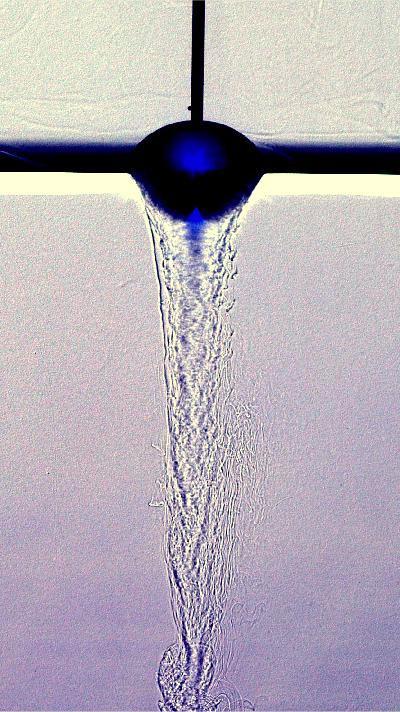
    When you pop a hard candy in your mouth, you probably don’t give much thought to the fluid dynamics involved in dissolving it. The series above shows a hard candy suspended in water being slowly eaten away. As sugars in the candy dissolve into the water, the fluid becomes denser and falls away. This creates the downward flow visible in the center of the image. As sugar-laden water sinks, fresher water is pulled in alongside the walls of the candy. That flow helps erode the candy, creating a rougher surface. Since rough surfaces have a greater surface area exposed (than a smooth surface), they prompt further and faster dissolution. That strengthens the downward flow, pulls in more ambient water, and keeps the whole process going. (Image credit: M. Wykes)

  • Featured Video Play Icon

    Perijove

    The Juno spacecraft continues to send back incredible photos of Jupiter’s atmosphere. This video animates images from the sixth close pass of Jupiter to give you a sense of what Juno sees as it swoops by our system’s largest planet. The trajectory passes from the north pole to the south, showing Jupiter’s whitish zones, dark belts, and massive storms. Up close Jupiter looks like an Impressionist painting, all vortices and shear instabilities. The large white spots you see are enormous counterclockwise rotating vortices known as anticyclones – many of them larger than our entire planet. (Video credit: NASA / SwRI / MSSS / G. Eichstädt / S. Doran)

  • Capillary Action in Microgravity

    Capillary Action in Microgravity

    On Earth, gravity dominates over many fluid effects, but in microgravity a different picture emerges. This animation shows a two-channel apparatus partially filled with silicone oil being dropped. While in free-fall, the liquid experiences microgravity conditions and the height of the fluid in the two connected channels changes. The oil meniscus climbs up the walls of the tubes thanks to capillary action. This is the result of intermolecular forces between the liquid and solid walls. Capillary action is most effective in narrow tubes where surface tension and the adhesion between the liquid and solid can actually propel liquid up the walls, as seen here. On Earth we mostly ignore capillary action, except in very small spaces, but for space systems, it is a major force to reckon with in designing flows. (Image credit: NASA Glenn Research Center, source)

  • Featured Video Play Icon

    Building Labs on a Chip

    In their second video on microfluidics, the Lutetium Project takes viewers inside the process of creating microfluidic circuits, also known as labs-on-a-chip. When you want to build pipes only a few microns across, you need to use special techniques. As the video shows, manufacturing starts with photolithography, a process used to selectively mask parts of the substrate which are then etched away chemically. This creates a mold that’s later covered in a polymer solution. Once hardened, the polymer is removed from the mold, treated and attached to a glass slide. The result is a tiny fluid circuit that’s only a few square centimeters in total size. To really appreciate the process, check out the video, which helpfully takes you inside the clean room to see the chip manufacturing process firsthand. (Video and image credit: The Lutetium Project)

  • Stabilizing Films

    Stabilizing Films

    Liquids don’t typically survive very long as thin films. If you try to make one from water, gravity drains it away immediately. (Not so in space.) To make a liquid film stick around, we add surfactants like soap. These extra molecules congregate at the surface of the film and provide a stabilizing force to oppose gravity’s drainage. Exactly what that stabilizing force is depends on the surfactant.

    Surfactants that are insoluble are often quite viscous. These molecules distribute themselves across the interface and then they stay. They resist both gravity or even just moving thanks to their high viscosity. That produces a soap film pattern like the one on the right – symmetric and slow to change.

    Other surfactants may be soluble in the film and have no appreciable viscosity themselves. These surfactants constantly move and shift on the interface as surface tension variations occur. When weak spots form, the surfactant molecules shift, via the Marangoni effect, to stabilize the film. This creates a film pattern like the familiar one on the right, with an ever-shifting palette of colors. (Image and research credit: S. Bhamla et al., source; submission by S. Bhamla)

  • Inside Ink Jet Printing

    Inside Ink Jet Printing

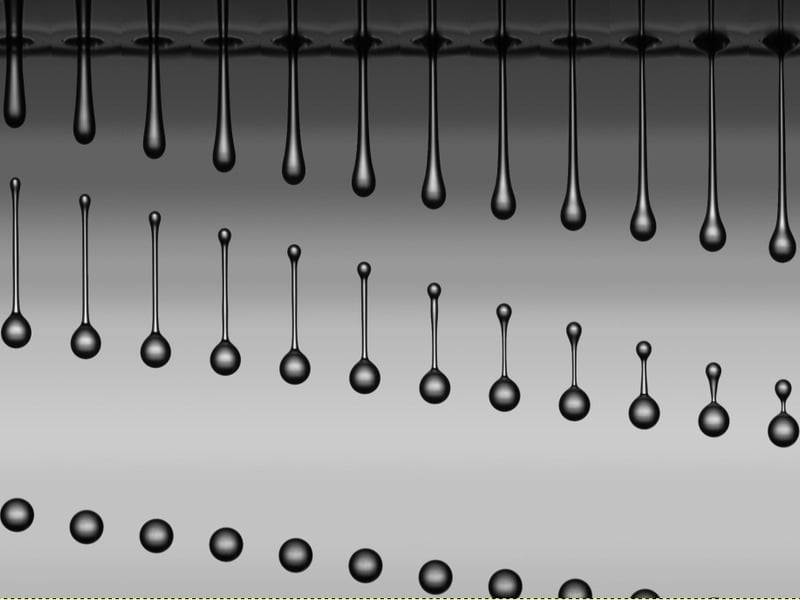
    Inkjet printers produce droplets at an incredible rate. A typical printhead generates droplets that are about 10 picoliters in volume – that is, ten trillionths of a liter – moving at about 4 meters per second. Resolving the formation of those droplets would require ultra-high speed imaging at millions of frames per second. Instead researchers devised an alternative method to capture droplet formation, based on stroboscopic techniques. In this case the strobe is a 7 nanosecond laser pulse (7 billionths of a second) that illuminates a given droplet twice. By doing this for many droplets, the researchers can create a highly detailed time series like the one above, which shows the inkjet breakup and droplet formation. Here each droplet is 23 micrometers wide – about one-third the width of a human hair. (Image credit: A. van der Bos et al., source)

  • Breaking Waves in the Sky

    Breaking Waves in the Sky

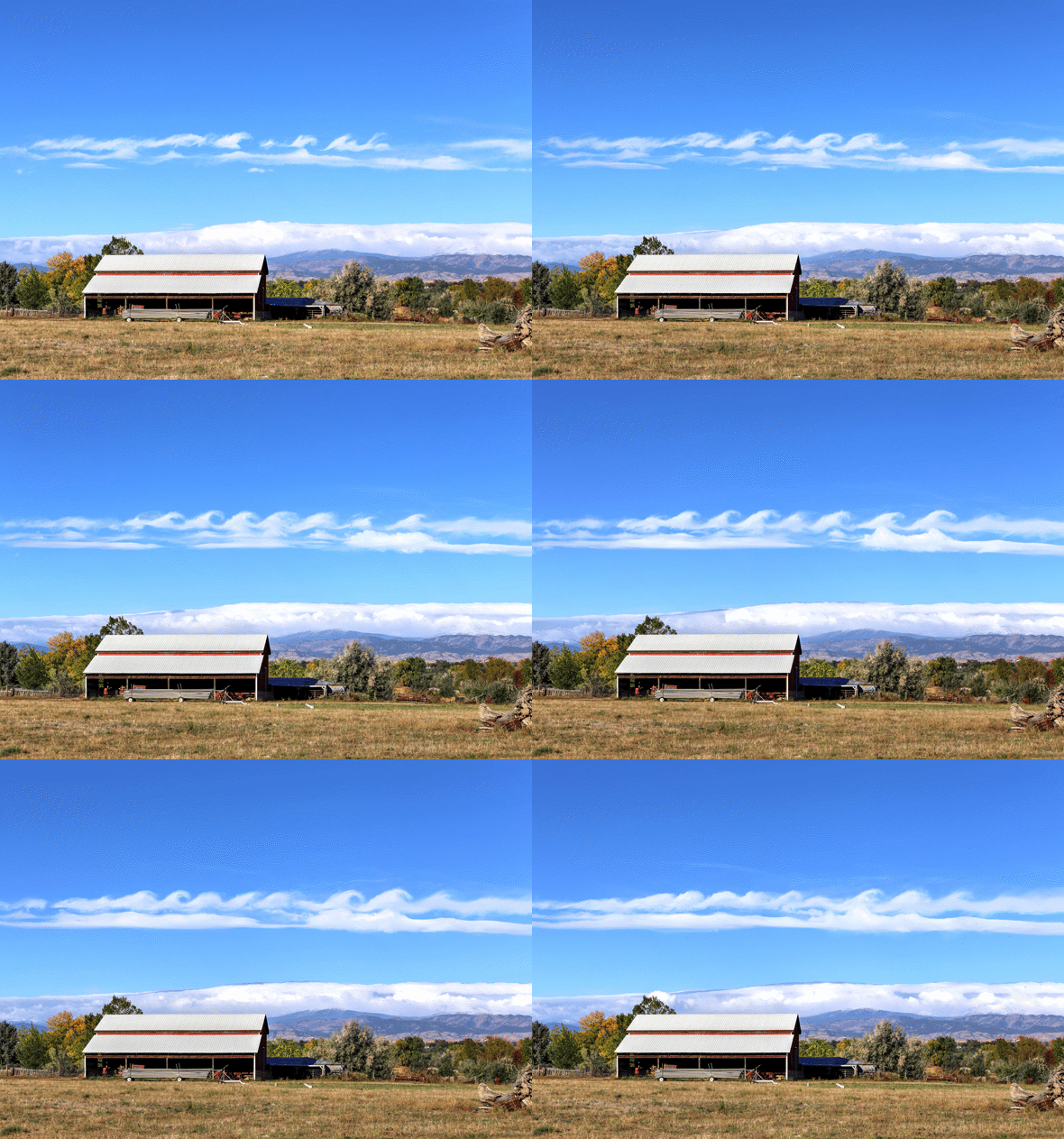
    Under the right atmospheric conditions, clouds can form in a distinctive but short-lived breaking wave pattern known as a Kelvin-Helmholtz cloud. The animation above shows the formation and breakdown of such a cloud over the course of 9 minutes early one morning in Colorado’s Front Range region. Kelvin-Helmholtz instabilities occur when fluid layers with different velocities and/or densities move past one another. Friction between the two layers moving past creates shear and causes the curling rolls seen above.

    In the background, you can also see a foehn wall cloud low to the horizon. This type of cloud forms downwind of the Rocky Mountains after warm, moist Chinook winds are forced up over the mountains, cool, and then condense and sink in the mountains’ wake. (Image credit and submission: J. Straccia, more info)

  • Featured Video Play Icon

    Quad Copter Schlieren

    Schlieren photography is a classic method of flow visualization that utilizes small variations in density (or temperature) to make otherwise unseen air motion visible. Because changing air’s density or temperature changes its index of refraction, variations in either quantity show up as dark and light regions. Here researchers use it to reveal some of the airflow around a small quadcopter, including the vortices that spiral off each propeller and help generate the lift necessary for take-off. The full video includes a couple of neat demos, including what happens when the blades are wet (shown below). In that case, the wingtip vortices are somewhat disrupted by strings of water droplets being flung off the blades by centrifugal force. Beautiful!  (Video and image credit: K. Nolan et al., source; submitted by J. Stafford)

  • A Drip’s Vortex

    A Drip’s Vortex

    Drip food coloring into water and you can often see a torus-shaped vortex ring after the drop’s impact. That vortex rings form during droplet impact has been well known for over a century, but only recently have we begun to understand the process that leads to that vortex ring. Part of the challenge is that the vortex formation is very small and very fast, but recent work with x-ray imaging has allowed experimentalists to finally capture this event.

    When a drop impacts a pool, surface tension draws some of the pool liquid up the sides of the drop. At the same time, the impact causes ripple-like capillary waves down the sides of the drop. This causes pool liquid to penetrate sharply into the drop, triggering the spirals that mark the forming vortex ring. When drops impact with even higher momentum, multiple vortex spirals can form, as seen on the lower right image. The authors observed as many as four rings during an impact. For more, check out the (open access) article.  (Image and research credit: J. Lee et al., source)