If you’ve ever clapped near a wall with a corrugated surface, you may have noticed some strange echoes. Surfaces like these can cause a chirping sound to observers. The reason, as Nick Moore explains in the video above, is that the original sound reflects off the corrugations at different times and travels back to the observer such that the first reflections to arrive are closely spaced (and thus higher pitched) while the later reflections are spread further out. This creates a chirp that starts at a high pitch and then falls to lower ones. Have you ever come across structures that do this? (Video credit: N. Moore)
Year: 2017

“Fractal”
Timelapses are a wonderful way to capture the power and majesty of storms like the supercell thunderstorms featured in Chad Cowan’s “Fractal”. The video contains snapshots from six years’ worth of storms over the US’s Great Plains. The highlights include some spectacular mammatus clouds (0:30) and excellent billowing cloud formation (1:27) with turbulence every bit as towering as that of a volcanic plume. June is one of the best months for amazing storms in the Great Plains, largely thanks to the atmospheric mixing that occurs over the Rocky Mountains. If you have the opportunity to witness these amazing natural displays, enjoy it, but be safe! (Video credit: C. Cowan; image via Colossal)


Schooling in Soap Films
In sports, flocks of birds, and schools of fish, we’re accustomed to thinking that the followers get an aerodynamic or hydrodynamic advantage over the leaders, but this may not always be the case. Here are two flags placed one after another in a soap film flowing from top to bottom. The flags are passive, meaning that their motion is entirely dependent on the flow around them; they cannot exert any resistive force of their own. In this case, scientists observe an effect known as inverted drafting. The lead flag actually experiences less drag – by as much as 50% – than the following flag. This seems to be a result of flow around the second flag having an upstream influence on the motion of the first. (Image and research credit: L. Ristroph and J. Zhang, pdf)

How Cycling Position Affects Aerodynamics


New FYFD video! How much does a rider’s position on the bike affect the drag they experience? To find out I teamed up with folks from the University of Colorado at Boulder and at SimScale to explore this topic using high-speed video, flow visualization, and computational fluid dynamics.
Check out the full video below, and if you need some more cycling science before the Tour de France gets rolling, you can find some of my previous cycling-related posts here. (Image and video credit: N. Sharp; CFD simulation – A. Arafat)
ETA: Please note that the video contained in this post was sponsored by SimScale.

Watching Radiation
We’re used to radiation being invisible. With a Geiger counter, it gets turned into audible clicks. What you see above, though, is radiation’s effects made visible in a cloud chamber. In the center hangs a chunk of radioactive uranium, spitting out alpha and beta particles. The chamber also has a reservoir of alcohol and a floor cooled to -40 degrees Celsius. This generates a supersaturated cloud of alcohol vapor. When the uranium spits out a particle, it zips through the vapor, colliding with atoms and ionizing them. Those now-charged ions serve as nuclei for the vapor, which condenses into droplets that reveal the path of the particle. The characteristics of the trails are distinct to the type of decay particle that created them. In fact, both the positron and muon were first discovered in cloud chambers! (Image credit: Cloudylabs, source)

Glacial Remains
The high walls of this alpine canyon were cut by flowing glacial ice. This type of amphitheater-shaped valley is known as a cirque. The photo shows one of the Chicago Lakes on Mount Evans in the Colorado Rockies. The glacier that once sat here carved the steep walls you see in the background but also hollowed out a series of depressions like the ones shown in the figure below. When temperatures warmed and the glacier melted, it left behind a series of three small lakes, or tarns, like the one in the photo above. Cirques are found throughout the mountain ranges of the world. (Image credit: Mt. Evans – J. Shoer; cirque formation – DooFi)


Tendrils of Fog
Fog snakes its way from the ocean into the Strait of Juan de Fuca in this animation constructed from satellite imagery. The strait lies between Vancouver Island and the Olympic Peninsula in the Pacific Northwest. Fogs like this form when skies are clearer and heat from the surface is able to escape upward. The surface air then cools and condenses into fog. Steady winds pushed fog into the strait over the course of about 9 hours. There’s a remarkable level of detail in the satellite images, taken by the new GOES-16 satellite that launched in late 2016. Notice the ragged wave front as the fog stretches eastward and the shock-wave-like lines behind it in the strait. Both result from interactions between the fog cloud and the shape of the land masses it’s encountered. (Image credit: NASA Earth Observatory)

Cavitating
Cavitation happens when the local pressure in a liquid drops below its vapor pressure. A low-pressure bubble forms, typically very briefly, when this occurs. These bubbles are spherical unless they form near a surface. In that case, the bubbles take on a flatter, oblong shape. As they collapse, the bubbles form a jet, like the one seen inside the bubble above. The jet extends through the bubble and stretches into a funnel shaped protrusion on the bubble’s far side. Eventually, the whole shape becomes unstable and breaks into many smaller bubbles. Shock waves can be generated in the collapse, too; often the jet generates at least two in addition to the ones created when the bubble reaches its minimum size. This is part of why cavitation can be so destructive near a surface. (Image credit: L. Crum)
“Galaxy Gates”


Viewing fluids through a macro lens makes for an incredible playground. In “Galaxy Gates”, Thomas Blanchard and the artists of Oilhack explore a colorful and dynamic landscape of paint, oil, and glitter. The nucleation of holes and the breakdown of sheets to filaments and droplets plays a major role in the visuals. The surface layer is constantly peeling away to reveal what’s going on underneath. In many cases this initial motion settles into a field of oil-rimmed droplets floating like planets against a colorful galactic backdrop. Watch carefully in the second half of the video, and you can even catch a few instances of a stretched ligament of fluid breaking into a string of satellite drops, like at 1:51. Check out some of Blanchard’s previous work here and here. (Video credit: Oilhack and T. Blanchard; GIFs and h/t to Colossal)

Flow in a Turbine
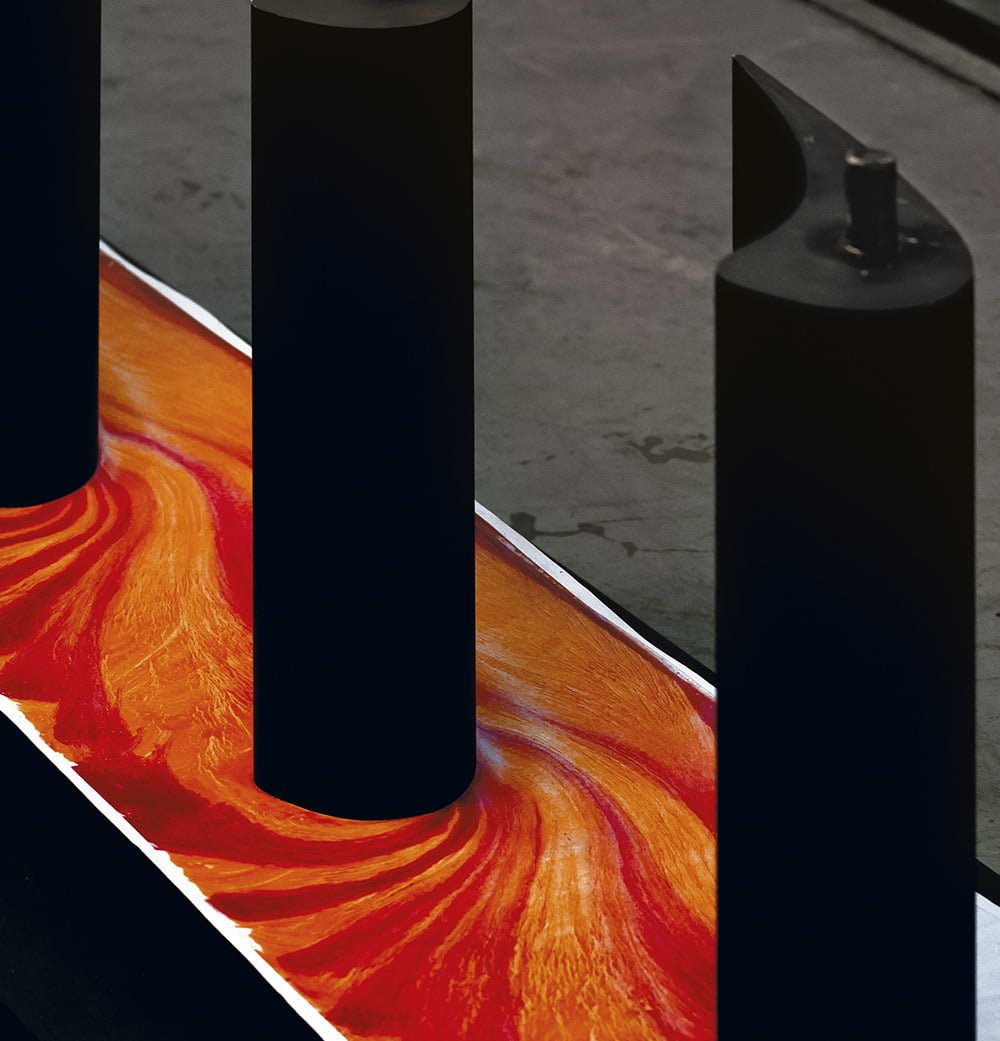
Fluid flows are complex, complicated, and ever-changing. Researchers use many techniques to visualize parts of a flow, which can help make what’s happening clearer. One technique, shown above, uses oil and dye to visualize flow at the surface. The vertical, black, airfoil-shaped pieces are stators, stationary parts within a turbine that help direct flow. After painting the stator mount surface with a uniform layer of oil, the model can be placed in a wind tunnel (or turbine) and exposed to flow. Air moving around the stators drags some of the oil with it, creating the darker and lighter streaks seen here. Notice how the lines of oil turn sharply around the front of the stator and bunch up near its widest point. Those crowded flow lines tell researchers that the air moves quickly around this corner. (Image credit: D. Klaubert et al., source)