Month: June 2016

  • Denticles and Sharkskin

    Denticles and Sharkskin

    Look closely enough at a shark’s skin, and you will find it is covered in tiny, anvil-shaped denticles (lower left). To try and discover how and why these denticles help sharks, researchers are 3D printing denticles in different patterns onto flexible sheets to create biomimetic shark skin (lower right). 

    They test the artificial shark skin in a water tunnel by moving it with prescribed motions and measuring different characteristics, like the swimming speed attained and the power required. When compared to a smooth but flexible control surface, one pattern came out ahead. The staggered-overlapped denticle pattern (shown in C of the lower right figure) achieved swimming speeds 20% higher than the smooth control despite having far more surface area due to the denticles. The cost of that speed was only 13% greater than the smooth case on average, and was about equal to the smooth case for small amplitude motion. This suggests that the patterning of a shark’s skin may help it swim faster with little to no additional cost in effort.

    For more on shark hydrodynamics, check out my previous posts on the topic, and if you want even more shark science, check out these great videos. (Image credit: R. Espanto; J. Oeffner and G. Lauder; L. Wen et al.; research credit: L. Wen et al., 1, 2)

  • Resonating Bowls

    Resonating Bowls

    Rub your hands on the handles of a Chinese resonance bowl and you can generate a spray of tiny droplets. The key to this, as the name suggests, is vibration. Rubbing the handles vibrates the bowl, causing small oscillations in the bowl’s shape that are too small for us to see. But those vibrations do produce noticeable ripples on the water in the bowl. When you hit the right frequency and amplitude, those vibrations disturb the water enough that the up-and-down vibration at the surface actually ejects water droplets. The vibration of the bowl affects water near the wall most strongly, which is why that part of the bowl has the strongest reaction. It takes even larger amplitude vibrations to get droplets jumping in the middle of the bowl, but you can see that happening in this video of a Tibetan singing bowl. (Image/video credit: Crazy Russian Hacker, source)

  • Rayleigh-Taylor Waves

    Rayleigh-Taylor Waves

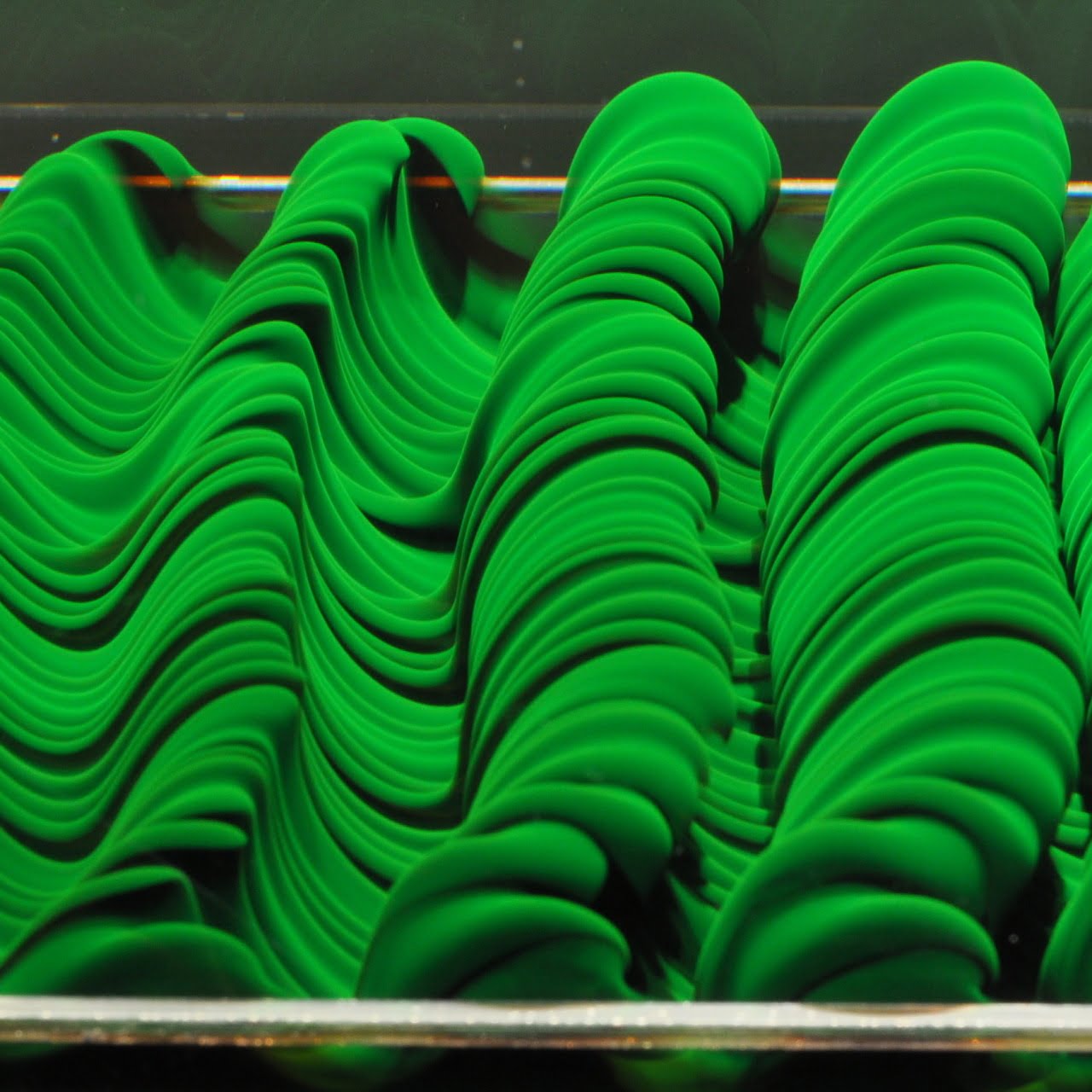
    Here on Earth, placing a denser fluid over a lighter one creates an unstable equilibrium. Thanks to gravity, the heavier, denser fluid wants to sink and the lighter fluid wants to rise. Any small disturbance will kick this into action, just like a tiny nudge can send a ball rolling down the hill. For the fluid, that nudge manifests as waviness in the interface between the two fluids. That waviness will quickly grow into billows like those shown above as the Rayleigh-Taylor instability takes over and the heavy (clear) fluid trades places with the lighter (green) fluid. You’ve probably witnessed this effect yourself when pouring milk into iced coffee. To see it in action, check out the video of this experiment or my FYFD video on the Rayleigh-Taylor instability. (Image credit: M. Davies Wykes)

  • Reader Question: Splashes

    Reader Question: Splashes

    Reader effjoebiden asks:

    So is the crown splash the curving wave of water on either side of the tire, the spikes of water in the middle behind the tire, or both? And is the Worthington jet also the same phenomenon that can happen with a massive meteorite impact?

    Here the term “crown splash” refers to the curving sheets of water spreading on either side of the tire. Those liquid sheets (or lamella) break down at the edges into spikes and droplets just like the ones seen when a drop falls into a pool, which is the traditional source of the term “crown splash” because it resembles a crown.

    And, yes, enormous meteor impacts can create Worthington jets (that column of fluid that pops up after a droplet impacts)! This is why some craters have peaks in the middle. There are actually some surprising similarities between meteor impacts and fluid dynamics.

    (Image credits: S. Reckinger et al., original post)

  • Featured Video Play Icon

    Sublimation

    Sublimation is a transition directly from a solid phase to a gaseous one. Given typical Earth atmospheric conditions, one of the most commonly observed examples of sublimation is that of solid carbon dioxide, a.k.a. dry ice. Submerging dry ice in water both speeds up the sublimation–since water is a better conductor of heat than air–and creates ethereal fog that’s a combination of the expanding carbon dioxide and condensate from the water. This gorgeous video from Wryfield Lab lets you admire the process close-up. As the dry ice sublimates, watch for the ice crystals that grow on its surface. This is deposition–the opposite of sublimation–and comes from water vapor freezing onto the dry ice. (Video credit: Wryfield Lab; via Gizmodo)

    A warning for those who want to try this at home: only do this in well-ventilated spaces. The shift from solid to gas requires a huge increase in volume. Carbon dioxide is denser than air, so it does stay low to the ground, but you can still suffocate yourself (or children or pets) if you do this in an enclosed space.

  • Daily Fluids, Part 4

    Daily Fluids, Part 4

    Inside or outside, we encounter a lot of fluid dynamics every day. Here are some examples you might have noticed, especially on a rainy day:

    Worthington Jets
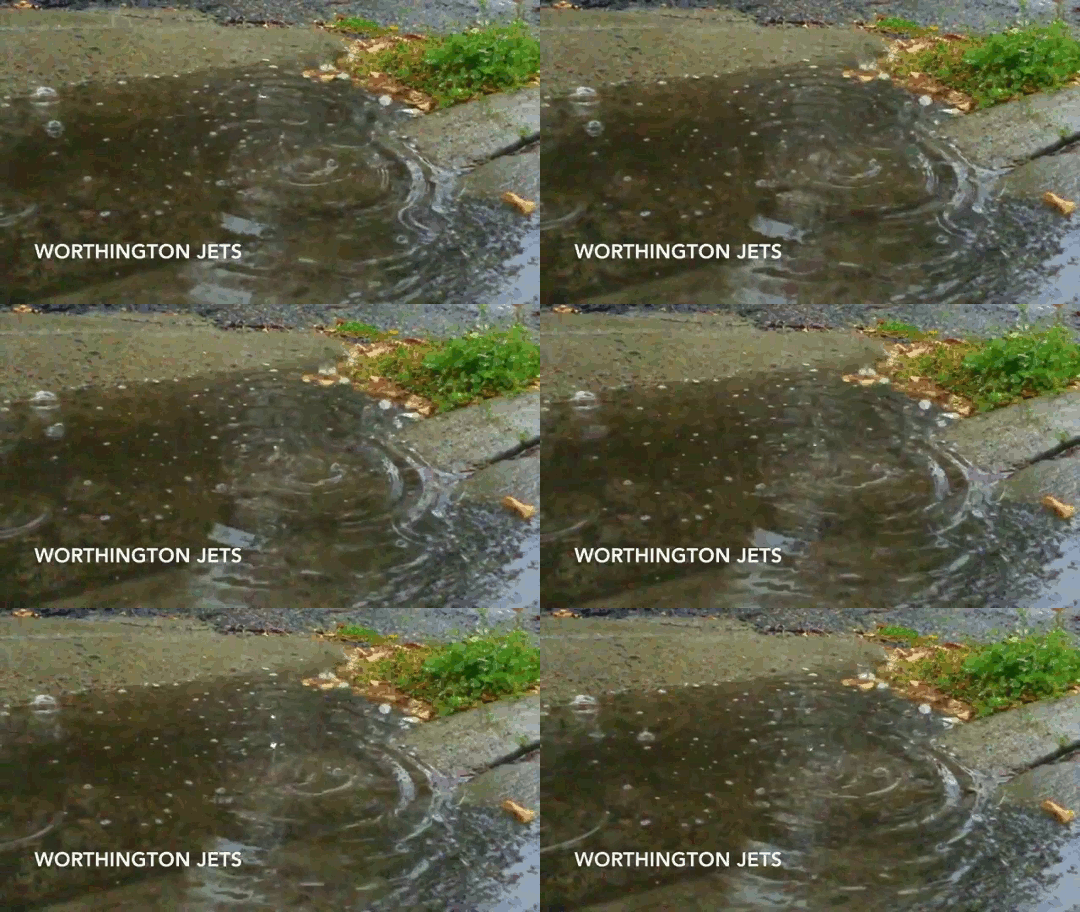
    After a drop falls into a pool, there’s a column-like jet that pops up after it and sometimes ejects another small drop. This is known to fluid dynamicists as a Worthington jet, but really it’s something we all see regularly, especially if you watch rain falling onto puddles or look really closely at your carbonated drink.

    Crown Splash
    Like the Worthington jet, crown splashes often follow a drop’s impact into another liquid. But they can also show up when slicing or stomping through puddles!

    Free Surface Dynamics
    Anytime you have a body of water in contact with a body of air, fluid dynamicists call that a free surface. How the interface between the two fluids shifts and transforms is fascinating and complicated. Waterfalls are a great example of this, but so are ocean waves or even the ripples from tossing a rock into a pond.

    Hydrophobic Surfaces
    Water-repellent surfaces are called hydrophobic. Water will bead up on the surface and roll off easily. While many manmade surfaces are hydrophobic, like the teflon in your skillet, so are many natural surfaces. Many leaves are hydrophobic because plants want that water to fall to the ground where their roots can soak it up. Keep an eye out as you wash different vegetables and fruits and see which ones are hydrophobic!

    Check out all of this week’s posts more examples of fluid dynamics in daily life. (Image credit: S. Reckinger et al., source)

  • Daily Fluids, Part 3

    Daily Fluids, Part 3

    A lot of the fluid dynamics in our daily lives centers around the preparation and consumption of food. (And in its digestion afterward, but that’s another story!) Here are a few examples of fluid dynamics you might not have realized you’re an expert on:

    Low Reynolds Number Flows
    This is a fancy way of discussing the motion of syrup, honey, and other thick and viscous fluids we interact with in our lives. These flows are typically slow moving and exhibit some neat properties like coiling or being possible to unstir.

    Immiscible Fluids
    Oil and water don’t mix, a fact anyone familiar with salad dressings or marinades is well aware of. The way around this is to shake them up! This disperses droplets of the oil within the water (or vinegar or whatever) to create an emulsion. While not truly mixed, it does make for more pleasant eating.

    Multiphase Flows
    Multiphase flows are ones containing both liquid and gaseous states. Boiling is an example we often see in our daily lives, though carbonated beverages, water sprayers, and sneezes are other common ones.

    Leidenfrost Effect
    The Leidenfrost effect occurs when liquid is introduced to a surface that is much, much hotter than its boiling point. Part of the liquid instantly vaporizes, leaving droplets to skitter around on a thin vapor layer. This is most often seen around the stove and in skillets. (And, yes, it does qualify as a multiphase flow!)

    Tune in all week for more examples of fluid dynamics in daily life. (Image credit: S. Reckinger et al., source)

    P.S. – I’m at VidCon (@vidconblr) this year! If you are, too, come say hi and get an FYFD sticker 😀

  • Daily Fluids, Part 2

    Daily Fluids, Part 2

    We play with fluid dynamics all the time, though we don’t always think of it as such. Here are a few ways it shows up in the ways we play:

    Aerodynamics
    This is the study of air moving past an object.  Whether you’re throwing a paper plane, flying a kite, or riding a bike, aerodynamics has an impact on what you’re doing.

    Lift
    Skipping a rock won’t work unless its impact generates some lift, but we see lift in lots of other places, too, from birds and planes to racecars and sailboats.

    Magnus Effect
    The Magnus effect relates to lift forces on a spinning object. It can affect the way a frisbee flies, but we see it a lot in ball-related sports, too. The flight of golf balls, volleyballs, baseballs, and soccer balls can all be significantly impacted by the Magnus effect. Check out these videos for a primer on the Magnus effect and the reverse Magnus effect.

    Bubbles
    Everybody loves playing with bubbles. But they may have more of a impact than you realize, whether it’s in making the foam on your latte, enhancing the aroma of your champagne, or making your joints pop.

    Tune in all week for more examples of fluid dynamics in daily life. (Image credit: S. Reckinger et al., source)

  • Daily Fluids, Part 1

    Daily Fluids, Part 1

    Just getting cleaned up and ready for the day involves a lot of fluid physics. Here are a few of the phenomena you may see daily without realizing:

    Plateau-Rayleigh Instability
    This behavior is responsible for the dripping of your faucet. More specifically, it’s the reason that a falling jet breaks up into droplets. It works on rain, too!

    Forced Convection
    Everyone is familiar with a winter wind making them colder or hot air from a dryer getting the moisture off their hands. These are examples of forced convection – heat transfer by driving a fluid past a solid. Another common example? The fans in your computer!

    Liquid Atomization
    This is the process of breaking a liquid into lots of tiny droplets. Aside from any aerosol can ever, this phenomenon is also key to your daily shower and internal combustion in your car.

    Archimedes Principle
    This might be one of my favorite bits of the whole video because it hearkens back to some of my own earliest fluid dynamics exposure. Archimedes Principle says that buoyancy is equal to the weight of the fluid a body displaces. My mom (a science teacher) taught me about this one in the bathtub! It’s key to everything that ever floated, including us!

    Tune in all week for more examples of fluid dynamics in daily life. (Image credit: S. Reckinger et al., source)

  • Featured Video Play Icon

    A Day in the Life of a Fluid Dynamicist

    Today I’m sharing one of my favorite videos from last year’s Gallery of Fluid Motion. It’s a short film entitled “A Day in the Life of a Fluid Dynamicist.” Although some parts of it probably only apply to fluid dynamicists (Navier-Stokes equations, anyone?) a lot of the activities depicted are common to everyone. The film does a nice job of highlighting some of the many examples of fluid dynamics that we come across in our daily lives. As a film by scientists made for scientists, though, you may find some of the terminology obscure. Never fear! This week on FYFD, I’ll be breaking down some of the film’s segments, explaining what they mean, and showing you just how much fluid dynamics you experience every day! (Video credit: S. Reckinger et al.)