Month: January 2016

  • Featured Video Play Icon

    Pluto: Subsurface Convection

    Pluto’s rich and unexpected surface features indicate the dwarf planet is still geologically active. This is one of the largest surprises of the New Horizons mission because it was assumed that Pluto was too small, too isolated, and too old for such activity. Instead, its cryovolcanoes and surface convection cells point to significant and vigorous convection in Pluto’s mantle, likely heated by the decay of radioactive elements in its core. The simulation above shows a representation of mantle convection on Earth, simulated over billions of years.

    Mantle convection is described by the dimensionless Rayleigh number, which compares the effects of thermal conduction to those of convection. Above a fluid’s critical Rayleigh number, convection is the driving process in heat transfer. In Pluto’s case, if one assumes a mantle of pure water ice, the Rayleigh number is about 1600, barely enough to surpass the critical point where convection dominates. If, instead, one assumes a mantle containing 5% ammonia, the resulting composition has a Rayleigh number of more than 10,000–well past the critical point and large enough to support the vigorous convection necessary to explain Pluto’s surface features.  (Video credit: W. Bangerth and T. Heister; Pluto research credit: A. Trowbridge et al.; via Purdue University)

    This concludes FYFD’s week of exploring Pluto’s fluid dynamics. You can see previous posts in the series here.

  • Pluto: Convection in Sputnik Planum

    Pluto: Convection in Sputnik Planum

    The icy plain of Sputnik Planum, located in Pluto’s heart-shaped Tombaugh Reggio, is criss-crossed with troughs that divide the plain into polygons.  The current interpretation of these features is that they are the result of thermal convection. As with Rayleigh-Benard convection cells on Earth, the interior of the polygons is formed by the upwelling of warmer, buoyant material, and the troughs between cells mark locations where cooled material convects back into the mantle. On Pluto, these cells consist of nitrogen ice (and occasional water ice like the dirty black chunk seen in the upper right photo) that slowly rises and sinks from the planet’s surface, constantly refreshing the surface features. This would explain why Sputnik Planum is missing evidence of typical older features like impact craters. (Image credits: NASA/JHU APL/SwRI)

    Join FYFD all this week for a look at fluid dynamics and planetary science on Pluto! Check out the previous posts here.

  • Pluto: Cryovolcanoes

    Pluto: Cryovolcanoes

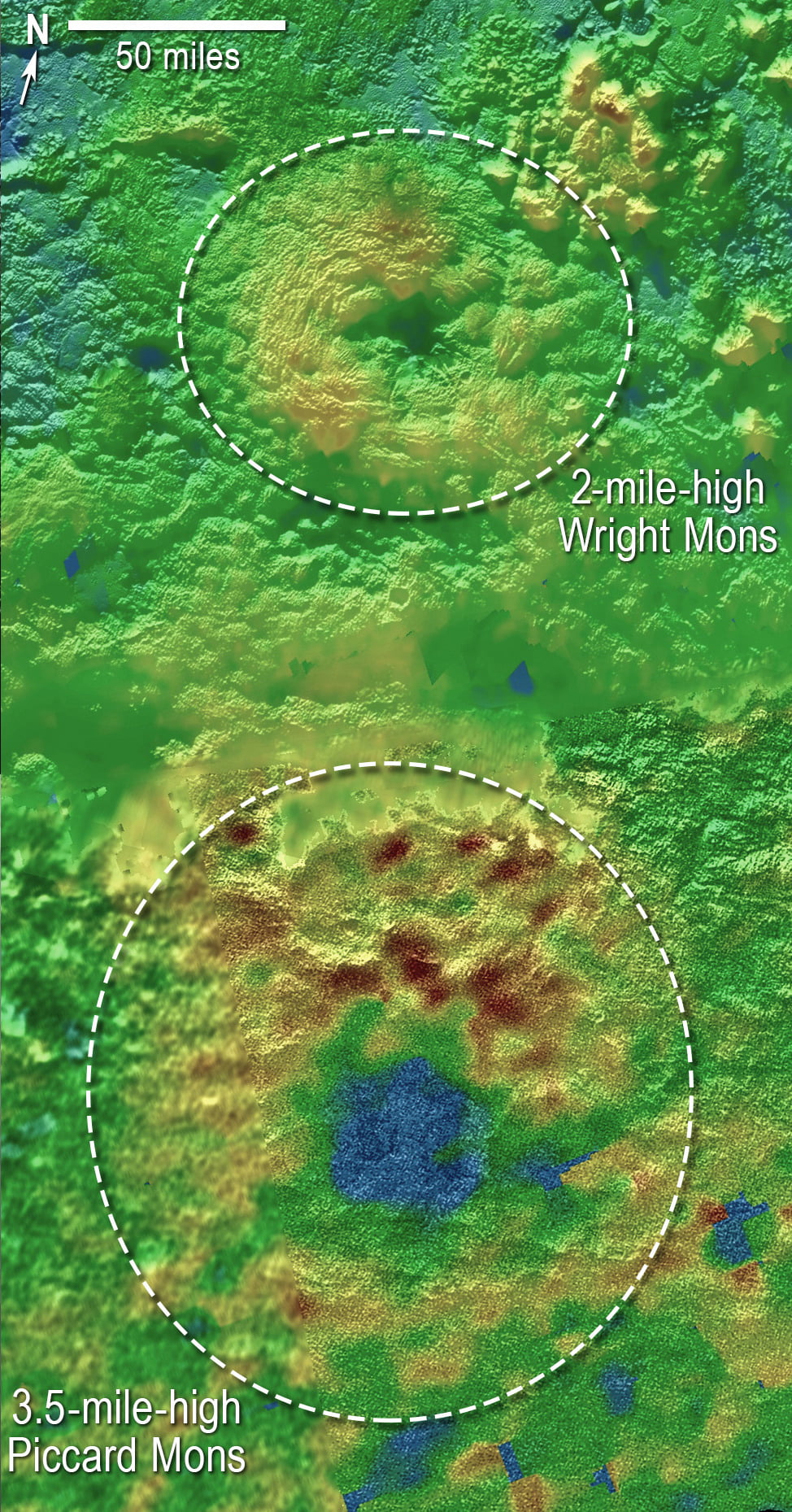
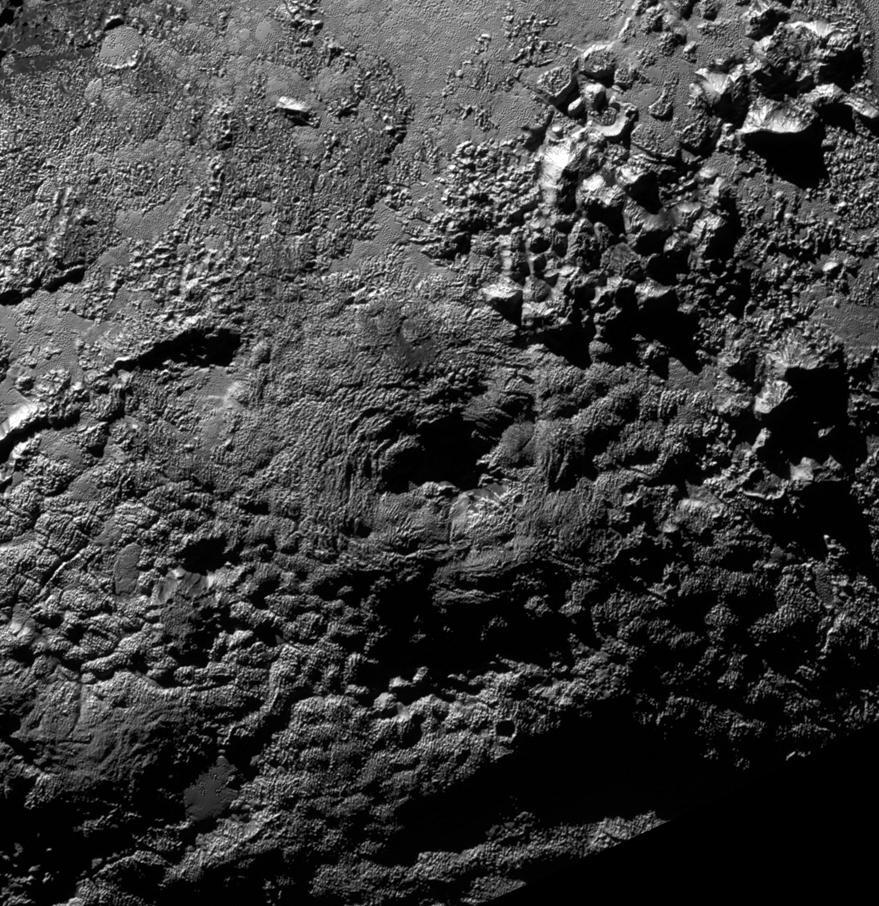
    Since its flyby last summer, NASA’s New Horizons mission has had planetary scientists questioning all our assumptions about Pluto and its fellow cold, icy worlds on the outskirts of the solar system. The two mountainous features above, the 4-km tall Wright Mons and 5.6-km tall Piccard Mons, are part of the mystery. Both mountains have a large depression in the middle, and their appearance from orbit is consistent with volcanoes seen on Earth and other planets. But instead of rock, these mountains are formed from water ice, and rather than spewing hot magma, it’s believed that these mountains are cryovolcanoes that erupt with a slurry of water, nitrogen, ammonia, or methane. Since no active eruptions were recorded during the flyby, scientists cannot be certain of the hypothesis, but it does explain the observed features. Check out the video below for a terrestrial demonstration of a “cryovolcano”. (Photo credits: NASA/JHU APL/SwRI; video credit: A. Cheri/U. Wash)

    Join FYFD all this week for a look at the fluid dynamics and planetary science of Pluto!

  • Melted Polymers

    Melted Polymers

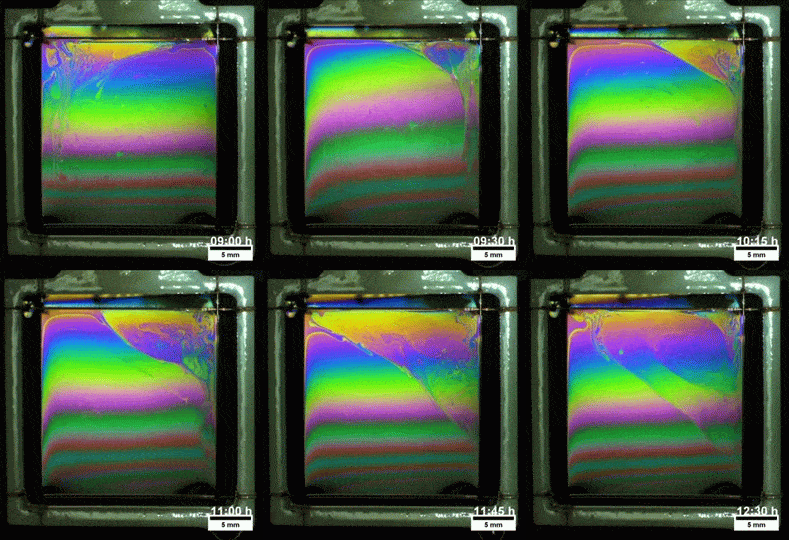
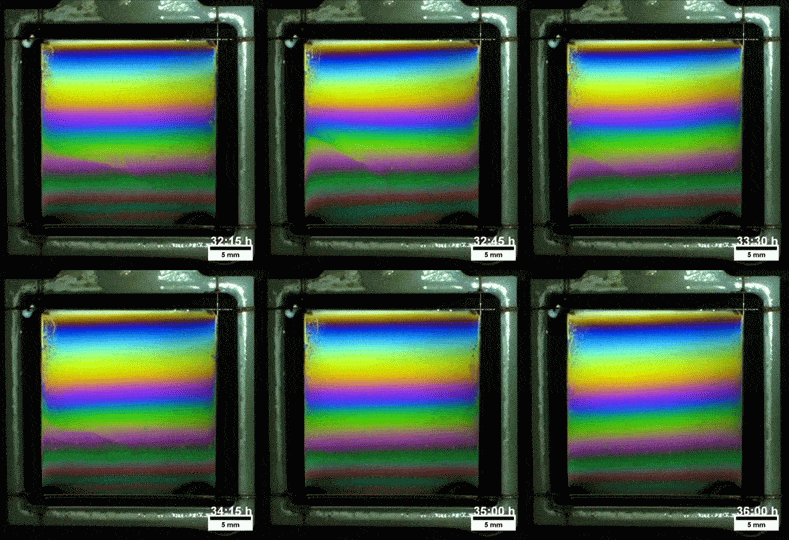
    What you see here, despite appearances, is not a soap film. On the contrary, this is a thin vertical film made up of melted polymers. Like a soap film, it is extremely thin, varying from a few nanometers at its thinnest to several hundred nanometers at the thickest point. But unlike a freestanding soap film, this polymer film can last for more than a day before the film breaks. Researchers attribute the long life of the films to structural forces inside the fluid.

    They observed that the films remain highly stratified, varying smoothly in thickness from their thinnest point at the top to the thickest point at the bottom. They hypothesize that the geometry of the film preferentially traps the polymer’s molecules in preferred orientations, which reinforces the stratification and helps stabilize the film. For more, check out the research paper. (Image credit: T. Gaillard et. al., source; via KeSimpulan)

  • Featured Video Play Icon

    Perching Physics

    Compared to birds, manmade aircraft tend to be quite limited and inelegant. Fixed-wing aircraft, for example, require long, flat areas for take-off and landing, whereas birds of all sizes are adept at maneuvers like perching. This video examines the perching behaviors of large birds and extends the physics to a small unmanned aerial vehicle (UAV). As a bird approaches a perching location, it pitches its body and wings upward. This places the bird in what’s known as deep stall, where air flowing over the upper surface of the wing separates just after the leading edge. This move dramatically increases drag on the bird, slowing it for landing. At the same time, the speed of the pitch maneuver generates a vortex on the wing that helps the bird maintain lift despite the drop in speed. With the help of both forces, the bird can make a graceful, controlled landing in only a short distance. (Video credit: J. Mitchell et. al.)

  • Beach Cusps

    Beach Cusps

    This composite photo shows the arc of the sun over Lulworth Cove in England during the December solstice. The low sun angle reveals a distinctive circular diffraction pattern of waves inside the cove. Along the shoreline, the beach has eroded into a regular, arc-like pattern known as beach cusps. Although there are multiple theories about how cusps form, their pattern is self-sustaining. They consist of a horn of coarse materials that projects into the water and an arc of finer sediments called an embayment. When incoming waves hit the horn, they slow down, depositing heavier coarse sediment on the horn while lighter, fine particles are carried further ashore. (Image credit: C. Kotsiopoulos; via APOD; submitted by jshoer)

  • The Best of FYFD 2015

    The Best of FYFD 2015

    2015 was a pretty good year. FYFD turned five, we had a great reader survey response, and Tumblr gave us a Tumblr Lifetime Achievement! Guess that means I’ve got more in common with Wil Wheaton and the New York Public Library than my lifelong obsession with books. 

    Without further ado, I give you the top 10 FYFD posts of 2015:

    1. The secret of the dancing droplets
    2. The open siphon and self-pouring liquids
    3. Fingers of sea foam
    4. The physics of rain drops falling on a puddle
    5. Fin-like Kelvin-Helmholtz clouds in the Galapagos
    6. A fish swimming in microgravity
    7. Hawaiian lava waterspouts
    8. Colorado’s Kelvin-Helmholtz clouds
    9. Delicious fluid dynamics in the kitchen
    10. Inside of a fluidic oscillator

    Thanks for a great year, readers, and stay tuned. There are exciting developments afoot for 2016!

    (Image credits: N. Cira et al., Ewoldt Research Group, L. Meudell, K. Weiner, C.Miller, IRPI LLC, B. Omori, Breckenridge Resort, Buttery Planet, M. Sieber et al.)