Icing is a major problem for aircraft. When ice builds up on the leading edge of a wing it creates major disruptions in flow around the wing and can lead to a loss of flight control. One of the important factors in predicting and controlling ice building up is knowing when and where water droplets will freeze. The video above shows how surface conditions on the wing affect how an impacting droplet freezes. On a subzero hydrophilic surface, a falling droplet spreads and freezes over a wide area, which would hasten ice buildup. A hydrophobic surface is slightly better, with the droplet freezing over a smaller area, whereas a superhydrophobic surface shows no ice buildup. Unfortunately, at present superhydrophobic surfaces and surface treatments are extremely delicate, making them unsuitable for use on aircraft leading edges. (Video credit: G. Finlay)
Month: October 2014

“Cymatic Sun”
“Cymatic Sun” from artist Lachlan Turczan uses vibrating fluids to generate mesmerizing and surreal visuals. At some points distinct Faraday waves are visible on the surface. At other times, there is simply a blur of motion and refracted light. Check out my “fluids as art” tag for many more great examples of fluid dynamics and art merging. (Video credit and submission: L. Turczan)
Shooting Droplets with Lasers
Last week we saw what happens when a solid projectile hits a water droplet; today’s video shows the impact of a laser pulse on a droplet. Several things happen here, but at very different speeds. When the laser impacts, it vaporizes part of the droplet within nanoseconds. A shock wave spreads from the point of impact and a cloud of mist sprays out. This also generates pressure on the impact face of the droplet, but it takes milliseconds–millions of nanoseconds–for the droplet to start moving and deforming. The subsequent explosion of the drop depends both on the laser energy and focus, which determine the size of the impulse imparted to the droplet. The motivation for the work is extreme ultraviolet lithography–a technique used for manufacturing next-generation semiconductor integrated circuits–which uses lasers to vaporize microscopic droplets during the manufacturing process. (Video credit: A. Klein et al.)

Meandering Rivulet
This rivulet is the result of a horizontal liquid jet impacting a vertical pane of glass. Gravity, surface tension, adhesion, and even surface finish can affect the path the water follows. Like the meandering path of rain on a windshield, it’s hard to predict a priori where the flow will go without accounting for a myriad of seemingly inconsequential variables governing both the liquid and solid surface. (Photo credit: T. Wang)

Hydrofoil Cavitation
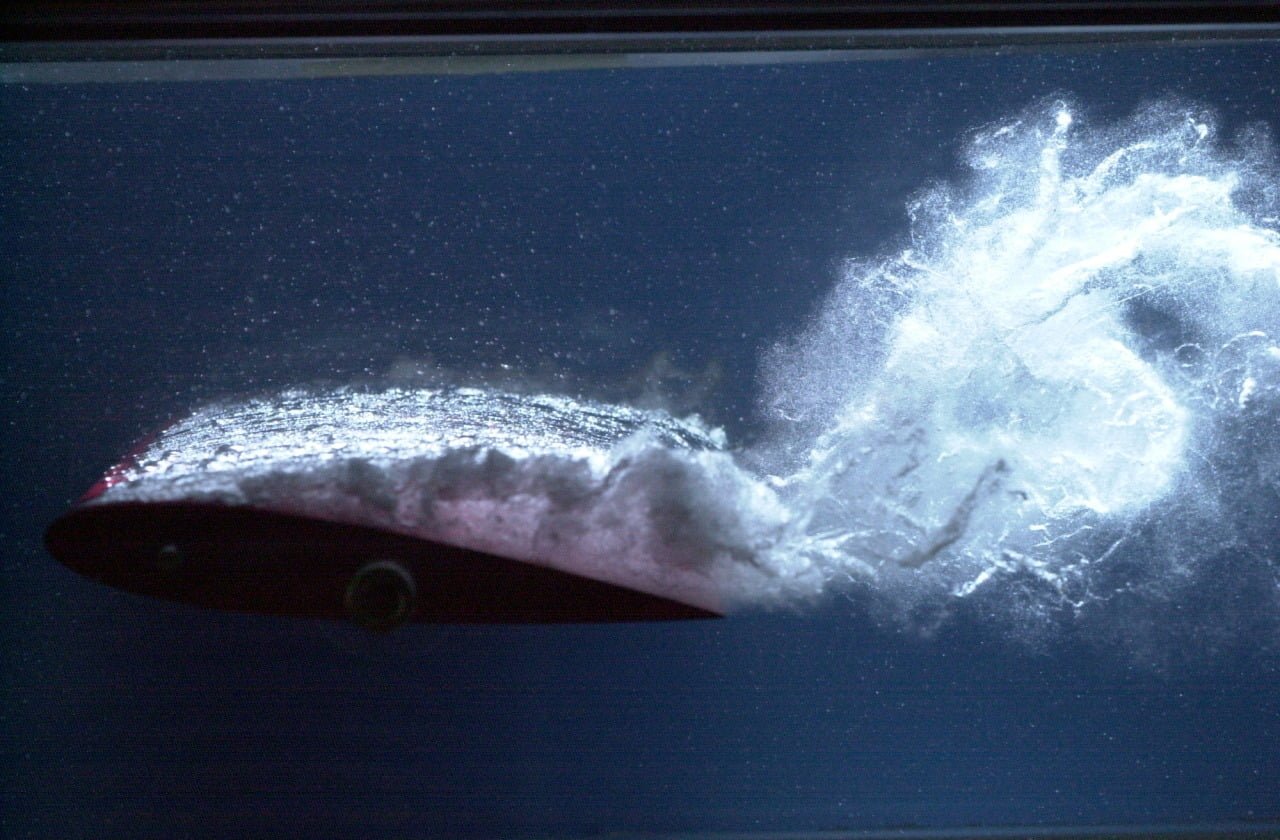
A cavitation-induced bubbly sheet flows over the upper surface of a hydrofoil in the image above. Cavitation can occur when local pressure in a liquid drops below the vapor pressure, causing a cavity to form. Due to its angle of attack, water flowing over the upper surface of the hydrofoil is accelerated. The high flow velocities and accompanying low pressures over the top of the hydrofoil produce cavitation bubbles which continue to flow over and off the surface. Because cavitation bubbles implode when the pressure again increases, they can cause serious damage to solid surfaces. This is why generating cavitation can damage propellers or shatter a bottle. (Photo credit: R. Arndt et al.)
Zesty Fireballs
Zesting the skin of a citrus fruit like oranges releases a spray of tiny oil droplets. Citrus oil has several volatile components, meaning that it evaporates quickly at room temperature. It is also a liquid with a relatively low flash point, meaning that only modest temperatures (~40-60 degrees Celsius) are needed to generate enough vapor to ignite a vapor/air mixture. With volatile and flammable liquid fuels, a spray of droplets is an ideal platform for combustion because the essentially spherical droplets have a high surface area from which they can evaporate and provide vaporous fuel. (Video credit: ChefSteps)

Shooting Droplets
This animation shows high-speed video of a polystyrene particle striking a falling water droplet. Under the right conditions, the particle rips through the droplet, stretching the water into a bell-shaped lamella extending from a thicker rim. When the particle detaches, surface tension rapidly collapses the lamella into a ring which destabilizes. Thin ligaments and droplets fly off the crown-like ring as momentum overcomes surface tension’s ability to hold the droplet together. Be sure to check out the full video on YouTube or later next month at the APS Division of Fluid Dynamics meeting. (Yes, I will be there!) (Image credit: V. Sechenyh et al., source video)

Phytoplankton Bloom
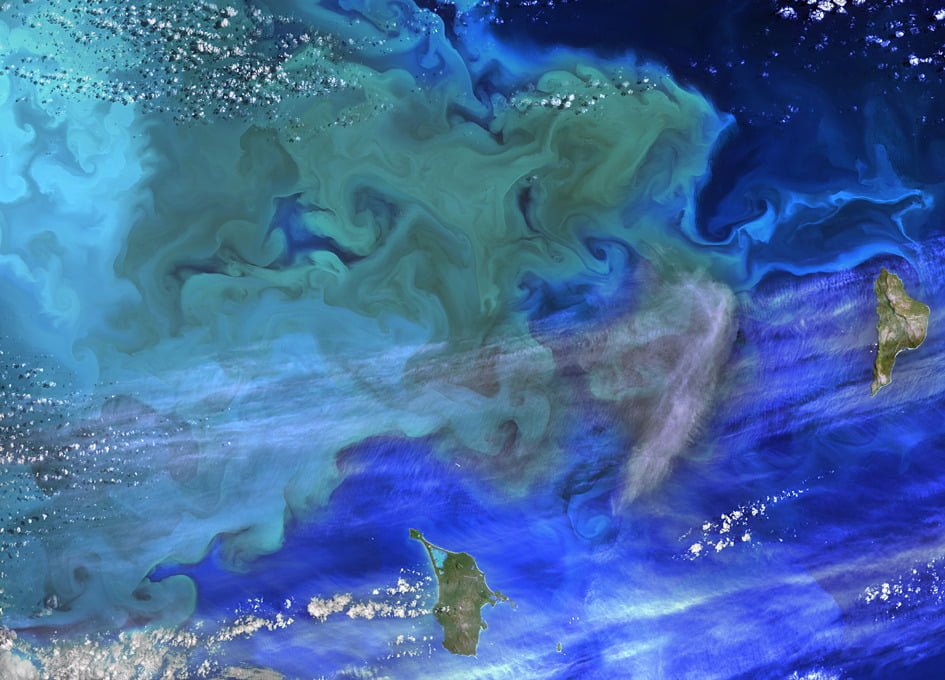
In satellite imagery the blue and green whorls of massive phytoplankton blooms stand out against the ocean backdrop. These microscopic organisms are part of a delicate predator-prey balance and can be very sensitive to nutrient concentrations and other environmental conditions. Their individual size is negligible, but in a bloom phytoplankton are numerous enough that they act as seed particles for the flow. As a result, differing concentrations of phytoplankton reveal the swirling, turbulent mixing of ocean waters. (Image credit: NASA/USGS; via SpaceRef; submitted by jshoer)
Bouncing with Liquids and Grains
Bouncing a ball partially filled with a liquid can create chaotic results when the motion of the ball, fluid, and vibration plate couple. The behavior of a grain-filled ball is a bit different, though. Large grains will tend to bounce with the same frequency as the ball, even across a range of vibration conditions. A ball filled with smaller grains displays a variety of responses depending on the vibration conditions. Among these is a localized wave-like form called an oscillon which oscillates with a period different from but coupled to that of the vibration plate. All these different behaviors inside the bouncing sphere have noticeable effects on its outward motion, too. The chaotic activity of the fluid inside a bouncing ball makes it unstable, and, if not confined, it will bounce itself off the vibration platform. The grain-filled ball, on the other hand, remains bouncing on the platform even after being perturbed. This seems to be a result of the energy dissipation provided by the many inelastic collisions inside the ball as it bounces. (Video credit: F. Pacheco-Vazquez et al.)

Supernova Simulation
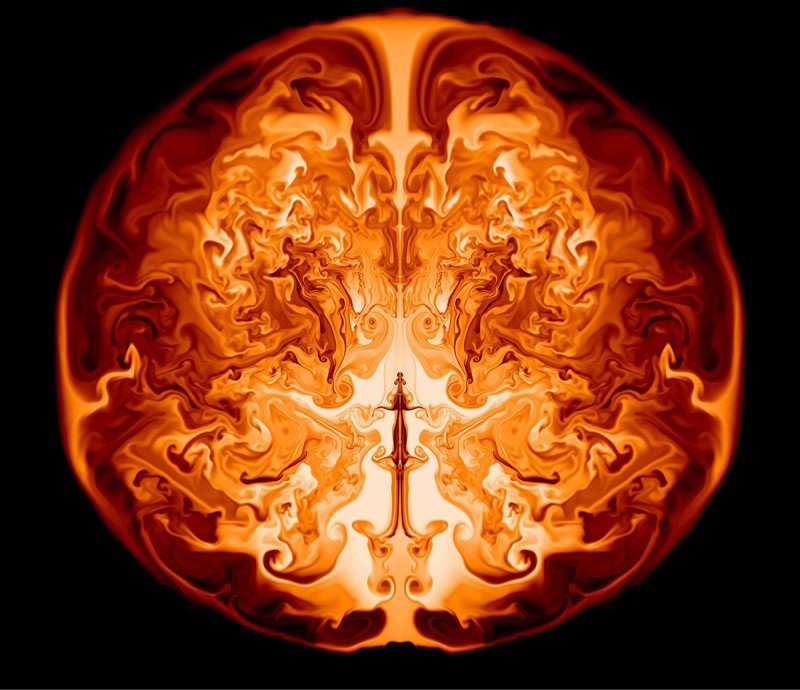
New research shows that supermassive first-generation stars may explode in supernovae without leaving behind remnants like black holes. The work is a result of modeling the life and death of stars 55,000 to 56,000 times more massive than our sun. When such stars reach the end of their lives, they become unstable due to relativistic effects and begin to collapse inward. The collapse reinvigorates fusion inside the star and it begins to rapidly fuse heavier elements like oxygen, magnesium, or even iron from the helium in its core. Eventually, the energy released overcomes the binding energy of the star and it explodes outward as a supernova. The image above is a slice through such a star approximately one day after its collapse is reversed. Hydrodynamic instabilities like the Rayleigh-Taylor instability produce mixing of the heavy elements throughout the expanding interior of the star. The mixing should produce a signature that can be observed in the aftermath as these stars seed their galaxies with the heavy elements needed to form planets. For more, see Science Daily and Chen et al. (Image credit: K. Chen et al., via Science Daily; submitted by mechanicoolest)