Sediment transport via fluid motion is a major factor in engineering, geology, and ecology. This video shows two common forms of sediment transport: particle suspension and saltation. Suspension, in which the fluid carries small solid particles, is visible high in the blue water layer. Saltation occurs closer to the surface when loose particles are picked up by the flow before being redeposited downstream. Watch some of the individual particles near the surface to see the process. Kuchta has several more demo videos of flow in this desktop flume, sold by Little River Research & Design. (Video credit: M. Kuchta; submitted by gravelbar)
Year: 2013

“Orchid”

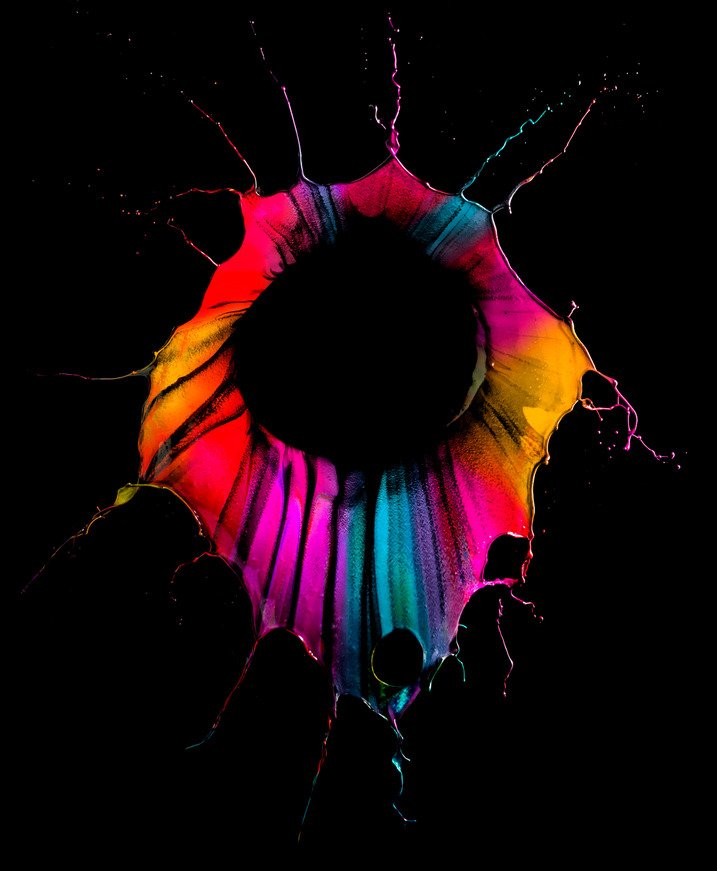
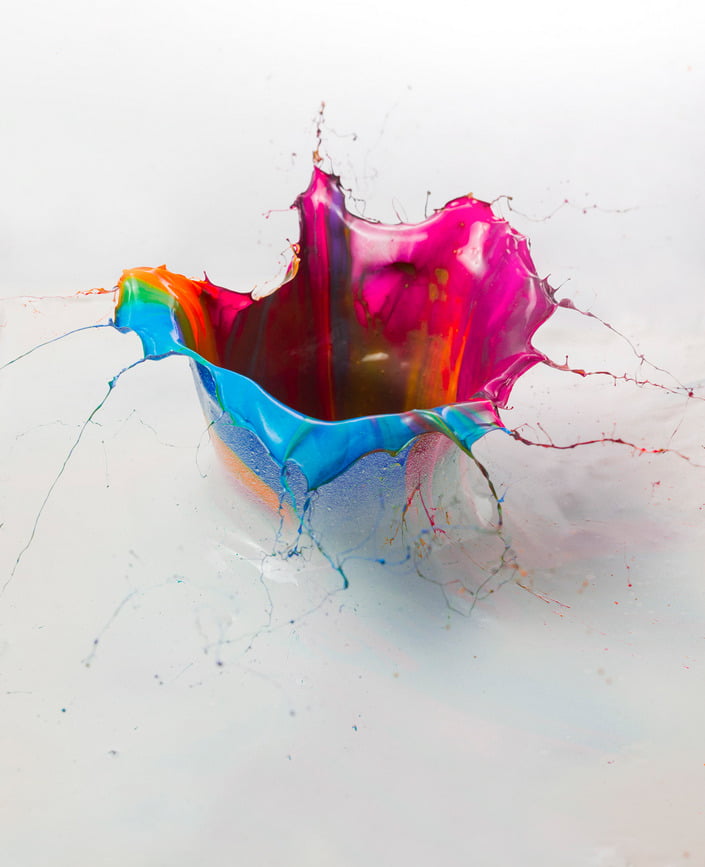
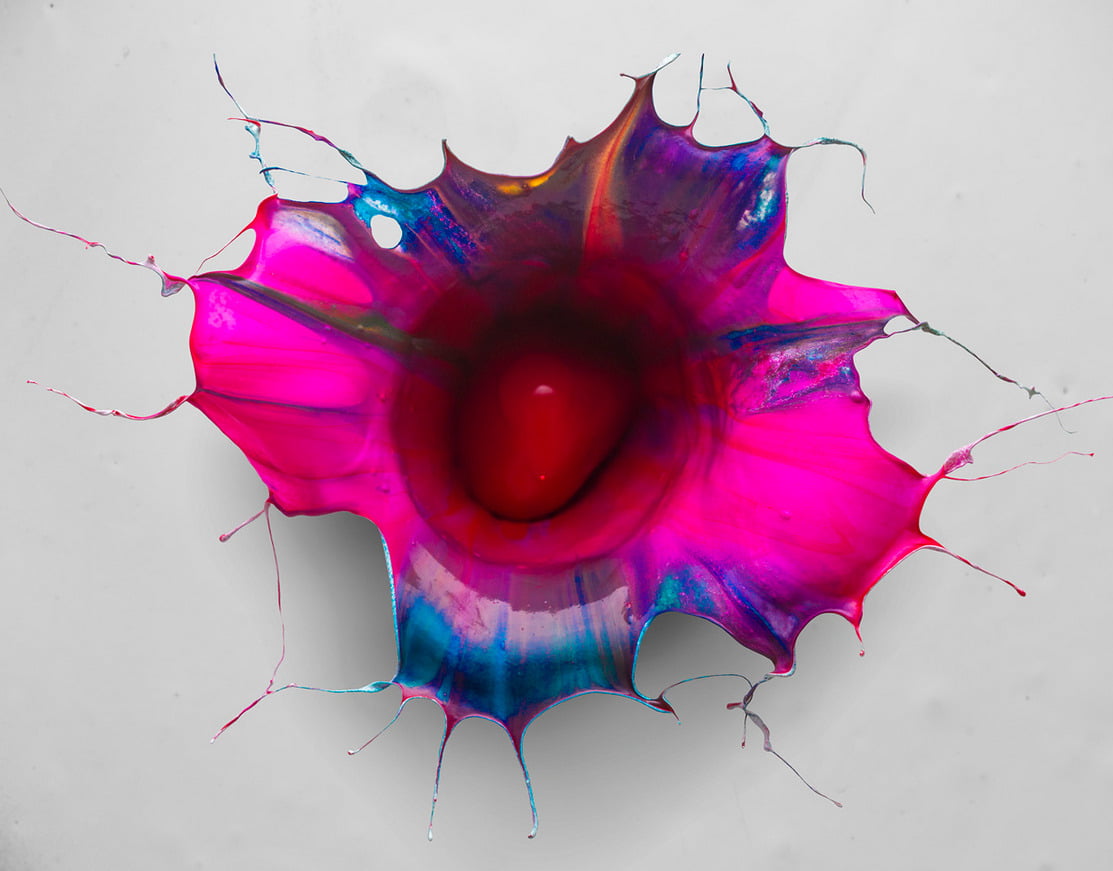
Artist Fabian Oefner enjoys capturing both art and science in his work. In his latest series, “Orchid”, the blossom-like images are the result of splashes. He layered multiple colors of paint, ending with a top layer of black or white, then dropped a sphere into the paint. The images show how the colors mix and rebound, a delicate splash crown seen from above. The liquid sheet thickens at the rim and breaks up into ligaments from the instability of the crown’s edge. It makes for a remarkable demonstration of the effects of momentum and surface tension. Several of Oefner’s previous collections have appeared on FYFD (1, 2, 3). (Photo credit: F. Oefner)

Making Better Tags for Tracking Turtles


Tagging equipment is used on all manner of aerial and marine creatures to gather data about animal behavior in their natural environments. It can be difficult, though, for researchers to gauge what effects the tags have on an animal. A recent study by T. T. Jones et al. used drag measurements on marine turtle casts to estimate the effects of common tagging equipment. They found that, on large turtles, the equipment increases a turtle’s drag by as little as 5%, but for smaller species or juvenile turtles, the drag cost can be much larger – in some cases doubling a turtle’s drag when swimming. Such large increases in drag may significantly change a tagged turtle’s behavior and skew results or even endanger the animal. The researchers suggest a model that allows others to estimate a tag’s drag effects across species. (Image credits: T. Gray and M. Carey; research credit: T. T. Jones et al.; via PopSci; submitted by Chi M.)

Holey Splashes
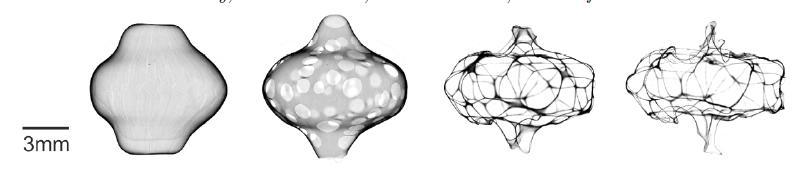
A liquid’s surface tension can have a big effect on its splashes. In this video, a 5-mm droplet hits a surface covered in a thin layer of a liquid with lower viscosity and surface tension. The result is a dramatic effect on the spreading splash. As the initial curtain grows and expands, the lower surface tension of the impacted fluid thins the splash curtain. Fluid flows away from these areas due to the Marangoni effect, causing holes to grow. The sheet breaks up into a network of liquid filaments and ejected droplets before gravity can even bring it all to rest. For more, see this previous post and review paper. (Video credit: S. Thoroddsen et al.)

Fire in Microgravity
In the movie “Gravity” Sandra Bullock’s character battles a fire aboard the International Space Station. Combustion is a huge concern in space habitats. Microgravity fires are challenging to detect and fight because they behave very differently in the absence of buoyancy. On Earth, buoyancy makes hot air rise from a flame while cooler air is pulled in near the base. This feeds fresh oxygen to the teardrop-shaped flame. In space, there is no buoyancy and flames are spherical. They also burn at lower temperatures and lower oxygen concentrations–so low, in fact, that the oxygen depletion necessary to extinguish a fire is lower than what humans require to survive.
No buoyancy makes it harder for fires to spread, but it also makes them harder to detect since smoke doesn’t rise toward a detector on the ceiling. Instead, fire detectors aboard the Space Station are housed in the ventilation system that moves air through the modules constantly. In the event of a fire, astronauts use a three-step fire suppression system. First, they shut off the ventilation system to delay the fire’s spread. Then they shut off power to the affected unit, and, finally, they use fire extinguishers on the flames. The Russian module is equipped with a foam extinguisher and the others use CO2 units. (Image credit: Warner Brothers)

Fluids Round-up – 2 November 2013
Fluids round-up time! Here are your latest links:
- Over at PhysicsFocus, Colin White discusses the Bernoulli fallacy and other zombie myths of physics. (Via @JenLucPiquant)
- Aviation Week has an exclusive look at Skunk Works’ SR-72 next-gen hypersonic aircraft.
- MinutePhysics asks if it’s better to walk or run through rain. This post has another take on the question.
- io9 describes why bubbles lose their color as they pop.
- Physics Buzz looks at knotted fluid vortices. They also have a nice write-up on the foaming of a struck beer, which we talked about last week.
- Enjoy the beauty of mathematics next to the physics they describe. (via io9)
- More fun fluids from Physics Buzz, this time looking at new tiny jellyfish-like flying robots.
- Remember the Chelyabinsk meteor from February? Discovery reports on an analysis of the air burst and its probability.
- Is there fluid mechanics in neck cracking? (?!?)
- New research shows that mesoscale self-assembly can be achieved using capillary charges.
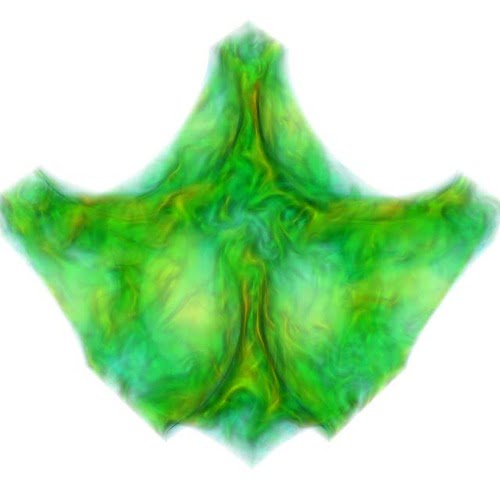
- Finally, our lead image shows a simulation of turbulent flow in a tightly packed lattice of spheres. It’s an entry from Argonne National Laboratory’s annual “Art of Science” contest. Take a look at the entries and vote for your favorites!
While not strictly fluid dynamical, I want to take a moment to talk about education. I receive a lot of stunned reactions and self-deprecation when people learn I study aerospace engineering. Many people say, “Oh, I could never do that!” or “You must be some kind of genius.” I’m not. It’s true that studying engineering and fluid dynamics involves a lot of math and some it is complex (no pun intended). There’s a lot of unfounded fear about science and math in our society, when really they are just skills that any of us can improve with practice and effort. So, for those out there who have ever thought, “I can’t do that, there’s too much math,” please watch this young woman address mathphobia. She sums up just about everything I’ve always wanted to tell you.(Photo credit: Argonne National Laboratory)Liquid Sculptures
[original media no longer available]
Water sculptures–a marriage of liquids, photography, and timing–are spectacular form of fluid dynamics as art. Artist Markus Reugels is a master of the form. This video captures the life and death of such water sculptures at 2,000 fps, beginning with the fall of the initial blue droplet. The droplet’s impact causes a rebounding Worthington jet, which reaches its pinnacle just as a second droplet strikes. The impact spreads into an umbrella-like skirt consisting of a thin, expanding liquid sheet with a thicker rim. The rim itself is unstable, breaking into regularly spaced filaments and tiny satellite droplets that shoot outward before the entire structure collapses into the pool. One especially cool aspect of watching this in video is seeing how the blue dye from each droplet spreads as the water splashes and rebounds. You can see the set-up Reugels uses for his photography here. (Video credit: M. Reugels and L. Lehner)
Cornstarch Physics
Oobleck, a non-Newtonian fluid made up of water and cornstarch, is a perennial Internet favorite for its ability to dance and the fact that one can run across a pool of it. It’s typically described as a shear-thickening fluid and only exhibits solid-like behavior under impact. Strictly speaking, oobleck is a suspension of solid grains of cornstarch in water. When struck, the initially compressible grains jam together, creating a region more like a solid than a liquid. From this point of impact, a solidification front expands through the suspension, jamming more grains together and enabling the fluid to absorb large amounts of momentum. The process is known as dynamic solidification. (Video credit: University of Chicago; research credit: S. Waitukaitis & H. Jaeger)

How Erosion Shapes a Flow
Erosion creates all manner of strange shapes as wind and water cut away at solids. But why does the interaction of the fluid and solid result in the geometries we observe? Above is a collage from an experiment in which a soft clay sphere was immersed in a water tunnel. After 70 minutes, the sphere had worn into a roughly conical body (Image A) reminiscent of a re-entry capsule. Images B and C show instantaneous streaklines around the clay at 10 minutes and 70 minutes, respectively. Images D and E show diagrams of the flowfield seen in B and C. Fast-moving flow above and below the stagnation point (SP) wears the front of the body into a conical shape, whereas the recirculating vortices aft of the separation point (SL) create a sloped shoulder and flattened back in the clay. The results are consistent with a model in which erosion tries to create uniform shear stress at the solid surface – essentially the process is keeping the frictional force between the fluid and air constant along the surface. This makes sense. If a region’s shear stress is higher, it will be worn more quickly than the surrounding solid, causing it to recede and experience decreased shear stress (relative to the surrounding area) as a result. (Image credit: L. Ristroph et al.)

How Fast Do Holes Grow?
Taylor and Culick predicted a constant velocity for the rim of an opening hole in a soap film of uniform thickness. Unfortunately, it is difficult to experimentally produce a soap film of uniform thickness. It is much easier to create films of uniform thickness with liquid crystals in their smectic-A phase, in which the molecules are ordered in layers along a single direction. When smectic-A bubbles burst, however, it bears little resemblance to a soap bubble. Smectic-A bubbles burst spontaneously during oscillations, the holes in the film growing until a network of filaments is left behind. The filaments themselves will rapidly break up into droplets due to the Plateau-Rayleigh instability. (Photo credit: R. Stannarius et al.)