Fluid dynamics appear at all kinds of scales. The animation above shows two comets, Encke and ISON, on their recent approach toward the sun. The darker wisps emanating from the right side of the image are part of the solar wind, a plasma stream continuously emitted by the sun’s upper atmosphere. Although the solar wind is very rarefied by terrestrial standards, its density is sufficient to whip the comets’ tails of gas and dust from side-to-side. Scientists use images like these to learn more about the structure of the solar wind based on its interaction with the comets. For more great images of ISON’s journey around the sun, check out NASA Goddard. (Image credit: K. Battams/NASA/STEREO/CIOC; submitted by John C)
Year: 2013

North Dakota Ice Disk
Cold weather can create some wild fluid dynamics, so pay attention to your local rivers and waterfalls during the next cold snap. The video above comes from North Dakota where a combination of cold dense air and a stable river eddy created a spinning ice disk, roughly 16 meters in diameter. The disk forms as a collection of ice chunks–not one solid, spinning piece–because the ice formed gradually. As ice pieces form, they get caught in the river eddy and begin to spin as part of the disk, rather like dust and ice do in the rings of Saturn. Such formations are rare but not unheard of; here’s a video showing a similar disk as it grows. (Video credit: G. Loegering; via Yahoo and io9; submitted by Simon H and John C)

Liquid Umbrella
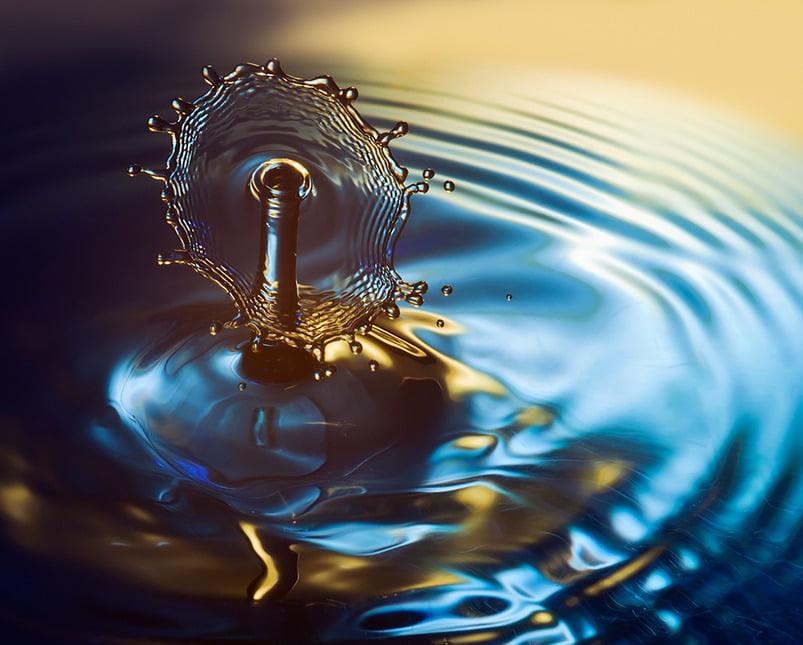
When a water drop strikes a pool, it can form a cavity in the free surface that will rebound into a jet. If a well-timed second drop hits that jet at the height of its rebound, the impact creates an umbrella-like sheet like the one seen here. The thin liquid sheet expands outward from the point of impact, its rim thickening and ejecting tiny filaments and droplets as surface tension causes a Plateau-Rayleigh-type instability. Tiny capillary waves–ripples–gather near the rim, an echo of the impact between the jet and the second drop. All of this occurs in less than the blink of an eye, but with high-speed video and perfectly-timed photography, we can capture the beauty of these everyday phenomena. (Photo credit: H. Westum)
Put the Lid Down When You Flush
Hospital-acquired infections are a serious health problem. One potential source of contamination is through the spread of pathogen-bearing droplets emanating from toilet flushes. The video above includes high-speed flow visualization of the large and small droplets that get atomized during the flush of a standard hospital toilet. Both are problematic for the spread of pathogens; the large droplets settle quickly and contaminate nearby surfaces, but the small droplets can remain suspended in the air for an hour or more. Even more distressing is the finding that conventional cleaning products lower surface tension within the toilet, aggravating the problem by allowing even more small droplets to escape. To learn more, see the Bourouiba research group’s website. (Video credit: Bourouiba research group)

Bubbles Through Constrictions
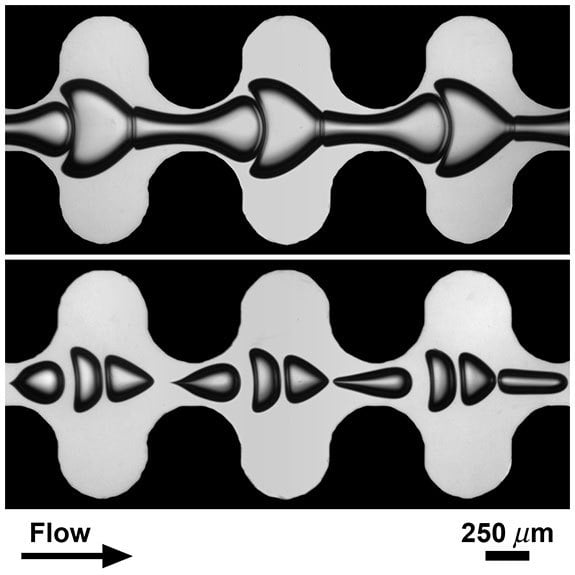
Surface tension usually constrains bubbles to the smallest area for a given volume – a sphere – but sometimes other forces generate more complicated geometries. The images above show bubbles flowing through microfluidic channels filled with a highly viscous carrier fluid. The bubble size and packing affects the shapes they assume, but so does the geometry of the channel. The narrow constrictions accelerate the flow, elongating the bubbles, whereas the wider channel regions slow the carrier fluid and squish the bubbles together. (Image credit: M. Sauzade and T. Cubaud (Stony Brook University))
Pathlines vs. Streaklines
When considering fluid motion, there are many ways to describe trajectories through the flow. One is the pathline, the trajectory followed by an individual fluid particle. Imagine releasing a rubber duck down a stream. Following the duck’s position over time would give you a pathline. Now imagine that instead of releasing a single rubber duck you release lots of them – say one every half-second from the exact same starting spot. You would end up with a line of rubber ducks stretching downstream, each of them sharing the same origin but with a different starting time. This is called a streakline. Would the streakline of rubber ducks follow the same trajectory as the lone duck? Not if the flow is time-varying! In fact, for unsteady flows, pathlines and streaklines can give completely different pictures of a flow, as illustrated in the video above. Knowing and understanding the difference between these types of trajectories is extremely important when it comes interpreting flow visualizations in unsteady flows because some visualization methods produce pathlines and others produce streaklines. (Video credit: V. Miller and M. Mungal)

Bouncing Off The Surface
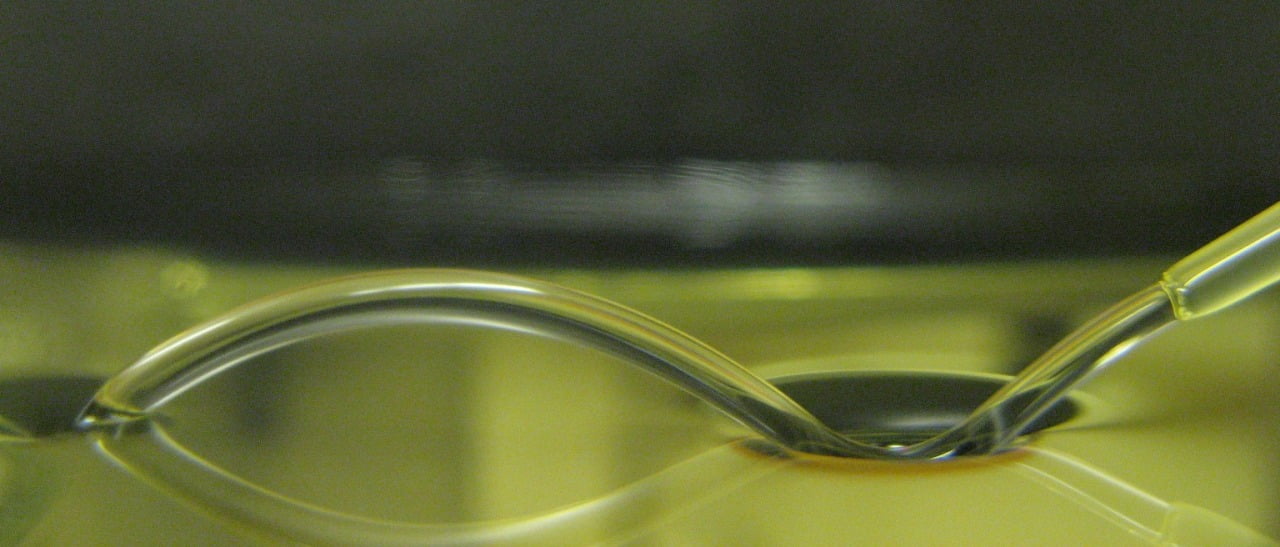
For the right angles and flow rates, it’s possible to bounce a fluid jet off a pool of the same fluid. As the jet flows, it pulls a thin layer of air with it, entraining the air. This air film is what keeps the jet separate from the pool when it initially hits. In the photo above, the jet is flowing right to left; notice how it maintains its integrity within the dimple during the bounce. The pool’s surface tension acts almost like a trampoline, redirecting the jet’s momentum into the bounce. It’s even possible to get a double bounce. In this video, the mechanism is the same, although the apparatus is different. In the photo above, the jet is introduced with a horizontal velocity to induce air entrainment and bouncing. In the video, the pool is spinning, which provides the necessary horizontal velocity between the jet and the liquid pool. (Photo credit: J. Bomber and T. Lockhart)
Liquid Crystal Films
Smectic liquid crystals can form extremely thin films, similar to a soap bubble, that are sensitive to electrically-induced convection. Here an annular smectic film lies between two electrodes. When a voltage is applied across it, positive and negative charges build up on the surface of the film near their respective electrodes. The electrical field surrounding the fluid pushes on the surface charges, causing flow inside the film. Above a threshold voltage, an instability forms and the film develops into a series of counter-rotating vortices, which spin faster as the voltage increases. The color variations in the video above are due to differences in the film’s thickness, much like iridescence of a soap bubble. (Video credit: P. Kruse and S. Morris)
APS DFD etc.
It’s time! The American Physical Society’s Division of Fluid Dynamics meeting opens in Pittsburgh tomorrow morning. It promises to be a very busy few days. Most of that activity will probably not be immediate apparent here on FYFD, but I encourage you to follow along on @fyfluiddynamics, where I’ll be giving a running commentary.
For those attending APS, I have two talks:
- “F*** Yeah Fluid Dynamics: Lessons in online outreach” – Sunday, 5:37pm, Rm 306/307
- “Discrete surface roughness effects on a blunt hypersonic cone in a quiet tunnel” – Tuesday, 1:31pm, Rm 326
I’m looking forward to the chance to meet in person as well, so keep an eye out (I’ll have FYFD stickers on my nametag) and be sure to say hello! There’s been some interest in an informal FYFD get-together, too, so keep an eye on Twitter for that.
Finally, I want to extend my thanks again to all the donors who made it possible for me to get to APS this year. I deeply appreciate your generosity. Special thanks are due to Pointwise, Symscape, and @cenyree for their outstanding support of FYFD! Thank you all again. – Nicole

Start Your Rocket Engine
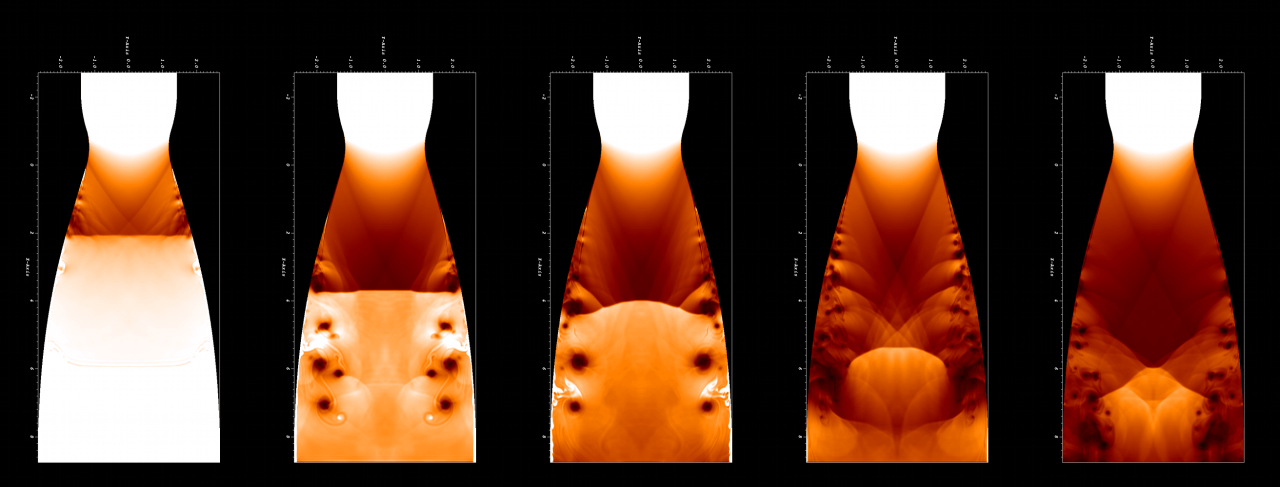
When supersonic flow is achieved through a wind tunnel or rocket nozzle, the flow is said to have “started”. For this to happen, a shock wave must pass through, leaving supersonic flow in its wake. The series of images above show a shock wave passing through an ideal rocket nozzle contour. Flow is from the top to bottom. As the shock wave passes through the nozzle expansion, its interaction with the walls causes flow separation at the wall. This flow separation artificially narrows the rocket nozzle (see images on right), which hampers the acceleration of the air to its designed Mach number. It also causes turbulence and pressure fluctuations that can impact performance. (Image credit: B. Olson et al.)