Year: 2013

  • Featured Video Play Icon

    The Fluid Dynamical Sewing Machine

    Originally posted: 3 Jan 2012 Nonlinearity and chaos are important topics for many aspects of fluid dynamics but can be difficult to wrap one’s head around. But this video provides an awesome, direct example of one of the key concepts of nonlinear systems–namely, bifurcation. What you see is a thread of very viscous fluid, like honey, falling on a moving belt. Initially, the belt is moving quickly and the thread falls in a straight line. When the belt slows down, the thread begins to meander sinusoidally. With additional changes in the belt’s speed, the thread begins to coil. A multitude of other patterns are possible, too, just by varying the height of the thread and the speed of the belt. Each of these shifts in behavior is a bifurcation. Understanding how and why systems display these behaviors helps unravel the mysteries of chaos. (Video credit: S. Morris et al.)

    Reminder: There’s still time left to take the reader survey! Please take a couple minutes to help improve FYFD and science outreach. Thank you!
  • Bursting Bubble

    Bursting Bubble

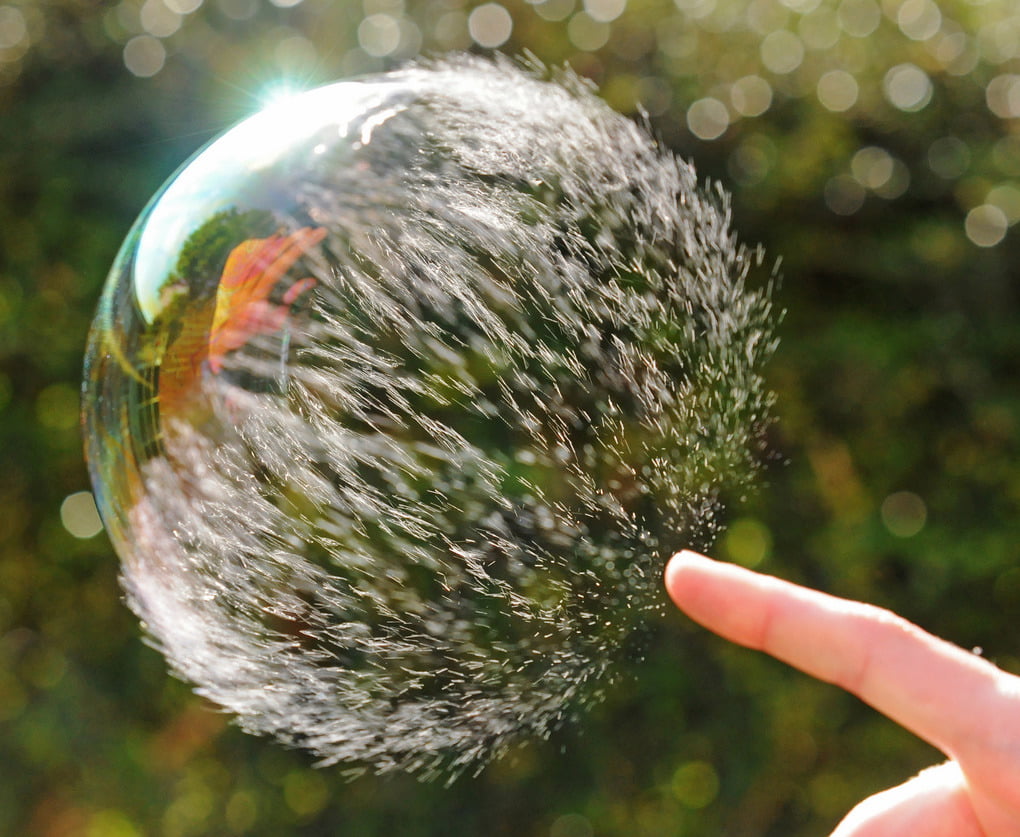
    Originally posted: 24 Aug 2011 That soap bubbles burst in the blink of an eye is a pity considering how fascinating their disappearing act is. This photo set from photographer Richard Heeks captures the bubbles mid-burst. Once the bubble’s film is breached, surface tension rips the smooth film back like a broken balloon, causing the liquid that used to be part of the bubble to erupt into droplets. (Photo credit: Richard Heeks)

    Reminder: Many thanks to those who have filled out the survey! There are some great responses so far. If you haven’t done so, won’t you please fill out our reader survey?

  • Soap Film Butterfly

    Soap Film Butterfly

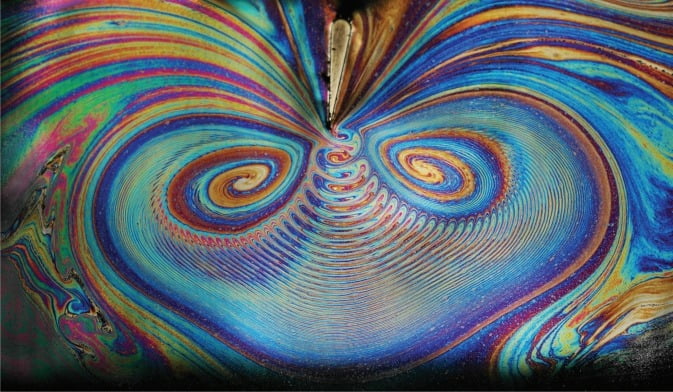
    Originally posted: 14 Jan 2011 This gorgeous butterfly-like double spiral roll takes place on a horizontal soap film. The foil (seen top center) inserted in the film flaps back and forth. Each time the foil changes direction a vortex forms at the tip and gets advected away. The vortices stretch and distort in the roll, but if you look at the photograph closely, you’ll see the tiny shed vortices persisting throughout the roll structure. The bright colors that make this flow visible are due to interference patterns related to the local thickness of the film. (Photo credit: T. Schnipper et al.)

    Reminder: If you haven’t already, please fill out our reader survey and help us improve FYFD!

  • Featured Video Play Icon

    Rocket Sonic Boom

    Originally posted: 22 July 2010 This video of the NASA Solar Dynamics Observatory’s launch is such a favorite of mine that it was part of the original inspiration for FYFD and was the very first video I posted. Watch closely as the Atlas V rocket climbs. At 1:51 you’ll see a rainbow-like cloud in upper right corner of the screen. This effect is created by sunlight shining through ice crystals of the cloud. A couple seconds later you see pressure waves from the rocket propagate outward and destroy the rainbow effect by re-aligning the ice crystals. Just after that comes the announcement that the vehicle has gone supersonic. The atmospheric conditions of the launch happened to be just right to make those pressure waves coming off the rocket visible just before they coalesced into a leading shockwave. (Video credit: B. Tomlinson)

    Reminder: If you haven’t already, please fill out our reader survey and help us improve FYFD!

  • Happy Birthday, FYFD!

    Happy Birthday, FYFD!

    Today marks the third birthday of FYFD, and it’s been a pretty crazy ride so far. Three years ago, I would have never predicted a blog about fluid dynamics could gain over 170,000 followers. (Thanks for proving me wrong!) As part of my efforts to continue FYFD’s science outreach, I am conducting a reader survey. My goals are to learn about FYFD’s reader demographics and to solicit advice for future improvements to the site. Please take a few moments to participate!

    The FYFD archives contain more than 800 posts. As part of our birthday celebration this week, we’ll take a trip back through the archives to revisit some of my favorites. Stay tuned, and don’t forget to fill out the survey! Thanks for helping make FYFD a success. (Photo credit: Unknown photographer/The Paper Wall)

  • Featured Video Play Icon

    Dublin’s Pitch-Drop Experiment

    Readers may recall the University of Queensland’s pitch-drop experiment, recognized as the longest continuously running experiment in the world. Back in 1927, a professor started the experiment with the goal of measuring the extremely high viscosity of pitch. Since then, only eight drops have fallen. Queensland’s is not the only version of this experiment, though; Trinity College Dublin has a similar set-up and have just caught a falling pitch drop on camera for the first time ever. Take a look in the video above. Queensland is expecting a drop to fall sometime this year as well. (Video credit: Trinity College Dublin Physics; via SciAm)

  • Sedimentary Swirls

    Sedimentary Swirls

    Local currents swirl sediments and phytoplankton blooms in this satellite image of the Tarut Bay in Saudi Arabia. Such blooms typically occur where nutrients are being washed together, thereby creating a kind of natural flow visualization of currents and matter flow in the ocean. (Photo credit: NASA Earth Observatory)

  • Foam Array

    Foam Array

    Soap foams represent an interplay of gravitational, capillary, interfacial, and viscous forces, none of which is easily isolated in a laboratory experiment. This makes it difficult to sort out the various effects governing the foam since individual variables cannot be controlled independently. The image above is of a special foam, one in which the liquid phase has been replaced with a ferrofluid. This adds an additional parameter–external magnetic fields–to the problem, but, unlike the others, this is an independent variable. By manipulating the external magnetic field, researchers can control the foam’s drainage rate and even the structure it takes on. (Photo credit: E. Janiaud)

  • Drop-Tower Droplets

    Drop-Tower Droplets

    A microgravity environment can cause some nonintuitive behaviors in fluids. Many of the effects that dominate fluid dynamics in space are masked by gravity’s effects here on Earth. As a result, it can be very difficult to predict how seemingly straightforward technologies like heat exchangers, refrigeration units, and fuel tanks will behave. The photos above show two bubble jets–created by injecting a liquid-gas mixture into a liquid–colliding in microgravity. This particular experiment was conducted in a drop tower rather than on-orbit, which produced some side effects like the large bubbles seen in the images. These were created by the coalescence of smaller bubbles that congregated near the top of the tank shortly before the experiment attained free-fall. (Photo credit: F. Sunol and R. Gonzalez-Cinca)

  • Featured Video Play Icon

    Levitation By Sound

    Levitation is an effect usually associated with electromagnetic forces, but it’s possible with sound as well. This acoustic levitation is achieved by using the pressure from sound waves to balance gravity’s effect. By manipulating the sound, it’s possible to bring separate objects together while continuing to levitate them. The behavior is demonstrated in the video above by combining solid sodium with a drop of water for what any high school chemist will tell you is a spectacular reaction. (Though, if that’s too small-scale for you, there’s also this video.) (Video credit: D. Foresti et al; via SciAm)