This schlieren image shows a sphere traveling at Mach 3 over a perforated plate. The bow shock in front of the sphere is clearly visible, as is its reflection off the plate. The pressure caused by the bow shock produces a series of spherical acoustic waves below the plate. A tiny vortex ring moves downward from each hole, followed at the right by a secondary ring moving upward from the holes in the plate. (Photo credit: U.S. Army Ballistic Research Laboratory; reprinted in Van Dyke’s An Album of Fluid Motion)
Year: 2011

Shark Wakes
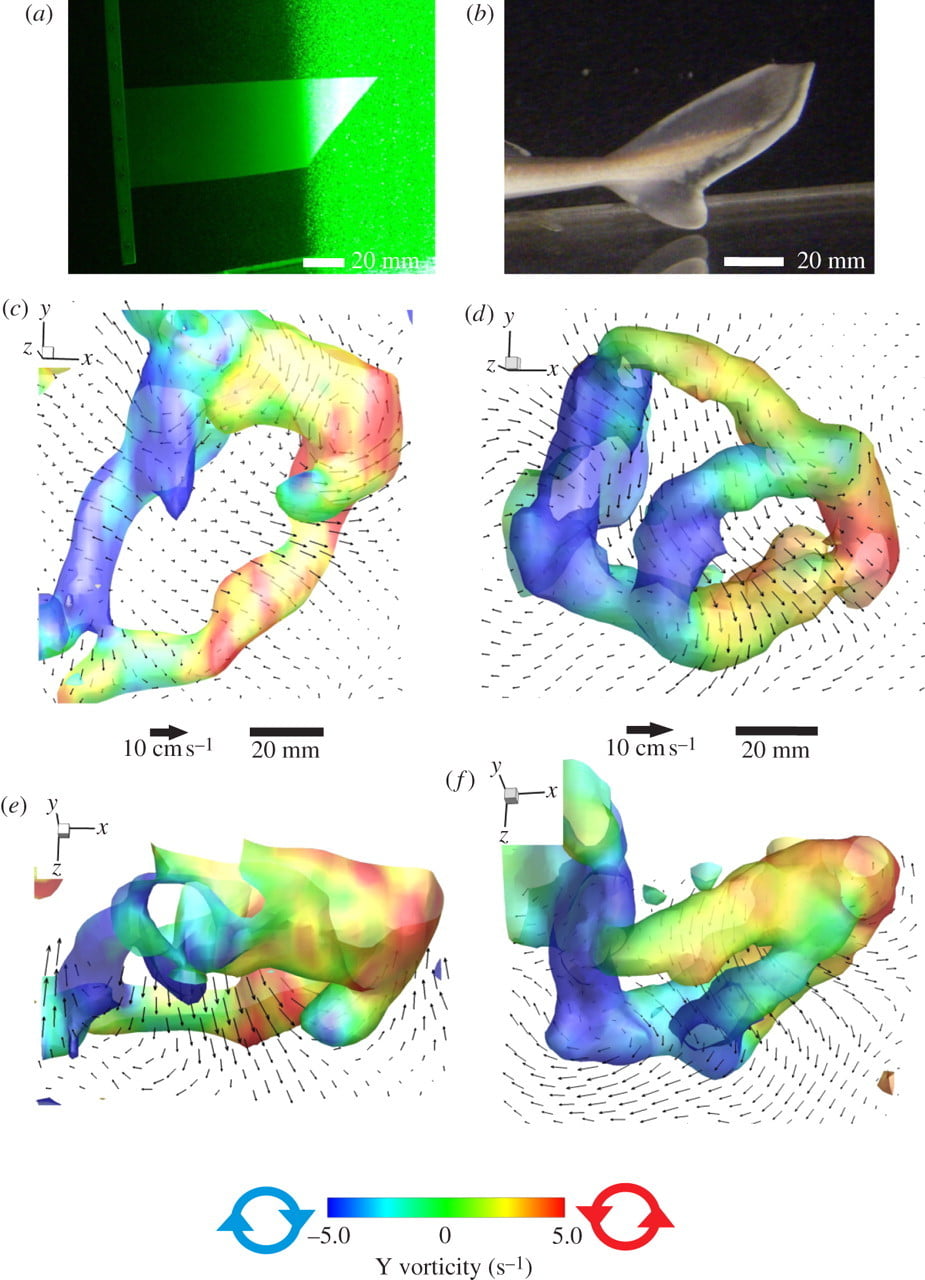
Volumetric imaging of swimming spiny dogfish, a type of shark, shows that their distinctively asymmetric tails produce a set of dual-linked vortex rings with every half beat of their tail. The figure above shows data from the actual shark on the right (b,d,f) and a similarly shaped robotic tail on the left (a,c,e). The second row contains lateral views (c,d) and the bottom row contains dorsal views (e,f) of the vorticity isosurfaces measured. The robotic tail does not demonstrate the same double vortex structure, leading scientists to suspect that the shark may be actively stiffening its tail mid-stroke to control its wake. The finding could help engineers design aquatic robots whose morphing fins help it swim more efficiently. For more, see Wired.
Freezing Drops
[original media no longer available]
The physics of droplets freezing is important for understanding applications like ice formation on airplane wings. Here we see how a warm droplet deposited on a cold plate freezes. A freezing front advances through the drop, which expands vertically as it freezes. Ultimately, the expansion of the ice and the surface tension of the water create a pointed singular tip.

Stone-Skipping Physics
Many people have learned to throw skipping stones across a pond or lake, but how many have considered the physics of how it happens? In this video, researchers use high-speed video to explore the skipping of various balls across water. The deformation of the ball as well as the shape of the cavity its impact creates determines whether it rebounds off the water’s surface.
High-Speed Droplet Collisions
This high-speed video shows the apparatus often used by photographers for fluid sculptures created from droplet collisions. As amazing as these formations are in still images, seeing their evolution at 5,000 fps is even more lovely.

Pitching Plate Flow Viz
This photograph uses fluorescent dye to visualize the wake behind a rigid flat plate pitching about its leading edge. A vortex is shed from the plate twice in each cycle of oscillation. These vortices entangle, producing the structured wake above. The top photo shows a side view of the wake, the bottom photo is a top view. (Photo credit: J. Buchholz and A. Smits)
Sewer Combustion
Enjoy a little high-speed video of combustion (the safe way!) this Thanksgiving holiday. For non-U.S. folks, have a great Thursday!
Superfluid Fountains
Superfluids, a special type of fluid located below the lambda point near absolute zero, exhibit some mind-bending properties like zero viscosity and zero entropy. They are, in essence, a macroscopic manifestation of quantum mechanics. Here their thermomechanical, or fountain, effect is explained. This bizarre state of matter isn’t only found in laboratories, though. Scientists now think that superfluids may exist at the heart of neutron stars.
Sloshing Dynamics
[original media no longer available]
Sloshing refers to the motion of a liquid inside a moving container, for example, in tanker trucks or inside a spacecraft’s fuel tank. The motion of the liquid payload can drastically affect the dynamics of the vehicle carrying it due to the ever shifting center of mass. In the video above, dyed water is being oscillated horizontally to and from the camera. As the frequency of this oscillation changes, the modes of sloshing–the shapes the liquid surface assumes–change dramatically.

Faces from Laminar Mixing