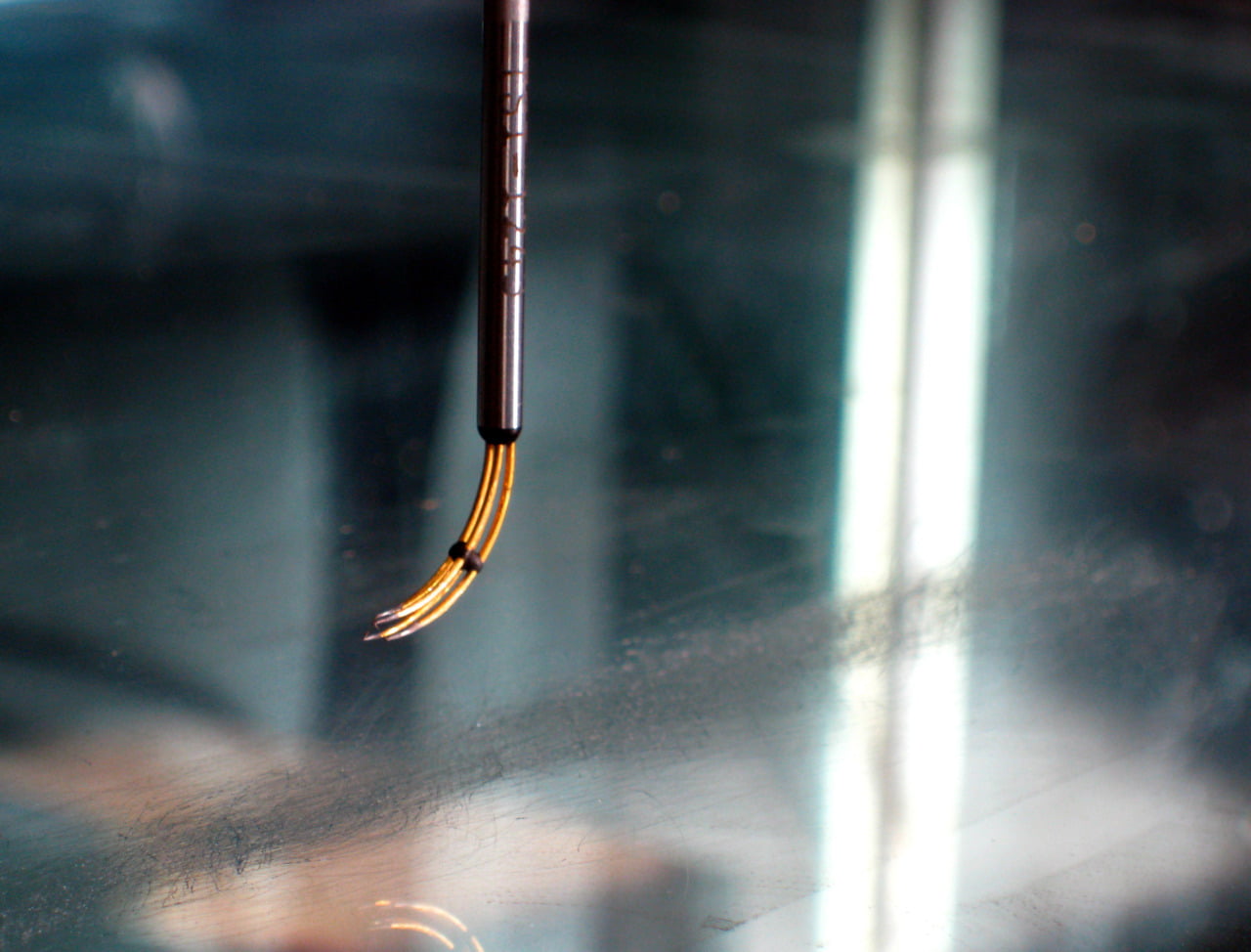
Hotwire anemometry is used in experimental fluid dynamics to measure velocities with high temporal resolution. The boundary layer crosswire probe shown here was used for turbulence research. Between the prongs, which are about the thickness of a sewing needle, are tiny wires about 3 microns in diameter. A human hair is about 80 microns in diameter. Hotwires actually measure voltage; when part of an electrical circuit, the hotwire’s temperature rises above ambient. As air flows over the wire, it cools, which causes the wire’s resistance to drop. By tracking this change in resistance, it is possible to determine the speed of the air moving over the wire.
Year: 2011
Reader Question: General Audience Fluids Books
nothing43-blog-blog asks:
Do you know any good books on fluid dynamics? Not textbooks or handbooks, but more along the lines of what you’d find in the “popular science” section of the book store – accessible to a larger audience. Or maybe a good “history of fluid dynamics” book?
That’s a great question! To be honest, I really haven’t seen any general audience fluid dynamics books–fluid dynamics is a field I like to refer to as “the physics physicists gave up on”–but that doesn’t mean there aren’t any. I know fluid dynamics shows up in Feynman’s books (which are excellent reading regardless), and I read a great biography of G. I. Taylor written by G. K. Batchelor that discusses Taylor’s life and contributions to fluid mechanics through two World Wars and the aftermath. Van Dyke’s Album of Fluid Motion is a classic that’s not heavy on technical material. I’ll look into a couple of others as I get hold of them and post any suggestions I have. In the meantime, does anyone else have some general fluid dynamics reading suggestions?

Cornstarch Monsters
The patterns formed when vibrating a liquid on a speaker cone are standing waves known as Faraday waves. With a large enough amplitude, this produces some very cool effects with a shear-thickening non-Newtonian fluid like oobleck. (It would actually be interesting to see what happens when you vibrate a shear-thinning liquid like shampoo…) This video also details how you can set up this demonstration yourself at home.

Neutron Superfluids in Stars?
This image shows a composite X-ray (red, green, and blue) and optical (gold) view of the supernova remnant Cassiopeia A, located about 11,000 light years away. At the heart of this supernova remnant is a neutron star. After ten years of observations, astronomers have found a 4% decline in the temperature of this neutron star, which cannot be accounted for in current theory. Two research teams have independently found that this cooling could be due to the star converting the neutrons in its core into a superfluid. As the neutron superfluid is formed, neutrinos are emitted; this decreases the energy in the star and causes more rapid cooling. See Wired for more. #
Godspeed, Discovery!
The space shuttle, despite three decades of service, remains a triumph of engineering. Although it is nominally a space vehicle, fluid dynamics are vital throughout its operation. From the combustion in the engine to the overexpansion of the exhaust gases; from the turbulent plume of the shuttle’s wake to the life support and waste management systems on orbit, fluid mechanics cannot be escaped. Countless simulations and experiments have helped determine the forces, temperatures, and flight profiles for the vehicle during ascent and re-entry. Experiments have flown as payloads and hundreds of astronauts have “performed experiments in fluid mechanics” in microgravity. Since STS-114, flow transition experiments have even been mounted on the orbiter wing. The effort and love put into making these machines fly is staggering, but all things end. Godspeed to Discovery and her crew on this, her final mission!

Swimming Sandfish Lizards
Sandfish lizards can “swim” through granular flows like sand using an undulating, sinusoidal motion. Having studied this motion, engineers have built a robot that swims similarly through large glass beads and have now created a numerical simulation of the physics that matches the measured forces on the swimmer to within 8%. This type of flow is, in some respects, tougher than actual fluids because individual particles have to followed, while in most of fluid mechanics, we can use the continuum assumption to treat a liquid or gas as a continuous medium. #
Dancing Droplets
When a droplet falls onto a larger pool of the same liquid, it briefly sits on a layer of air that prevents coalescence. When that air drains away, the coalescence cascade–in which the droplet breaks into progressively smaller droplets until fully absorbed–begins. But if you vibrate the pool of liquid, the droplet bounces, effectively injecting more air between it and the pool. This prevents coalescence. What’s really neat here is that the researchers demonstrate this effect with arrays of droplets dancing in formation.
Shock Waves
Flow visualization really can be considered a form of art. Though we fluid mechanicians are looking for physics, we’re quite aware of the beauty of what we study. The clips in this video mostly show transient shockwave behavior, including lots of shock reflection and even a few instabilities. It’s unclear what the speeds are, aside from faster than sound; the medium is air.
Rafting for Rocks
Another look at the science behind the roaming rocks of Death Valley.

Rocket Launch Phenomena
The launch of the Solar Dynamics Observatory (SDO) last year provided a rarely seen glimpse of how shock waves affect the atmosphere during launch, but only recently have researchers explained the white column that seemed to follow SDO toward orbit. Simulations indicate that the shock waves from the rocket aligned the ice crystals in the atmosphere into an array of spinning tops. Individual crystals precess as a result of the rocket passing; the column is part of a larger oval that would have been visible had the ice crystals covered a larger range. See Wired for more. #


