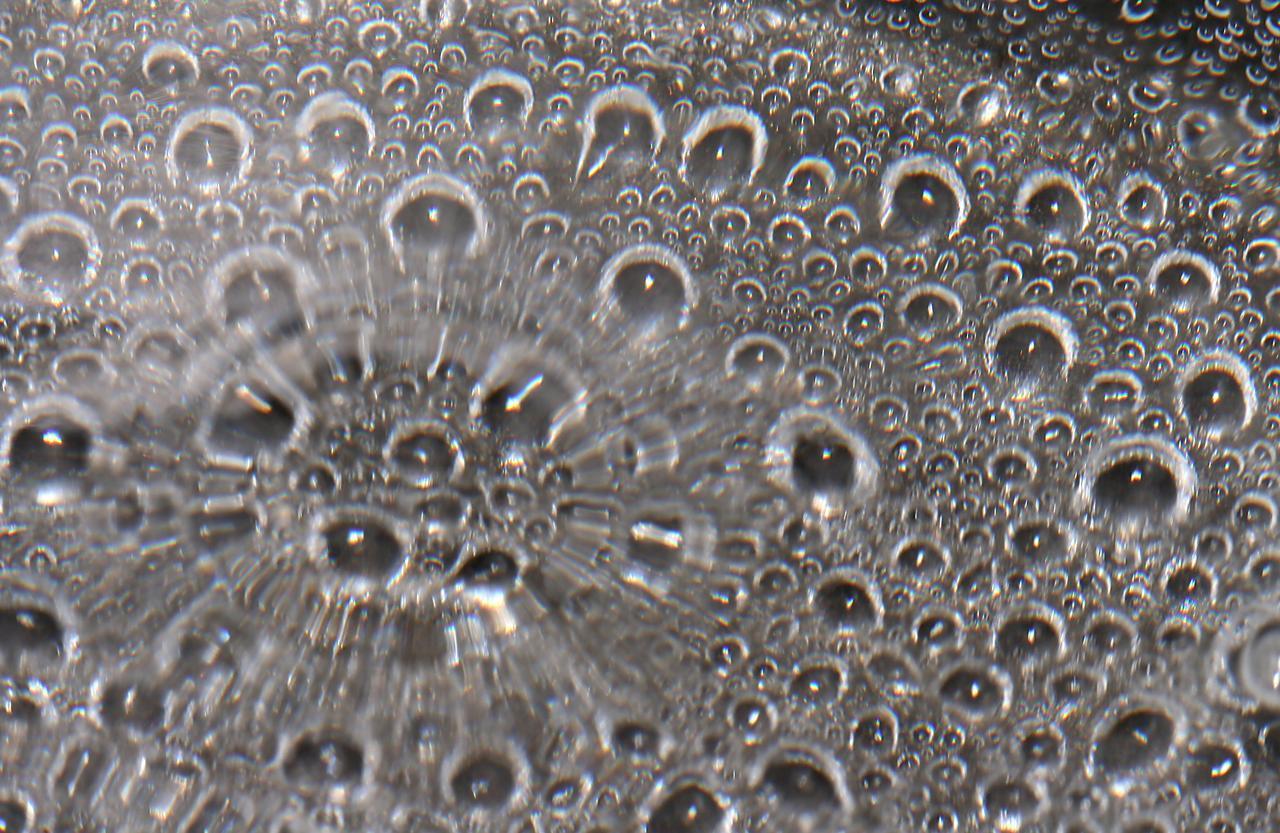
A decane liquid lens floating on water (think drops of fat in chicken soup) displays different breakup and pinch-off than seen in three-dimensional droplet breakup. The pinch-off process in two dimensions relies on line tension rather than surface tension, and the quasi-2D liquid lens system is somewhere between these. The video above is a magnification of the filament connecting one liquid lens as it is broken into two smaller liquid lenses (the dark areas on the left and right of the screen). # (via scienceisbeauty)
Year: 2011

Liquid Acrobatics
Imagine blowing through a straw into a nearly empty glass–we probably all did this as children and sent water, milk, and soda flying everywhere! In essence, this video shows that same act, but filmed by a high-speed camera. The “straw” blows a steady stream of helium into a shallow pool of silicone oil and slowly moves so that the angle the straw makes with the pool changes. As the angle changes, different regimes are visible. First waves appear on the surface of the pool, then a bulge forms, which develops into a droplet stream, then on into the chaos of bubbles and jets. It’s good I couldn’t see this in slow motion as a child or I would have never used my straw for drinking!
Mythbusters Walking on “Water”
The Mythbusters walk on “water” using non-Newtonian fluids. I think everyone wants to do this at least once in their life.
Leapfrogging Vortices
This numerical simulation shows two pairs of vortices interacting in a leap-frogging motion. Another version shows the same situation but with a small perturbation in the rotational alignment that causes even more interesting interactions. Both simulations are of potential flow–an idealized flow without viscosity where velocity can be described as the gradient of a scalar function. The mathematics governing potential flow are notably easier than the full Navier-Stokes equations that govern fluid mechanics. (submitted by jessecaps)

Rocket Exhaust
This image of the Apollo 11 launch shows the Saturn V’s underexpanded nozzle (identifiable by the excessive width of the exhaust jet) shortly after liftoff. The faint diamond shape of the exhaust is a series of shock waves and expansion fans that equalize the exhaust pressure to the ambient. In general, a rocket nozzle is most efficient when it expands the exhaust to ambient pressure, but, since ambient pressure changes with altitude, designers have to choose a particular altitude for peak efficiency or design a nozzle capable of changing its shape with altitude.

Boiling in Microgravity
This week’s edition of the ISS research blog focuses on the Boiling Experiment Facility (BXF) and the goals of unlocking the secrets of boiling in microgravity. Without gravity to provide buoyant convection, boiling in space tends to produce one giant bubble instead of the hundreds of tiny ones we’re accustomed to seeing on our stoves. According to Dr. Tara Ruttley:
TheBoiling Experiment Facility or BXF, which launched on STS-133 in February 2010, will enable scientists to perform in-depth studies of the complexities involved in bubble formation as a result of heat transfer. For instance, what roles do surface tension and evaporation play during nucleate boiling when buoyancy and convection are not in the equation? What about the variations in the properties of the heating surface? By controlling for gravity while on the International Space Station, scientists can investigate the various elements of boiling, thus potentially driving improved cooling system designs. Improved efficiency in cooling technology can lead to positive impacts on the global economy and environment; two hot topics that have much to gain from boiling in space.

The Ekranoplan
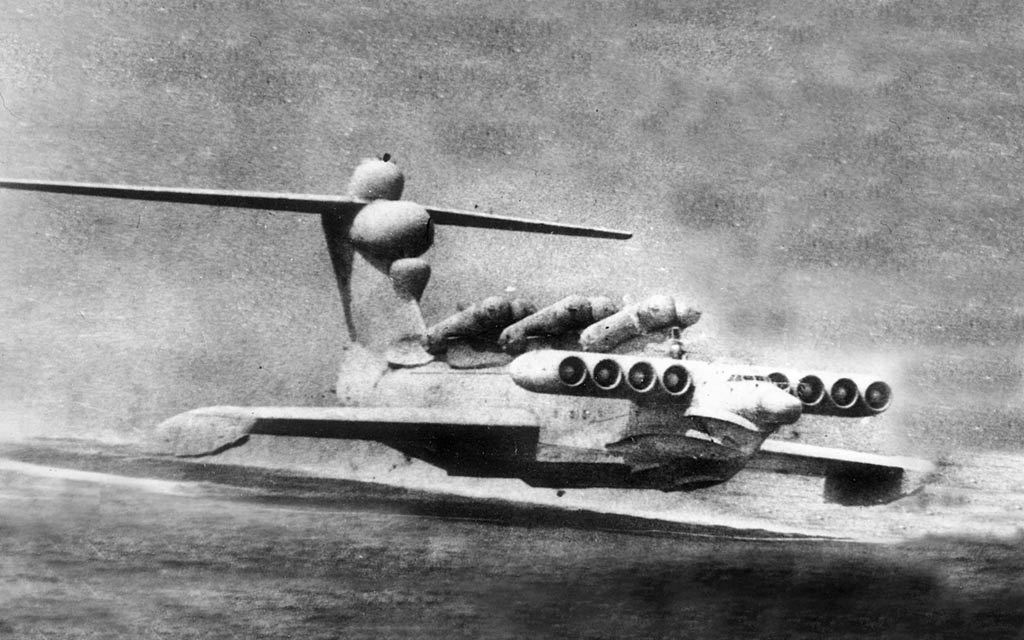
The ekranoplan, the monster of the Caspian Sea, was a Soviet-era aircraft nearly 74 meters in length and weighing 380,000 kgs fully loaded. (In contrast, the C-17 is 53 m long and weighs 265,350 kg fully loaded.) This enormous craft relied on ground effect to stay aloft, where it was capable of 297 knots. Flying close to the ground or water increases the possible lift on wings through a “cushioning effect” that increases pressure on the lower wing surface and by disrupting the formation of wingtip vortices which typically reduce lift through downwash.
Jets from Waves
When vibrated, fluid surfaces can exhibit standing waves known as Faraday waves. In this experiment, increased forcing of these standing waves causes the formation of a jet. Under the right conditions, as the standing wave collapses, a singularity forms on the fluid surface when velocity and surface curvature diverge. The narrow jet column forms as a result of the fluid’s kinetic energy getting focused by the collapse. For more, see this letter to Nature. #
Reynolds on Transition
For although only the disciplined motion is recognized in military tactics, troops have another manner of motion when anything disturbs their order. And this is precisely how it is with water: it will move in a perfectly direct disciplined manner under some circumstances, while under others it becomes a mass of eddies and cross streams, which may be well likened to the motion of a whirling, struggling mob where each individual particle is obstructing the others. The larger the army, and the more rapid the evolutions, the greater the chance of disorder; so with fluid, the larger the channel, and the greater the velocity, the more chance of eddies.
Volcanic Shock Waves
This footage of last year’s eruption of Eyjafjallajökull in Iceland shows shockwaves emanating from the mouth of the volcano as hot ash and gases explode from underground.