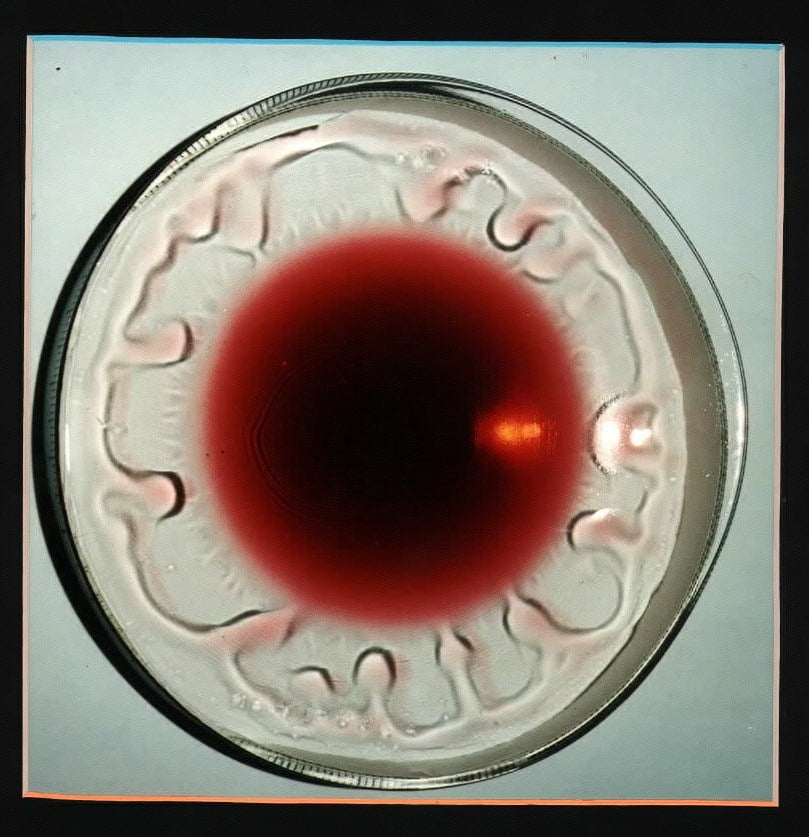
This photo shows the Saffman-Taylor instability in a Hele-Shaw cell. Here a viscous fluid has been placed between two glass plates and a second less viscous fluid inserted, resulting in a finger-like instability as the less viscous fluid displaces the more viscous one. This is an effect that can be easily explored at home using common liquids like glycerin, water, dish soap, or laundry detergent. #
Year: 2010

Airplanes Creating Snow
Scientists now think that that airplanes may be responsible for increasing local snowfall by flash-freezing supercooled water vapor in clouds. Water droplets can persist in the atmosphere to temperatures of -42 degrees Celsius. But when an airplane’s wing passes through moist air, the acceleration of the air passing over the wing causes a pressure decrease that can drop the temperature by as much as 19 C, causing the water droplets to form ice crystals immediately. (The particulate matter in the aircraft exhaust probably also aids this process.) The same behavior can also create holes in clouds and cause ice to form on the wings. # (Related behavior: vapor cones)
Photo credit: lhoon

Water Drops at 10,000 FPS
We’ve seen water droplets join a larger pool at 2,000 frames per second, but what about 10,000 frames per second? (via Gizmodo)

Soap Bubble Shapes
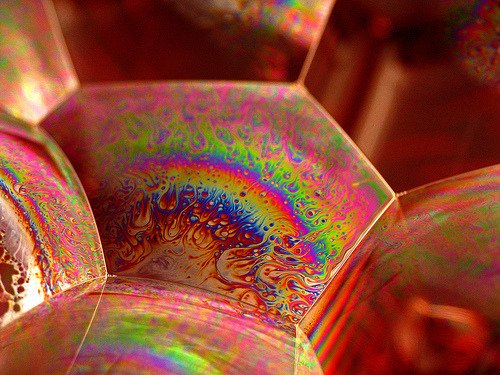
The shapes of soap bubbles are determined by surface tension, which ensures the smallest surface area for a given contained volume. (#) Their iridescent colors are created by the interference and refraction of light waves passing through the nonuniform thickness of the bubble, as well as to the motion of the soap mixture itself.
Photo credit: found via fuckyeaheyegasms, originally from teacupofmoons
Mach Diamonds
Joe asks:
Why does this rocket have that repeating pattern in its exhaust? I’m amazed that it’s so stable for so far as distance from the nozzle.
Excellent question! The diamond-shaped pattern seen in the rocket’s exhaust is actually a series of reflected shock waves and expansion fans. The rocket’s nozzle is designed to be efficient at high altitudes, which means that, at its nominal design altitude, the shape of the nozzle is such that the exhaust gases will be expanded to the same pressure as the ambient atmosphere. At sea level, the nozzle is overexpanded, meaning that the exhaust gases have been expanded to a lower pressure than the ambient. The supersonic exhaust has to reach ambient pressure, and it does so through an oblique shock right at the exit of the nozzle. However, the oblique shock, in addition to raising the pressure, turns the gases toward the exhaust centerline. To ensure flow symmetry, two additional oblique shocks form. But then the exhaust is at a higher pressure than ambient. Expansion fans form to reduce the pressure, but those, too, affect the direction the exhaust gases flow. The pattern, then, is a series of progressively weaker oblique shocks and expansion fans that raise the exhaust gas pressure to that of the ambient atmosphere.

Microgravity Marangoni
Astronauts are preparing an experiment on the Marangoni effect, in which a variation in surface tension can cause mass flow, for flight aboard the International Space Station. The effect, also responsible for causing tears of wine, will benefit from study in microgravity because competing effects like gravity-induced sedimentation and buoyant convection will be negligible. Astronaut Ron Garan reports more on the upcoming experiment on the Fragile Oasis blog.
Reader Question: Oswald de Waele
fyeahhexagons-deactivated201103 asks:
Could you do a quick post explaining the Oswald de Waele relationship please? Thanks!
Sure! The Oswald-de Waele relationship (a.k.a. a power-law fluid) is an attempt to generalize the relationship between shear stress and shear rate in fluids. For a Newtonian fluid, that relationship is linear:

This relationship describes many fluids–like air or water–very well. But there are plenty of non-Newtonian fluids as well, both shear-thinning (paint, shampoo, ketchup) and shear-thickening (oobleck). The Oswald-de Waele relationship approximates the behavior of these fluids using:

Values of n less than one correspond to shear-thinning (or pseudoplastic) fluids; a value greater than one is a shear-thickening (or dilatant) fluid. And n = 1 corresponds to a regular Newtonian fluid. #
Crown Breakup
When a droplet falls into a pool of similar fluid, one often observes a crown-like impact effect. This student video shows high-speed footage of different fluids crowning and explores the effects of surface tension on crown breakup.
Leaping Ferrofluid
This video shows some of the dynamic behaviors of a ferrofluid near moving magnetic fields. Ferrofluids are formed from a suspension of ferrous particles in a liquid, usually oil.

Archimedes
Archimedes may be the world’s most famous fluid mechanician. The story of his discovery of the principles of buoyancy (and his subsequent running naked through the streets proclaiming “Eureka!”) is classic. His other famous fluid-related invention is the Archimedes screw, a type of pump still used today in applications from moving granular flows to maintaining blood flow in heart patients. Scientific American is currently featuring a book excerpt about Archimedes and his contributions to physics and math. It’s well-worth a read. #