When two jets of a viscous liquid collide, they can form a chain-like stream or even a fishbone pattern, depending on the flow rate. This video demonstrates the menagerie of shapes that form not only with changing flow rates but by changing how the jets collide – from a glancing impingement to direct collision. When just touching, the viscous jets generate long threads of fluid that tear off and form tiny satellite droplets. At low flow rates, continuing to bring the jets closer causes them to twist around one another, releasing a series of pinched-off droplets. At higher flow rates, bringing the jets closer to each other creates a thin webbing of fluid between the jets that ultimately becomes a full fishbone pattern when the jets fully collide. The surface-tension-driven Plateau-Rayleigh instability helps drive the pinch-off and break-up into droplets. (Video credit: B. Keshavarz and G. McKinley)
Tag: viscous flow

Bubbles Through Constrictions
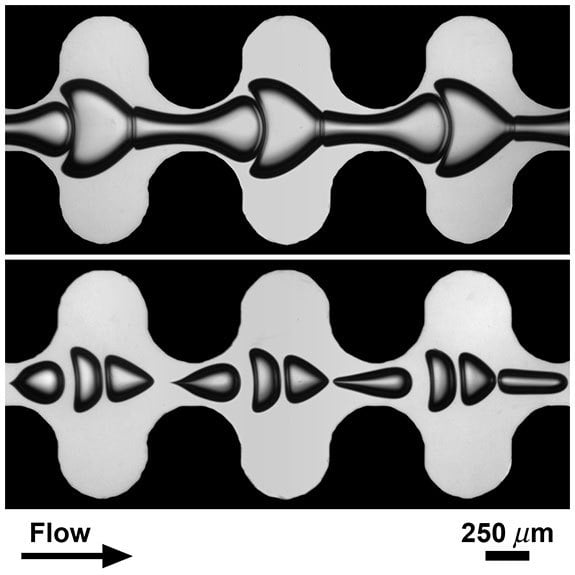
Surface tension usually constrains bubbles to the smallest area for a given volume – a sphere – but sometimes other forces generate more complicated geometries. The images above show bubbles flowing through microfluidic channels filled with a highly viscous carrier fluid. The bubble size and packing affects the shapes they assume, but so does the geometry of the channel. The narrow constrictions accelerate the flow, elongating the bubbles, whereas the wider channel regions slow the carrier fluid and squish the bubbles together. (Image credit: M. Sauzade and T. Cubaud (Stony Brook University))

The Reynolds Number Illustrated
The dimensionless Reynolds number is a key concept in fluid dynamics, allowing scientists to distinguish regimes of flow between differing geometries and even different fluids. This video gives a great primer on the subject by examining the physics of swimming for a sperm versus a sperm whale. The Reynolds number is essentially a ratio between inertial forces (driven by velocity and size) and viscous forces, and its value can indicate how important different effects are. Sperm and other microbes live at very small Reynolds numbers, meaning that viscosity dominates as the force they must overcome to move. For more on the low Reynolds number world, check out how brine shrimp swim and what happens if a microbe tries to flap its tail. (Hint: it goes nowhere, and this is why.) (Video credit: A. Bhatia/TED Ed; via Jennifer Ouellette)

Selective Suction
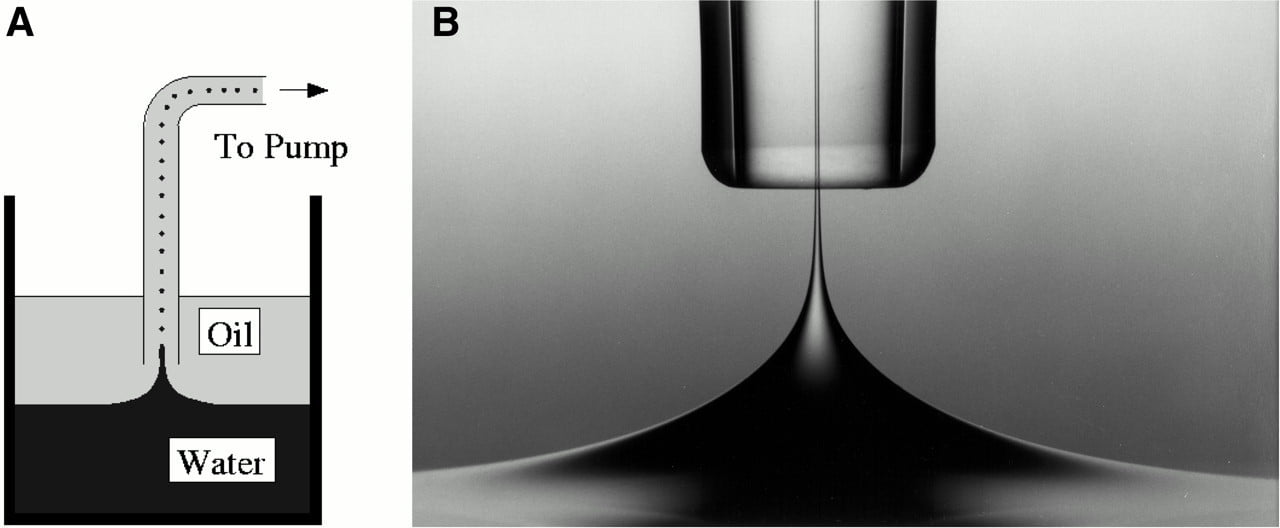
A thin spout of water is drawn up through a layer of oil in the photo on the right. This simple version of the selective withdrawal experiment is illustrated in Figure A, in which a layer of viscous oil floats above a layer of water. A tube introduced in the oil sucks fluid upward. At low flow rates, only the oil will be drawn into the tube, but as the flow rate increases (or the tube’s height above the water decreases), a tiny thread of water will be pulled upward as well. The viscous outer fluid helps suppress instabilities that might break up the inner fluid, and their relative viscosities determine the thickness of the initial spout. In this example, the oil is 195 times more viscous than the water. (Photo credit: I. Cohen et al.)
Bubbles With Tails
In water and other Newtonian fluids, a rising bubble is typically spherical, but for non-Newtonian fluids things are a different story. In non-Newtonian fluids the viscosity–the fluid’s resistance to deformation–is dependent on the shear rate and history–how and how much deformation is being applied. For rising bubbles, this can mean a teardrop shape or even a long tail that breaks up into fishbone-like ligaments. The patterns shown here vary with the bubble’s volume, which affects the velocity at which it rises (due to buoyancy) and thus the shear force the bubble and surrounding non-Newtonian fluid experience. (Video credit: E. Soto, R. Zenit, and O. Manero)
The Fluid Dynamical Sewing Machine
Originally posted: 3 Jan 2012 Nonlinearity and chaos are important topics for many aspects of fluid dynamics but can be difficult to wrap one’s head around. But this video provides an awesome, direct example of one of the key concepts of nonlinear systems–namely, bifurcation. What you see is a thread of very viscous fluid, like honey, falling on a moving belt. Initially, the belt is moving quickly and the thread falls in a straight line. When the belt slows down, the thread begins to meander sinusoidally. With additional changes in the belt’s speed, the thread begins to coil. A multitude of other patterns are possible, too, just by varying the height of the thread and the speed of the belt. Each of these shifts in behavior is a bifurcation. Understanding how and why systems display these behaviors helps unravel the mysteries of chaos. (Video credit: S. Morris et al.)
Reminder: There’s still time left to take the reader survey! Please take a couple minutes to help improve FYFD and science outreach. Thank you!

Hanging Liquids
A horizontal filament of viscous liquid hanging between two plates stretches under gravity. The photo above is a composite showing the stretching of a single thread over several time steps. The fluid forms a catenary, the same shape as a hanging chain or cable when supported only at its ends. This behavior is confined to viscous filaments of sufficient length and diameter. Short and thin filaments instead form a U-shape with a thin horizontal filament joined to two thicker vertical threads. This difference in shape occurs due to the drainage of the liquid along the filament’s length. If the viscous thread begins to fall before surface tension drains the fluid from the center toward the ends, then a catenary of essentially uniform diameter forms. If instead the liquid drains before falling, the non-uniform U-shape is observed. (Photo credit: M. Le Merrer et al.)

Dendritic Designs
Imagine a thin layer of viscous liquid sandwiched between two horizontal glass plates. Then pull those plates apart at a constant velocity. What you see in the image above is the shape the viscous fluid takes for different speeds, with velocity increasing from left to right and from top to bottom. For lower velocities, the fluid forms tree-like fingers as air comes in from the edges. At higher velocities, though, there’s a transition from the finger-like pattern to a cell-like one. The cells are actually caused by cavitation within the fluid. When the plates are pulled apart fast enough, the local low pressure in the fluid causes cavitation bubbles to form just before the force required to remove the plate reaches its peak. (Photo credit: S. Poivet et al.)
Entering a Viscous Liquid
When a solid object impacts on a liquid a cavity typically forms, entraining air into the pool. But this behavior varies widely according to the surface of the solid as well as the fluid’s properties. This video shows a sphere impacting a highly viscous liquid. The sphere stops shortly after impact while the cavity continues expanding in its wake. With a fluid like water, a long and thin cavity will typically pinch off before the object is decelerated, causing bubbles to form. No such behavior here. Instead the wide cavity pinches off at the surface of the motionless sphere and begins its rebound upwards. It even appears to pull the sphere partially back towards the surface! (Video credit: A. Le Goff et al.)

Stopping Jet Break-Up
When a stream of liquid falls, a surface tension effect called the Plateau-Rayleigh instability causes small variations in the jet’s radius to grow until the liquid breaks into droplets. For a kitchen faucet, this instability acts quickly, breaking the stream into drops within a few centimeters. But for more viscous fluids, like honey, jets can reach as many as ten meters in length before breaking up. New research shows that, while viscosity does not play a role in stretching and shaping the jet as it falls–that’s primarily gravity’s doing–it plays a key role in the way perturbations to the jet grow. Viscosity can delay or inhibit those small variations in the jet’s diameter, preventing their growth due to the Plateau-Rayleigh instability. In this respect, viscosity is a stabilizing influence on the flow. (Photo credit: Harsha K R; via Flow Visualization)