Tiny organisms live in a world dominated by viscosity. There’s no coasting or gliding. If a microorganism stops swimming, friction will bring it to a halt in less than the space of a hydrogen atom! To make matters worse, simply flapping an appendage forward and backward will get them nowhere. As we’ve seen before, these highly viscous laminar flows are reversible, meaning that a backward power stroke is simply undone by a mirrored forward recovery stroke. Instead, microorganisms like the paramecium swimming above are covered in tiny hairlike cilia which beat asymmetrically. They extend to their full length during the power stroke, but they stay bent during the forward recovery stroke. That asymmetry guarantees that they move more fluid backward than forward, thereby letting the paramecium make progress. (Image credit: C. Baroud, source)
Tag: viscous flow

Climbing Up the Walls
You may have noticed when baking that fluids don’t always behave as expected when you agitate them. If you put a spinning rod into a fluid, we’d expect the rod to fling fluid away, creating a little vortex that stirs everything around. And for a typical (Newtonian) fluid, this is what we see. The fluid’s viscosity tries to resist deforming the fluid, but the momentum imparted by the rod wins out. With a viscoelastic fluid, on the other hand, the story is much different. As before, the spinning of the rod deforms the fluid. But the viscoelastic fluid contains long chains of polymers. As those polymers get stretched by the deformation, they generate their own forces, including forces parallel to the rod. Instead of being flung outward, the viscoelastic fluid starts climbing up the rod, with the stretchy elasticity of the polymers helping pull more fluid up and up. (Image credit: Ewoldt Research Group, source)

Bonbon Coatings
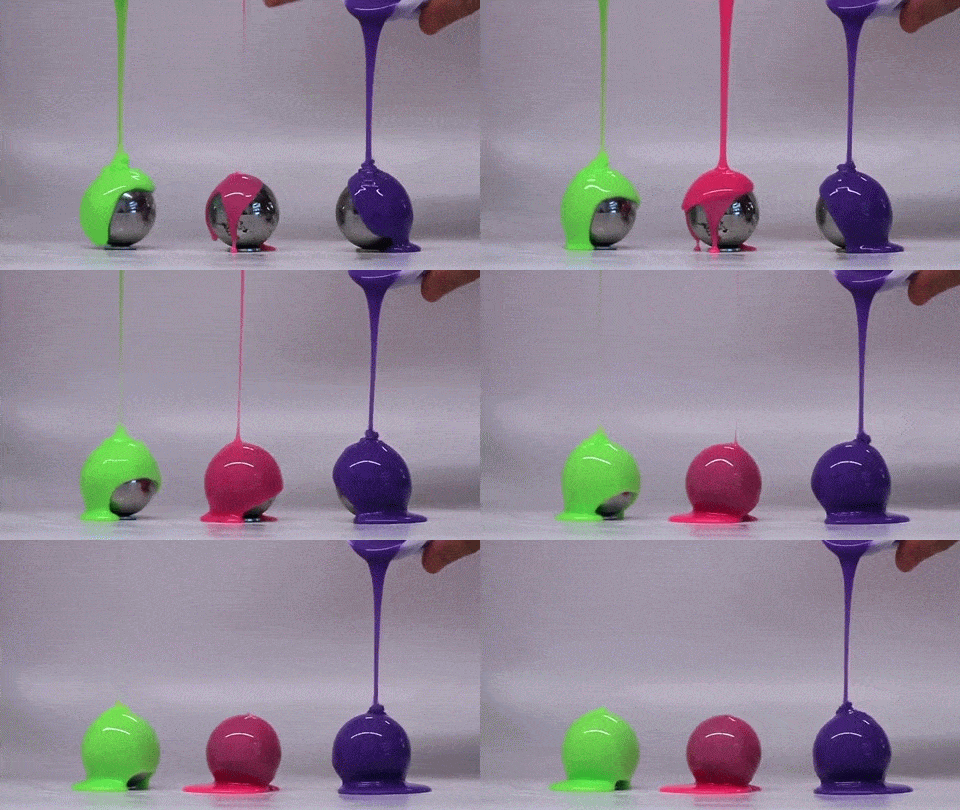
If you’ve ever bitten into a chocolate-covered bonbon, you may have noticed that the candy’s chocolate coating is remarkably uniform. Inspired by this observation, a group of engineers have investigated how viscous fluids poured over a curved surface flow and solidify; their findings were published this week.
Rather than heated chocolate, the group used polymer-filled fluids that cure and harden over time. Interestingly, they found that the final shell is quite uniform and that its thickness does not depend on the pouring technique. Instead, they can predict the final shell thickness based on the radius of the mold and the rheological properties of the fluid–specifically its density, viscosity, and curing time. The reason for this is that the time it takes for the fluid to drain and coat the mold is much shorter than the time it takes for the polymer to cure. As a result, the amount of fluid that sticks to the mold depends on geometry and fluid properties – not how the fluid was poured.
Amateur confectioners rejoice: pouring uniform chocolate coatings may be easier than you thought! (Image credit: MIT News, video; research credit: A. Lee et al.)

Drawing With Microfluidic Tweezers

One of the challenges of dealing with objects at the microscale is finding ways to manipulate them. This is what techniques like optical tweezers or magnetic traps are used for. The downside to these methods is that they often require complex experimental set-ups or place restrictions on the kinds of particles that can be manipulated. Recently, however, researchers have developed a new hydrodynamic alternative: the Stokes trap.
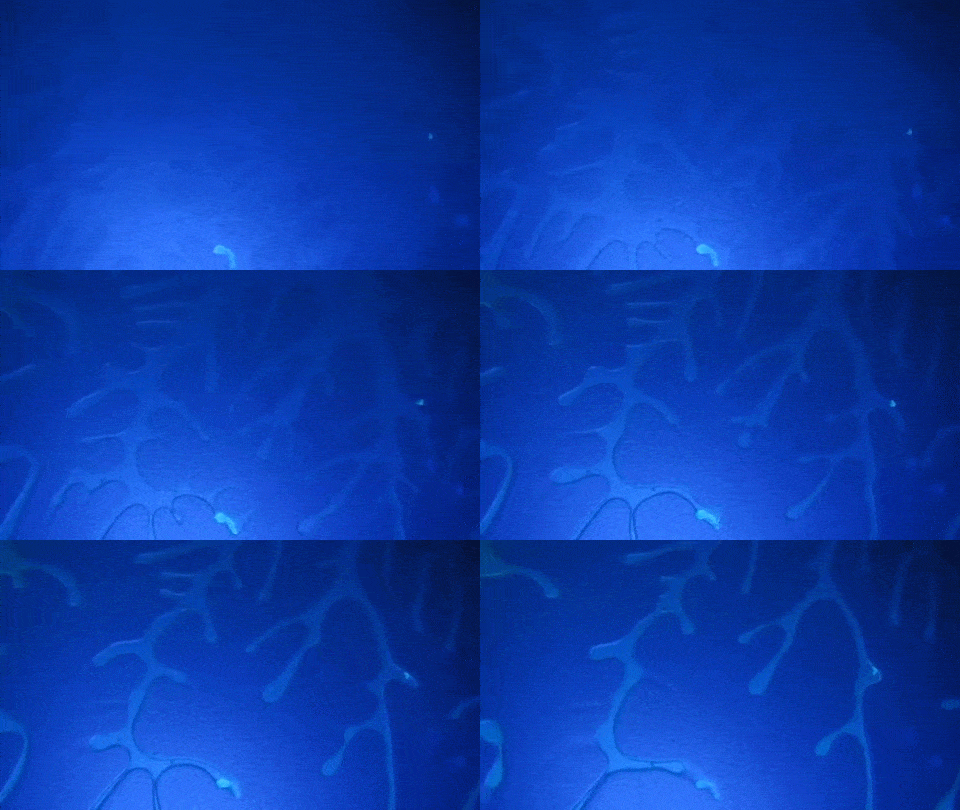
Using a six-channel microfluidic device like the the ones shown in A) and B) above, scientists can alter the flow in the device in such a way that they trap and manipulate two particles at the same time. The simultaneous inflow and outflow in the device creates streamlines like those shown in C) and D) above. The large white areas where the streamlines converge and diverge are stagnation points–areas of little to no velocity. The scientists trap their particles at the stagnation points and then carefully shift the flow rates into and out of the device to move the stagnation points–with particles in tow–wherever they want them. In the animation, you can see part of a movie where they use the particles to write out a capital I (for University of Illinois). The researchers hope the technique will be used in the future for studying the physics of soft materials and biologically-relevant molecules like DNA. For more, check out the full paper or the group’s website. (Image credit and submission: C. Schroeder et al.)

Martian Viscous Flow

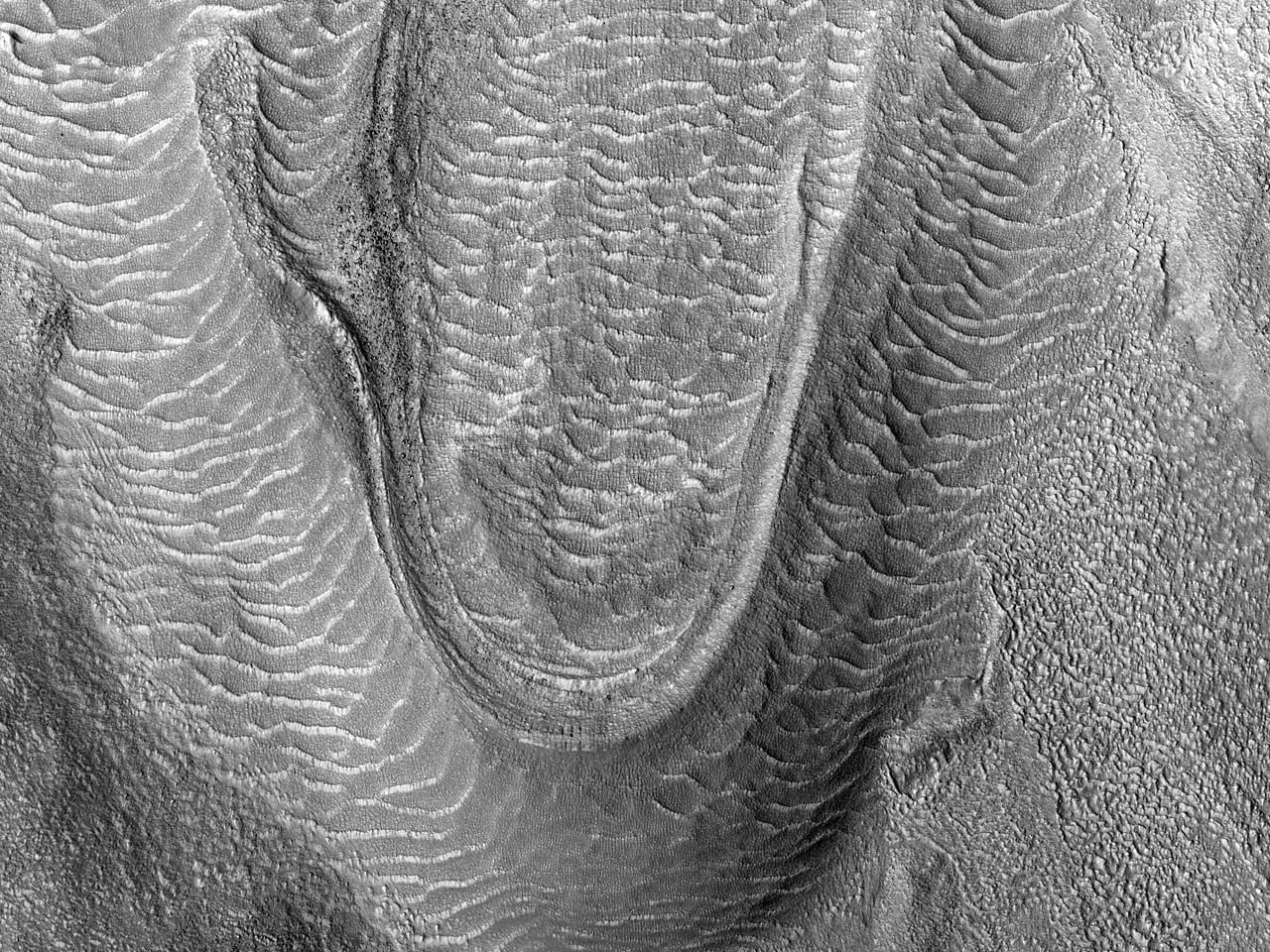
These images from the Mars Reconnaissance Orbiter show what are called viscous flow features. They are the Martian equivalent of glacial flow. Such features are typically found in Mars’ mid-latitudes.
Ground-penetrating radar studies of Mars have shown that some of these features contain water ice covered in a protective layer of rock and dust, making them true glaciers. Another study of similar Martian surface features found that their slope was consistent with what could be produced by a ~10 m thick layer of ice and dust flowing superplastically over a timescale equal to the estimated age of the surface features. Superplastic flow occurs when solid matter is deformed well beyond its usual breaking point and is one of the common regimes for glacial ice flow on Earth. (Image credit: NASA/JPL/U. of Arizona; via beautifulmars)
Wrinkling Fluids
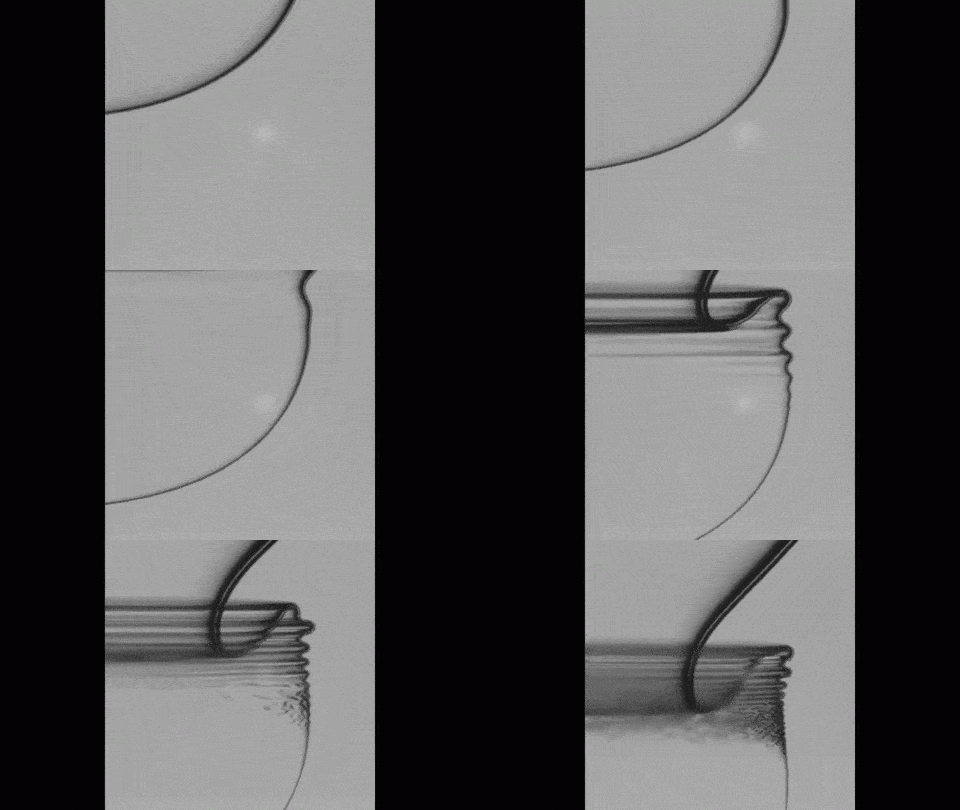
What you see here is a viscous drop falling into a less viscous fluid. Shear forces between the drop and the surrounding fluid cause the drop to quickly deform into a shape like an upside-down mushroom as it descends. The cap forms a vortex ring that curls the viscous fluid back on itself. As it does, that motion compresses the viscous sheet, causing it to wrinkle, as seen in the close-up in the bottom animation. Check out the full video here. (Image credit: E. Q. Li et al., source)

Electric Coiling

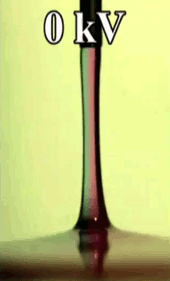
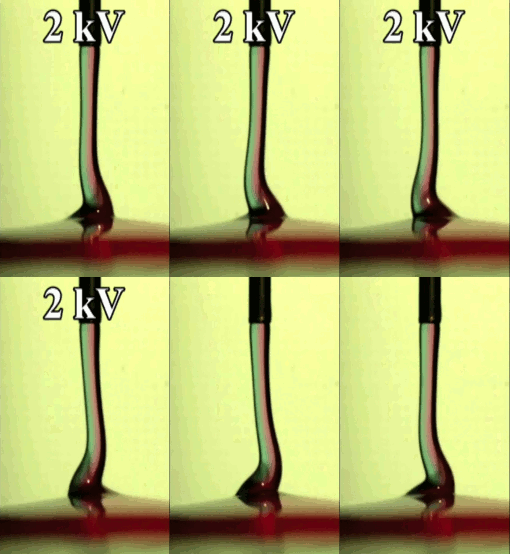


A falling jet of viscous fluid–like honey or syrup–will often coil. This happens when the jet falls quickly enough that it gets skinnier and buckles near the impact point. Triggering this coiling typically requires a jet to drop many centimeters before it will buckle. In many manufacturing situations, though, one might want a fluid to coil after a shorter drop, and that’s possible if one applies an electric field! Charging the fluid and applying an electric field accelerates the falling jet and induces coiling in a controllable manner.
An especially neat application for this technique is mixing two viscous fluids. If you’ve ever tried to mix, say, food coloring into corn syrup, you’ve probably discovered how tough it is to mix viscous substances. But by feeding two viscous fluids through a nozzle and coiling the resulting jet, researchers found that they could create a pool with concentric rings of the two liquids (see Figure C above). If you make the jet coil a lot, the space between rings becomes very small, meaning that very little molecular motion is necessary to finish mixing the fluids. (Image credits: T. Kong et al., source; via KeSimpulan)

Chocolate Fountain
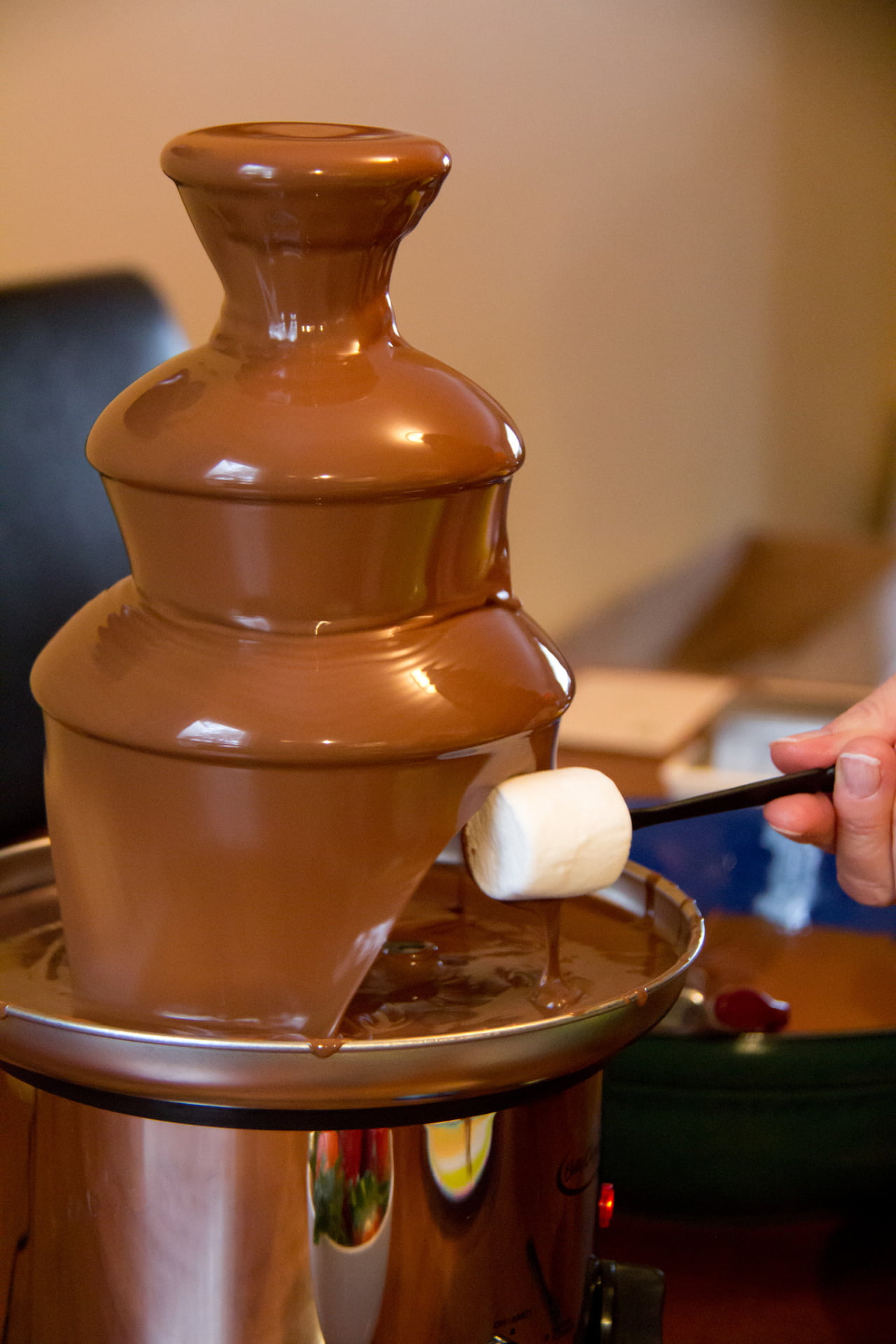
Amidst your holiday celebrations, you may have encountered a chocolate fountain. In a recent paper, applied mathematicians have laid out the physics behind these delicious decorations, and it turns out they are an excellent introduction to many fluids concepts. Molten chocolate is a mildly shear-thinning, non-Newtonian fluid, meaning that it becomes less viscous when deformed. This adds a wrinkle to the mathematics describing the flow, but only a little one. The researchers divide the flow into three regimes: pipe flow driving the chocolate up the inside of the fountain, thin-film flow over the fountain’s domes, and, finally, the curtain of falling chocolate where foodstuffs are dipped. The final regime is the most mathematically challenging and may be the most fascinating. The authors found that the free-falling curtain of liquid pulls inward as it falls due to surface tension. Their paper is quite approachable, and I recommend those of you with mathematical inclinations check it out. (Image credit: P. Gorbould; research credit: A. Townsend and H. Wilson)
Viscous Fingers
Take a viscous fluid, like laundry detergent, and sandwich it between two plates of glass. Fluid dynamicists call this set-up a Hele-Shaw cell. If you then inject a less viscous fluid, like air, between the plates–or if you try to pry them apart–you’ll see a distinctive pattern of dendritic fingers form. This viscous fingering, also known as the Saffman-Taylor instability, occurs because the interface between the two fluids is unstable. Invert the problem, though–inject a more viscous fluid into a less viscous one–and no special shapes will form because the interface will remain stable. (Image credit: Random Walk Studios, source)
Nectar-Eating Bats


Nectar-eating bats have evolved to use several methods to drink. Some bats, like the Pallas’ long-tongued bat (top), use a lapping method. Hair-like papillae on the bat’s tongue increase the contact area with the nectar, helping to draw the fluid up in viscous globs as the bat repeatedly dips its tongue into the nectar. The orange nectar bat (middle and bottom), in contrast, has a tongue with a long central groove. This bat’s tongue stays submerged as it drinks. Researchers hypothesize that muscle action along the tongue, combined with capillary action in the narrow groove, allow the bat to actively pump nectar up to its mouth. It’s worth noting that the edges of the bat’s tongue do not curl around to touch, so the bat is definitely not using suction as one would with a straw. (Image credit: M. Tschapka et al., source)