Tag: solar dynamics

  • Eyes on the Sun

    Eyes on the Sun

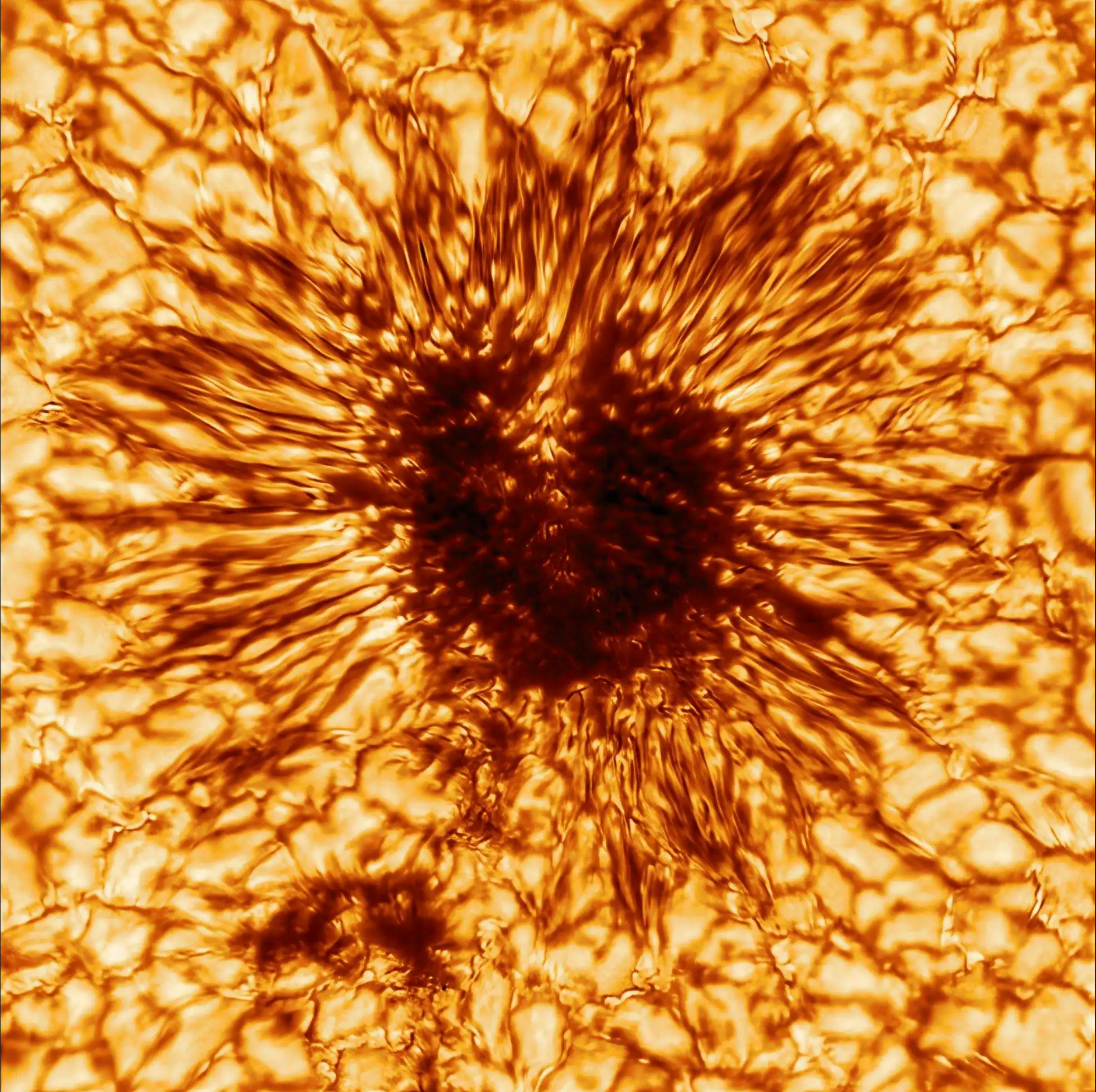
    Though it may look like the Eye of Sauron, this image is actually one of our best-ever glimpses of a sunspot. Captured by the Daniel K. Inouye Solar Telescope, this sunspot is larger than our entire planet, yet we can see details as small as 20km across. The dark central region of the image is the sunspot’s umbra, surrounded by the lighter, streakier penumbra. Along the edges of the image, you see a more typical pattern of bright convection cells. Compared to the rest of the sun’s surface, sunspots are cool — about 1,000 K cooler — due to their intense magnetic field flux inhibiting convection. (Image credit: NSO/AURA/NSF; via Bad Astronomer; submitted by Kam-Yung Soh)

  • Searching For Solar Neutrinos

    Searching For Solar Neutrinos

    An experiment in Italy has reported new findings confirming a long-standing theory of nuclear fusion in our Sun. The researchers were able to detect neutrinos released by the relatively rare fusion of carbon and nitrogen. But catching those neutrinos took an impressive fluid dynamical feat.

    The Borexino solar-neutrino detector is essentially an enormous nylon balloon, filled with liquid hydrocarbons, immersed in water, and buried beneath a kilometer of rock. Most neutrinos fly through this milieu unhindered, but a few collide with hydrocarbon molecules, creating streaks of light picked up by the detector.

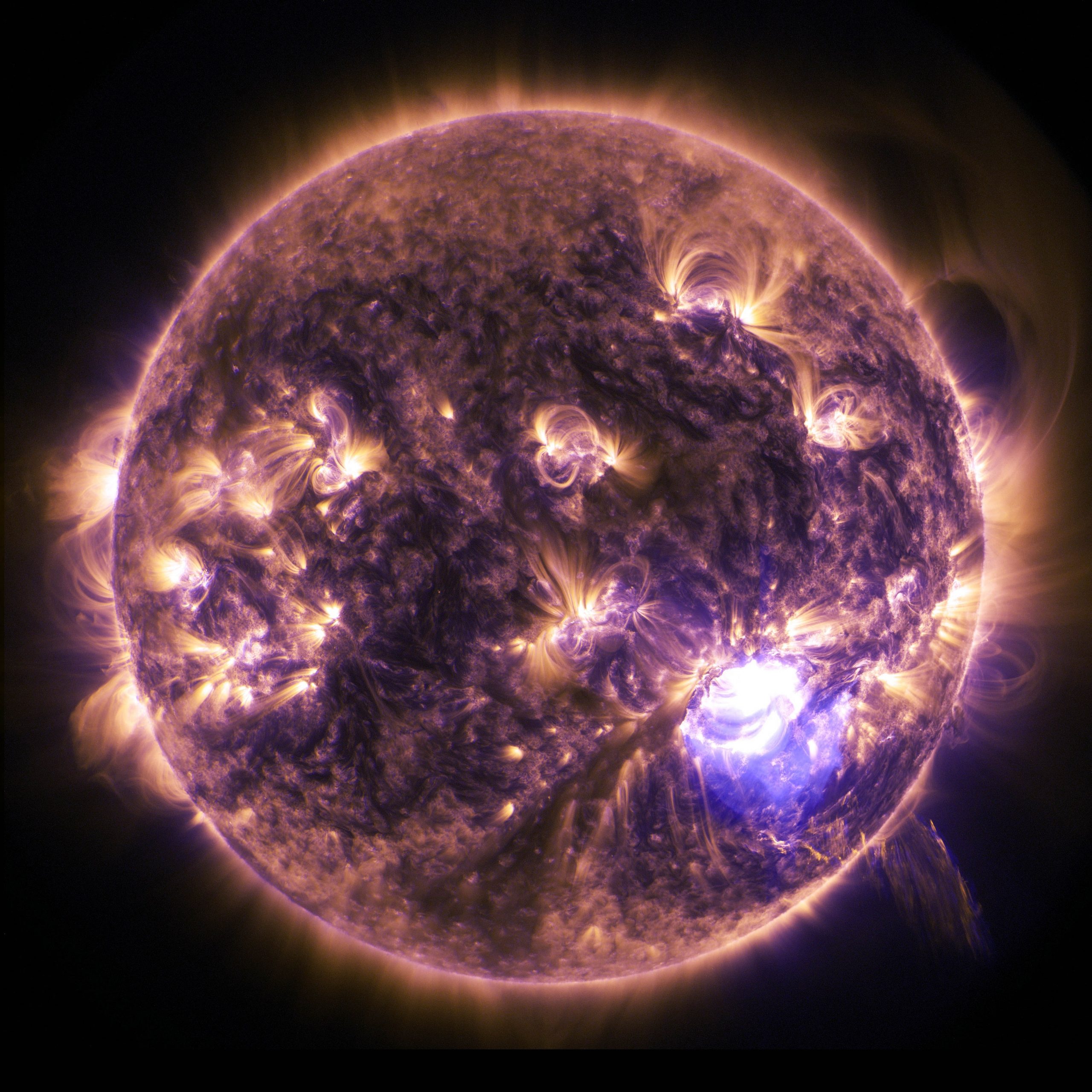
    The challenge in distinguishing solar carbon-nitrogen neutrinos comes from an isotope in the balloon’s nylon lining, which slowly leaks into the detector. The noise caused by the leaking isotope is easily confused with the true solar signal. To tamp down on that noise level, the researchers took elaborate steps to ensure that all 278 tonnes of liquid in the detector remained at exactly the same temperature, thereby eliminating convection in the detector. With only molecular diffusion to move the noisy isotopes, the researchers held the liquid incredibly still. One team member described the fluid as moving only tenths of a centimeter a month! (Image credit: NASA SDO; via Nature; submitted by Kam-Yung Soh)

  • New Details on the Sun’s Surface

    New Details on the Sun’s Surface

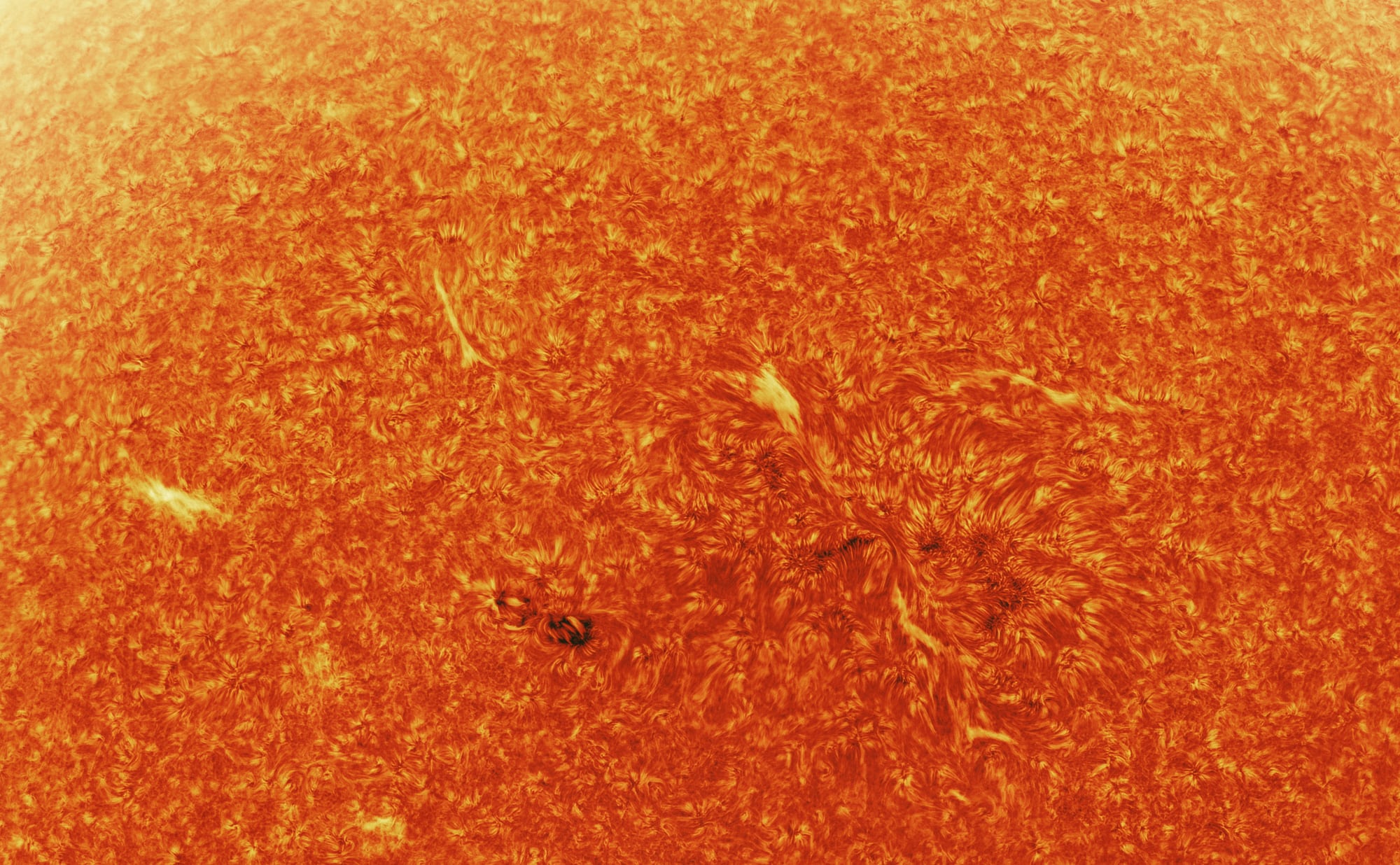
    As part of its shakedown, the new Inouye Solar Telescope has captured the surface of the sun in stunning new detail. Seen here are some of the sun’s turbulent convection cells, each about the size of the state of Texas. Hot plasma rises in the center of each cell, cools, and then sinks near the dark edges. Also visible within these dark borders are bright spots thought to mark magnetic fields capable of channeling energy out into the corona. Researchers hope the new telescope will help them uncover the physics behind these processes. (Image and video credit: Inouye Solar Telescope)

    Convection cells on the sun.

    Editor’s note: Like several other telescopes located in Hawai’i, the Inouye Solar Telescope was built against the wishes of many native Hawaiians. Although FYFD supports scientific progress, it is my personal belief that scientific advances should not come at the expense of indigenous populations. I strongly urge my scientific colleagues to listen to and work alongside those with concerns about future facilities.

  • Featured Video Play Icon

    Sunlight Is Older Than You Think

    Joe Hanson over at “It’s Okay to Be Smart” has a great video on the random walk photons have to make to escape the core of the sun and other stars. Because the high-energy photons born in the star’s core have to bounce their way out rather than flying in a straight line, those photons can spend thousands of years escaping the sun. After that, the eight-and-a-half minute trip to Earth is nothing.

    But there’s a key element missing in this explanation: convection! That radiative random walk photons do doesn’t last all the way from the core of the sun to its surface. From a depth of about 200,000 km onward, the dominant mode of transport in the sun is convection, actual fluid motion that carries heat and light much faster than simple molecular diffusion, or Brownian motion, does. That’s why the surface of the sun shines with convection cells similar to the ones you’ll see in your skillet when heating a layer of oil.

    Fluid motion beyond molecular diffusion is also a big part of the other flows Joe describes in the video. If you had to wait on Brownian motion in order to smell your morning coffee, it would be cold long before you knew it was there! (Video and image credit: It’s Okay to Be Smart; sun surface image credit: Big Bear Solar Observatory/NJIT)

  • Plasma Shock Waves

    Plasma Shock Waves

    Solar flares and coronal mass ejections send out shock waves that reverberate through our solar system. But shock waves through plasma – the ionized, high-energy particles making up the solar wind – do not behave like our typical terrestrial ones. Instead of traveling through collisions between particles, these astrophysical shock waves are driven by interactions between moving, charged particles and magnetic fields. 

    A driving burst of plasma accelerated into ambient plasma creates electromagnetic forces that accelerate ambient ions to supersonic speeds, pushing the shock wave onward even without particles directly colliding. Thus far, piecing together the physics of these interactions has been a challenge because spacecraft are limited in what and where they can measure. But a group here on Earth has now recreated and observed some of this process in the lab. (Image credit: NASA Solar Dynamics Observatory; research credit: D. Schaeffer et al.; via phys.org)

  • Simulating Solar Flares

    Simulating Solar Flares

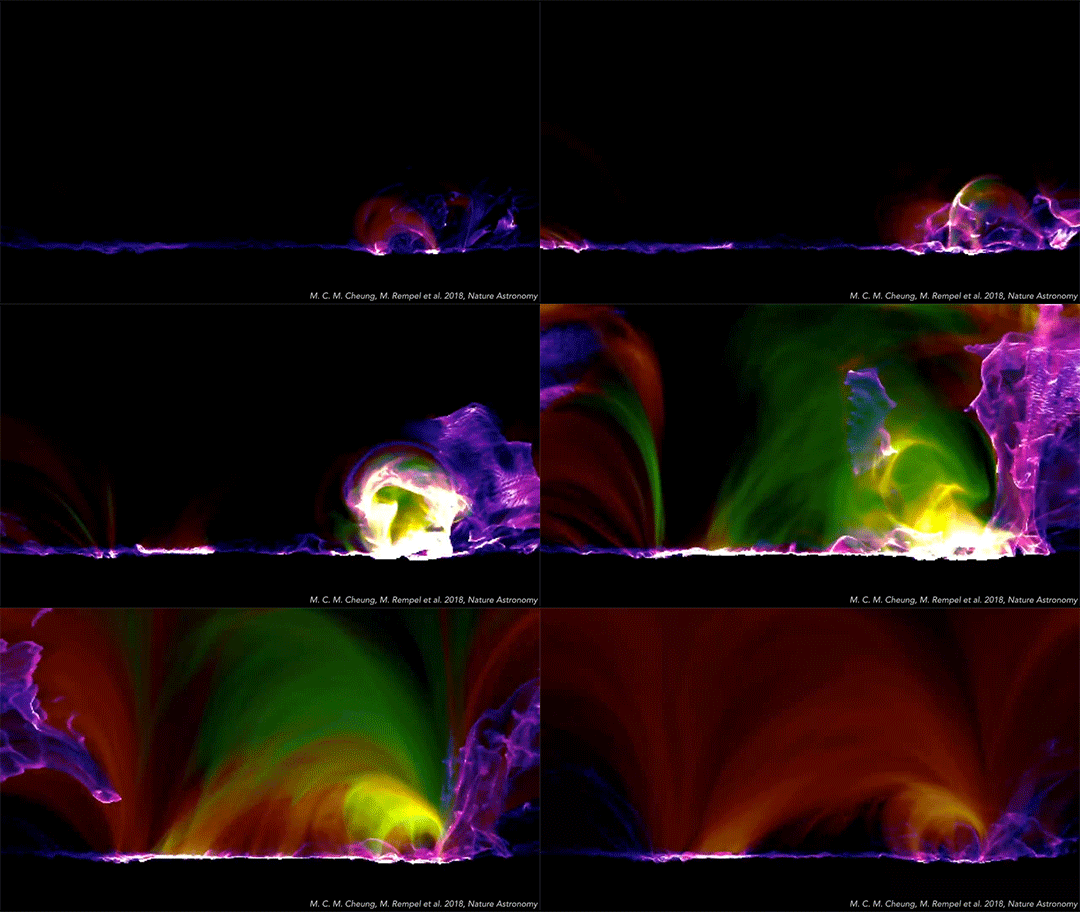
    Few topics in fluid dynamics are more mathematically complicated than magnetohydrodynamics – the marriage between electromagnetism and fluids. That mathematical complexity, along with the vast range of scales necessary to describe physical systems like our sun, means that, until now, researchers had to simplify their assumptions when simulating solar physics. But now, for the first time, a group has built a comprehensive, three-dimensional simulation capable of generating realistic solar flares. This is what you see above.

    Solar flares occur when a tangle of magnetic loops near the sun’s surface break and reconnect, releasing enormous magnetic energy and spewing a fountain of ionized plasma into the corona. They’re a danger particularly to satellites in orbit, so being able to simulate these events realistically is a major advance toward understanding the physics of space weather. (Image and video credit: NCAR & UCAR Science; research credit: M. Cheung et al.; via Bad Astronomy; submitted by Kam-Yung Soh)

  • Solar Prominence

    Solar Prominence

    Near the surface of the sun, the interplay of magnetic fields and plasma flow creates solar prominences that appear to dance. The prominence shown here was recorded in 2012 by the NASA Solar Dynamics Observatory, and its arc is large enough to easily surround the Earth. This is fluid dynamics – specifically magnetohydrodynamics – on a scale difficult for us earthbound humans to imagine. Scientists are still working to understand the complex processes that drive flows like this one. Fortunately, we can appreciate their beauty regardless. (Image credit: NASA SDO, source; via APOD; submitted by jpshoer)

  • Solar Eclipses and Coronal Mass Ejections

    Solar Eclipses and Coronal Mass Ejections

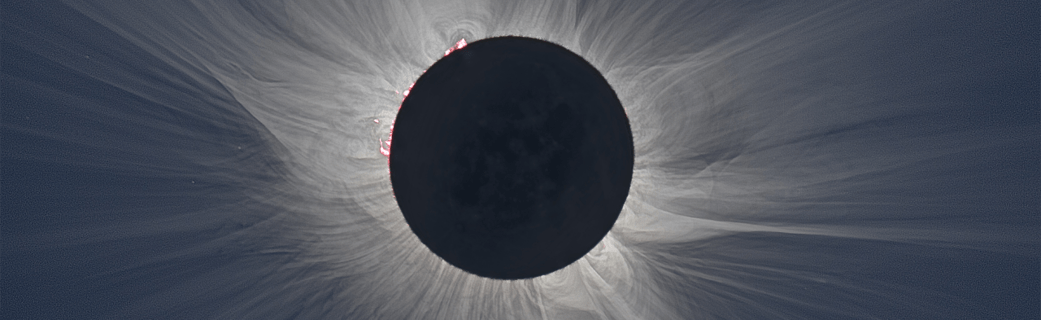
    Observations of many solar phenomena have only become accessible to humans relatively recently with the advent of satellites. Prior to that, it simply wasn’t feasible to observe dynamics in the sun’s atmosphere, like solar prominences or coronal mass ejections – the sun was simply too bright to see them – except during the occasional total solar eclipse!

    In the 1970s, scientists identified massive bursts of solar plasma as coronal mass ejections. These solar storms are responsible for so-called space weather and, when directed toward Earth, can pose a hazard to technologies on the ground and astronauts in orbit. Scientists initially thought this was the first time such storms had been observed, but they later recognized that photographs and sketches of an 1860 total eclipse revealed that humanity had seen a coronal mass ejection more than 100 years before! Check out the NASA video below for the full story. You can also learn about some of the science that will be going on in today’s eclipse. And, for those in the U.S. today, have a fun and safe time viewing the ecliipse!  (Image credit: S. Habbal, M. Druckmüller and P. Aniol, source; video credit: NASA Goddard)

  • Solar Wind

    Solar Wind

    Fluid dynamics appear at all kinds of scales. The animation above shows two comets, Encke and ISON, on their recent approach toward the sun. The darker wisps emanating from the right side of the image are part of the solar wind, a plasma stream continuously emitted by the sun’s upper atmosphere. Although the solar wind is very rarefied by terrestrial standards, its density is sufficient to whip the comets’ tails of gas and dust from side-to-side. Scientists use images like these to learn more about the structure of the solar wind based on its interaction with the comets. For more great images of ISON’s journey around the sun, check out NASA Goddard.  (Image credit: K. Battams/NASA/STEREO/CIOC; submitted by John C)

  • Convection on the Sun

    Convection on the Sun

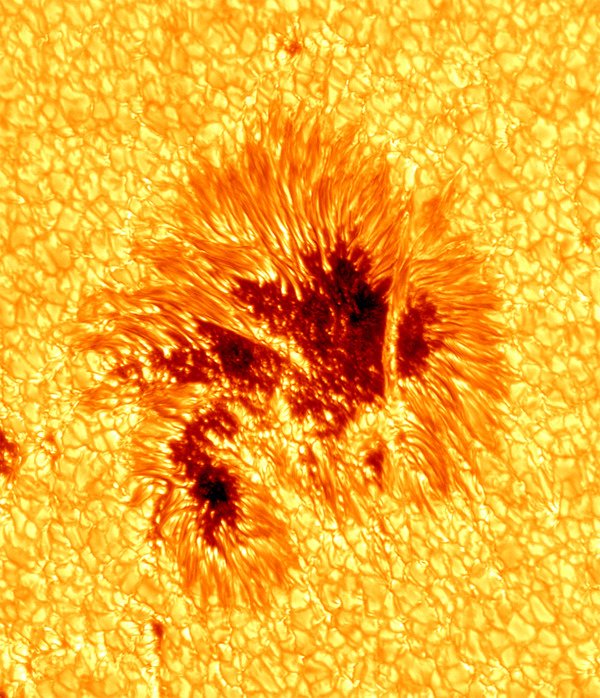
    New photographs showing ultra-fine structure in the sun’s chromosphere and photosphere have been released. They offer a fascinating view into the magnetohydrodynamics of the sun, where the fluid behaviors of plasma are constantly modified by the sun’s magnetic field. The left image shows fine-scale magnetic loops rooted in the photosphere, while the right image shows our clearest photo yet of a sunspot. The dark central portion is the umbra, where magnetic field lines are almost vertical; it’s surrounded by the penumbra, where field lines are more inclined. Further out, we see the regular convective cell structure of the sun. (Photo credit: Big Bear Solar Observatory/NJIT; via io9 and cnet)