This video describes how the sun’s energy drives wind and ocean currents on earth. As solar winds stream forth from the sun, our magnetosphere deflects the brunt of the impact (creating auroras at the poles) while the atmosphere, land masses, and oceans absorb thermal energy from the sun’s light. Because of our cycles of day and night and the differences in how land, water, and ice absorb heat, temperature differentials around the earth drive a massive heat engine, causing the circulation of water and wind all around our world. Numerical simulations like the ones underlying this video are vital for the prediction of climate and weather, as well as for developing models and techniques that can be applied to other problems in science and engineering. (Video credit: NASA; via Gizmodo)
Tag: solar dynamics

Convective Cells
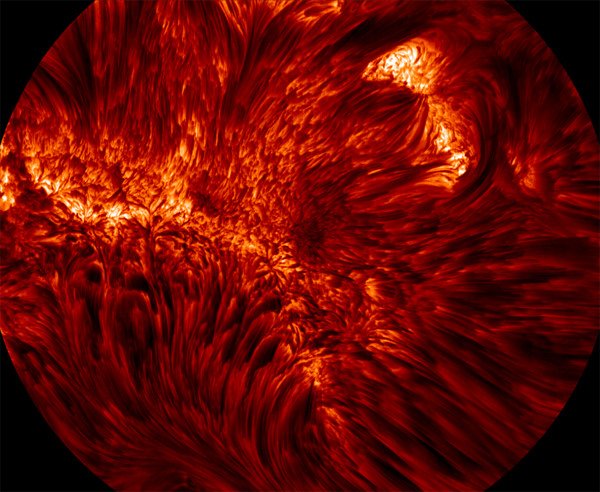
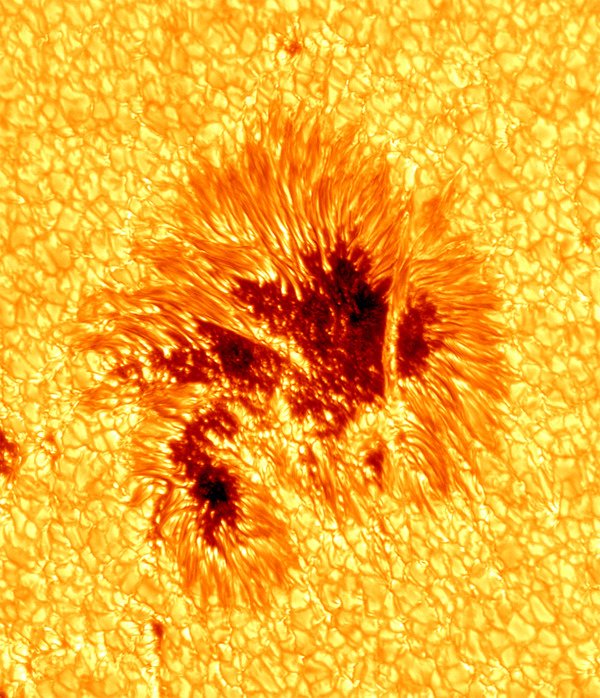
Convective cells form as fluid is heated from below. As the fluid near the bottom warms, its density decreases and buoyancy causes it to rise while cooler fluid descends to replace it. This fluid motion due to temperature gradients is called Rayleigh-Benard convection and the cells in which the motion occurs are called Benard cells. This particular type of convection is essentially what happens when a pot is placed on a hot stove, so the shapes are familiar. Similar shapes also form on the sun’s photosphere, where they are called granules.

Dancing Plasma
Two dark areas of plasma, cooler than the surrounding fluid, dance and intertwine above the sun’s surface. Plasma, a rarefied gas made up of ions, is an electrically conductive fluid, shaped here by the magnetic field of the sun. Note how the strands pass material back and forth along the magnetic field lines. This timelapse video, captured by NASA’s Solar Dynamics Observatory, takes place over the course of a day and is captured in the extreme ultraviolet range.

Solar Tornadoes
NASA’s Solar Dynamics Observatory captured this video of swirls of darker, cooler plasma caught between competing magnetic forces over the course of 30 hours. The plasma strands rotate like tornadoes caught on magnetic field lines. It sometimes feels incredible to observe such familiar-looking fluid behavior in such unfamiliar places, but it’s just a reminder that physics works no matter where you are.

Voyager Explores the Edge of the Solar System
Though unconventional by our terrestrial concepts of fluids, the solar wind and its interaction with objects in and around our solar system can be considered a form of fluid dynamics. This NASA video discusses discoveries made by the Voyager spacecrafts as they leave our solar system and pass into interstellar space. The solar wind, a rarefied stream of charged particles, streams outward from the Sun at supersonic speeds. Eventually, the pressure from the interstellar medium surrounding the solar system is sufficient to slow the solar wind to subsonic speeds, causing a termination shock much like the hydraulic jump that forms in a kitchen sink when you turn the faucet on.

Solar Flare
An M-class solar flare with a towering prominence erupted from the Sun over the course of three hours in late September. Notice how the plasma does not fall straight back to the surface but flows back down following the Sun’s magnetic field lines. As an rarefied ionized gas, plasma follows coupled laws of electromagnetism and fluid dynamics. #

Aurora from the ISS
The solar wind, a rarefied stream of hot plasma ejected from the sun, constantly bombards Earth’s magnetic field. This results in the formation of the magnetosphere, which deflects most of these charged particles away from the earth. Some of them, however, are drawn toward the magnetic poles; when these charged particles strike the upper atmosphere, they cause the gases there to release photons, resulting in the lights we know as auroras. This animation shows the International Space Station flying through the aurora australis–the southern lights. The fluid-like motion of the aurora is no accident; though diffuse, the solar wind is still a fluid governed by magnetohydrodynamics.

Glorious Coronal Mass Ejection
In early June, NASA’s Solar Dynamics Observatory recorded a stunning coronal mass ejection, in which larger than usual quantities of cool (relatively speaking) plasma erupted from the surface of the sun and rained back down along magnetic field lines. Plasma is an ionized gas-like state of matter subject to the same laws that govern more familiar fluids like water or air, with the additional caveat that, being electrically conductive, plasmas also obey Maxwell’s equations. #

Aurora Physics
The auroras at Earth’s poles are much more than pretty lights. This video explains their formation; fluid mechanics (specifically magnetohydrodynamics) play a major role in the convective transport of heat inside the sun as well as the movement of the plasma that makes up a solar storm that interacts with Earth’s magnetic field and produces the auroras.

Coronal Waves
NASA’s Solar Dynamics Observatory has found evidence of Kelvin-Helmholtz waves in the sun’s corona. These waves, which occur between two fluids of different densities or moving at different speeds, are similar to the iconic waves surfers ride. Researchers suspect that this turbulent motion may help explain why the corona is 1,000 times hotter than the surface of the sun. #
