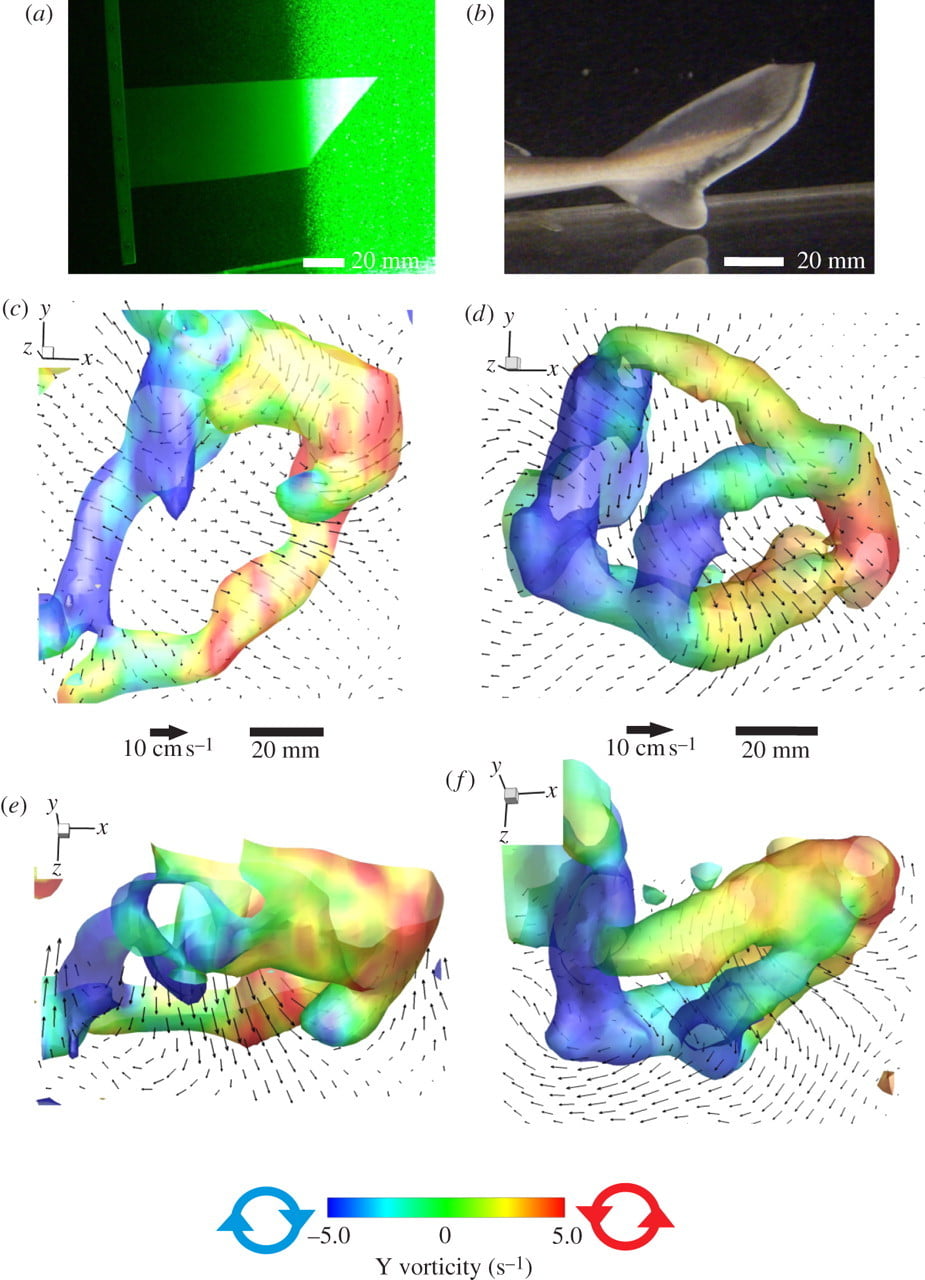
Volumetric imaging of swimming spiny dogfish, a type of shark, shows that their distinctively asymmetric tails produce a set of dual-linked vortex rings with every half beat of their tail. The figure above shows data from the actual shark on the right (b,d,f) and a similarly shaped robotic tail on the left (a,c,e). The second row contains lateral views (c,d) and the bottom row contains dorsal views (e,f) of the vorticity isosurfaces measured. The robotic tail does not demonstrate the same double vortex structure, leading scientists to suspect that the shark may be actively stiffening its tail mid-stroke to control its wake. The finding could help engineers design aquatic robots whose morphing fins help it swim more efficiently. For more, see Wired.
Tag: shark

Bristling Scales Give Sharks Speed
The shortfin mako shark is one of the ocean’s fastest and most agile hunters, thanks in part to flexible scales along its body. As water flows around the shark’s body, the scales bristle to angles in excess of 60 degrees. This causes turbulence in the boundary layer along the shark’s body and prevents boundary layer separation which would otherwise increase the shark’s drag. In this respect, the scales serve much the same purpose as dimples on a golf ball. (Abstract, National Geographic article) #
