When a solid object impacts on a liquid a cavity typically forms, entraining air into the pool. But this behavior varies widely according to the surface of the solid as well as the fluid’s properties. This video shows a sphere impacting a highly viscous liquid. The sphere stops shortly after impact while the cavity continues expanding in its wake. With a fluid like water, a long and thin cavity will typically pinch off before the object is decelerated, causing bubbles to form. No such behavior here. Instead the wide cavity pinches off at the surface of the motionless sphere and begins its rebound upwards. It even appears to pull the sphere partially back towards the surface! (Video credit: A. Le Goff et al.)
Tag: science

Internal Wave Demo
This video has a fun and simple demonstration of the importance of fluid density in buoyancy and stratification. Fresh water (red) and salt water (blue) are released together into a small tank. Being lighter and less dense, the red water settles on top of the blue water, though some internal waves muddy their interface. After the water settles, a gate is placed between them once more and one side is thoroughly mixed to create a third fluid density (purple), which, when released, settles between the red and blue layers. In addition to displaying buoyancy, this demo does a great job ofaa showing the internal waves that can occur within a fluid, especially one of varying density like the ocean. (Video credit: UVic Climate Modeling Group)
Washing Your Face in Space
What happens to a wet washcloth when wrung out in space? Astronaut Chris Hadfield answers this question from students with a demonstration. Without gravity to pull the water downward, surface tension effects dominate and the wrung cloth forms a tube of water around it. Surface tension and capillary action draw the fluid up and onto Hadfield’s hands as long as he holds the cloth. After he lets go, we see that the water remaining around the cloth soaks back in (again due to capillary action) and the wet, twisted washcloth simply floats without releasing water or relaxing its shape. While pretty much what I would have expected, this was a very cool result to see! (Video credit: C. Hadfield/CSA; submitted by Bobby E)

Turning Sound Into Imagery


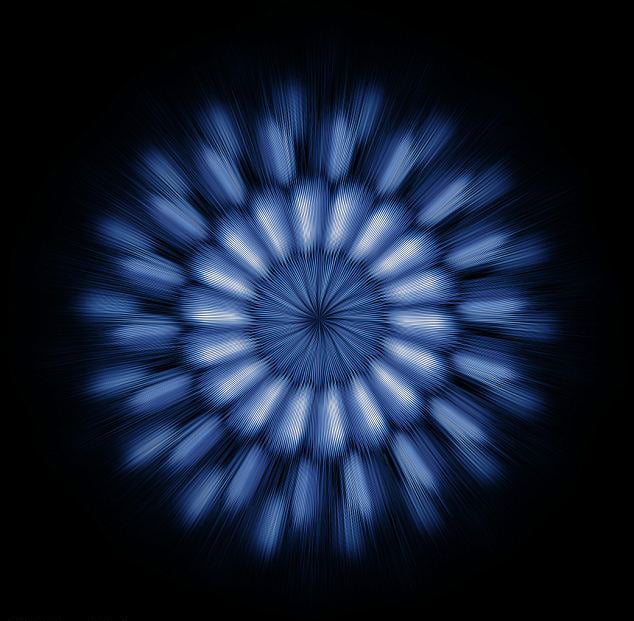

The acoustic signatures of many animals contain features we humans cannot appreciate, given the limited range of frequencies we can hear. In fluid dynamics and many other fields, scientists and engineers have to find ways to analyze and decompose time-series data–like acoustic pressure signals–into useful quantities. Mark Fischer uses one tool for such analysis, a wavelet transform, to turn the calls of whales, birds, and insects into the colorful snapshots seen here. Wavelet transforms are somewhat similar to Fourier transforms but represent a signal with a series of wavelets rather than sinusoids. They’re also widely used for data compression. (Image credits: M. Fischer/Aguasonic Acoustics; via DailyMail)
Explosions Underwater
Underwater explosions are, in general, much more dangerous than those in air. This video shows an underwater blast at 30,000 fps. During the initial blast, a hot sphere of gas expands outward in a shock wave. In air, some of the energy of this pressure wave would be dissipated by compressing the air. Since water is incompressible, however, the blast instead moves water aside as the bubble expands. Eventually, the bubble expands to the point where its pressure is less than that of the water around it, which causes the bubble to collapse. But the collapse increases the gas pressure once more, kicking off a series of expansions and collapses. Each bubble contains less energy than the previous, thanks to the loss of pushing the water aside. (Video credit: K. Kitagawa)

Imitating Flapping Flight

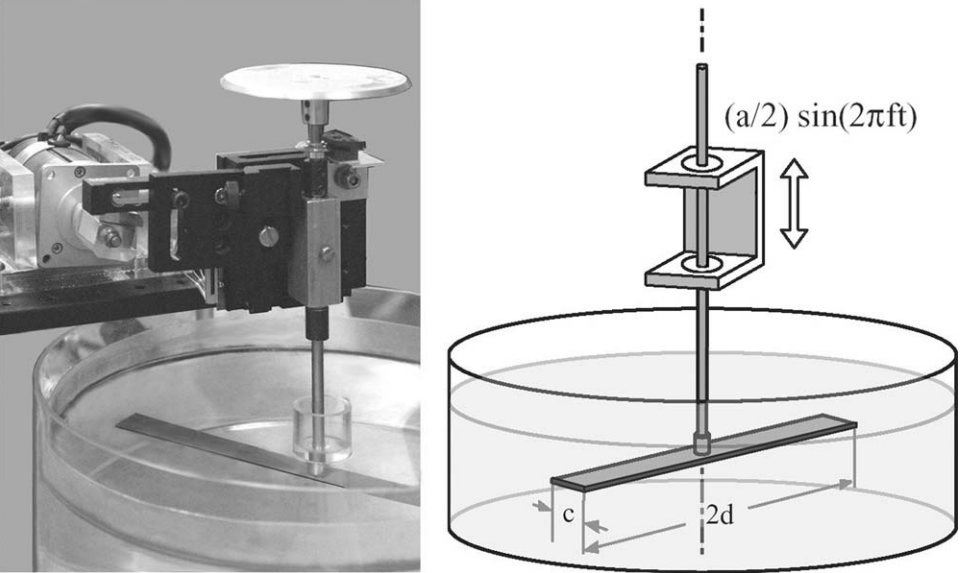
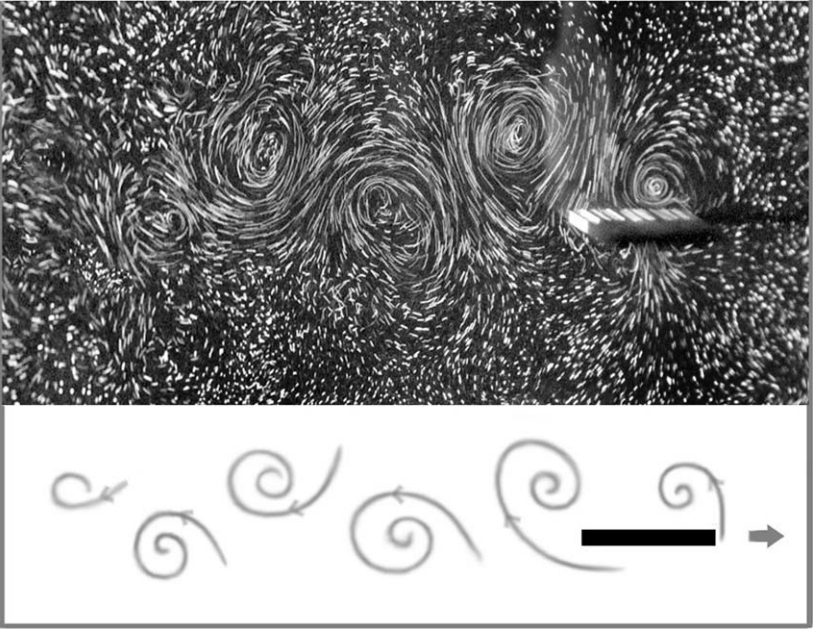
Flapping flight, despite being utilized by creatures of many sizes in nature, remains remarkably difficult to engineer. In this experiment, a simple rectangular wing is flapped up and down sinusoidally. Above a critical flapping frequency, the wing–which is free to rotate–accelerates from rest to a constant speed. This rotation is equivalent to forward flight. The upper image shows a photo and schematic of the setup, while the lower images shows flow visualization of the wing’s wake. The wing moves to the right, shedding thrust-providing periodic vortices in its wake. (Photo credits: N. Vandenberge et al.)

Liquid Sculptures


Water droplet art celebrates the infinite forms created from the impact of drops with a pool and rebounding jets. It’s a still life captured from split second interactions between inertia, momentum, and surface tension. These examples from photographer Markus Reugels are among some of the most complex shapes I’ve seen captured. Be sure to check out his website for more beautiful examples of liquids frozen in time. (Photo credits: Markus Reugels; via Photigy)
Shocking Droplets
Typical liquid drops will break apart into long, stretched ligaments and a spray of tiny droplets when deformed. But with just a small addition of polymers, these same liquids become viscoelastic and capable of some pretty incredible behaviors. This video shows a viscoelastic drop being struck by a shock wave that passes from right to left. The droplet is smashed and deformed, then stretches into jellyfish-like sheet of liquid. But incredibly, the elastic forces in the droplet are enough to hold it together. Researchers are interested in understanding these behaviors for many applications, including preventing accidental explosions caused by explosive fuels atomizing in air. (Video credit: T. Theofanous et al.)

Bouncing to Mix Oil and Water
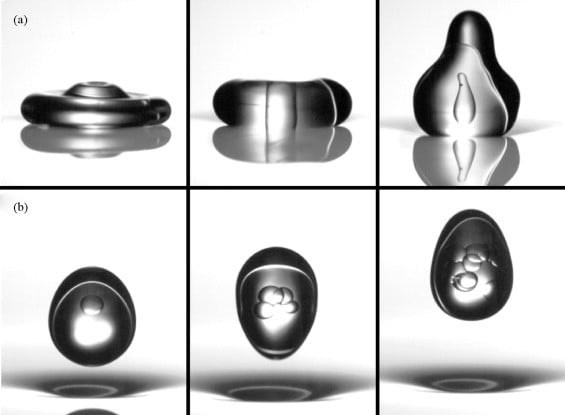
Mixing immiscible liquids–like oil and water–is tough. The best one can usually do is create an emulsion, in which droplets of one fluid are suspended in another. The series of images above shows a double emulsion consisting of oil and water that’s been formed by bouncing the compound droplet on a vibrating bath. The vibration of the liquid surface keeps the droplet from coalescing with the bath and the deformation provides mixing. The top row shows the initial impact while the bottom row of images shows the droplet after many bounces. As time goes on, the layer of oil around the compound drop becomes a cluster of tiny droplets contained within the water portion of the drop. (Photo credit: D. Terwagne et al.)
Bottle Rocket Shock Waves
This high speed video shows schlieren photography of a bottle rocket’s exhaust. The supersonic CO2 leaving the nozzle is underexpanded, meaning its pressure is still higher than the ambient atmosphere. As a result, a series of diamond-shaped shock waves and expansion fans appear in the exhaust jet. Each shock and expansion changes the pressure of the exhaust until it ultimately reaches the same pressure as the ambient air. This distinctive pattern, also known as Mach diamonds or shock diamonds, often occurs in wake of rockets. (Video credit: P. Peterson and P. Taylor)