Crash Course Physics returns to the subject of fluids with their video on fluid dynamics. They stick with ideal fluids (i.e. incompressible, inviscid, laminar flows) for simplicity and cover some of the basics by discussing conservation of mass (also called continuity) and a simple form of Bernoulli’s equation. Despite keeping things basic, the video does a nice job introducing these topics; I especially like that they explain Bernoulli’s equation as a form of conservation of energy. Sometimes it’s easy to let the terminology in fluid dynamics mask the fact that the equations we use are just alternative forms of the classical equations for conserving mass, momentum, and energy. As with their fluids at rest video, the information is densely packed, so expect to pause and rewind. (Video credit: Crash Course)
Tag: science

Dust Devils
Dust devils, like fire tornadoes and waterspouts, form from warm, rising air. As the sun heats the ground to temperatures hotter than the surrounding atmosphere, hot air will begin to rise. When it rises, that air leaves behind a region of lower pressure that draws in nearby air. Any vorticity in that air gets intensified as it gets pulled toward the low pressure area. It will start to spin faster, exactly like a spinning ice skater who pulls in his arms. The result is a spinning vortex of air driven by buoyant convection. On Earth, dust devils are typically no more than a few meters in size and can only pick up light objects like leaves or hay. On Mars, dust devils can be hundreds of meters tall, and, though they’re too weak to do much damage, they have helpfully cleaned off the solar panels of some of our rovers! (Image credit: T. Bargman, source; via Gizmodo)

Martian Ripples

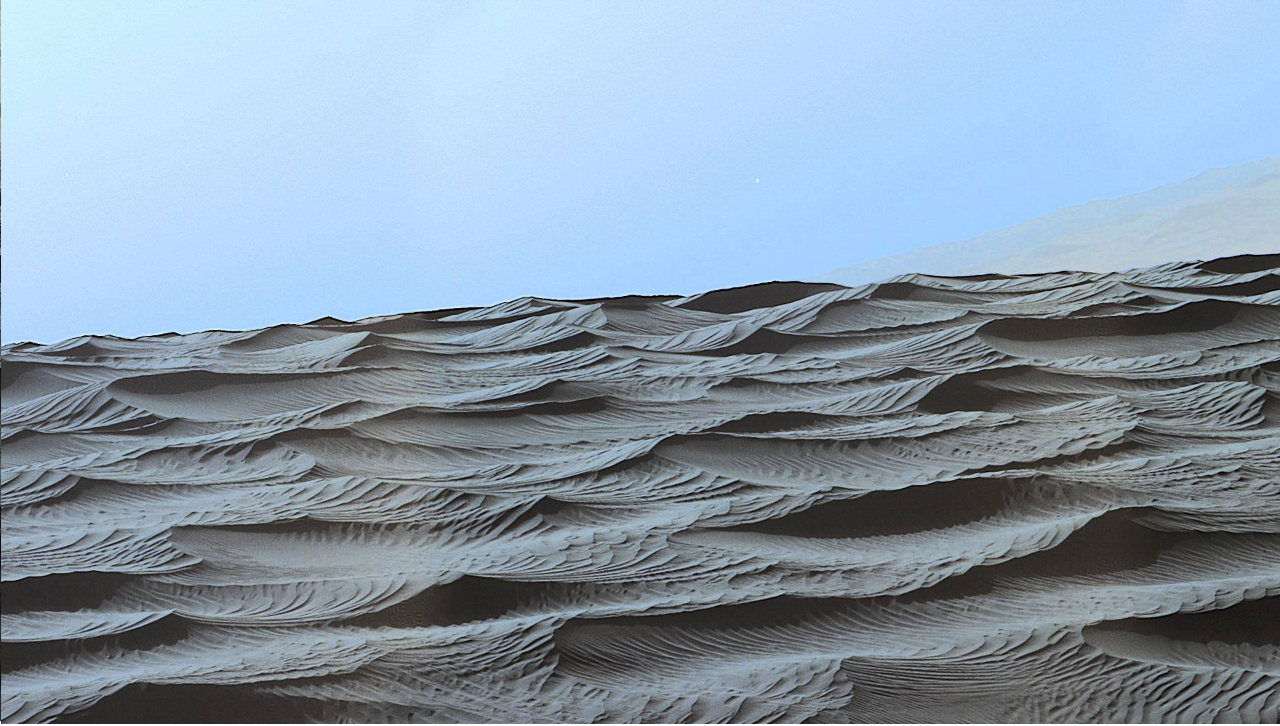
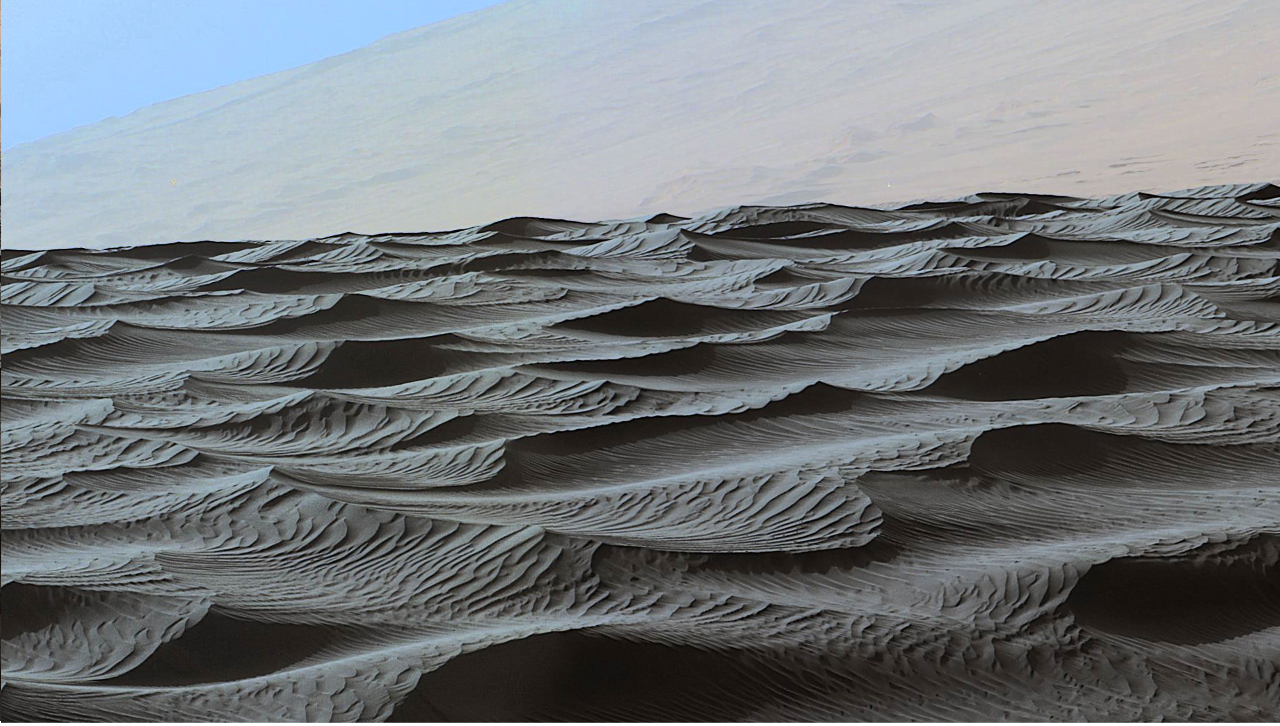
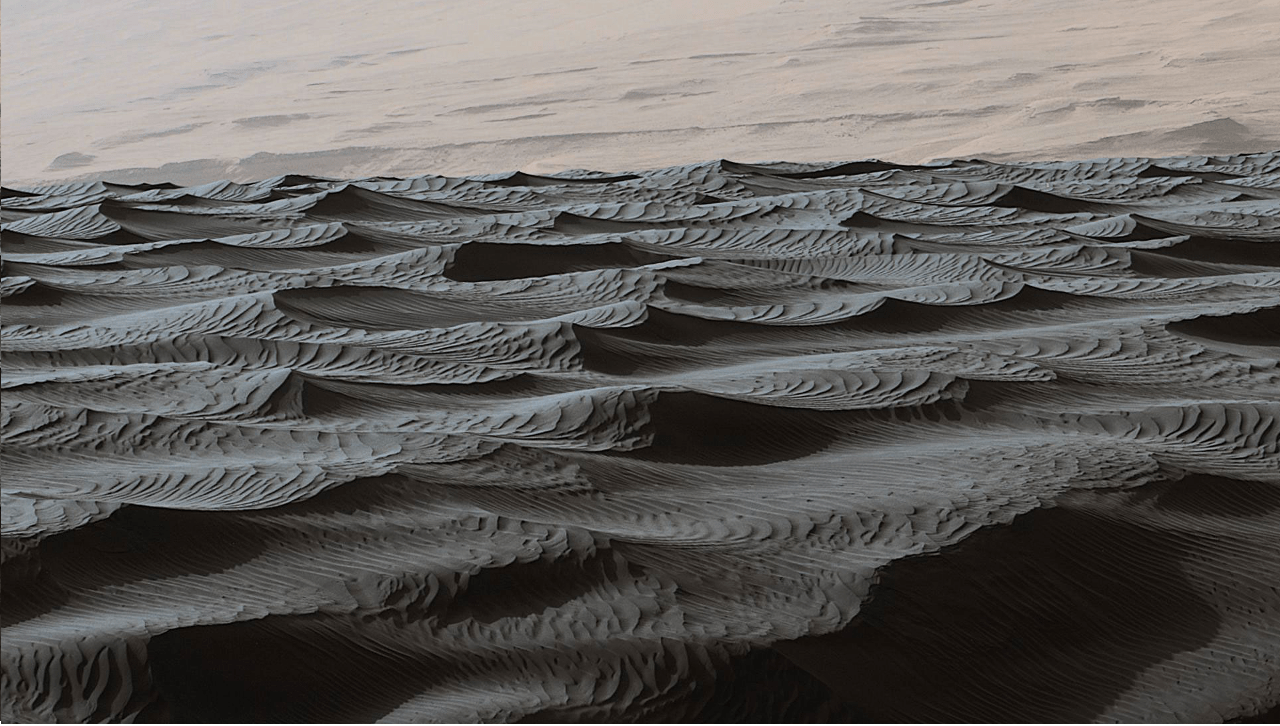

Earth and Mars both feature fields of giant sand dunes. The huge dunes are shaped by the wind and miniature avalanches of sand, and their surface is marked by small ripples less than 30 centimeters apart. These little ripples are formed when sand carried by the wind impacts the dunes. But Martian dunes have a second, larger kind of ripple, too. These sinuous, curvy ripples lie about 3 meters apart and cast the dark shadows seen in the images above. On Earth we see ripples like these underwater, where water drags sand along the surface. On Mars, the same process is thought to play out with the wind, and so scientists have named these wind-drag ripples. (Image credit: NASA/JPL/MSSS; via APOD, full-res; submitted by jshoer)

These Invertibrates May Help Robots Swim
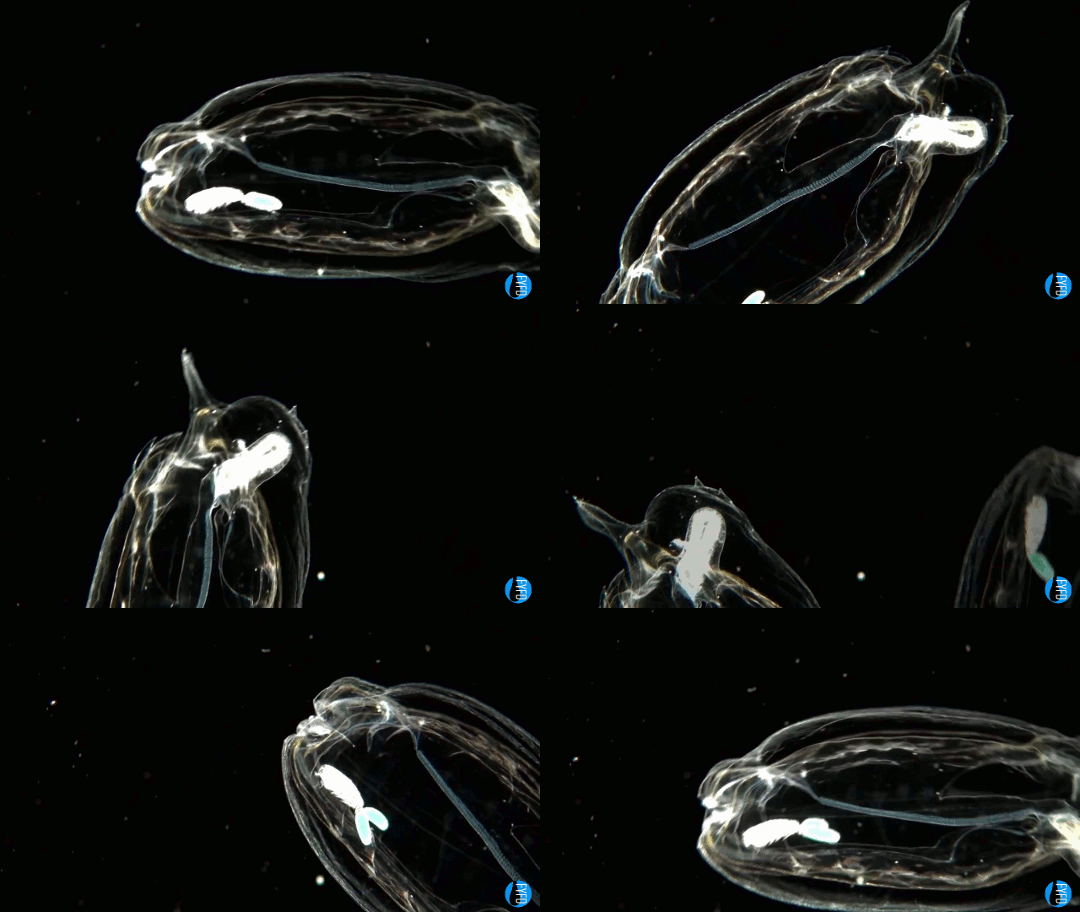
New FYFD video! Learn all about salps, vortex rings, and underwater robots. Thanasi Athanassiadis takes me inside his lab and his newly published research into how proximity affects the thrust two vortex rings can produce.
There are a ton of little things I love about how this video came out, especially the chalkboard animations. Check it the full video below and click through to the video description for lots more information about salps and vortex rings.
(Image and video credits: N. Sharp and A. Athanassiadis; Original salp images: A. Migotto and D. Altherr)
Quarry Smashing
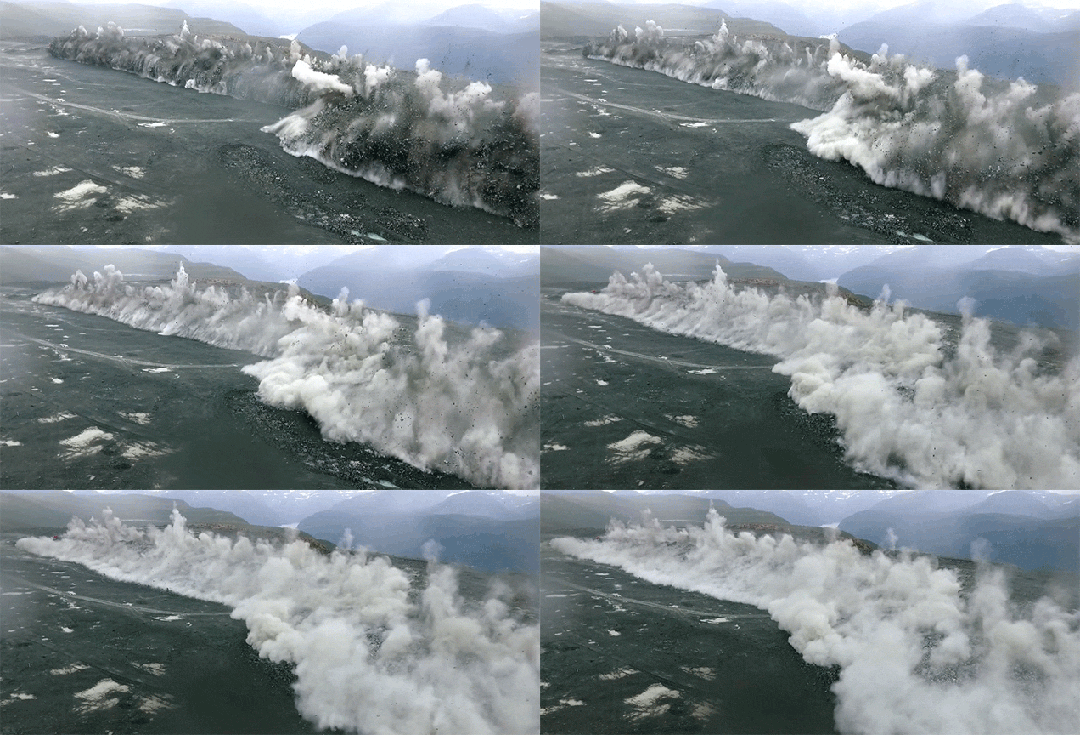
Despite appearances, this is not a crashing ocean wave. In fact, it’s a planned explosion at a quarry, and that wave is more than 360,000 tons of rock and 68 tons of explosive pouring down. The scale of this is hard to imagine, and the physics of a ocean breaker and a massive wave of rocks and gas are similar enough that it’s no wonder our brains interpret them as the same event. Visual effects artists have been using this trick for decades. Rather than simulate the motion of a true fluid, many CGI effects are created from digital particles that, much like the rocks above, are similar enough to fool our eyes and our brains. (Image credit: K. Venøy, source; via Gizmodo)

The Knuckleball
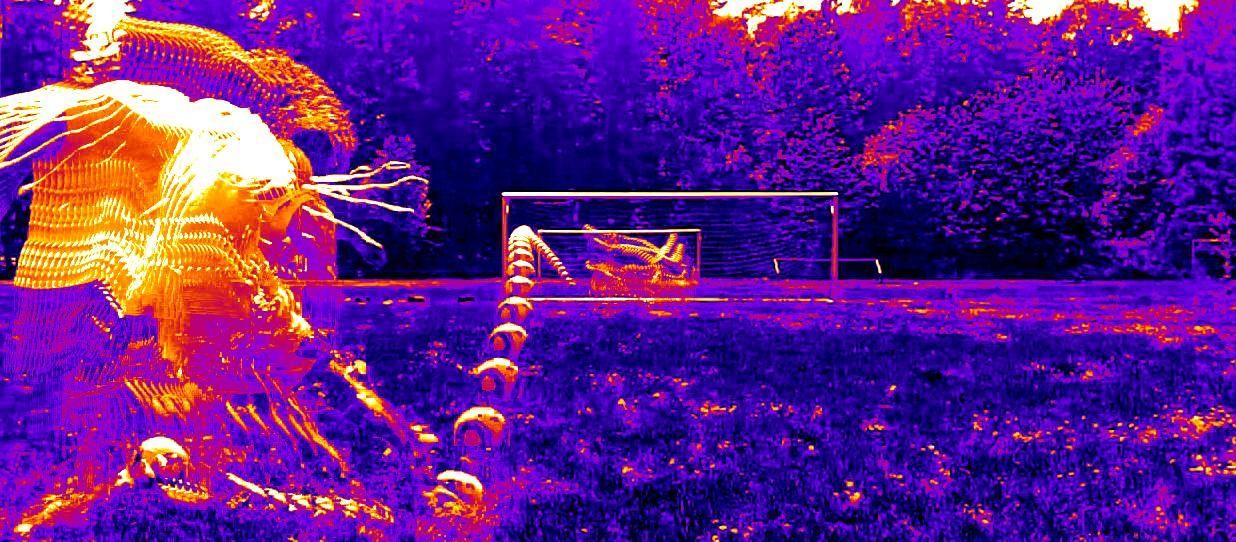
For more than a century, athletes have used the zigzagging path of a knuckleball to confound their opponents. Knuckleballing is best known in baseball but appears also in volleyball, soccer, and cricket. It occurs when the ball has little to no spin. The source of the knuckleball’s confusing trajectory, according to a new study, is the unsteadiness of the lift forces around the ball. As the ball flies, tiny variations occur in the flow on either side, causing small variations to the lift as well. Using experiments and numerical models, the researchers established that this white noise in the lift forces is sufficient to cause knuckleball-like path changes.
They were also able to explain why some sports see the knuckleball effect and others don’t. The wavelength of the deviations – the distance between a zig and a zag – is relatively long, so knuckleballing can only be noticed if the distance the ball flies is long enough for the deviation to be apparent. Additionally, the side-to-side motion is largest when flow on the ball is transitioning from laminar to turbulent flow, so knuckleballing also requires a very particular (and usually low) initial speed. (Image credit: L. Kang; research credit: B. Texier et al.; submitted by @1307phaezr)
Granular Plugs
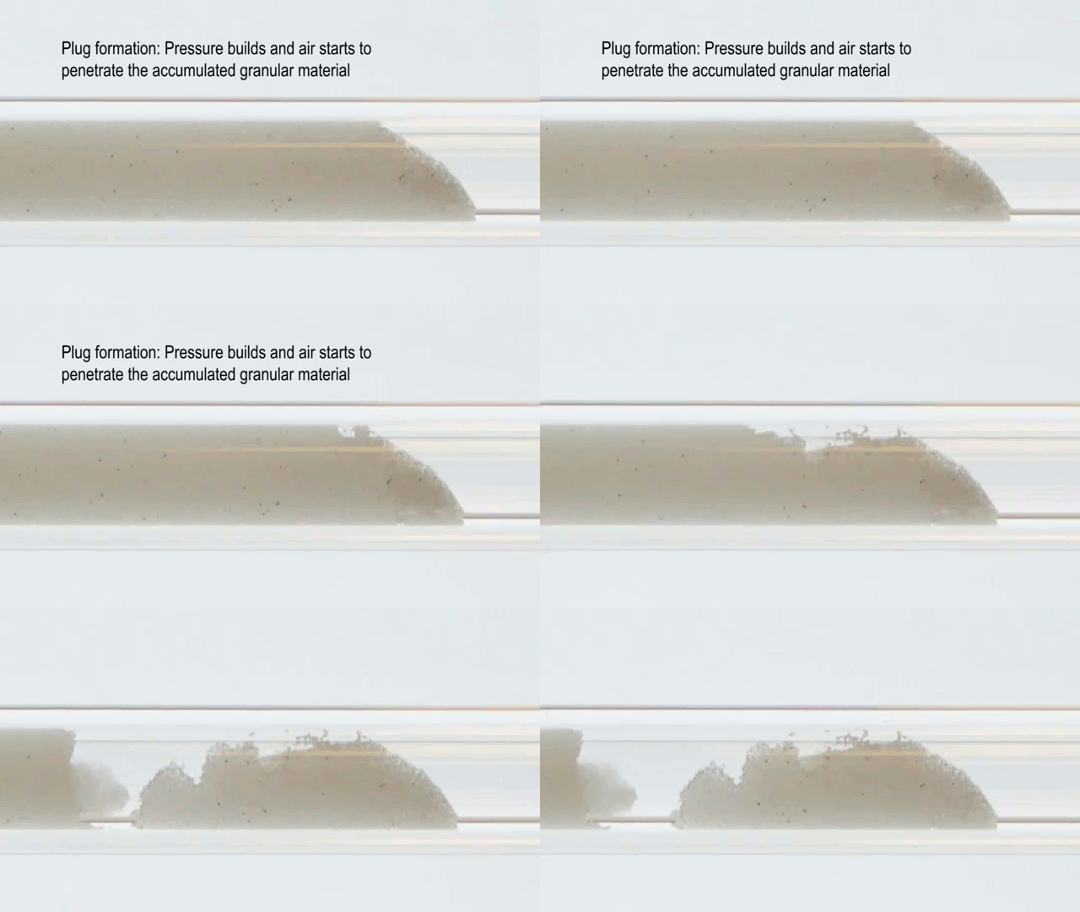
Imagine filling a narrow tube with a mixture of water and tiny glass beads. Then take a syringe and very slowly start drawing out the water. As the water gets sucked out of the tube, air will be pulled into the opposite end. The meniscus where the air and water meet sweeps up the glass beads like a liquid bulldozer. As the experiment continues, pressure builds up and air starts filtering through the beads, changing the viscous and frictional forces the system experiences. Eventually, the grains break off, leaving a chunk of glass beads – known as a plug – behind. Keep draining the tube and more plugs form. Check out the video below to see it in action! (Image/video credit: G. Dumazer et al., source; research paper; open synopsis; submitted by B. Sandnes)

“Vorticity”
Photographer Mike Olbinski is back with another storm-chasing timelapse entitled “Vorticity”. Like his previous work, this film is a breath-taking example of physics in action. It is well worth taking a few minutes to watch in fullscreen, at high resolution, and with headphones. Olbinski’s timelapses beautifully capture the incredible dynamic motion of our atmosphere. Fittingly, “Vorticity” is all about the swirling, roiling motion of supercell thunderstorms and the tornadoes they can spawn, but the film also captures many other great phenomena from the convection that builds clouds to unusual formations like undulatus asperatus and mammatus clouds. (Video credit: M. Olbinski; submitted by Paul vdB)

The Seabird That Can’t Get Wet
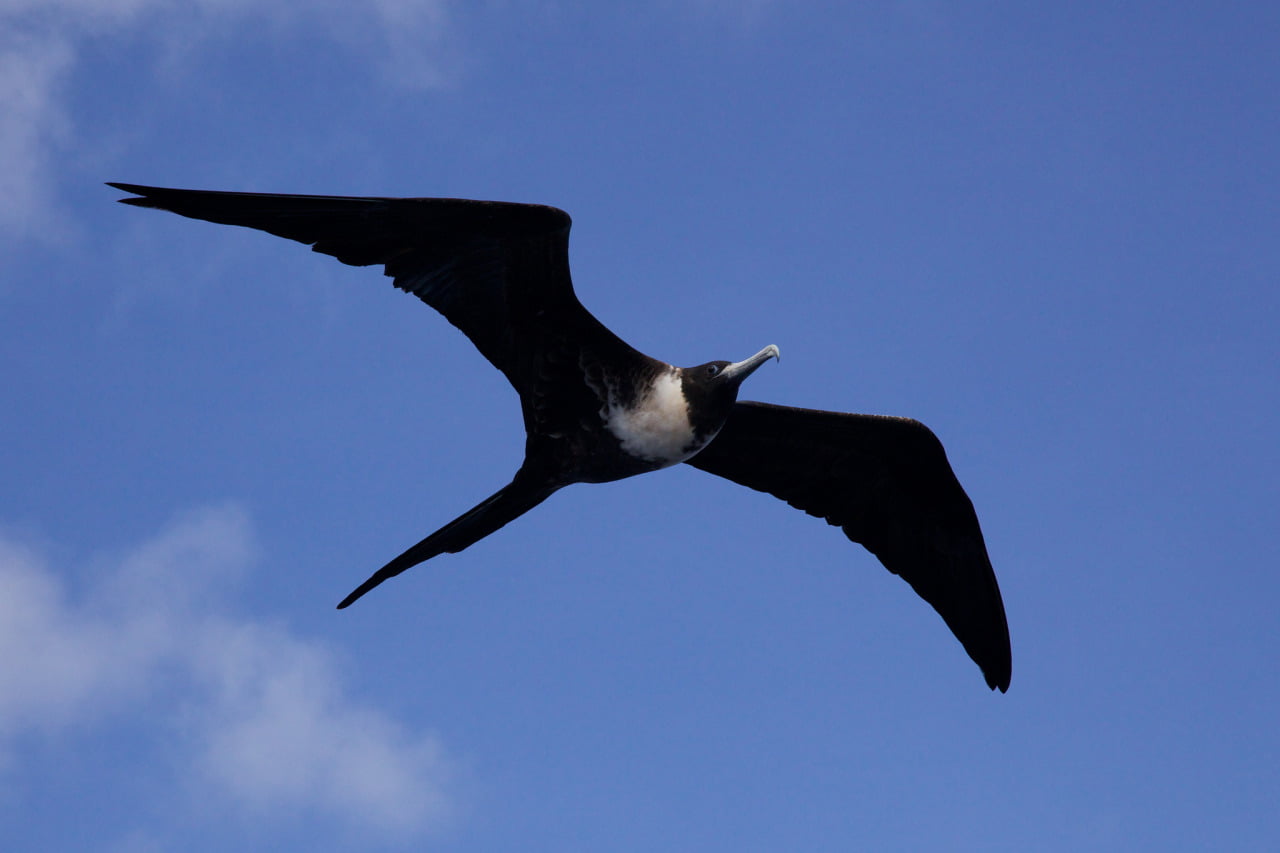
Unlike most seabirds, the frigatebird does not have waterproof feathers. Landing in the water during a transoceanic flight would quickly drown the bird, so instead they stay aloft. But until recently, scientists did not realize just how adept the birds are. Studying tagged frigatebirds in flight, researchers found that the birds could reach altitudes of 4000 meters and that they could soar without flapping for up to 64 kilometers! They achieve these heights by seeking out clouds, which mark strong atmospheric updrafts. The birds ride these thermals up to the cloud tops – well into freezing conditions – and then glide slowly back down.
Their bodies are impressively built for slow glides. Frigatebirds boast a low body weight for their large wing area. This ratio is known as wing loading, and it’s a fundamental characteristic of any flier, avian or otherwise. Low wing loading is key to gliding longer because it reduces the speed at which a glider loses altitude. (Image credit: D. Brossard; research credit: H. Weimarskirch et al.; via @skunkbear)

Reversing Time

Waves contain lots of information. They are also time invariant, which means that they will behave the same regardless of whether time moves forward or backward. This isn’t a property we observe often in life since time just moves forward for us. But a new experiment has demonstrated a method of wave control that can, in a sense, roll back the clock.
To do this, the scientists created a instantaneous time mirror, or ITM. When they create a disturbance on the surface of a pool of water, it sends out capillary waves in the form of ripples. A short time later, they accelerate the pool sharply downward. This universal disturbance is their instantaneous time mirror, which generates backward-propagating ripples. Those new backward-propagating waves travel back toward the source and refocus into the shape of the initial disturbance. This works for both a simple point disturbance (top image) and for a more complicated geometry like a smiley face (bottom image). (Image credit: V. Bacot et al., source; submitted by @g_durey)
ETA: To be clear, this experiment does not refute causality. It’s more like saying that the information for the initial conditions is still carried on in the later state and that you can do something to extract that information.