Tag: science

  • Featured Video Play Icon

    “Pulse”

    Photographer Mike Olbinski returns with another incredible storm-chasing timelapse video, this time all in black-and-white. To me, that choice helps “Pulse” emphasize the ominous majesty of these supercells and tornadoes by highlighting the textures that make up the clouds. Watching clouds in timelapse, they seem to materialize from nowhere as moisture drawn up from the land cools and condenses. Sped up, suddenly the convective rotation and the roiling turbulence inside clouds is perfectly clear. I especially love the sequence beginning at 2:25, where a distant black line slowly transforms into an incredible landscape marked with successive waves of rolling, turbulent clouds. Watch this one on a large screen at a high resolution, if you can. You won’t regret it! (Video credit: M. Olbinski)

  • Shot Through a Drop

    Shot Through a Drop

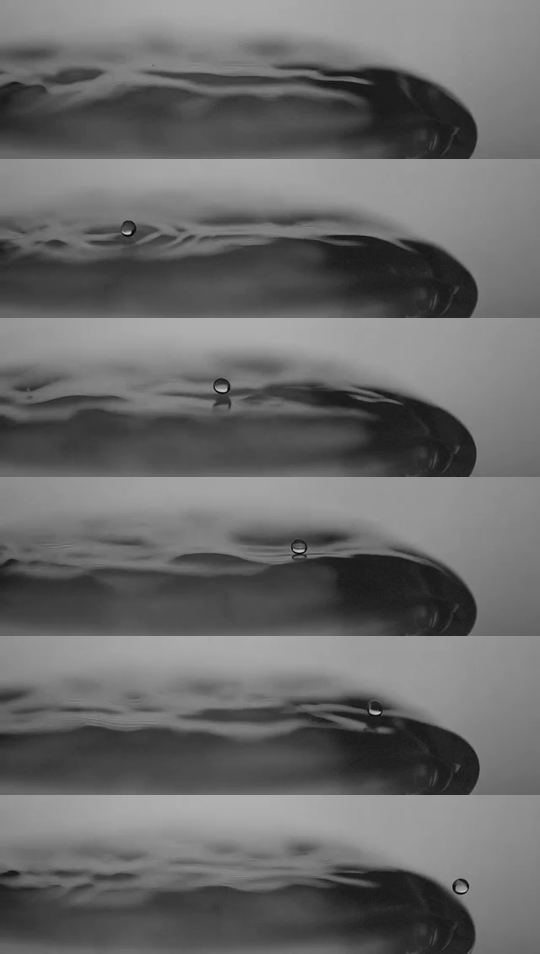
    Shoot a sphere through a drop with sufficient speed, and you’ll see something like the composite photo above. Going from right to left, the projectile is initially coated in liquid and stretches the fluid behind it as it continues flying. This forms a thin sheet of fluid called a lamella with a thicker, uneven rim at its far end. The lamella continues stretching until the projectile breaks through and detaches. Now the lamella starts rebounding back on itself as surface tension struggles to keep the fluid together. A new rim forms on the front, and both the front and back rims thicken as the lamella collapses. Along the rims thicker portions start forming droplets – like spikes on a crown – as the surface-tension-driven Plateau-Rayleigh instability starts breaking the structure down. The untenable sheet of fluid will break up into a cloud of smaller, satellite droplets when it can hold together no longer. (Image credit: V. Sechenyh et al., video)

  • Crowns On Impact

    Crowns On Impact

    Dropping a partially-filled test tube of water against a table makes the meniscus at the air-water interface invert into a jet of liquid. In some cases, the impact is strong enough to generate splashing crowns of water around the base of the jet. These crowns come in two forms – one with many splashes layered upon one another and the other with only a few splashes and a faster jet. 

    The many-layered splash crowns come from the pressure wave that reflects back and forth from the bottom of the tube to the surface and back. This pressure wave moves at the speed of sound and vibrates the water surface, creating the many splashes. The same reflected pressure wave occurs in the second type of splash crown, but it gets disrupted by cavitation bubbles that form in the water (visible in the lower left image). Instead the splash crowns form from the shock waves generated when the cavitation bubbles collapse. (Image credits: A. Kiyama et al.)

  • Featured Video Play Icon

    “Kingdom of Colours”

    Oil, paint, and soap combine to create a polychrome landscape in Thomas Blanchard’s “Kingdom of Colours” short film. Colorful droplets of paint coated in oil form anti-bubbles that skim along the liquid surface until they burst, dispersing new colors. One of my favorite touches in this video, though, are the branching fingers of color that appear repeatedly (most often in blue-violet). This is an example of a phenomenon known as the Saffman-Taylor instability. It’s a hallmark of a low viscosity fluid pushing into a higher viscosity one–like air into honey. (Image/video credit: T. Blanchard; via Flow Vis)

  • Creating Moana’s Ocean

    Creating Moana’s Ocean

    Hopefully by now you’ve had an opportunity to see Disney’s film Moana. Fluid dynamics play a central role in the movie, and Disney’s animators faced the challenge of hundreds of shots requiring special effects to animate water, lava, waves, and wind. Science Friday has a great segment interviewing a couple of Moana’s animators, in which they discuss the process of turning the ocean itself into a character. 

    Because the physics of fluids is so complex, scientists and animators differ in the way they approach simulations. Scientists usually try to capture a full physical representation of a flow, simulating every detail to the smallest scale and time step. Animators, on the other hand, are interested in capturing a realistic feel for a flow. For an animator, the simulation should be exactly as complex as necessary to make the water move in a way a person believes it should. With Moana, animators had the extra challenge of melding the ocean character’s actions with appropriate water physics–think bubbles, drops, and splashes. The results are impressive and exceptionally fun. (Image credits: Disney/Science Friday; via Jesse C.)

  • Sedimentary Swirls

    Sedimentary Swirls

    Sediment swirls in Bear Lake caught the eye of an astronaut aboard the International Space Station last year. Bear Lake is situated in the Rocky Mountains, on the Idaho-Utah border. The eddies in the center of the lake are each about 3 km across and are likely the result of inflow from the lake’s tributaries. Silt and sediment picked up by the rivers and streams gets deposited into Bear Lake, revealing the turbulent mixing of tributary waters with those already in the lake. (Image credit: NASA; via NASA Earth Observatory)

  • The Best of FYFD 2016

    The Best of FYFD 2016

    2016 was a wild ride here at FYFD, full of lots of travel and crazy things like making the New York Times and doing radio interviews. I also revamped the YouTube channel and went full-time doing science communication. But let’s look at what you thought was the best part of FYFD’s 2016 based on the most popular posts of the year:

    1. The physics of chocolate bonbons and other poured coatings
    2. What makes this octopus kite look so realistic?
    3. Shooting oobleck with a golf ball
    4. Buckling of a crown splash
    5. Lava as a gravity current
    6. Microscale rockets could aid with drug delivery
    7. How prairie dogs keep the air in their burrows fresh
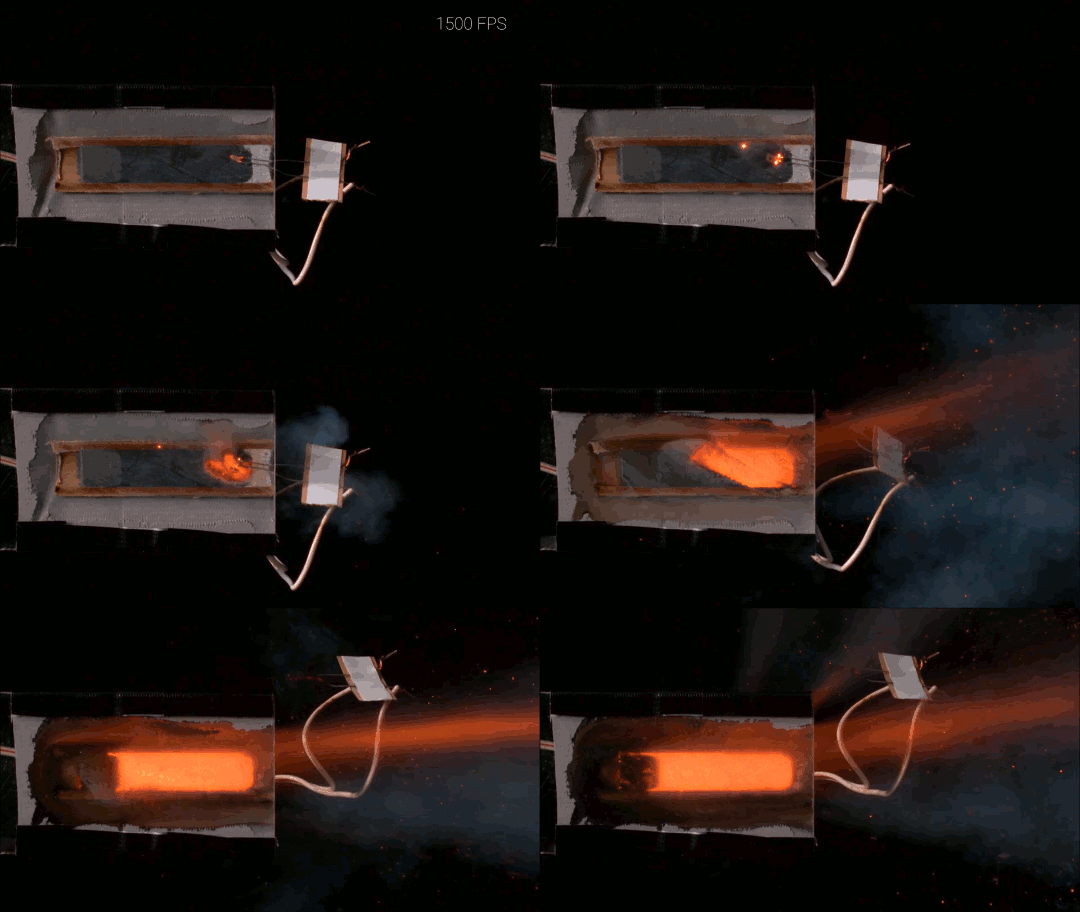
    8. Why molten aluminum slides right off dry ice
    9. The dangers of underwater explosions
    10. Skipping an elastic ball off water

    Special congrats to The Backyard Scientist and The Splash Lab – both of whom earned multiple spots in the top 10 with their awesome physics-filled visuals. Stay tuned in 2017 for more great fluid dynamics, and if you’d like to help support what I do with FYFD, consider becoming a patron or making a one-time donation!

    (Image credits: MIT News; E. Chew; The Backyard Scientist; J. Marston et al.; J. Tarsen; J. Li et al.; N. Sharp; The Backyard Scientist; M. Rober; J. Belden et al.)

  • Featured Video Play Icon

    Why Ice is Slippery

    Ice is slippery. This is a fundamental fact we humans have dealt with so often that we rarely take the time to ask why. Other solids aren’t inherently slippery, so what is it that makes ice so? Remarkably, scientists only began to ask this question and propose theories within the past couple hundred years. One common suggestion is that the high pressure of an ice skate on ice locally melts the ice, creating a thin liquid layer a skater glides across. But this does not explain why ice is slippery for shoes or tires, nor why it’s possible to ice skate at more than a few degrees below freezing. Several other effects may be in play, such as frictional heating or the peculiar molecular forces between water molecules. Current research suggests that ice has a thin liquid layer tens or hundreds of nanometers thick that causes its slippery nature. For a great review of the subject, see Robert Rosenberg’s Physics Today article. (Video credit: SciShow)

  • Featured Video Play Icon

    Paint Spilling Physics

    There is a remarkable amount of physics contained in art. In this video, scientists from The Splash Lab explore some of the physics involved in pouring paint atop a rectangular post. The spreading paint transforms its shape repeatedly, and, at the corners of the post, it preserves a tiny history of all the colors poured. Paint sliding down the sides shifts from a thin sheet to a thicker jet that deposits color in waves. For tall posts, the distance the paint falls is long enough for instabilities to set in, producing a paint puddle that’s riddled with curves and waves between each color of paint. It’s a lovely reminder of the complexity inherent even within a simple action. (Video credit: R. Hurd et al.)

  • Erie Waves

    Erie Waves

    Photographer Dave Sandford braved the cold and turbulent waters of Lake Erie in late fall to capture some remarkable wave action. Like on the ocean, waves in the Great Lakes are largely driven by winds, but lakes don’t develop the constant set of rolling waves that oceans do. Instead their waves are more erratic and unpredictable. Sandford focused on capturing the moment when wind-driven waves coming into shore collided with waves rebounding from piers or rocks along the shore. The results are waves that, through Sandford’s lens, look like exploding mountainsides. Such energetic waves mix sediment and nutrients in the lake, and the spray of droplets can even loft aerosols and pollutants from the water into the atmosphere.   (Photo credit: D. Sandford; via Flow Vis)