Tag: science

  • Sliding Down a Pitcher Plant

    Sliding Down a Pitcher Plant

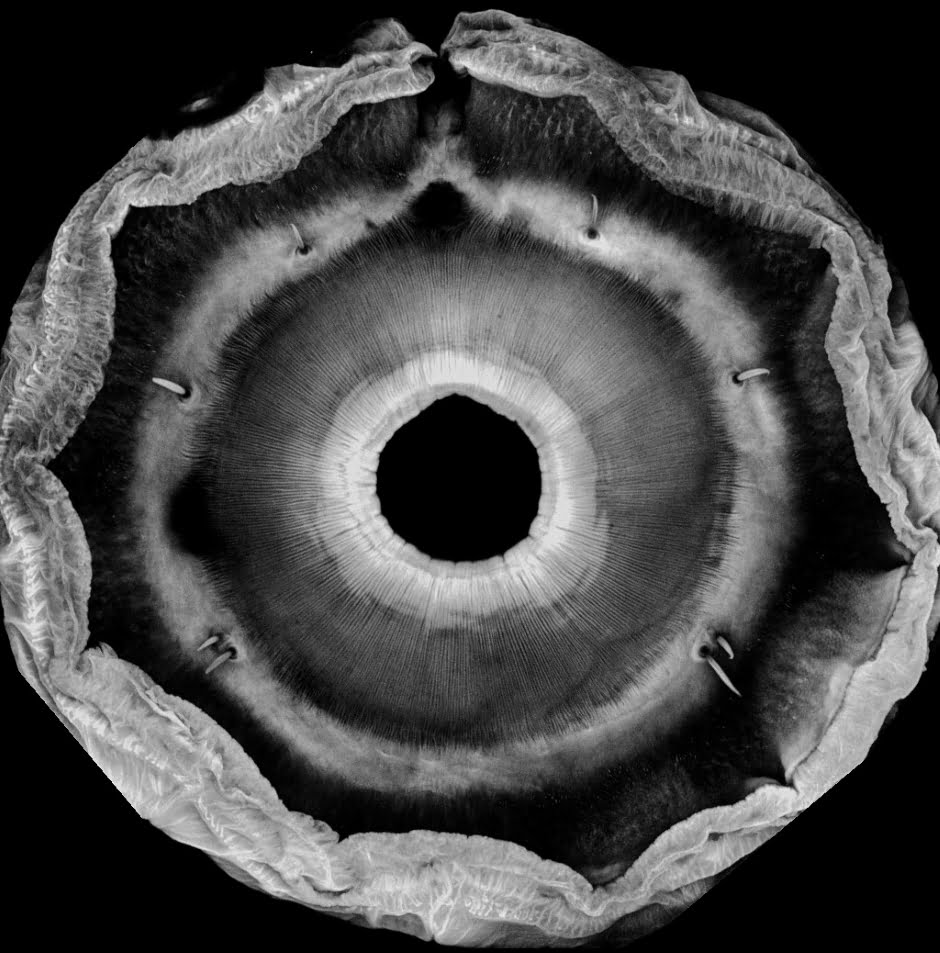
    Carnivorous pitcher plants supplement their nutrient-poor environments by capturing and consuming insects. The viscoelastic fluid inside them helps trap prey, but fluid dynamics plays a role elsewhere on the plant as well. The inner and outer surfaces of the pitcher are covered in macroscopic and microscopic grooves, seen above, oriented toward the interior of the plant. 

    Researchers found that these grooves trap droplets on the slippery plant through capillary action. Once adhered, the droplet cannot easily move across the grooves, but it can slip along them, carrying the droplet and any insect stuck to it, into the plant. By replicating pitcher-plant-inspired grooves on manmade surfaces, researchers found they were able to better control droplet motion on slippery, lubricant-infused surfaces than in previous work. (Image and research credit: F. Box et al.; via Royal Society; submitted by Kam-Yung Soh)

  • Bay of Fundy Tides

    Bay of Fundy Tides

    Canada’s Bay of Fundy has some of the wildest tidal flows in the world. Every six hours, the flow direction through the strait shifts and tidal currents rise to several meters per second. This creates distinct jets a couple kilometers long that pour from one side of the strait to the other. 

    What you see here is a numerical simulation of the flow using a technique called Large Eddy Simulation (or LES, for short). It’s one method used by fluid dynamicists to model turbulent flows without taking on the complexity of the full Navier-Stokes equations. At large lengthscales, like those of the jets and eddies we see above, LES uses the exact physics. But when it comes to the smaller scales – like the flow nearest the shores or the bottom of the strait – the simulation will approximate the physics in order to make calculations quicker and easier. Models like these make large-scale problems – including modeling our daily weather patterns – possible. (Image credit: A. Creech, source)

  • Featured Video Play Icon

    A Broken Monitor’s Fingers

    In this short video, the artists of Chemical Bouillon explore a broken LCD monitor and its liquid crystals. By sandwiching the fluid between thin, transparent sheets, they create dendritic shapes as the liquid crystals and other fluids (air? ink?) push into one another. There’s a lot here that’s likely connected to the Saffman-Taylor instability, but without knowing more details on the ingredients and set-up, it’s hard to speculate beyond that. (Video and image credit: Chemical Bouillon)

  • Energy-Efficient Deicing

    Energy-Efficient Deicing

    Defrosting and deicing surfaces is an energy-intensive affair, with lots of heat lost to warming up system components rather than the ice itself. In a new study, researchers explore a faster and more efficient method that focuses on heating just the interface. They coated their working surface in a thin layer of iridium tin oxide, a conductive film used in defrosting. Then, once the surface was iced over, they applied a 100 ms pulse of heating to the film. That localized heat melted the interface, and gravity pulled away the detached ice. Compared to conventional defrosting methods, this technique requires only 1% of the energy and 0.01% of the time. If the method scales reliably to applications like airplane deicing, it would provide enormous savings in time and energy. (Image and research credit: S. Chavan et al.)

  • Boiling in Microgravity

    Boiling in Microgravity

    In the playground of microgravity, every day processes can behave much differently. This photo comes from the RUBI experiment, the Reference mUltiscale Boiling Investigation, aboard the International Space Station. Freshly installed and switched on, the apparatus is now generating bubbles like this one. On the left, you see temperature sensors used to measure bubble temperatures. High-speed and infrared cameras are also part of the experiment.

    The advantage of studying boiling in space is a lack of gravity that can mask or overwhelm subtler effects. It effectively slows down the process, making it easier to observe. And since boiling is such an important part of heat transfer in many manmade devices, it shows us how we have to adapt when operating in an environment where heat – and bubbles – don’t automatically rise. (Image credit: ESA; submitted by Kam-Yung Soh)

  • Champagne’s Shock Wave

    Champagne’s Shock Wave

    The distinctive pop of opening a champagne bottle is more than the cork coming free. The sudden release of high-pressure gas creates a freezing jet that’s initially supersonic. It even creates a Mach disk, like those seen in rocket exhaust. That supersonic flow can only be maintained, though, with a large enough pressure difference between the gas in the bottle and the atmosphere outside. Once the pressure drops below that critical point, the jet slows down and becomes subsonic. For more on champagne popping and its colorful plume, check out this previous post. (Image and research credit: G. Liger-Belair et al.; via Nature; submitted by Kam-Yung Soh)

  • Waves on a Supercell

    Waves on a Supercell

    This Colorado supercell thunderstorm features an unusual twist. Notice the sawtooth-like protrusions along the outer cloud wall. These are Kelvin-Helmholtz waveslike these fair-weather clouds we’ve seen before, but instead of occurring vertically, they project horizontally! That implies that the invisible layer of air just outside the cloud wall is moving faster than the wall itself. That creates shear along the outer edge of the cloud wall and causes these waves to form. This is the first time I’ve ever seen this sort of thing. What an awesome photo! (Image credit: M. Charnick; submitted by jpshoer)

  • Crowds as a Fluid

    Crowds as a Fluid

    At a low density, crowds of people can behave like a fluid, which has led to numerous hydrodynamically-based crowd models. At higher densities, though, crowds are more like a soft solid, and researchers are adapting models developed for granular materials like sand to describe these crowds. In granular materials, these models help scientists identify how vibrations move through the complex network of grains and what circumstances might cause sudden reorganizations. In a large crowd, this could tell scientists the difference between the innocuous shuffle at a rock concert and the trigger for a deadly stampede. Getting real-world data for comparison is tough – obviously, it’s unethical to intentionally cause a crowd to panic – so thus far the models remain relatively untested. (Image credit: M. Lebrun; research credit: A. Bottinelli and J. Silverberg)

  • Featured Video Play Icon

    Getting Cold

    Just as some chemical reactions produce heat, many chemical combinations absorb heat. In “Getting Cold,” the Beauty of Science team demonstrates this by showing endothermic processes in both visible and infrared light. Combinations that appear humdrum from our normal perspective suddenly become vibrant and interesting when we see the temperature variations accompanying them. 

    Evaporation is a good example. As humans, we sweat so that when our sweat evaporates off our skin, it takes heat away with it. Water (the main ingredient in sweat) isn’t the fastest evaporating liquid, however. Here it’s shown alongside ethyl acetate, a common ingredient in nail polish remover. And anyone who’s used nail polish remover is familiar with the chill it leaves behind as it evaporates. Just look how much colder and darker it is when evaporating! (Video and image credit: Beauty of Science)

  • Explosive Flame Fronts

    Explosive Flame Fronts

    Though they look like jellyfish or space creatures, these images from photographer Linden Gledhill are actually explosions. What you’re seeing is the detonation of hydrogen gas with oxygen. The teal sphere with its wavy surface marks the flame front, and the crisp, stringy edges seen here and there in the foreground are the remains of a soap bubble that held the hydrogen before it sparked. You can see a similar set-up (using methane rather than hydrogen) in action here, and you can see other artistic takes on combustion in previous posts like this one. (Image credit: L. Gledhill, Flickr)