Tag: science

  • Mossy Vortex Rings

    Mossy Vortex Rings

    Many plants have evolved an ability to move remarkably quickly. Often, this capability is driven by water. Here we see the moss Sphagnumaffine, which disperses its spores explosively. The process is triggered by the spore capsule gradually drying out; its shape changes from round to cylindrical, pressurizing the capsule. Once the internal pressure is high enough to overcome the strength of the capsule’s upper membrane, the capsule bursts, sending a plume of spores aloft. The sudden release of spore-laden air forms a vortex ring, which lifts the spores higher far more efficiently than they would be otherwise. (Image credit: capsule dry-out – J. Edwards et al., spore dispersal – J. Edwards et al. 2010; research credit: J. Edwards et al.)

  • Featured Video Play Icon

    Mammatus Clouds

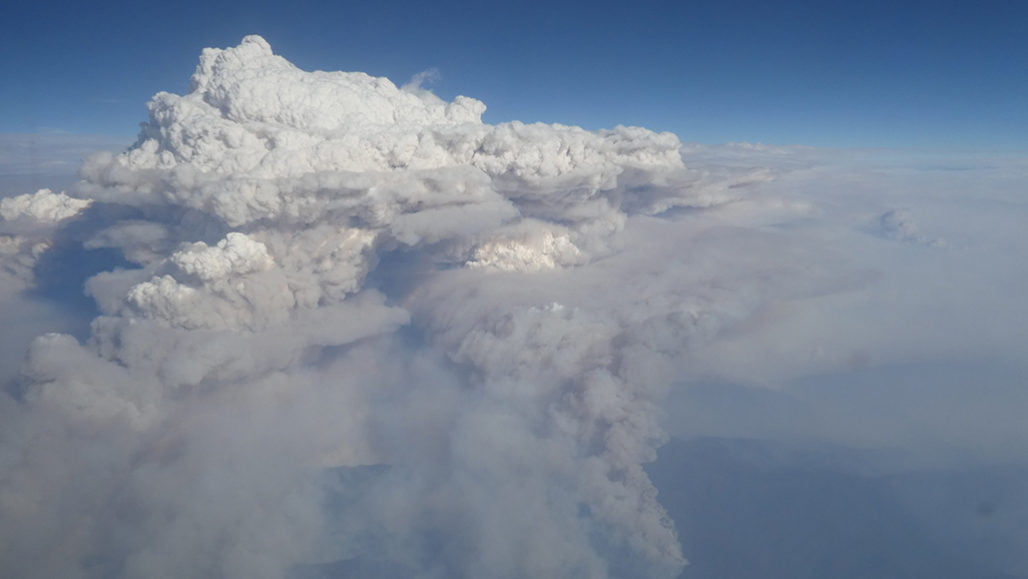
    Mammatus clouds are a relatively rare and dramatic variety. One advantage of living in Colorado is that I see them somewhat often, especially during our stormy springs and summers. This video by Mike Olbinski features a dramatic skyscape of mammatus clouds (here in Colorado, natch) at sunset.

    Although they’re often associated with stormy weather, there’s no widely accepted theory as to how mammatus clouds form. Their lobe-like protrusions form from cold, sinking air, but this is about as far as theories agree. It’s even unclear what their relation to extreme weather may be since these short-lived cloud formations can appear around, before, or even after such weather. (Image and video credit: M. Olbinski)

  • Featured Video Play Icon

    Celebrating Turbulence

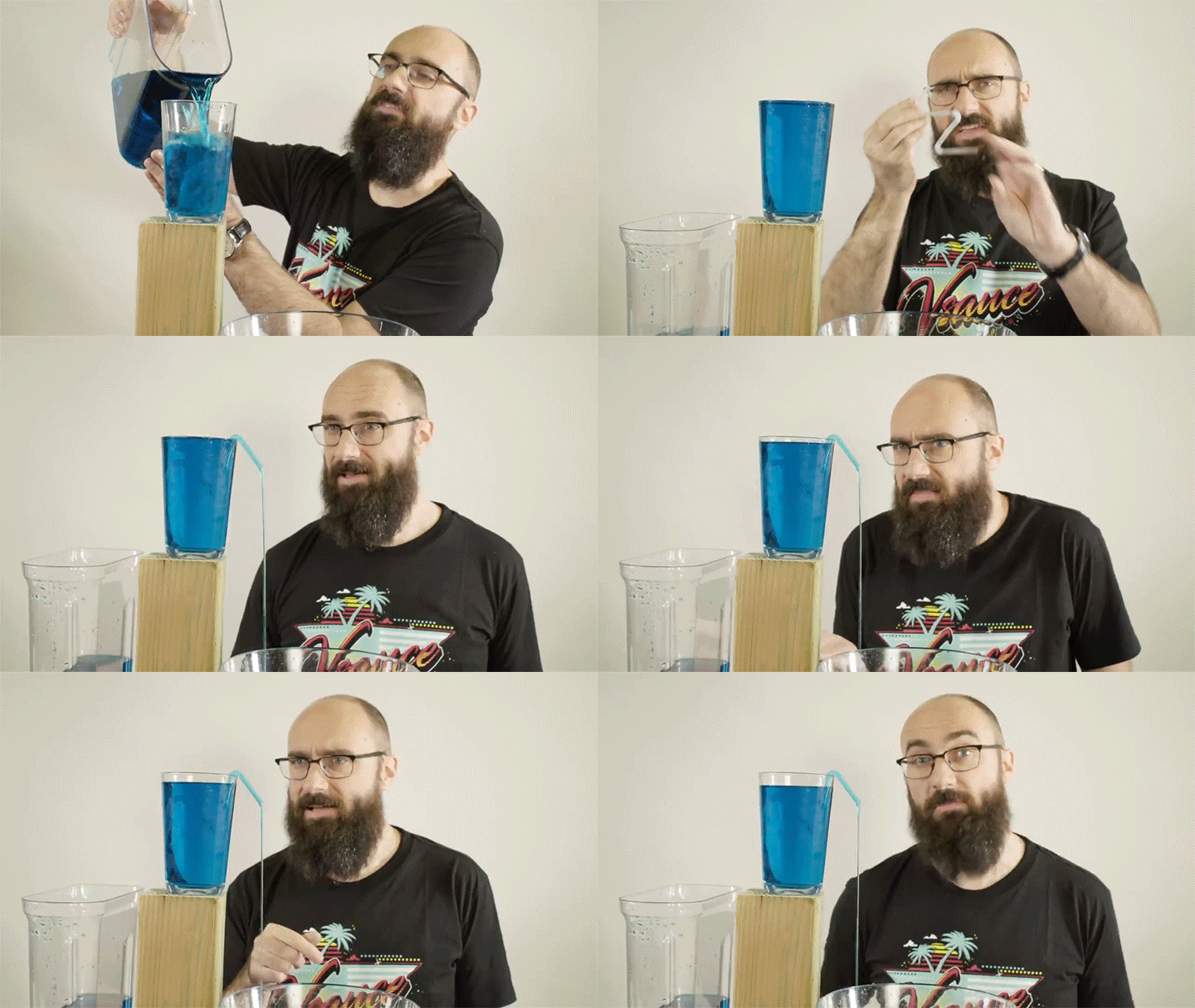
    Laminar flow is easy to love, but turbulence is a far richer phenomenon. That’s the premise behind Veritasium’s new video (and, yes, I agree with him). In the video Derek provides a nice introduction to turbulence, including a checklist of qualities a turbulent flow must have.

    Personally, I don’t classify flows as simply being either laminar or turbulent; I view those two states as ends of a spectrum, which means there are many flows that fall somewhere in-between. (For more on what happens between laminar and turbulent, check out my video on transition.)

    As neat and eye-catching as laminar flow can be, turbulence is critical to life as we know it. It’s a necessary ingredient in cloud and raindrop formation. It drives the mixing of blood in our hearts. It keeps the leaves on trees from overheating. Without it, your coffee would be cold long before your cream mixes in. Turbulence is even critical to star formation; without turbulence, our entire solar system might have lacked the matter and time necessary to form! (Video and image credit: Veritasium)

  • Scaling High-Speed Impacts

    Scaling High-Speed Impacts

    The impact of a solid object into a bed of grains is a major topic in many fields from ballistics to astronomy. Researchers study these impacts experimentally using photoelastic disks, which display visible stress patterns when placed between polarizers. The lightning-like patterns you see above reveal how forces propagate inside the grains as the object hits.

    Researchers focused on the peak forces generated during high-speed impacts, an area that hasn’t been well-captured by existing impact models. They found that this peak force obeys its own scaling laws that depend on factors like impact speed, impacter size, grain stiffness, and grain density. (Image and research credit: N. Krizou and A. Clark)

  • Toad Singing

    Toad Singing

    With spring heading into summer, many parts of the United States enjoy a nighttime chorus of frogs and toads. These amphibians are singing to attract mates and delineate territory. Some, like this American toad, sing from the water, and the vibration of their vocal sac creates ripples that last as long as they’re vocalizing. The toad sings by closing its nostrils and mouth, then forcing air from its lungs over its vocal cords. Those vibrations are amplified by resonance in its vocal sac, generating the high chirp we hear. (Image credit: cassiescisco)

  • Dissolving Caramel

    Dissolving Caramel

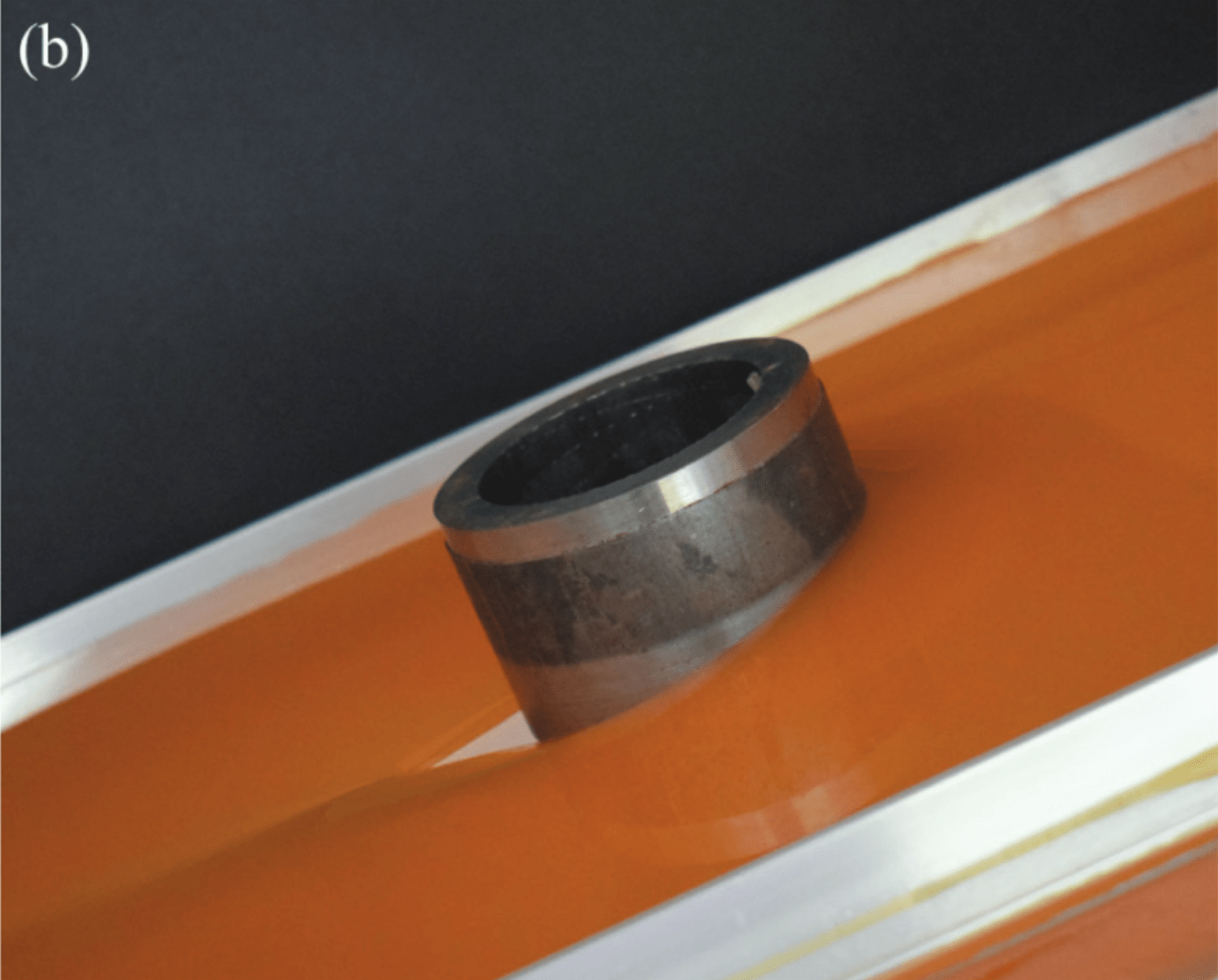
    In nature, erosion patterns are driven by the interactions of flow and topography. Here, researchers study that process in the lab by placing an inclined block of caramel in quiescent syrup and watching as it dissolves. Initially, the bottom surface of the block develops regularly-spaced plumes — the dark lines seen in the first image. But because the caramel-laden plumes are heavier than the surrounding fluid, the flow quickly becomes unstable. The plumes cross one another and begin to carve chevrons into the caramel.

    The chevrons appear to march their way upward in the video. They slowly grow and change into a distinctly scalloped pattern. Scallops like these are often seen by geologists in caves and icebergs, and the authors argue that their results and modeling indicate the importance of buoyant flow effects on such natural formations. (Image and research credit: C. Cohen et al.)

  • Featured Video Play Icon

    “As Above”

    In Roman Hill’s “As Above,” we see expansive celestial landscapes: nebulae, the corona of a star, and expanding interstellar dust clouds. Except, in reality, we are watching fluids undergoing a chemical reaction, on a canvas only 8 square millimeters in size. It’s a fun — and beautiful — reminder that the patterns of physics repeat across many scales. (Video and image credit: R. Hill)

  • Featured Video Play Icon

    How Did Pterosaurs Fly?

    One of my favorite aspects of fluid dynamics is how well it pairs with so many other fields, from mathematics and space exploration to biology, medicine, and even paleontology. That last field is key to today’s question, namely: how did a prehistoric reptile the size of an F-16 manage to fly?

    As Joe’s video describes, many factors went into Quetzalcoatlus’ flight. The pterosaur had strong but hollow bones to save on weight while anchoring flight muscles. Its wing shape mimicked an airfoil’s. And, finally, it overcame the challenge of taking off by using both its front and hind limbs to leap off the ground, much like modern bats do.

    There’s no doubt that it would be stunning (and probably terrifying!) to see these creatures in action. But you may wonder how scientists piece together these animals from incomplete fossils. Don’t worry! There’s a video for that question, too. (Video and image credit: It’s Okay to Be Smart; see also the video’s references)

  • Measuring Contaminants in Drops and Bubbles

    Measuring Contaminants in Drops and Bubbles

    Rising bubbles and droplets are common in many chemical and industrial applications. But just a tiny concentration of contaminants on their surface can completely alter their behavior, disrupting coalescence and slowing down chemical reactions.

    Historically, it’s been hard to measure the level of contamination in these some drops and bubbles, but a new study outlines a way to measure these small concentrations by perturbing the drops and watching how they deform. By analyzing how the drop shimmies and shakes, they’re able to measure its surface tension and, ultimately, the concentration of contaminants. (Image credit: S. Sørensen; research credit: B. Lalanne et al.; via APS Physics)

  • #ShutDownSTEM in Support of Black Academics

    #ShutDownSTEM in Support of Black Academics

    Academia, like every part of our society, has a race problem. Today, I’m joining in the effort to change that by taking a break from business as usual and examining the issues facing my Black colleagues and what I can do to change them. I encourage you to do the same, and if you stick around, I’ll give you some ways to help!

    The Current State of Affairs

    Physics and engineering struggle across the board with diversity. According to a 2020 report from the American Physical Society (APS, home to my professional society, the Division of Fluid Dynamics, or DFD), my society’s membership is currently about 14% female. That’s actually an improvement over 3 years ago, when we were all of 11% female. APS doesn’t even publish unit-level statistics on racial and ethnic minorities, though they do report statistics for minorities across physics as a whole.

    Only 3-4% of bachelor’s degrees awarded in physics or engineering go to Black graduates. At the graduate level, the statistics are even grimmer. Only about 100 Black women total have earned PhDs in physics. And studies have made it clear that the issues standing in the way of Black physicists and engineers are largely systemic and beyond their personal control. The problem is not that Black physicists and engineers are less capable; it’s that they face systemic and structural obstacles that make it harder to succeed. Those include isolation, frequent microaggressions, fewer role models and mentors, and implicit bias.

    Working Toward Change

    As someone without an academic institution, I’m somewhat limited in my capacity to change the culture there. I have no say in hiring or tenure decisions. (If you are at a university, here are some resources that may help you create change.)

    But my work does play an important role in increasing visibility for minorities in physics in engineering, including African Americans. To that end, I pledge to redouble my efforts to feature the voices and work of Black fluid dynamicists.

    I also want to support organizations that help Black physicists and engineers like the National Society of Black Physicists, the National Society of Black Engineers, and African American Women in Physics. And this is where you can help! For the next month, I will donate all of my proceeds from the sales of FYFD merchandise to these organizations. Moreover, I will personally match those proceeds with my own donation (up to $500). So if you’ve been thinking about grabbing a t-shirt or some stickers to share your love of fluid dynamics, now’s a great time!

    FYFD Merch
    Buy FYFD merch before July 10th and help support Black physicists and engineers!

    Final Thoughts and More Resources

    It’s important to recognize that is about more than one day. It’s about making a sustained commitment to eliminate anti-Black racism in STEM and academia. To that end, I include here some useful resources, both on general anti-racism efforts and on academic ones in particular. I hope you’ll join me in making our field more diverse and inclusive.

    Anti-Racism Resources

    Meet Some Black Physicists, Engineers, and Fluid Dynamicists

    This list is in no way comprehensive, but I want to highlight some of the amazing Black folks who have and are working in these fields. Have recommendations for more? Let me know in the comments or on Twitter.

    (Featured image credit: #ShutDownSTEM)