Tag: rotating flow

  • Featured Video Play Icon

    The Tea Leaves Effect

    If you’ve ever stirred a cup of tea with loose leaves in it, you’ve probably noticed that the leaves tend to swirl into the center of the cup in a kind of inverted whirlpool. At first, this behavior can seem counter-intuitive; after all, a spinning centrifuge causes denser components to fly to the outside. In this video, Steve Mould steps through this phenomenon and how the balance of pressures, velocities, densities, and viscosity cause the effect. (Note that Mould uses the term “drag,” but what he’s really referring to is the boundary layer across the bottom of the container. But who wants to explain a boundary layer in a video when they can avoid it?) (Video and image credit: S. Mould)
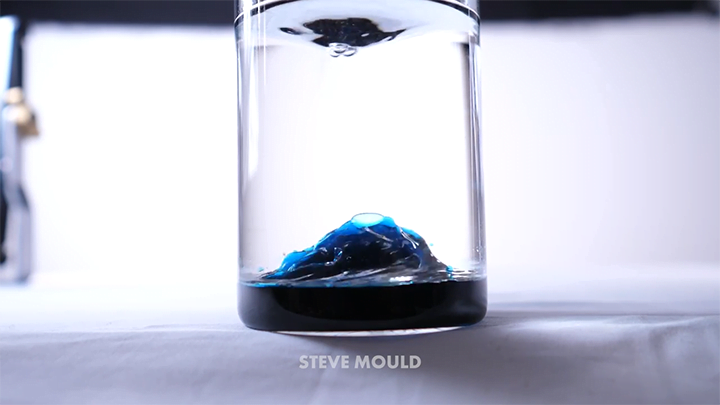
    When liquid in a cup is stirred, the densest layers move to the center.
  • Rotating Waves of Grains

    Rotating Waves of Grains

    Rotating drums are a popular way to explore granular dynamics. Here, researchers fill a cylinder (seen below) with heavy grains and a low-viscosity fluid, then rotate the mixture about a horizontal axis. This sets up a contest between centrifugal forces and gravitational forces on the grains. At the right rotation rates, the grains form annular rings around the outside of the cylinder, where they rotate at a different speed than the fluid. This difference in speed between the two layers can trigger a Kelvin-Helmholtz instability and cause waves along the interface between the grains and the fluid, as seen in the examples above. (Image and research credit: V. Dyakova and D. Polezhaev; top image adapted by N. Sharp)

    Image of the experimental apparatus when not rotating.
  • Spinning Off-Axis

    Spinning Off-Axis

    To make a vortex in the laboratory, researchers typically set a tank on a rotating platform and allow the water to drain out a hole in the center of the tank. In that case, a vortex forms over the drain (like in your bathtub!) and remains centered over the hole. In nature, though, vortices rarely follow such a simple path.

    In this experiment, researchers moved the drainage hole so that it is not aligned with the tank’s axis of rotation. Although the vortex forms over the drain (marked by a yellow dot in the lower image), it quickly moves away, following a roughly circular path around the axis until it comes to a stop. Green dye marks fluid from the tank’s bottom boundary layer, which eventually gets entrained up into the vortex. (Image and research credit: R. Munro and M. Foster; via Physics Today)

    Timelapse animation showing the development of the vortex. The yellow dot marks the location of the drain.
    Timelapse animation showing the development of the vortex. The yellow dot marks the location of the drain.

  • Mixing the Immiscible

    Mixing the Immiscible

    Immiscible liquids — like oil and water — do not combine easily. Typically, with enough effort, you can create an emulsion — a mixture formed from droplets of one liquid suspended in the other — like the one above. But a team of researchers have taken mixing immiscible liquids to a new level using their Vortex Fluid Device (VFD).

    Longtime readers may remember the group from their Ig-Nobel-winning demonstration of unboiling an egg, but this time the team is used the VFD to mix and de-mix immiscible liquids. As shown in the video below, the VFD is essentially a fast-spinning tube tilted at a 45-degree angle. As it spins, the liquids inside are forced into thin films with very high shear rates — high enough that immiscible liquids like water and toluene are forced together without forming an emulsion. Essentially, the mechanical forces mixing the liquids are strong enough to overcome the chemistry that typically keeps them apart.

    Impressively, the device manages this without using harsh surfactants or catalysts that other methods rely on. As a result, the technique offers a greener method for mixing chemicals for pharmaceuticals, cosmetics, food processing, and more. (Image credit: pisauikan; research credit: M. Jellicoe et al.; video credit: Flinders University; submitted by Marc A.)

  • Featured Video Play Icon

    Taylor Columns

    When rotating, fluids often act very differently than we expect. For example, an obstacle in a rotating flow will deflect flow around it at all heights. This is known as a Taylor column.

    In this video, we see the phenomenon recreated in a simple rotating tank (that’s easy to build yourself). Once all the water in the tank is rotating at the same rate, there is very little variation in flow with height. Food coloring dropped into the tank forms tight vertical columns. Even with a short obstacle in place and induced flow in the tank from a change in rotation rate, the dye continues to move uniformly in height. Because the dye cannot travel through the obstacle, it goes around and does so at every height, leaving the space above the obstacle dye-free.

    The same phenomenon occurs in planetary atmospheres; this rotating tank is basically a mini-version of our own atmosphere. Where there are obstacles — like mountains — on our planet, air has an easier time flowing around the mountain instead of over it! (Image and video credit: DIYnamics)

  • Featured Video Play Icon

    Centrifugal Instability

    When it comes to geophysics, there are all kinds of phenomena that depend on rotation. In this short video, researchers demonstrate one such phenomena — the centrifugal instability — in a tank on a turn table. The experiment begins once the fluid in the tank is all rotating together, like a solid body would. Then, they reduce the rotation rate of the turn table. Almost immediately, we see rolls encircle the tank.

    The rolls form due to the difference in momentum between fluid in the interior and near the wall. Friction with the wall slows the fluid there down much faster than that in the middle of the tank. As the faster-moving fluid gets centrifuged outward, it forms rolls. As the video demonstrates, these rolls can be relatively uniform and laminar, or, with enough change in rotation rate, they can become turbulent. (Image and video credit: UCLA Spinlab)

  • Featured Video Play Icon

    Calimero’s Uprising!

    Here on FYFD posts often focus on research results, with animations and images showing only a tiny portion of the apparatus necessary to conduct that work. But in this timelapse, we get to see a glimpse of what it takes to make the research happen. The video covers a 12-week period in which student Sietze Oostveen sets up, modifies, and takes measurements with a rotating tank apparatus called Calimero. 

    The video captions give you a sense of all the little tasks that go into experimental work, from installing thermal control and measurement systems (in this case, laser Doppler velocimetry, or LDV) to making sure that the rotating table is balanced correctly. In experimental work, it’s worth remembering that you’ll likely spend as much or more time preparing to take data than you will actually doing measurements! (Video credit: S. Oostveen/UCLA Spinlab)

  • Evaporative Convection

    Evaporative Convection

    Since we spend so much of our lives around transparent fluids like air and water, we often miss seeing some of their coolest-looking flows. Here, we see a layer of water only 3 centimeters deep but a full meter wide. It’s seeded with tiny crystals that reflect light depending on their orientation, which allows us to see the flow. Initially, the tank is spun up, then left stationary for 2 hours while evaporation cools the water.

    Normally, the resulting flow would be too slow to notice, but that’s where the magic of timelapse comes in. With it, we can see the wriggling dark lines marking areas where cool, dense water sinks and brighter regions where warm fluid rises. What begins as an array of polygonal convection cells quickly merges into a couple of large, rounded cells. Check out the full video below, where you can see the streaming patterns far better than in animation. (Image and video credit: UCLA Spinlab)

  • Zones and Stars

    Zones and Stars

    Large-scale rotating flows, like planetary atmospheres, tend to organize themselves into zones. Within a zone, flow remains essentially in an east-west direction and serves as a barrier that keeps heat or other elements from mixing from one zone to another. This is, for example, how the tropical trade winds work here on Earth.

    Stars, on the other hand, don’t show this kind of zonal behavior. The reason, it turns out, is their magnetic fields. When there’s no magnetic influence, even weak shear in a rotating flow is enough to start organizing turbulent fluctuations and grow a zonal flow. This tendency toward growth is known as the zonostrophic instability. But when you add a magnetic field, instead of organizing the hydrodynamic disturbances, that weak shear strengthens the magnetic ones, which in turn suppress the flow fluctuations. As a result, the hydrodynamic disturbances cannot grow and no zonal flow forms.

    Researchers think this mechanism can explain both why stars have no zonal flows and just how deep zones can penetrate inside the atmospheres of gas giants like Jupiter and Saturn before their planet’s magnetic field suppresses them. (Image credit: NASA; research credit: N. Constantinou and J. Parker, arXiv; via LLNL News; submitted by Stephanie N.)

  • Swirling the Wrong Way

    Swirling the Wrong Way

    When you swirl wine, you create a rotating wave that travels in the direction that you’re moving the glass. You would expect that anything floating atop that fluid would travel in the same direction of rotation. But it turns out, for a large, thin raft floating atop the rotating fluid, that’s not the case.

    Above you can see a swirling container, rotating counter-clockwise, with a raft of foam. This is from a timelapse where only one photo is taken per rotation, so that it’s easier to see how the foam is rotating relative to the container. And, once enough foam covers the surface, it starts rotating in a clockwise direction – opposite the container! It works for more than foam, too. The researchers show that the same holds for powders or beads. The key to the counter-rotation is that the raft needs to be coherent; it has to be able to transmit friction and internal stress among its constituents. Otherwise, the raft will just drift along with the swirling wave. (Image and research credit: F. Moisy et al., source, arXiv; via Improbable Research; submitted by David H. and Kam-Yung Soh)