Each winter the Kolyma River in Siberia freezes to a depth of several meters. But by June the river thaws and discharges its annual 136 cubic kilometers of water into the Arctic. The dark color of the river comes from the sediment and organic material it carries. The Kolyma is the world’s largest river underlain with continuous permafrost. Parts of the river system’s permafrost date back to the Pleistocene more than 12,000 years ago. Since much of its organic matter comes from its permafrost, researchers expect the amount of organic material in the Kolyma’s discharge to increase as the permafrost degrades in our warming climate. (Image credit: NASA Earth Observatory)
Tag: rivers

Forming an Oxbow
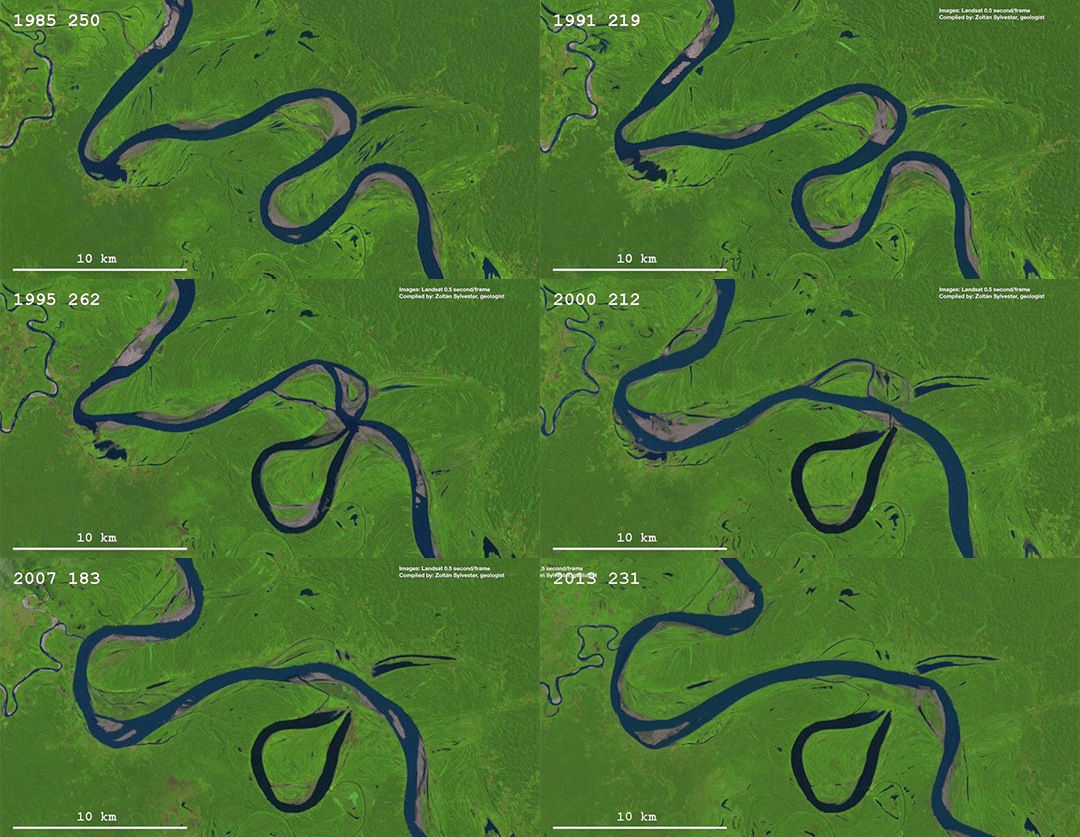
Without human intervention, meandering rivers become more sinuous over time. This is driven by the flow around a river bend, which tends to push sediment from the outer bank of the curve to the inner, making the bend more pronounced. Eventually, loops in the river can pinch off and form a separate oxbow lake, as seen in the animation above and video below.
By studying many photo sequences like this one, researchers have concluded that how quickly a river bend meanders depends on its curvature. In general, the higher the curvature, the faster the river bend will migrate. When rivers deviate from this rule of thumb, it’s typically because part of a river bank is tougher to erode than other sections. (Image and video credit: Z. Sylvester/Geolounge; research credit: Z. Sylvester; via Landsat; submitted by Aatish B.)

Namibia From Above
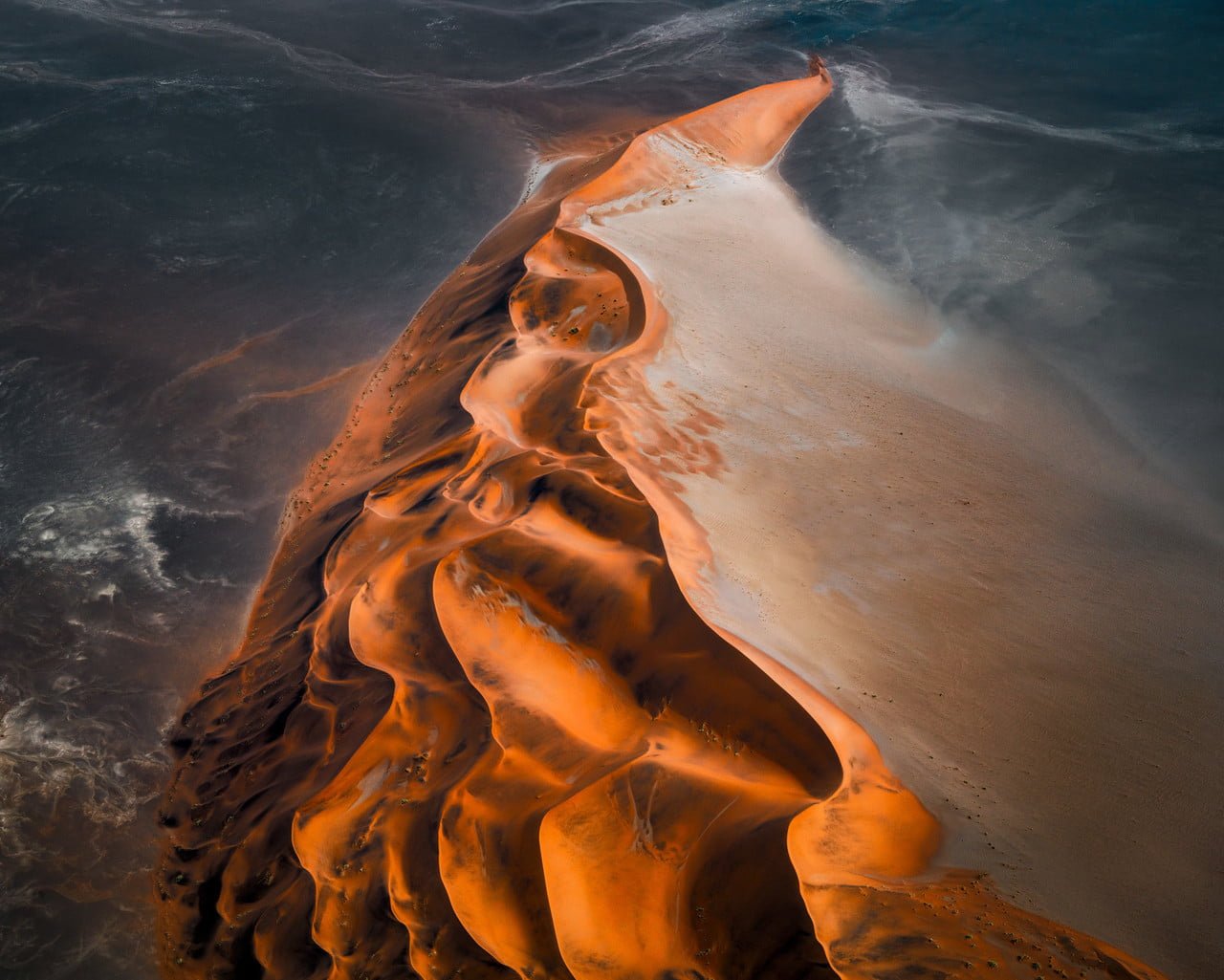
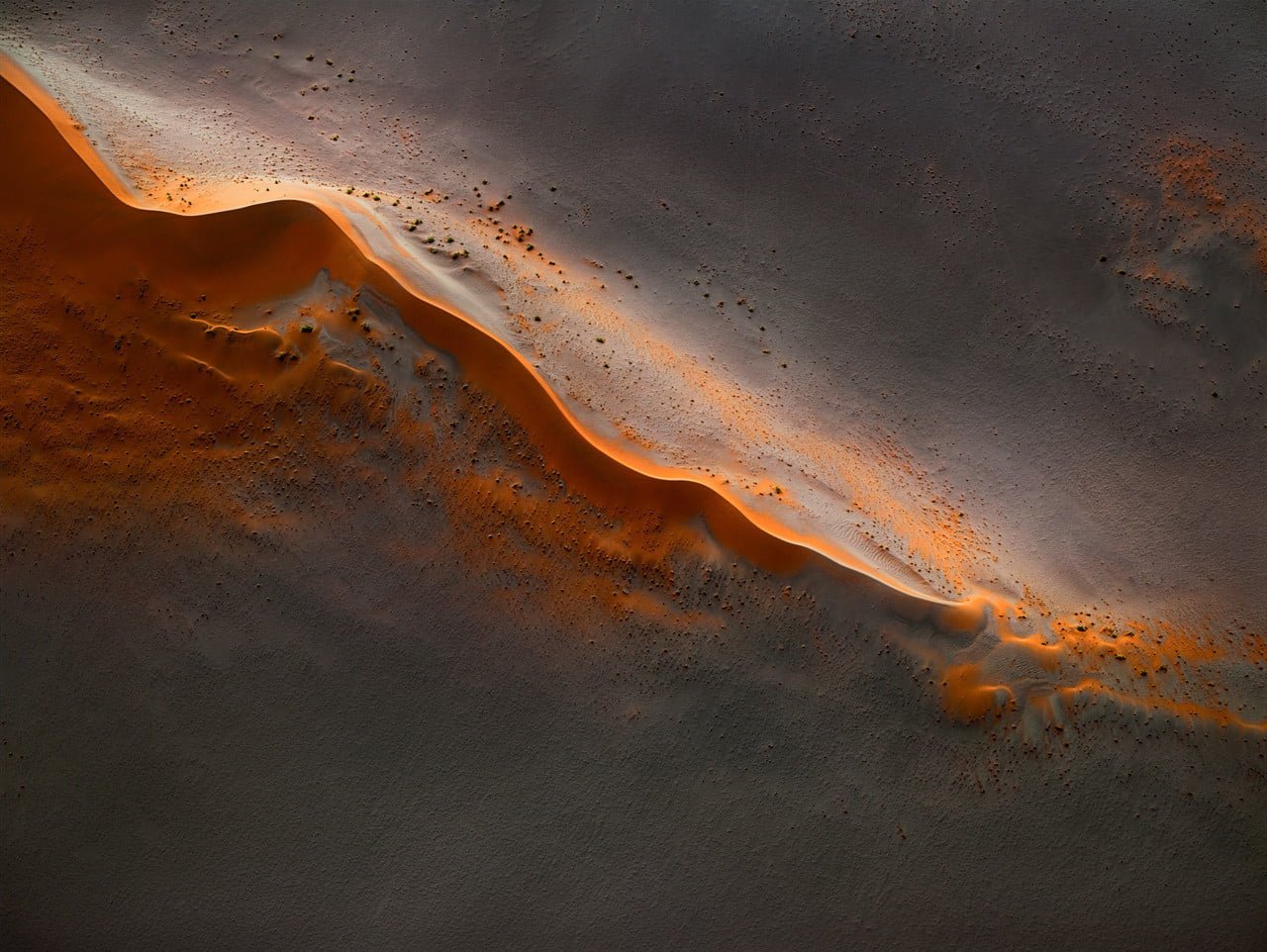
From above, we see an all-new perspective on the flows of air and water that shape our world. Although they look like abstract art, these aerial photographs of Namibia by Leah Kennedy show rippling dunes and spreading fingers of water. Linear dunes like these grow when the prevailing winds are always from the same direction. Over time, rivers meander, always seeking new drainage paths. Patterns like these are probably driven by periodic flooding. (Image credit: L. Kennedy; via Colossal)

Watery Veins
Glacial river veins wend and meander through these aerial photographs of Iceland by photographer Stas Bartnikas. Rivers naturally change their course over time, but here seasonal melts and the slow grinding of glaciers adds further chaos to the scene. Captured from above, these landscapes show the scars of past flows. (Image credit: S. Bartnikas; via Colossal)

Bringing Beavers Back
It’s easy sometimes to forget just how drastically humans alter landscapes. Before European fur trappers came to North America, its waterways were ruled by beavers, one of nature’s most impressive engineers. Now researchers, ranchers, and conservationists are installing beaver dam analogs (BDAs) in streams and creeks to help bring back the beavers and their benefits.
Initially, the BDA starts as several human-driven posts with willow bark woven between. These structures help slow the water, which refills floodplains, deposits sediment, and can help recharge the water table. Beavers augment the structures and build new ones, helping bring complexity and fertility back to devastated waterways.
The benefits have been multifold. In waterways re-engineered through BDAs, native trout species have flourished, sage grouse nesting is recovering, water tables have climbed by a meter (thereby reducing irrigation costs), and seasonal streams have had their flow extended. It sounds like an exciting story, both for conservation and agriculture. Check out the full story here. (Video credit: Science; see also their full article)

An Armored Bed
A river’s flow constantly changes its underlying bed. The rocks and particulates beneath a flowing river can typically be divided into two zones: an upper layer called the bed-load zone where the flow moves particles with it and a lower layer where particles are mostly trapped but may creep over long periods. In gravelly river-beds this upper bed-load zone tends to accumulate more large particles, a phenomenon known as armoring. Experiments show that, in this region, large particles have a net vertical velocity moving upward, while smaller particles tend to move downward. Exactly why large particles are more prevalent in the bed-load zone in unknown; several theories have been offered. One suggests that the size segregation is similar to the Brazil nut effect and that smaller particles have a tendency to fall into gaps and sink more easily than larger ones. (Image and research credit: B. Ferdowsi et al., source)

Washington Ice Disk
Winter weather in northern latitudes sometimes brings with it unusual phenomena like this ice disk spinning in the Middle Fork Snoqualmie River in Washington state. Photographer Kaylyn Messer ventured out to capture photos and videos of the event over the weekend. There are a couple theories as to how such disks form, but swirling river eddies are a key ingredient. One theory posits that chunks of ice forming on the river get caught up by the spinning eddy and slowly freeze together to form the disk. Another theory proposes that the disks occur when an existing chunk of ice breaks away, gets caught in the spinning eddy and slowly has its edges ground down into a circle. Personally, I lean toward the former explanation, though there is likely grinding at the edges either way. See more about this ice circle over at Messer’s blog. (Image credit: K. Messer; GIF by @itscolossal; via Colossal)

Meandering Colorado

Sometimes the meandering of a river is best seen from above. Because of the way water moves to negotiate a bend in the river, any curvature of a river will get carved into a more extreme curve over time. Eventually the river’s course becomes so exaggerated that a loop can bend almost back on itself. At this point, the river often pinches off the bend and shortens its course, as the Colorado River did several thousand years ago with the abandoned meander labeled The Rincon near the bottom of this satellite photo. Left to its own devices, the Colorado would eventually cut away the loop west of Lake Powell, too. (Image credit: NASA/Expedition 47; via NASA Earth Observatory)

Meander from Above
This photo of the Amazon River taken by Astronaut Tim Kopra reveals the many meandering changes of the river’s course. Left untouched by human intervention, rivers tend to get more curvy, or sinuous, over time, simply due to fluid dynamics. Imagine a single bend in a river. Due to conservation of angular momentum, water flows faster around the inside curve of the bend than the outside – just like an ice skater spins faster with her arms pulled in. From Bernoulli’s principle, we know there is an accompanying pressure gradient caused by this velocity difference – with higher pressure near the outer bank and lower pressure on the inner one. This pressure gradient is what guides the water around the bend, keeping the bulk of the fluid moving downstream rather than bending toward either bank.
At the bottom of the river, though, viscosity slows the water down due to the influence of the ground. This slower water, still subject to the same pressure gradient as the rest of the river, cannot maintain its course going downstream. Instead, it gets pushed from the outer bank toward the inner bank in what’s known as a secondary flow. This secondary flow carries sediment away from the outer bank and deposits it on the inner bank, which, over time, makes the river bend more and more pronounced. (Image credit: T. Kopra/NASA; submitted by jshoer)
Do you enjoy FYFD and want to help support it? Then please consider becoming a patron!

River Paths
As a follow-up to this recent post about river meander, check out this video from Numberphile about some of the mathematics behind the path of rivers. A river’s course is typically much longer than the direct distance between its origin and outlet; the ratio of these two distances is the river’s sinuosity. The fluid dynamics of a river’s bend tend to create stronger bends, but, once a bend reaches an extreme point, it will often be cut off, thereby straightening the river’s path. A model of unconstrained rivers suggests that, on average, the sinuosity of rivers should be about pi. As noted in the video, it would be very interesting to see how this theory holds up next to real rivers. But, given the way humans have fixed the course of rivers to prevent flooding, their current sinuosity is probably far from natural or unconstrained. (Video credit: Numberphile; research credit: H. Stølum; submitted by haxpaxmax)