Tag: Rayleigh-Taylor instability

  • Richtmyer-Meshkov Instability

    Richtmyer-Meshkov Instability

    If you send a shock wave through a magnetized plasma–something that happens in both supernova explosions and inertial confinement fusion–it can trigger an instability known as the Richtmyer-Meshkov instability. The image above shows a form of this, taken from a simulation. Rather than treating the plasma as a single idealized fluid, the researchers represented it as two fluids: an ion fluid and an electron fluid. This allowed them to better capture what happens when certain components of the plasma react to changes faster than others do.

    The image itself shows the electron number density across the fluid, where darker colors represent higher electron number density. The interface between high and low-densities shows a roll-up instability that resembles the Kelvin-Helmholtz instability, but there are also regions of mushroom-like plumes that more closely resemble Rayleigh-Taylor instabilities.

    The authors note that these structures don’t appear in simulations that represent a plasma as a single fluid; you need the two-fluid representation to see them. (Image and research credit: O. Thompson et al.)

  • Featured Video Play Icon

    Instabilities in a Particle Flow

    Even though particles are not (strictly speaking) a fluid, they often behave like one. Here, researchers investigate what happens when two layers of particles–with different size and density–slide down an incline together. The video is tilted so that the flow instead appears from left to right.

    When the larger, denser particles sit atop a layer of smaller, lighter particles, shear between the two layers causes a Kelvin-Helmholtz instability that runs in the direction of the flow. This creates a wavy interface that lets some small particles work upward while large particles shift downward.

    At the same time, a slice across the flow shows that plumes of small particles are pushing up toward the surface, driven by a Rayleigh-Taylor instability. The researchers also look at what happens when the particles are fluidized by injecting a gas able to lift the particles. (Video and image credit: M. Ibrahim et al.; via GFM)

  • Quantum Rayleigh-Taylor Instability

    Quantum Rayleigh-Taylor Instability

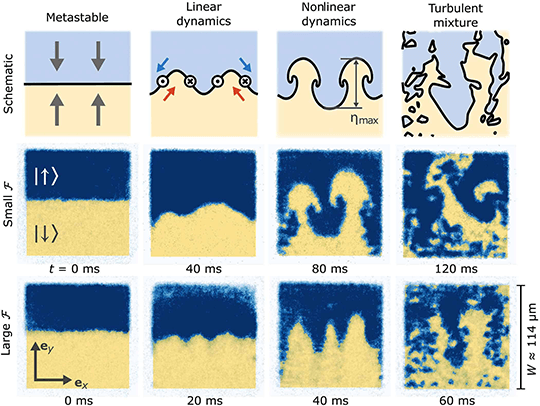
    The Rayleigh-Taylor instability–typically marked by mushroom-shaped plumes–occurs when a dense fluid accelerates into a less dense one. But researchers have now demonstrated the effect at quantum scales, too.

    For their experiment, the group used a Bose-Einstein condensate of sodium atoms and made the interface between them by exciting half of the atoms into a spin-up state and half into a spin-down one. With the interface is place, they reversed the magnetic field gradient, inducing a force on the atoms equivalent to the buoyant force seen in conventional Rayleigh-Taylor instabilities. As shown above, the interface first warped, then developed Rayleigh-Taylor mushrooms and eventually became turbulent. (Image and research credit: Y. Geng et al.; via Physics World)

    Fediverse Reactions
  • Featured Video Play Icon

    Seeking Randomness

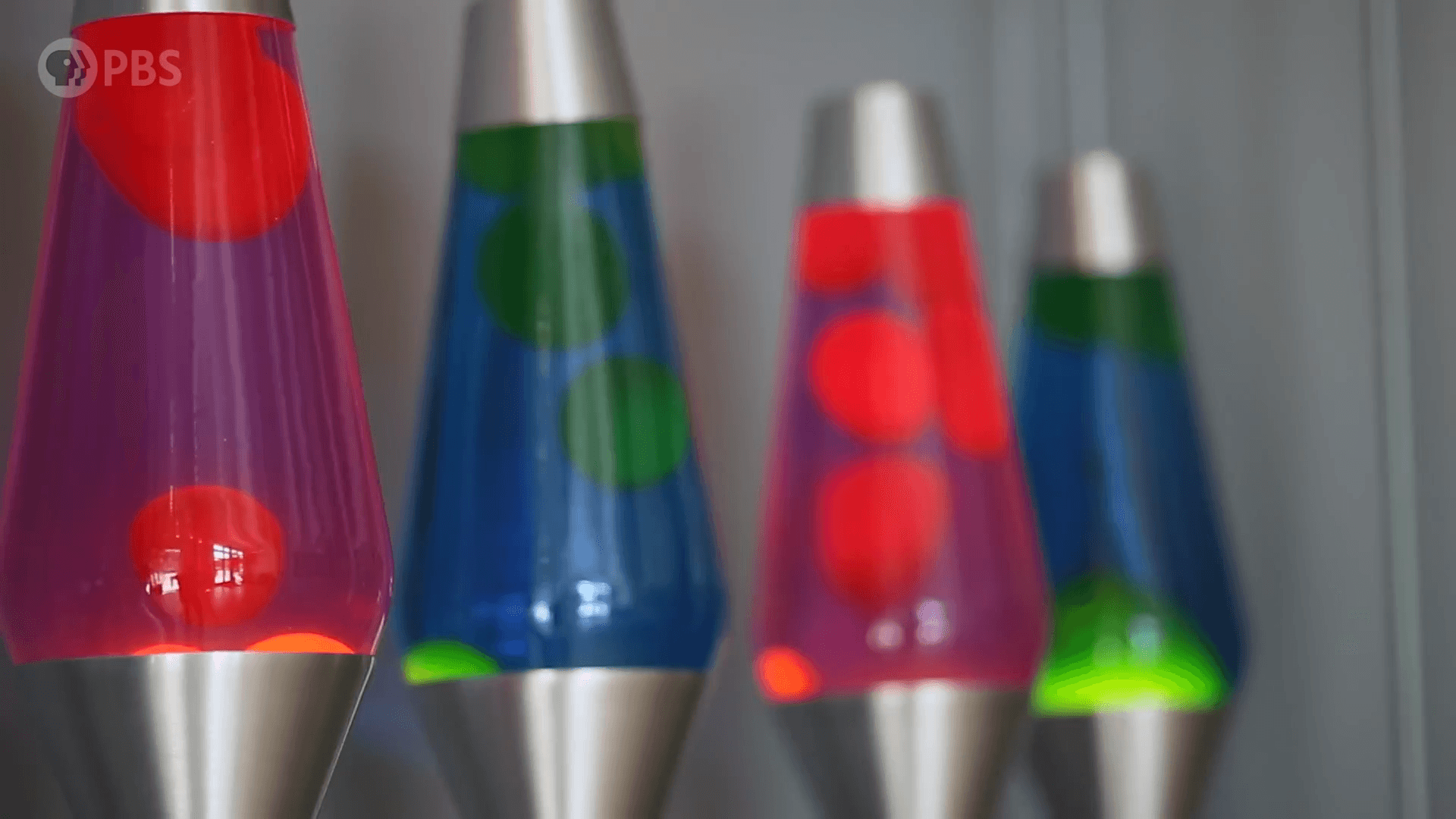
    Securing information on the Internet requires a lot of random numbers, something computers are not good at creating on their own. This need for random input raises an important philosophical and practical question: what is randomness? How can we be sure that something truly is random, or is it enough for a system to be practically random? Joe explores these questions in this Be Smart video, which shows off how companies use systems — including fluid dynamical ones like lava lamps and wave machines — to generate random numbers for encryption. (Video and image credit: Be Smart)

    Fediverse Reactions
  • Cat’s Eye Halo

    Cat’s Eye Halo

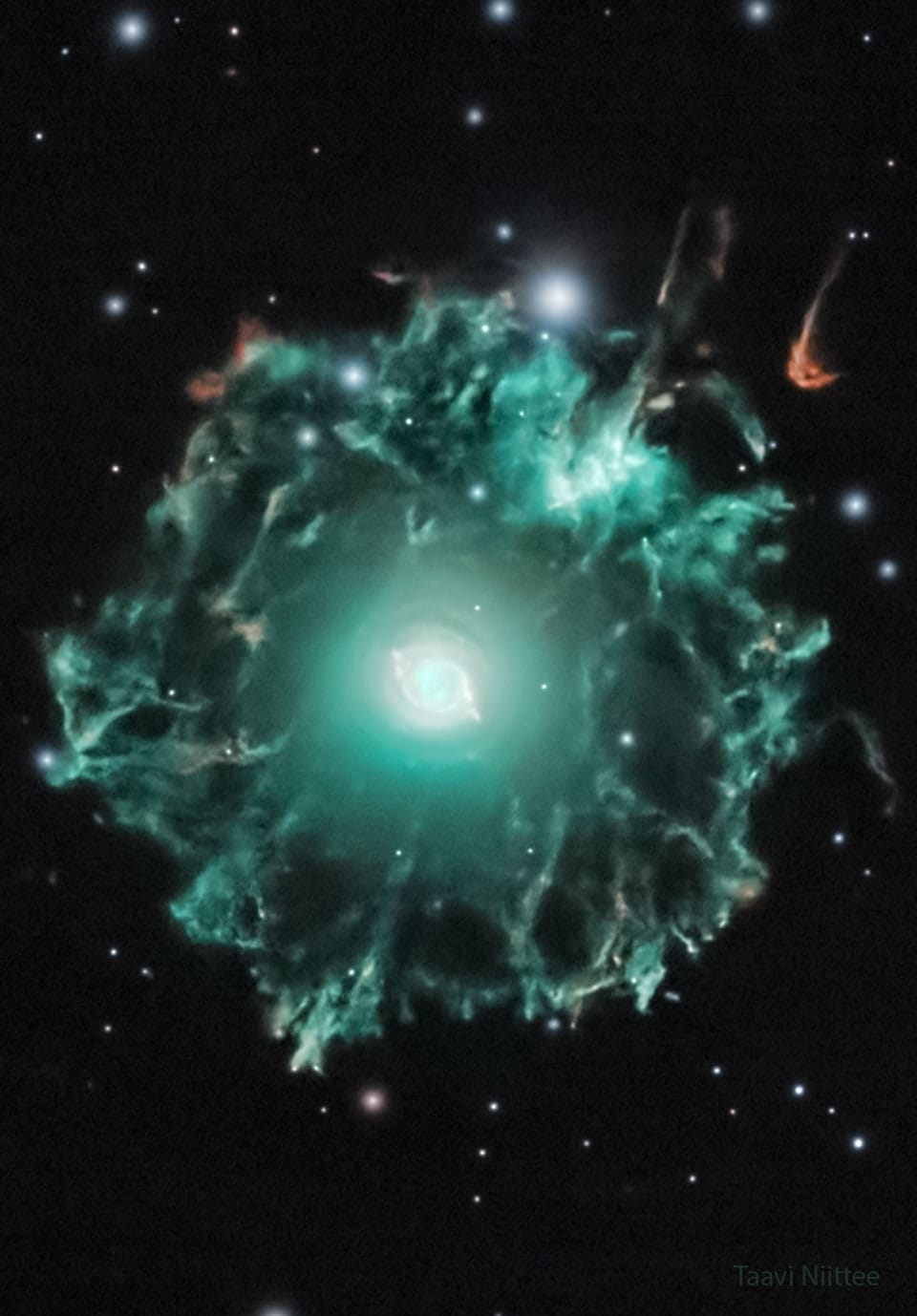
    The Cat’s Eye Nebula is a planetary nebula located in the Draco constellation. At its center is a dying star. Seen here is the faint halo that stretches 3 light-years around the central nebula. The filaments of the halo are estimated to be 50,000 to 90,000 years old and were shed during earlier periods in the star’s evolution. Their shape is reminiscent of Rayleigh-Taylor instabilities, to my eye. (Image credit: T. Niittee; via APOD)

    Fediverse Reactions
  • Growing Flexible Stalactites

    Growing Flexible Stalactites

    Icicles and stalactites grow little by little, each layer a testament to the object’s history. Here, researchers explore a similar phenomenon, grown from a dripping liquid. They’re called “flexicles” in homage to their natural counterparts, and they start from a thin layer of elastomer liquid. Though it begins as a liquid, elastomer solidifies over time.

    Timelapse video showing the formation of an initial layer of flexicles from a dripping elastomer.
    Timelapse video showing the formation of an initial layer of flexicles from a dripping elastomer.

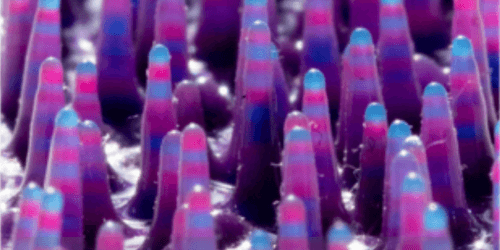
    To form flexicles, the researchers spread a layer of elastomer on an upside-down surface and allow gravity to do its thing (above). Thanks to the Rayleigh-Taylor instability, the dense elastomer forms a pattern of drips that, after hardening, creates a pebbled surface. Subsequent layers of elastomer will drip from the same spots as before, slowly growing longer flexicles (below). The team envisions using them for soft robotics, but, personally, I just really want poke at them and wiggle them. (Image and research credit: B. Venkateswaran et al.; via APS Physics)

    A stitched composite photo showing flexicles on a cylinder growing layer by layer.
    A stitched composite photo showing flexicles on a cylinder growing layer by layer.
  • Featured Video Play Icon

    “Aquakosmos – Ch. 2”

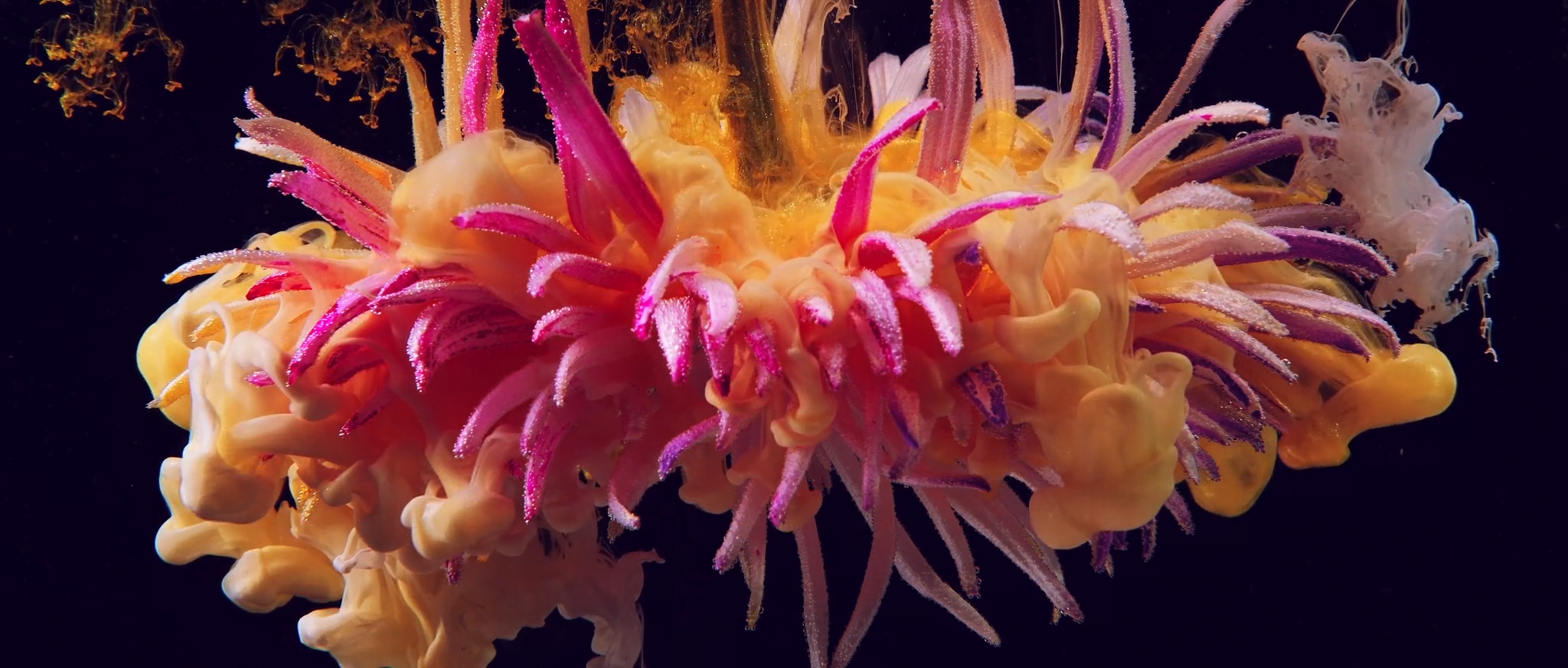
    Colored inks bulge and billow around flowers in filmmaker Christopher Dormoy’s “Aquakosmos – Ch. 2”. Because ink is denser than the surrounding water, it sinks, forming mushroom-like shapes as the Rayleigh-Taylor instability takes over. One of the fun things about this particular video is that we see the Rayleigh-Taylor instability at many different sizes, depending on the size and speed of different falling dyes. (Video and image credit: C. Dormoy)

  • Featured Video Play Icon

    “Emitter”

    For this latest experimental film, artist Roman De Giuli provides a glimpse of the unique fluid art machine he’s built over the last 3.5 years. With 10 channels driven by peristasltic tube pumps and stepper motors, his “printer” drips up to 10 colors on a paint-covered, tilted canvas to create these beautiful images. As he says in his description of the invention, the set-up produces paint layering that’s almost impossible to create by hand. Fluid dynamically speaking, we’re seeing gravity currents like a lava flow or avalanche that are mixing together viscously. There’s also some added effects from density differences between different layered paint colors. Artistically, this machine offers an infinite palette of visual opportunities; financially, though, De Giuli admits its an absolute beast at consuming paint! (Image and video credit: R. De Giuli)

  • Dripping Viscoelastics

    Dripping Viscoelastics

    An ultrasoft viscoelastic fluid drips in this research poster from the Gallery of Soft Matter. Complex materials like this one have stretchy, elastic behaviors typical of a solid along with the flowing, viscous properties of a fluid. Here, gravity overcomes the material’s elasticity, leaving it to sag and flow. As that happens, the fluid must slide past air, and the density difference between the two fluids creates the small distortions seen on the liquid sheet. This is an example of a Rayleigh-Taylor instability. (Image credit: J. Hwang et al.)

  • Featured Video Play Icon

    “Alive”

    In “Alive,” filmmaker Christopher Dormoy explores acrylic paints and the variety of ways in which the medium can be used. From a fluids perspective, there’s dripping, viscous flow, turbulent eddies, billowing plumes, and “accidental painting” due to density-driven instabilities. It’s a fun tour of fluid phenomena in art. What examples do you spot? (Video and image credit: C. Dormoy)