Tag: quantum mechanics

  • Pilot-Wave Hydrodynamics: Walking Drops

    Pilot-Wave Hydrodynamics: Walking Drops

    This post is a collaborative series with FYP on pilot-wave hydrodynamics. Previous entries: 1) Introduction; 2) Chladni patterns; 3) Faraday instability

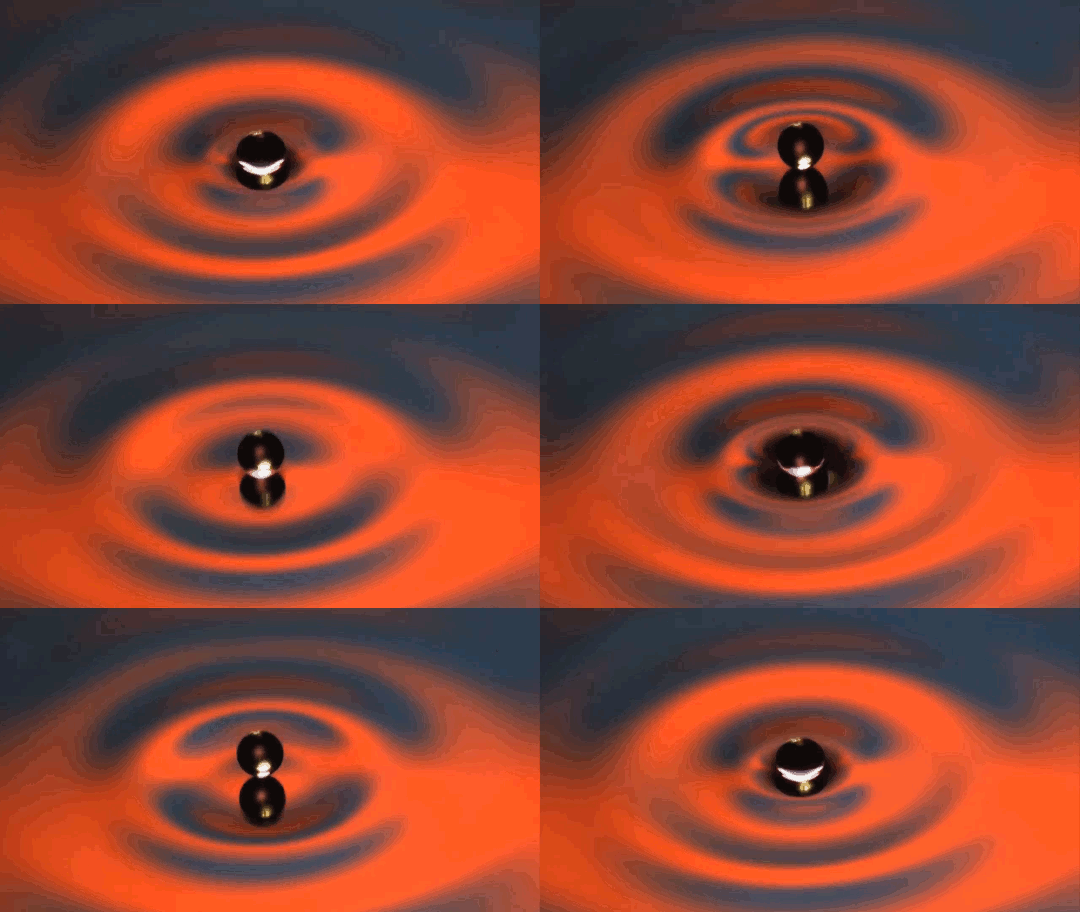
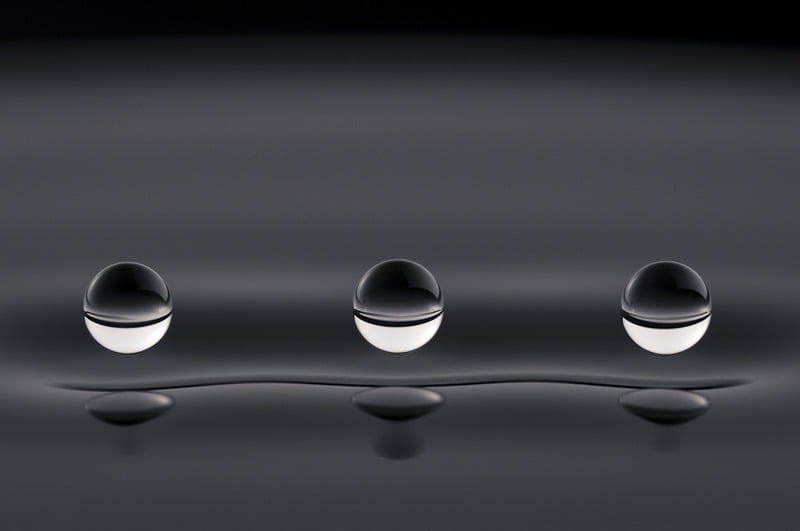
    If you place a small droplet atop a vibrating pool, it will happily bounce like a kid on a trampoline. On the surface, this seems quite counterintuitive: why doesn’t the droplet coalesce with the pool? The answer: there’s a thin layer of air trapped between the droplet and the pool. If that air were squeezed out, the droplet would coalesce. But it takes a finite amount of time to drain that air layer away, even with the weight of the droplet bearing down on it. Before that drainage can happen, the vibration of the pool sends the droplet aloft again, refreshing the air layer beneath it. The droplet falls, gets caught on its air cushion, and then sent bouncing again before the air can squeeze out. If nothing disturbs the droplet, it can bounce almost indefinitely.

    image

    Droplets don’t always bounce in place, though. When forced with the right frequency and acceleration, a bouncing droplet can transition to walking. In this state, the droplet falls and strikes the pool such that it interacts with the ripple from its previous bounce. That sends the droplet aloft again but with a horizontal velocity component in addition to its vertical one. In this state, the droplet can wander about its container in a way that depends on its history or “memory” in the form of waves from its previous bounces. And this is where things start to get a bit weird – as in quantum weirdness – because now our walker consists of both a particle (droplet) and wave (ripples). The similarities between quantum behaviors and the walking droplets, the collective behavior of which is commonly referred to as “pilot-wave hydrodynamics,” are rather remarkable. In the next couple posts, we’ll take a look at some important quantum mechanical experiments and their hydrodynamic counterparts.

    (Image credit: D. Harris et al., source)

  • Featured Video Play Icon

    Quantum Droplets

    Over the past decade, fluid dynamicists have been investigating tiny droplets bouncing on a vibrating fluid. This seemingly simple experiment has remarkable depth, including the ability to recreate quantum behaviors in a classical system. In this video, some of the researchers demonstrate their experimental techniques, including how they vary the frame rate relative to the bouncing of the drops. At the right frame rate, this sampling makes the droplets appear to glide along with their ripples, giving us a look at a system that is simultaneously a particle (drop) and wave (ripple). (Video credit: D. Harris et al.)

  • Hydrodynamic Quantum Analogs

    Hydrodynamic Quantum Analogs

    Over the past few years, researchers have been exploring the dynamics of droplets bouncing on a vibrating fluid. These systems display many behaviors associated with quantum mechanics, including wave-particle duality, single-slit and double-slit diffraction, and tunneling. A new paper examines the system mathematically, showing that the droplets obey many of the same mathematics as quantum systems. In fact, the droplet-wave system behaves as a macroscopic analog of 2D quantum behaviors. The implications are intriguing, especially for teaching. Now students of quantum mechanics can experiment with a simple apparatus to understand some of the non-intuitive aspects of quantum behavior. For more, see the paper on arxiv. (Image credit: D. Harris and J. Bush; research credit: R. Brady and R. Anderson)

  • Bouncing in Lockstep

    Bouncing in Lockstep

    Droplets of silicone oil bounce on a pool of the same thanks to the vibration provided by a loudspeaker. Each droplet’s bounce causes ripples in the pool and the interference between these ripples fixes the droplets in lockstep with one another. As long as the vibration continues to feed the thin layer of air that separates the droplets from the pool during each bounce and no impurities break the surface tension at the interface, the droplets will bounce indefinitely on their liquid trampoline. Such systems can be used to observe quantum-mechanical behavior like wave-particle duality on a macro-scale. (Photo credit: A. Labuda and J. Belina)

  • Featured Video Play Icon

    Bouncing in a Corral

    About a year ago, we featured a video in which a fluid droplet bouncing on a vibrating pool demonstrated some aspects of the wave-particle duality fundamental to quantum mechanics. Work on this system continues and this new video focuses on studying some of the statistics of such a bouncing droplet–called a walker in the video–when it is confined to a circular corral. Using strobe lighting and capturing one frame per bounce, the vertical motion of these droplets is filtered out and the walking motion and the surface waves that guide it are captured. When the droplet is allowed to walk for an extended time, its path appears complicated and seemingly random, but it is possible to build a statistical picture and a probability density field that describe where the walker is most likely to be, much the way one describes the likelihood of locating a quantum particle. Parallels between the physical macroscale system and quantum-mechanical theory are drawn. (Video credit: D. Harris and J. Bush; submission by D. Harris)

  • Featured Video Play Icon

    Superfluid Vortices

    Cooling helium to a few degrees Kelvin above absolute zero produces superfluid helium, a substance with some very bizarre behaviors caused by a lack of viscosity. Superfluids exhibit quantum mechanical properties on a macroscopic scale; for example, when rotated, a superfluid’s vorticity is quantized into distinct vortex lines, known as quantum vortices. These vortices can be visualized in a superfluid by introducing solid tracer particles, which congregate inside the vortex line, making it appear as a dotted line, as shown in the video above. When these vortex lines approach one another, they can break and reconnect into new vortices. These reconnections provoke helical Kelvin waves, a phenomenon that had not been directly observed until the present work by E. Fonda and colleagues. They are even able to show that the waves they observe match several proposed models for the behavior. (Video credit: E. Fonda et al.)

  • Featured Video Play Icon

    Wave-Particle Duality in Bouncing Droplets

    A droplet atop a vibrating pool is prevented from coalescing by the constant influx of air into a thin lubrication layer between it and the pool. But that is not the strangest aspect of its behavior.  Researchers have found that this system demonstrates some aspects of the mind-bending wave-particle duality at the heart of quantum physics. (Submitted by Dan H.) #

  • Neutron Superfluids in Stars?

    Neutron Superfluids in Stars?

    This image shows a composite X-ray (red, green, and blue) and optical (gold) view of the supernova remnant Cassiopeia A, located about 11,000 light years away. At the heart of this supernova remnant is a neutron star. After ten years of observations, astronomers have found a 4% decline in the temperature of this neutron star, which cannot be accounted for in current theory. Two research teams have independently found that this cooling could be due to the star converting the neutrons in its core into a superfluid. As the neutron superfluid is formed, neutrinos are emitted; this decreases the energy in the star and causes more rapid cooling. See Wired for more. #