Tag: plumes

  • Featured Video Play Icon

    Popping an Oil Balloon

    Oil and water don’t mix — or at least they won’t without a lot of effort! In this video, we get to admire just how immiscible these fluids are as oil-filled balloons get burst underwater.

    Visually, the two bursts are quite spectacular. In the first image, the initial balloon has a sizeable air bubble at the top, which rises even more rapidly than the buoyant oil, creating a miniature, jelly-fish-like plume that reaches the surface first. The large oil plume follows, behaving similarly to the balloon burst without an added air bubble.

    The last of the oil in both cases comes from a cloud of smaller droplets formed near the bottom of the balloon. Being smaller and less buoyant, these drops take a lot longer to rise to the surface and remain much closer to spherical as they do. I suspect these smaller droplets form due to the forces created by the fast-moving elastic as it tears away. (Video and image credit: Warped Perception)

  • Volcanic Plume

    Volcanic Plume

    Astronauts aboard the International Space Station captured this dramatic image of Raikoke Volcano’s eruption in late June. This uninhabited Pacific Island is part of the Kuril Islands off mainland Russia. The hot plume of ash and volcanic gas rose until its density matched that of the surrounding air, at which point it could only expand horizontally. This is why the plume appears to have such a flat top. It’s similar to the cumulonimbus clouds we associate with severe thunderstorms. Scientists speculate that the white ring around the plume’s base might be water vapor condensed from ambient air pulled in to the plume’s base or a side-effect of magma flowing into the surrounding sea. (Image credit: NASA; via NASA Earth Observatory)

  • Featured Video Play Icon

    Fiery Backdraft

    Combustion is ultimately a chemical reaction, and like any chemical reaction, it requires the right balance of ingredients. The only way to completely exhaust the reaction is to have the perfect amount of fuel (i.e. stuff to burn) and oxidizer (i.e. oxygen). When those ratios don’t match, the reaction can slow down or even appear to end, but that doesn’t mean a fire’s gone out.

    Firefighters face one of the dangerous consequences of this situation in the form of backdrafts. When a fire has been burning in a sealed container and exhausted its oxygen supply, it can get extremely hot even if the flames seem to have died down. When oxygen is added back by opening a door or window, the fire can react explosively, as the Slow Mo Guys demonstrate above. The good news is that backdrafts are relatively rare and there are steps you can take to avoid them. (Image and video credit: The Slow Mo Guys)

  • Featured Video Play Icon

    Bees, Squid, and Oil Plumes

    It’s time for another JFM/FYFD collab video! April’s video brings us a taste of spring with research on how bees carry pollen, squid-inspired robotics, and understanding the physics of underwater plumes like the one that occurred in the Deepwater Horizons spill eight years ago. Check it all out in the video below. (Image and video credit: T. Crawford and N. Sharp)

  • Featured Video Play Icon

    “Ink in Motion”

    In this short film, the Macro Room team plays with the diffusion of ink in water and its interaction with various shapes. Injecting ink with a syringe results in a beautiful, billowing turbulent plume. By fiddling with the playback time, the video really highlights some of the neat instabilities the ink goes through before it mixes. Note how the yellow ink at 1:12 breaks into jellyfish-like shapes with tentacles that sprout more ink; that’s a classic form of the Rayleigh-Taylor instability, driven by the higher density ink sinking through the lower density water. Ink’s higher density is what drives the ink-falls flowing down the flowers in the final segment, too. Definitely take a couple minutes to watch the full video. (Image and video credit: Macro Room; via James H./Flow Vis)

  • Dissolving

    Dissolving

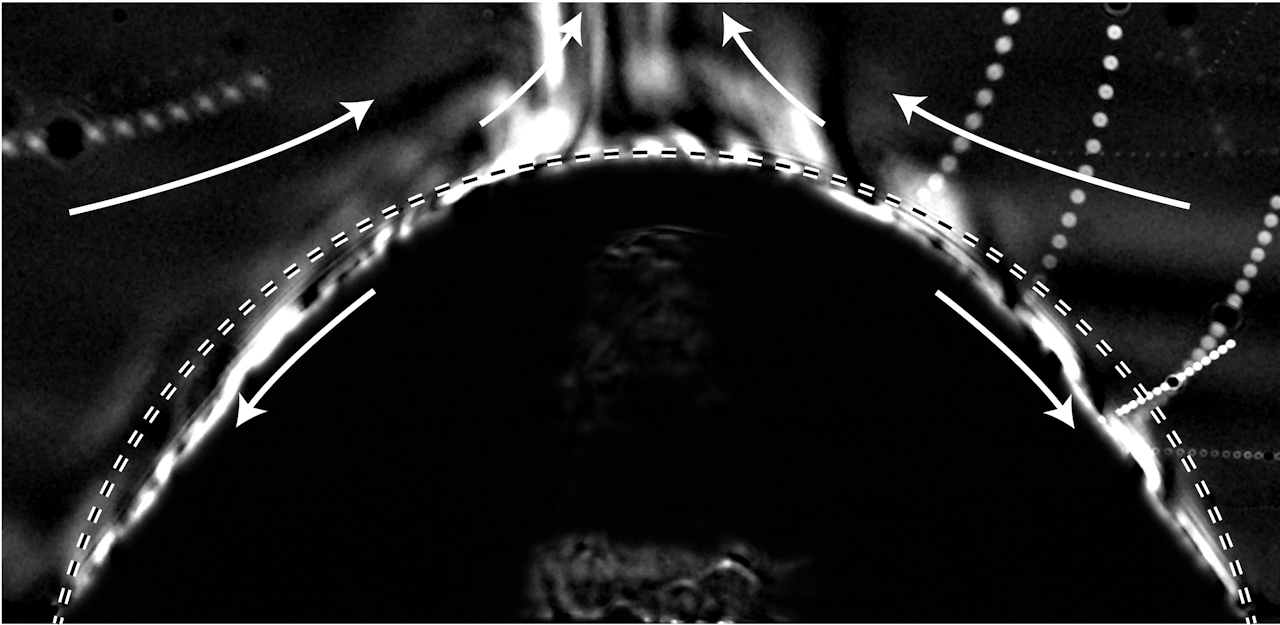
    It looks like the fiery edge of a star’s corona, but this photo actually shows a dissolving droplet. The droplet, shown as the lower dark region in this shadowgraph image, is a mixture of pentanol and decanol sitting in a bath of water. Pentanol is a type of alcohol that is fully miscible with decanol and is water soluble, so that it will dissolve into the surrounding water over time. Decanol, on the other hand, is immiscible with water, so that part of the droplet won’t mix with the surrounding water.

    The bright swirls along the droplet’s edge show areas with more pentanol. As the alcohol dissolves into the water, it forms a buoyant plume at the top of the droplet that rises due to pentanol’s lower density. That rising plume draws fresh water in from the sides, shown by the upper white arrows. Inside the droplet, flow moves in the opposite direction, from the top toward the outer edges. This is a result of uneven surface tension within the droplet. Scientists are interested in understanding the dynamics of these multiple component drops for applications like printing, where it’s desirable for pigments in an ink drop to be distributed evenly as the drop dries.  (Image credit: E. Dietrich et al.)

  • A Rocket Launch From Above

    A Rocket Launch From Above

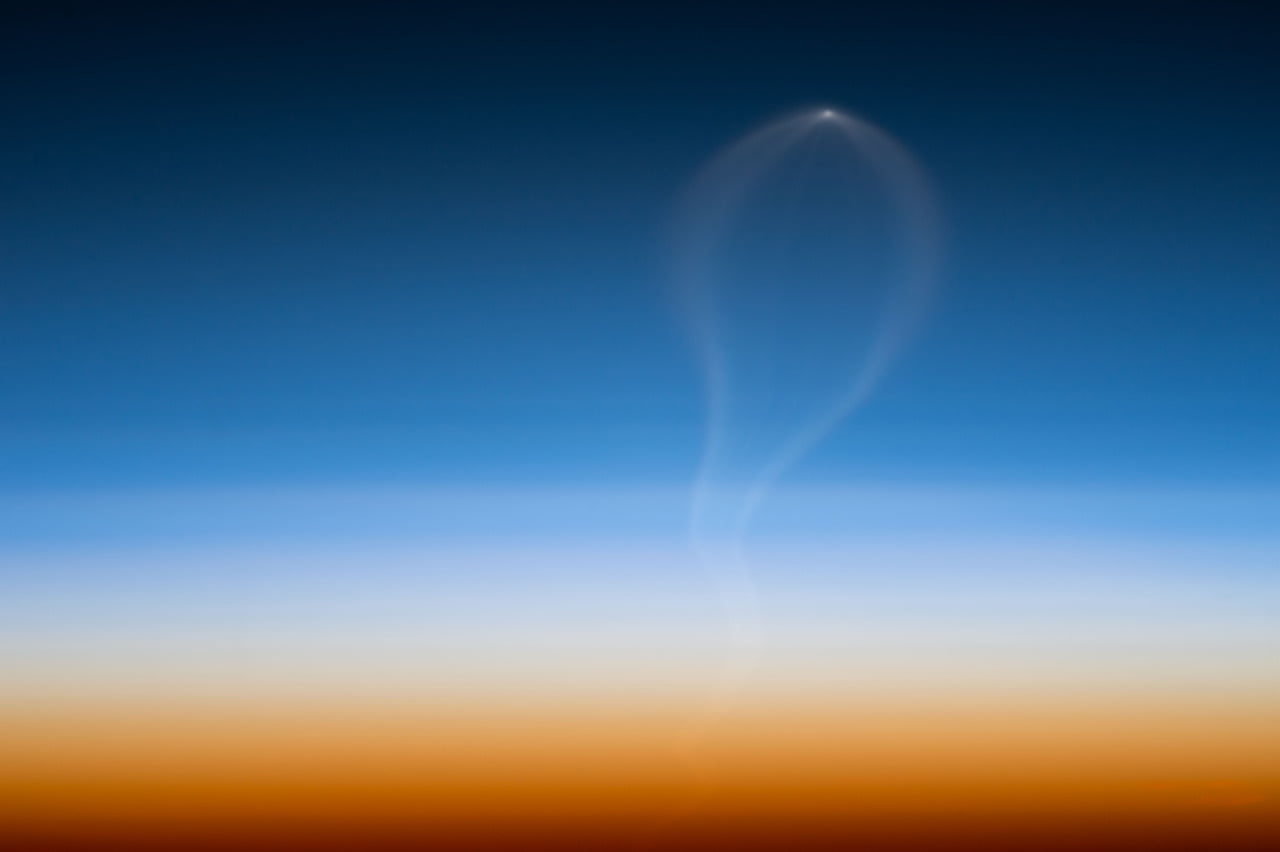
    Rocket launches often produce spectacular imagery, but it’s rare to get a launch view quite like this one. The photograph above shows the recent launch of an Atlas V rocket as viewed from the International Space Station. The rocket itself is too small to be seen directly. Instead, that bright spot you see is the rocket’s exhaust. The smoky swooping curves mark the rocket’s exhaust plume. Because the gases leaving the rocket are at much higher pressure than the scant air pressure in the upper parts of the atmosphere, the exhaust expands rapidly, ballooning outward. Here the water vapor in the exhaust has frozen into crystals that catch the sunlight and make them stand out against the surrounding sky. (Image credit: NASA; via NASA Earth Observatory)

  • Featured Video Play Icon

    Early Rocket Launch

    Pre-dawn launches provide some of the most dramatic rocket footage. This video is from an October 2nd Atlas V launch, and the really fun stuff starts at about 0:34. As the rocket climbs to higher altitudes, the atmospheric pressure around it decreases. As a result of this low pressure, the rocket’s exhaust gases balloon outward in a giant plume many times larger than the rocket. This happens in every launch, but it’s visible here because the rocket is at such a high altitude that its exhaust is being lit by sunlight while the observers on the ground are still in the dark. The ice crystals in the exhaust–much of the rocket’s exhaust is water vapor–reflect sunlight down to the earth. Around 0:47, a cascade of shock waves ripples through the plume just before the first-stage’s main engine cuts off. Once the engine stops firing, there’s no more exhaust and the plume ends. (Video credit: Tampa Bay Fox 13 News; submitted by Kyle C)

  • Featured Video Play Icon

    Sandscapes

    Many of us have played with sand art–the rotating frames filled with water, sand, and air. In this video, Shanks FX demonstrates some of the realistic and surrealistic landscapes you can create using this toy. It also makes for a neat fluid dynamics demonstration. The buoyancy of the trapped air bubbles lets the sand sift slowly down instead of falling immediately. And the sand descends in a variety of ways–sometimes laminar columns and other times wilder turbulent plumes. (Video credit and submission: Shanks FX/PBS Digital Studios)

  • Featured Video Play Icon

    Turbulent Ink

    Turbulence is found throughout our lives, but rarely is it as startlingly beautiful as in this Slow Mo Guys video. Here they show high-speed videos of ink being injected into water. The resulting plumes are turbulent from the very start, with innumerable folds and eddies billowing outward as the plume expands. The large difference in length scales–from the millimeter-sized curls to the meter-sized length of the plume–is one of the classic characteristics of turbulence and part of what makes turbulent flows so difficult to model computationally. Energy in these flows is generated at the large scales, but it’s dissipated at the very smallest scales through viscosity. This means that to properly model a turbulent flow, you have to capture the largest scales, the smallest scales, and everything in between in order to represent this energy cascade from large to small. It’s a problem that engineers, mathematicians, meteorologists, and physicists have struggled with for more than a century. But, here, at least, we can all just sit back and enjoy the beauty. (Video credit: The Slow Mo Guys)